
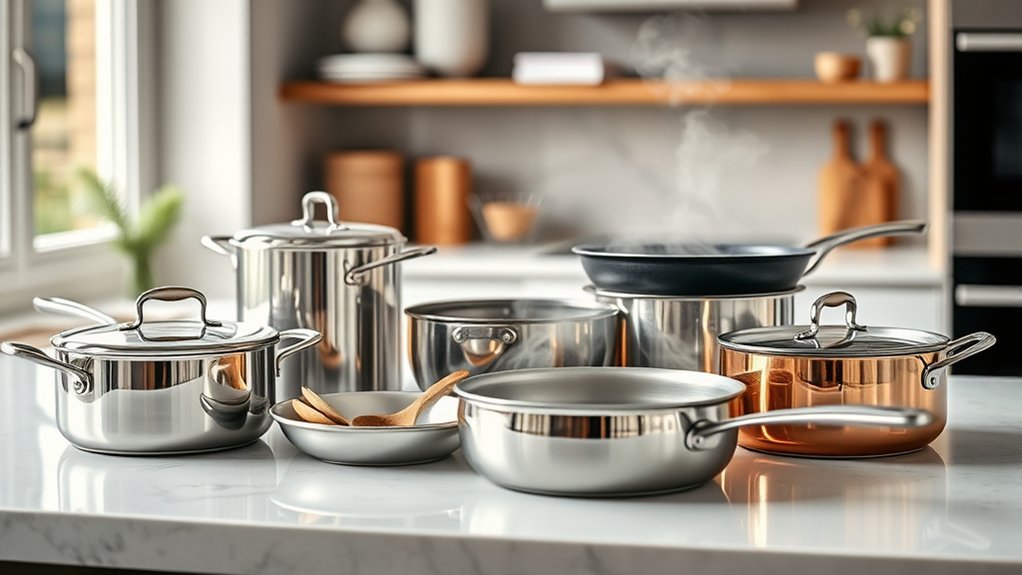
Cookware is the collection of pots, pans, and other heat-safe vessels used to cook food. Frying pans, saucepans, stock pots, Dutch ovens, woks, and similar pieces are designed for different methods such as sautéing, boiling, braising, and stir-frying. Material and construction affect heating, food release, weight, durability, cooktop compatibility, and care. Choosing cookware that fits the food, stove, and cooking style usually matters more than buying the largest or most expensive set.
Quick Answer
Cookware means pots, pans, and similar vessels used to cook food with heat. Common examples include frying pans, saucepans, stock pots, Dutch ovens, woks, and griddles. Stainless steel, cast iron, carbon steel, aluminum, copper, and coated surfaces each behave differently, so the best choice depends on the cooking method, cooktop, maintenance needs, and manufacturer specifications.
Key Takeaways
- Choose the cookware shape for the task: skillets for browning, saucepans for liquids, stock pots for large batches, Dutch ovens for braising, and woks for fast stir-frying.
- Material matters: stainless steel is versatile, cast iron retains heat, aluminum and copper respond quickly to temperature changes, and nonstick surfaces improve food release.
- Induction cooktops need cookware with a magnetic base; a simple magnet test can check compatibility.
- Do not overheat nonstick cookware, and follow the manufacturer’s maximum stovetop and oven temperatures.
- Replace cookware when damage affects safe handling or the cooking surface, such as loose handles, severe warping, flaking coatings, or badly cracked enamel.
What Is Cookware?
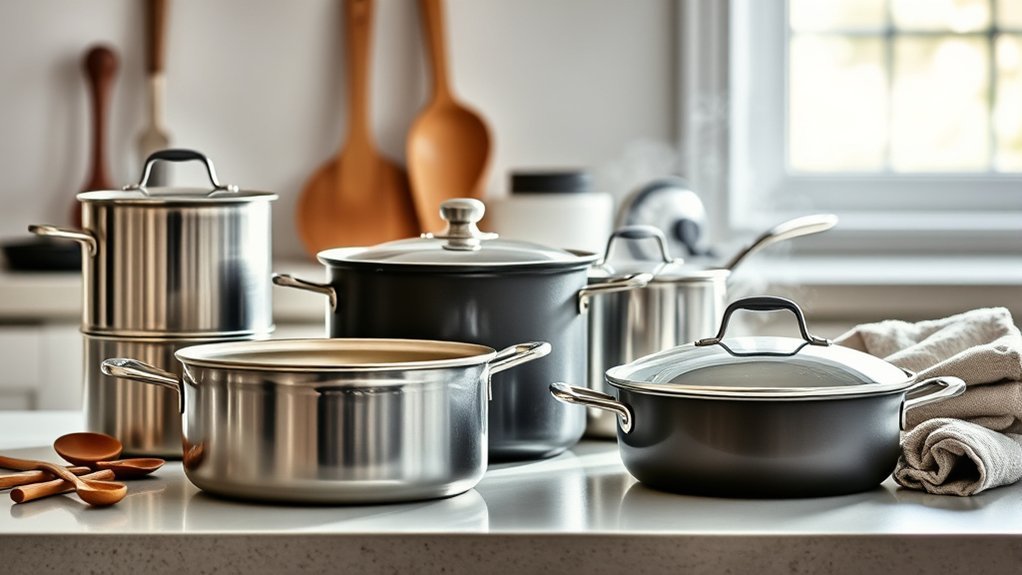
Cookware refers to pots, pans, and other containers designed to prepare food with heat from a stovetop, oven, grill, or another approved cooking appliance. Common cookware includes frying pans, saucepans, stock pots, Dutch ovens, woks, sauté pans, griddles, and similar vessels.
Materials such as stainless steel, cast iron, carbon steel, aluminum, copper, and coated metals affect durability, maintenance, responsiveness to temperature changes, heat retention, and food release. Construction also matters. For example, many stainless steel pans use an aluminum or copper core because stainless steel itself is durable but is not as thermally conductive as aluminum or copper.
When selecting cookware, consider cooking habits, storage, weight, handle comfort, oven use, and compatibility with gas, radiant electric, or induction cooking. A practical cookware collection matches the tools to the foods and methods used most often.
Cookware vs Bakeware
Cookware and bakeware overlap, but they are not identical categories. Cookware generally includes pots and pans used for methods such as frying, boiling, simmering, sautéing, searing, and braising. Bakeware is designed primarily for oven-based baking or roasting and includes cake pans, loaf pans, muffin tins, baking sheets, and many baking dishes.
The distinction is not simply “stovetop versus oven.” Many pieces of cookware, including cast-iron skillets and Dutch ovens, can move from stovetop to oven when their handles, lids, knobs, and coatings are rated for the required temperature.
Bakeware can be made from metal, glass, ceramic, silicone, or other oven-safe materials. Cookware commonly uses metals or metal-based constructions because they must transfer heat efficiently from a burner or induction element.
| Category | Typical Uses | Examples |
| Cookware | Frying, sautéing, boiling, simmering, braising, stir-frying | Skillet, saucepan, stock pot, Dutch oven, wok |
| Bakeware | Baking and oven roasting | Cake pan, loaf pan, muffin tin, baking sheet, baking dish |
- Cookware suits boiling, sautéing, simmering, searing, and frying.
- Bakeware supports baking, oven roasting, and shaping batters or doughs.
- Some pieces, especially Dutch ovens and oven-safe skillets, work in both stovetop and oven cooking.
- Always check the manufacturer’s oven-temperature limit before moving cookware into an oven.
Common Cookware Uses
Common cookware supports everyday tasks such as frying, boiling, sautéing, simmering, braising, stir-frying, and roasting. The shape of a pan affects evaporation, browning, capacity, and how easily food can be stirred or turned.
Frying pans, stock pots, Dutch ovens, saucepans, woks, sauté pans, and griddles each work best for particular cooking methods. Matching the vessel to the task makes temperature control and handling easier.
Proper care also helps cookware perform consistently and last longer.
Everyday Cooking Tasks
Different pieces of cookware handle specific jobs in everyday meal preparation:
- Frying pans and skillets handle eggs, pancakes, sautéed vegetables, meat browning, and shallow frying.
- Saucepans are useful for sauces, grains, oatmeal, reheating liquids, and smaller batches of soup.
- Stock pots provide the capacity needed for pasta water, stocks, soups, seafood boils, and larger batches.
- Dutch ovens work well for slow cooking, braising, stews, bread, and dishes that move from stovetop to oven.
- Woks are designed for fast stir-frying and tossing ingredients over concentrated heat.
The goal is not to own every possible shape. A few versatile pieces can cover most household cooking.
Heat-Specific Applications
Cookware shape and material should match the amount of heat and temperature response required by the recipe.
Frying pans provide a broad cooking surface for sautéing, searing, and frying. Lower sides allow moisture to escape more readily, which helps with browning.
Saucepans have taller sides that limit evaporation and make them suitable for sauces, grains, soups, and heated liquids.
A stock pot holds large volumes of liquid for soups, stocks, boiling pasta, and similar high-capacity tasks.
A Dutch oven has a heavy body and lid that make it useful for braising, stews, slow cooking, and recipes that need steady retained heat.
Woks combine a smaller base with high sloping sides, allowing ingredients to be moved rapidly between hotter and cooler areas of the pan.
For any cookware, burner size should be reasonably matched to the base so heat is not wasted around the sides.
Care And Maintenance
Cookware lasts longer when its cleaning and maintenance match the material and finish.
- Bare cast iron and carbon steel benefit from seasoning: a very thin film of oil is heated until it polymerizes into a protective coating that helps resist rust and improves food release.
- Stainless steel and ordinary aluminum do not normally require routine seasoning. Clean them according to the manufacturer’s instructions.
- Nonstick cookware should not be overheated, and non-metal utensils are often recommended to protect the coating.
- Enameled cookware normally needs no seasoning. Avoid severe impacts and thermal shock, and follow the manufacturer’s utensil and cleaning guidance.
- Stacked cookware can be separated with pan protectors or soft cloths to reduce scratching.
Main Cookware Types
Cookware types differ mainly in shape, depth, surface area, handle design, and intended cooking method. Frying pans are broad and shallow. Saucepans are deeper and usually have a single long handle. Stock pots provide large capacity, while Dutch ovens combine depth with a heavy lid and substantial heat retention. Woks use high sloping sides for fast tossing and stir-frying.
| Cookware | Main Use | Common Household Size |
|---|---|---|
| Frying pan / skillet | Frying, sautéing, browning, searing | 8–12 inches |
| Saucepan | Heating liquids, sauces, grains, small soups | 1–6 quarts |
| Stock pot | Soups, stocks, pasta, large-volume boiling | 6–20 quarts |
| Dutch oven | Braising, stews, roasting, bread | 4–7 quarts |
| Sauté pan | Sautéing, shallow frying, pan sauces | 3–5 quarts |
| Wok | Stir-frying, tossing, steaming | 12–14 inches |
| Griddle | Pancakes, sandwiches, burgers, breakfast foods | Varies |
Exact capacities and diameters vary by brand, so dimensions should be checked before purchasing, especially when storage space or burner size is limited.
Cookware Materials and Benefits
The performance of cookware depends on both its material and its construction. Stainless steel, cast iron, carbon steel, aluminum, copper, enamel, and nonstick surfaces have different strengths.
| Material | Main Strength | Main Limitation | Good For |
|---|---|---|---|
| Stainless steel | Durable, corrosion-resistant, non-reactive cooking surface | Food can stick; good pans often need a conductive core | Browning, sauces, boiling, everyday cooking |
| Cast iron | Excellent heat retention and durability | Heavy; bare iron needs rust prevention and seasoning | Searing, frying, baking, slow cooking |
| Carbon steel | Lighter than cast iron and responsive at high heat | Needs seasoning and dry storage | Searing, stir-frying, eggs after seasoning |
| Aluminum | Lightweight and conducts heat well | Bare aluminum can react more with acidic or salty foods; not inherently induction-ready | General cooking, especially when anodized or clad |
| Copper | Very responsive temperature control | Usually requires a sound food-contact lining; expensive | Temperature-sensitive sauces and precision cooking |
| PTFE nonstick | Excellent food release and easy cleanup | Coating can wear; should not be severely overheated | Eggs, pancakes, delicate fish, low-to-medium-heat cooking |
| Ceramic-coated metal | Smooth food release without a PTFE cooking surface | Release performance can decline with wear | Everyday low-to-medium-heat cooking |
| Enameled cast iron | Heat retention with a non-reactive enamel surface | Heavy; enamel can be damaged by impact or misuse | Braising, soups, sauces, acidic foods, oven cooking |
Stainless steel is versatile and resistant to food reactions. Aluminum is lightweight and highly conductive, while hard-anodized or clad constructions reduce direct contact between food and bare aluminum. Copper offers rapid temperature response but should have an intact food-safe lining when the cooking surface would otherwise be bare copper.
For more detailed material-safety guidance, see Health Canada’s cookware and bakeware guidance.
Note: “Ceramic cookware” can mean different products. Some cookware is metal with a ceramic-based nonstick coating, while other products are glazed ceramic vessels. Their heat limits and care requirements are not automatically the same.
Cookware Construction and Why It Matters
Two pans made from the same named material can perform differently because of how they are built.
Fully clad cookware bonds layers of conductive metal, usually aluminum or copper, between other metals across the base and sides. This can spread heat beyond the center of the burner and improve temperature consistency up the walls.
Disc-base or impact-bonded cookware concentrates the conductive layers in a plate attached to the bottom. It can work very well for boiling and general cooking while usually costing less than fully clad construction.
Also check the following details:
- Base: A flat, stable base is especially important on glass and induction cooktops.
- Handles: They should feel secure and comfortable when the pan is full.
- Lids: A well-fitting lid slows evaporation and is useful for simmering and braising.
- Knobs and handle materials: These often determine the actual oven-safe temperature of an otherwise oven-safe pan.
- Weight: Heavy cookware can retain heat well but should still be comfortable enough to lift safely.
How Coatings and Seasoning Work
Coatings and seasoning improve cookware surfaces in different ways. Factory-applied nonstick coatings create a manufactured release surface, while seasoning on bare cast iron or carbon steel is built by repeatedly heating a very thin film of oil until it polymerizes.
Enameled cast iron uses a glass-like enamel bonded to the iron. It does not require the same seasoning process as bare cast iron.
Seasoning Basics
Seasoning protects bare cast iron and carbon steel by creating a thin, hardened film of polymerized oil on the metal. A well-maintained layer helps reduce rust and improves food release over time.
- Clean the cookware according to the manufacturer’s instructions.
- Dry it completely so moisture does not remain on bare iron or steel.
- Apply a very thin film of an appropriate cooking oil.
- Heat the cookware as directed by the manufacturer so the oil polymerizes instead of remaining sticky.
- Allow it to cool and repeat when the seasoning becomes thin, patchy, or damaged.
Seasoning does not change the underlying metal’s thermal conductivity or turn cast iron into an evenly conducting material. Its main jobs are surface protection and food release.
The University of Maine Cooperative Extension’s cast-iron guide describes using a thin oil layer, thorough drying, and sufficient heat to develop the protective coating.
Non-Stick Coatings
Nonstick cookware uses a manufactured surface to reduce food adhesion. Traditional nonstick commonly uses PTFE, while other pans use ceramic-based coatings.
Health Canada advises users not to preheat empty nonstick cookware and not to use it at very high heat, giving 260°C (500°F) as an example of a temperature to avoid. It also recommends kitchen ventilation during cooking. The exact limit for a particular pan should come from its manufacturer.
PFAS terminology can be confusing. PTFE is a fluoropolymer within the broad PFAS family, but that does not mean normal use of an intact approved nonstick coating automatically produces meaningful dietary exposure. The U.S. Food and Drug Administration states that authorized polymerized PFAS coatings used in nonstick cookware contain negligible amounts capable of migrating to food.
Warning: Do not leave an empty nonstick pan heating unattended. Avoid temperatures above the manufacturer’s rating, ventilate the kitchen, and replace cookware if its coating is peeling, blistering, or flaking.
Ceramic-coated pans also have temperature and utensil limits that vary by manufacturer. A ceramic label by itself is not a reason to assume the pan can safely withstand higher temperatures than PTFE cookware.
Using suitable utensils, avoiding unnecessary overheating, and gentle cleaning can extend the useful life of coated cookware.
Enameled Surface Care
Enameled cookware has a glass-like coating bonded to metal, commonly cast iron. The surface is non-reactive and does not require the routine seasoning used on bare cast iron.
This makes enameled cast iron suitable for acidic foods such as tomato-based sauces or dishes containing wine, provided the enamel is intact and the cookware is used within its rated temperature range.
- Allow the cookware to cool before exposing it to sharply colder water.
- Use cleaning tools and utensils allowed by the manufacturer.
- Avoid severe impacts that can damage enamel.
- Do not routinely season an enameled cooking surface unless the manufacturer specifically instructs you to do so.
For example, Le Creuset’s enameled cast-iron care guidance states that its enameled cast iron does not require seasoning and recommends care that protects the finish.
Cooktop and Oven Compatibility
Cookware should be checked against both the cooktop and the oven before use. A pan may work perfectly on gas or electric heat yet fail to work on induction, while an induction-compatible pan may still have a handle or lid with a relatively low oven-temperature limit.
| Heat Source | What to Check |
|---|---|
| Gas | Stable base, burner sized to the pan, and handles positioned away from flame. |
| Radiant electric / glass | Flat base for good contact; avoid dragging rough cookware across the surface. |
| Induction | Flat magnetic base that the appliance can detect. |
| Oven | Maximum temperature for the pan, coating, handle, lid, and lid knob. |
The U.S. Department of Energy notes that induction cookware needs a flat bottom that a magnet will stick to.
Pro Tip: Before buying cookware for an induction range, place a magnet against the bottom. A firm attraction is a quick compatibility check, although the manufacturer’s induction symbol or specifications should still be confirmed.
Health and Safety Facts
Cookware safety depends on the material, condition of the surface, temperature, food being cooked, and whether the product is being used as intended. There is no single material that is automatically ideal for every cook and every recipe.
For nonstick cookware, the main practical rule is to avoid severe overheating. Health Canada advises against empty-pan preheating and very high temperatures, such as above 260°C (500°F), and recommends ventilation.
Stainless steel is durable and corrosion-resistant, but many stainless alloys contain nickel. People with a known nickel allergy should check the cookware’s composition and seek appropriate medical guidance if exposure is a concern.
Bare cast iron can react with acidic foods during long cooking or storage. It can also transfer iron to food. A systematic review found that iron-containing cookware increased the iron content of some foods and produced improvements in some studies, but results varied and the evidence does not support treating cookware as a predictable substitute for medical iron treatment.
Aluminum is lightweight and conducts heat well. According to Health Canada, worn or pitted aluminum can transfer more material to food, particularly with acidic or salty foods. Hard-anodized or clad aluminum reduces direct contact between food and bare aluminum.
Copper conducts heat very efficiently, but unlined or badly damaged copper cooking surfaces should not be used for food preparation because copper is reactive. Sound stainless-steel-lined copper avoids direct contact between the food and copper.
Glazed ceramic, enamel, and glass products should be made for food use. Decorative or unsuitable imported glazed products can present lead or cadmium concerns, so warning labels and manufacturer information should be followed.
Warped cookware does not automatically make food unsafe, but a severely warped base can rock on the stove, heat unevenly, perform poorly on induction, or become unstable during handling.
Cookware safety is less about finding one “perfect” material and more about using a suitable, undamaged product within its intended temperature and cooking limits.
How to Choose Cookware
Choosing cookware begins with the way cooking is actually done. A household that cooks quick breakfasts and stir-fries needs a different combination from one that frequently braises meat, makes large soups, or bakes bread.
Start by assessing daily cooking habits. Frying pans cover sautéing, browning, eggs, and many quick meals. Saucepans handle grains and liquids. Dutch ovens are useful for braising and slow cooking. A larger stock pot makes sense when large batches or pasta are common.
Material should also match the cooktop. Induction requires a magnetic base, while gas and radiant electric cooktops accept a broader range of materials.
Material and construction should match the food, cooktop, maintenance level, and cooking method rather than a single marketing label.
- Assess cooking habits. Buy the pieces used most often before specialty cookware.
- Match cookware to the cooktop. Confirm induction compatibility when relevant.
- Check oven limits. Handles, knobs, lids, and coatings can set a lower limit than the metal body.
- Compare maintenance. Bare cast iron and carbon steel require more surface care than stainless steel or enamel.
- Consider weight and grip. A pan is not practical if it is difficult to lift when full.
- Measure storage. Stackable shapes or detachable handles can help in a small kitchen.
- Inspect construction. Flat bases, secure handles, and substantial but manageable weight are useful signs.
- Avoid buying by labels alone. Terms such as “surgical-grade” do not by themselves prove that cookware is safer or better performing.
Useful Starter Cookware Pieces and Sizes
A basic kitchen usually does not need a large matching set. Individual pieces can be chosen according to actual cooking habits.
- 10- or 12-inch frying pan: everyday sautéing, frying, and browning
- 2- to 3-quart saucepan: sauces, grains, vegetables, and reheating
- 4- to 6-quart Dutch oven or pot: soups, braises, stews, and larger meals
- Larger stock pot: useful when regularly cooking pasta, stock, or large batches
- Nonstick frying pan: optional but convenient for eggs and other delicate foods
Household size, storage, burner diameter, and typical recipe volume should determine the exact capacities.
When to Replace Cookware
Cosmetic discoloration alone does not always mean a pan is finished. Replacement becomes more important when physical damage interferes with use.
- Replace or repair cookware with a loose or unsafe handle.
- Replace a coated pan if the cooking surface is peeling, blistering, or flaking.
- Stop using badly damaged copper lining that exposes reactive copper to food.
- Follow the manufacturer’s advice for cracked or extensively chipped enamel.
- Replace cookware that is so warped that it rocks dangerously or no longer makes suitable contact with the cooktop.
- Discard cookware if the manufacturer or a government safety agency has issued a relevant recall.
How to Care for Cookware
Proper cookware care starts with the manufacturer’s cleaning instructions. Warm water, suitable dish soap, and a non-abrasive sponge are safe defaults for many materials, but individual products can have different dishwasher, detergent, utensil, and temperature requirements.
Nonstick pans usually last longer when used at low to moderate temperatures, kept away from unnecessary empty heating, and cleaned without abrasive tools. Bare cast iron and carbon steel should be dried promptly and maintained with seasoning. To season bare cast iron, apply only a very thin oil layer and heat it according to the manufacturer’s directions so the oil polymerizes into a hard surface.
| Care Step | Purpose |
|---|---|
| Hand wash when recommended | Helps protect finishes and coatings |
| Season bare cast iron and carbon steel | Helps resist rust and improves food release |
| Store cookware dry | Reduces corrosion and trapped moisture |
| Use liners between stacked pans | Helps prevent scratches |
| Avoid sudden temperature changes | Reduces thermal stress and possible warping or surface damage |
| Check handles and surfaces regularly | Finds wear before it creates a handling or performance problem |
Storage also matters. Cookware should be kept dry and stable. Cloths, felt protectors, or pan separators can protect surfaces when pans are stacked. Dishwasher use should follow the individual product’s instructions because some coatings, bare metals, wood components, and decorative finishes are better hand washed.
Sources
- Health Canada — The Safe Use of Cookware and Bakeware — material-specific guidance for aluminum, copper, stainless steel, cast iron, ceramic, enamel, glass, and nonstick cookware.
- U.S. Food and Drug Administration — Questions and Answers on PFAS in Food — current information about authorized PFAS food-contact applications and nonstick coatings.
- U.S. Department of Energy — Making the Switch to Induction Stoves or Cooktops — induction operation and magnetic-cookware compatibility.
- University of Maine Cooperative Extension — Cast Iron Basics — cleaning, drying, and seasoning cast iron.
- Le Creuset — How to Care for and Clean Enameled Cast Iron — manufacturer guidance on enameled cast-iron care and seasoning.
- PubMed — Systematic Review of Iron-Containing Cookware — evidence on changes in food iron content and hemoglobin outcomes.
Frequently Asked Questions
What Is the Difference Between Kitchenware and Cookware?
Kitchenware is the broader category. It includes cookware plus knives, utensils, measuring tools, mixing bowls, storage containers, serving pieces, and other kitchen equipment. Cookware specifically refers to vessels designed to hold food while it is being cooked, such as frying pans, saucepans, stock pots, Dutch ovens, and woks.
What Are Examples of Cookware?
Examples of cookware include frying pans, skillets, saucepans, sauté pans, stock pots, Dutch ovens, woks, griddles, and roasting vessels designed for cooking. Common materials include stainless steel, cast iron, carbon steel, aluminum, copper, enameled metal, PTFE-coated metal, and ceramic-coated metal.
What Cookware Should You Not Use?
Avoid cookware with damage that affects the cooking surface or safe handling, including flaking nonstick coatings, dangerously loose handles, badly warped bases, extensively damaged enamel, and copper cookware whose protective food-contact lining has failed. Worn or pitted bare aluminum should not be used for prolonged cooking or storage of highly acidic or salty foods. Always follow recalls and manufacturer instructions.
What Is the Healthiest Cookware to Cook In?
There is no single cookware material that is universally the healthiest. Stainless steel, properly maintained cast iron, enameled cast iron, suitable aluminum cookware, lined copper, and intact nonstick cookware can all be practical choices when used as intended. Safety depends on the material, food, temperature, cookware condition, allergies, and manufacturer instructions. Cast iron can increase the iron content of some foods, but the amount varies and should not be treated as predictable iron supplementation.
How Can You Tell if Cookware Works on Induction?
Check the manufacturer’s induction symbol or product specifications. A quick test is to place a magnet against the bottom of the pan. If it sticks firmly to a flat base, the cookware is generally suitable for induction. Cast iron, enameled steel, and magnetic stainless steel commonly work, while plain aluminum, copper, glass, and ceramic normally need a magnetic base layer to work on induction.
Can All Cookware Go in the Oven?
No. A metal pan body may tolerate oven heat while its handle, nonstick coating, lid, knob, silicone part, or other component has a lower temperature limit. Check the manufacturer’s maximum oven temperature for the entire piece before putting cookware in the oven or under a broiler.
Conclusion
Cookware includes the pots, pans, and other cooking vessels that turn raw ingredients into finished meals. Frying pans, saucepans, stock pots, Dutch ovens, woks, and specialty pieces each solve different cooking problems, while materials such as stainless steel, cast iron, carbon steel, aluminum, copper, enamel, and nonstick coatings affect how those pieces behave.
Choosing wisely means matching the vessel to the cooking method, checking cooktop and oven compatibility, respecting material-specific temperature limits, and buying only the pieces that fit everyday needs. With appropriate cleaning, storage, seasoning where required, and regular inspection for damage, good cookware can provide dependable service for years.