
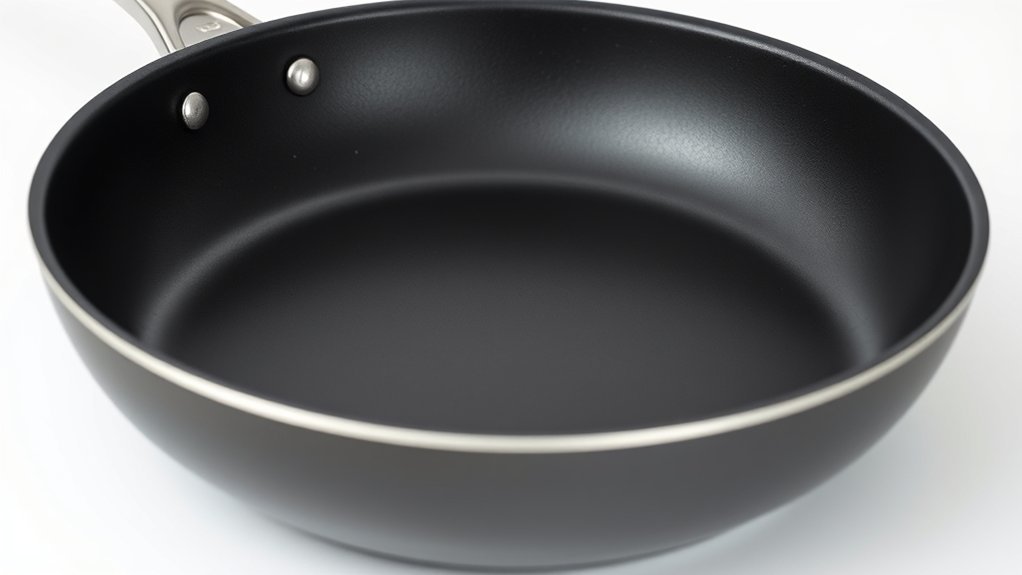
Nonstick pans usually combine a metal pan body with a thin surface designed to keep food from bonding strongly to it. Aluminum is common because it heats quickly, while stainless-clad aluminum offers more strength and induction compatibility in some designs. The cooking surface may use PTFE, a PFAS-free ceramic coating, or, in naturally low-stick cookware such as seasoned cast iron and carbon steel, a layer of polymerized cooking oil. The coating, substrate, thickness, and care all affect performance and lifespan.
Quick Answer
Most nonstick pans are made from an aluminum or stainless-clad metal body covered with a low-friction coating. Traditional nonstick usually uses PTFE, while ceramic nonstick generally uses a PFAS-free sol-gel coating. “Titanium,” “diamond,” “granite,” or “stone” labels often describe reinforcement or branding rather than the underlying coating chemistry.
Key Takeaways
- The metal body and nonstick surface are separate parts. Aluminum, stainless-clad aluminum, and occasionally cast iron provide structure and heat control.
- PTFE is the traditional high-release coating. Teflon is a brand name used for qualifying fluoropolymer products, not the generic name for every PTFE coating.
- Ceramic nonstick is usually a thin sol-gel coating over metal, not a pan made from solid ceramic.
- PFOA-free does not automatically mean PFAS-free. PFOA is one member of the much larger PFAS family.
- Follow the individual pan’s heat and care limits. Coating chemistry, handles, exterior finishes, and construction can all determine the actual temperature rating.
What Makes a Pan Nonstick?
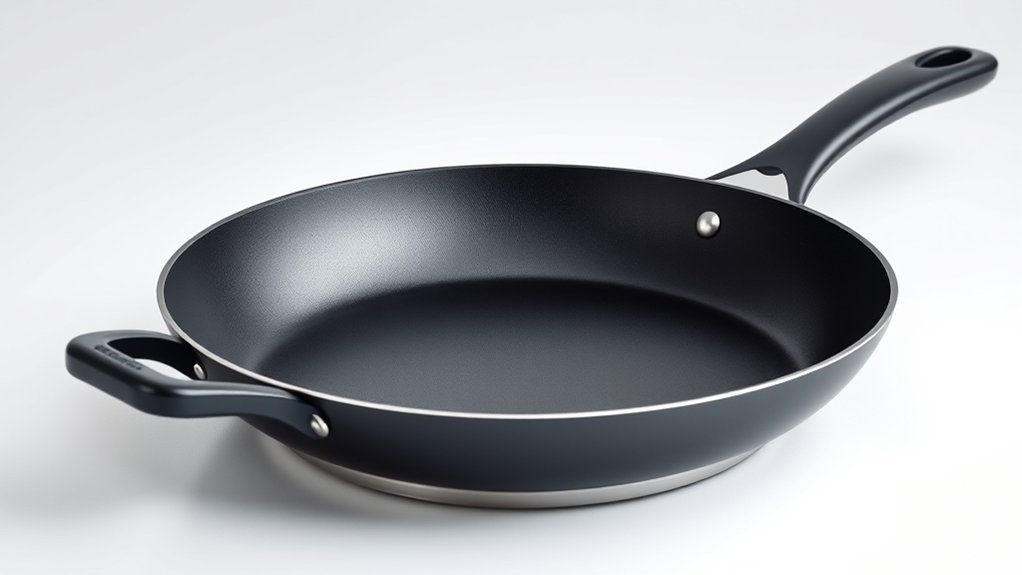
A pan becomes nonstick when its cooking surface has low surface friction and low food adhesion. In conventional coated cookware, manufacturers bond one or more thin coating layers to a metal substrate. The top layer provides food release while lower layers can improve adhesion, strength, corrosion resistance, or abrasion resistance.
PTFE coatings remain widely used because PTFE has a very low coefficient of friction and strong chemical resistance. Chemours, which owns the Teflon brand, lists PTFE among its low-friction fluoropolymer coating technologies. Teflon PTFE coating specifications list a maximum continuous-use temperature of 260°C (500°F) for the cited industrial PTFE systems, although a finished frying pan’s actual limit should always come from its manufacturer.
Ceramic nonstick coatings work differently. Modern ceramic cookware coatings are generally thin sol-gel systems containing silicon-based materials rather than a sheet of solid ceramic. PPG, a major industrial-coating supplier, distinguishes its PTFE-based systems from PFAS-free sol-gel ceramic cookware coatings.
Cast iron and carbon steel use another route. Heat and cooking oil can create a bonded seasoning layer on the metal. Well-developed seasoning reduces sticking, although it does not behave exactly like a factory-applied PTFE or ceramic coating.
Note: “Nonstick” describes cooking performance, not one single material. Two pans can both be sold as nonstick while using completely different substrates, coatings, and manufacturing methods.
What Are Nonstick Pans Made Of?
Most coated nonstick pans have two main parts: a structural metal body that carries and distributes heat, and a surface coating that helps food release. The metal determines much of the pan’s weight, responsiveness, warp resistance, and cooktop compatibility, while the coating controls most of the nonstick behavior.
Core Pan Materials
Common nonstick pan bodies include aluminum and stainless-clad constructions. Cast iron can also provide a naturally low-stick surface when properly seasoned, although it is less commonly used as the substrate for modern lightweight coated frying pans.
- Aluminum: Lightweight, affordable, and highly responsive to heat. Many mainstream nonstick frying pans use an aluminum body.
- Hard-anodized aluminum: Aluminum whose exterior surface has been electrochemically hardened. A separate nonstick coating may still be applied to the cooking surface, so “hard-anodized” does not tell you whether that surface contains PTFE or another coating.
- Stainless-clad construction: Multiple metal layers, often with aluminum between stainless-steel layers. This can add stiffness, durability, and, when the exterior is suitably magnetic, induction compatibility.
- Cast iron and carbon steel: Heavy-duty iron-based cookware that can develop a lower-stick seasoned surface without a conventional factory-applied nonstick topcoat.
The substrate also influences heat behavior. Aluminum responds quickly when the burner changes temperature, while heavier constructions generally change temperature more slowly and resist warping better.
How Nonstick Coatings Are Built
A nonstick surface is not always a single painted-on layer. Commercial systems may use a primer, intermediate coat, and topcoat. The primer helps the coating bond to the prepared metal, intermediate layers can add toughness or reinforcement, and the upper surface provides food release.
This layered construction helps explain why two pans described simply as “PTFE nonstick” can have very different durability. The polymer family matters, but so do surface preparation, layer thickness, reinforcement, curing, and quality control.
Common Nonstick Coatings
The two major categories consumers encounter are fluoropolymer coatings and ceramic sol-gel coatings.
- PTFE: The best-known traditional nonstick polymer. It provides excellent release and low friction.
- Other fluoropolymers: Some coating systems use fluoropolymers such as PFA or FEP, either alone or as part of multilayer systems.
- Ceramic sol-gel: Usually a silicon-based organic-inorganic coating designed to provide food release without PTFE. Products explicitly labeled PFAS-free avoid the broader PFAS class covered by that manufacturer’s claim.
- Seasoning: Polymerized cooking oil formed on cast iron or carbon steel. It is not a synthetic nonstick coating and can be renewed through reseasoning.
Brand families can contain several chemistries. For example, Xylan is not one generic substance; commercial Xylan products include different fluoropolymer formulations. Likewise, words such as “granite,” “stone,” “diamond,” or “titanium” do not by themselves reveal the base polymer.
| Surface type | What it is | Main strength | Main limitation |
|---|---|---|---|
| PTFE | Fluoropolymer coating | Very easy food release | Should not be seriously overheated; coating eventually wears |
| Ceramic nonstick | Usually a sol-gel coating over metal | Available in genuinely PFAS-free formulations | Food-release performance can decline with wear |
| Seasoned iron/steel | Polymerized oil bonded to metal | Renewable surface; suitable for high-heat cooking | Needs seasoning and cooking technique |
PTFE, Teflon, and Fluoropolymer Coatings
PTFE, or polytetrafluoroethylene, is a synthetic fluoropolymer valued for low friction, chemical resistance, and strong food-release performance. It is widely used in traditional coated nonstick cookware.
Teflon is a trademark owned by Chemours. Some Teflon-branded products use PTFE, while the Teflon portfolio also includes other fluoropolymers. A pan that uses PTFE therefore does not automatically use Teflon-branded coating.
PTFE Coating Basics
PTFE was discovered by Roy Plunkett in 1938 and later became one of the best-known nonstick materials. In cookware, the material is applied as part of a coating system and cured onto the prepared metal surface.
- PTFE has a very low coefficient of friction.
- Modern cookware sold as PFOA-free does not intentionally use PFOA as the finished nonstick coating.
- PTFE-coated cookware should be used within the finished product’s stated heat limit.
- Severe overheating can thermally degrade PTFE and generate fumes.
The U.S. Food and Drug Administration’s current PFAS guidance explains that authorized PFAS used in nonstick cookware coatings are polymerized and tightly bound during manufacturing. FDA says studies show a negligible amount of PFAS capable of migrating to food from these coatings.
PTFE vs. Teflon vs. PFOA vs. PFAS
These terms are related but they are not interchangeable:
- PTFE is a specific fluoropolymer used as a nonstick material.
- Teflon is a trademark used on qualifying Chemours fluoropolymer products.
- PFOA is a specific PFAS that historically served as a processing aid in some fluoropolymer manufacturing.
- PFAS is a broad family of fluorinated substances. Under broad definitions, fluoropolymers such as PTFE can fall within the PFAS category.
This distinction matters when reading cookware labels. PFOA-free does not necessarily mean PFAS-free or PTFE-free. If avoiding the entire PFAS category is the goal, look for an explicit PFAS-free statement from the manufacturer rather than relying only on “PFOA-free.”
Fluoropolymer Safety Limits
The safest practical rule is to follow the cookware manufacturer’s rated temperature rather than treating one number as a universal PTFE decomposition threshold. Chemours lists 260°C (500°F) as the maximum continuous-use temperature for the PTFE coating systems cited in its technical information, but individual pans can have lower limits because of handles, exterior finishes, lids, bonding systems, or other components.
Serious overheating is the important hazard to avoid. Empty cookware can heat much faster than cookware containing food, so leaving an empty PTFE-coated pan unattended over a powerful burner can push temperatures beyond normal cooking conditions surprisingly quickly.
The historical PFOA issue should also be separated from PTFE itself. Under the EPA’s 2010/2015 PFOA Stewardship Program, eight major companies committed to reducing and working toward eliminating PFOA, related precursors, and higher homologues from emissions and product content, and EPA reports that participating companies met the program goals. That does not mean every imported article or every possible source of PFOA disappeared worldwide in 2015.
Warning: Households with pet birds need extra caution. Birds are unusually sensitive to fumes from seriously overheated PTFE-containing products. The Merck Veterinary Manual warns that fumes from overheated nonstick-coated items can rapidly poison birds. Keep birds away from cooking fumes and never leave coated cookware overheating unattended.
Ceramic and PFAS-Free Alternatives
Ceramic nonstick cookware usually starts with an aluminum or stainless-clad metal body and adds a thin sol-gel coating. Despite the name, the cooking surface is generally not a thick slab of traditional fired ceramic. Commercial ceramic coatings commonly use silicon-based chemistry and may include pigments, fillers, or other reinforcing materials.
A ceramic pan can be a useful option when the manufacturer explicitly states that its coating is PFAS-free and PTFE-free. However, “ceramic” alone should not be treated as proof of a particular composition, and there is no universal 700°F operating limit for ceramic nonstick cookware. Heat ratings vary by brand and construction.
- Check for an explicit PFAS-free or PTFE-free statement.
- Follow the manufacturer’s actual oven and stovetop temperature limits.
- Avoid harsh abrasives unless the manufacturer specifically permits them.
- Do not assume a ceramic coating will retain its original food-release performance indefinitely.
Ceramic systems can lose slickness as the surface wears or accumulates residues. Recent comparative coating research has also found that PTFE systems can retain stronger nonstick performance than some tested sol-gel ceramic coatings after repeated use, although exact durability varies widely by formulation and pan quality.
What Do Titanium, Diamond, Granite, and Stone Mean?
These labels often cause confusion. A pan advertised as “titanium,” “diamond,” “granite,” “marble,” or “stone” nonstick may still use a PTFE-based or ceramic-based coating underneath the marketing description. The named material can refer to reinforcing particles, pigments, surface texture, appearance, or a proprietary coating system.
That means “titanium-reinforced” does not automatically mean PTFE-free or PFAS-free. To identify the chemistry, look for a manufacturer’s explicit statement such as “PTFE-based,” “PTFE-free,” or “PFAS-free.”
What Makes a Nonstick Pan Durable?
Durability depends on more than whether a label says PTFE or ceramic. The coating formulation, number of layers, substrate preparation, pan thickness, reinforcement, curing process, and everyday care all matter.
A thicker, well-built pan body also helps because it can distribute heat more evenly and resist warping. If a pan develops hot spots or distorts badly, the coating can experience uneven thermal and mechanical stress.
Reinforcing materials marketed as titanium, minerals, or diamond particles can be incorporated into certain coatings to improve abrasion resistance, but those words alone do not tell you how long a finished pan will last. Independent performance and the manufacturer’s actual warranty are more useful than a reinforcement name by itself.
Pro Tip: Reserve coated nonstick pans for the jobs that benefit most from them—eggs, pancakes, crepes, delicate fish, and other sticky foods. Using stainless steel, cast iron, or carbon steel for hard searing and prolonged high-heat work can reduce unnecessary wear on a nonstick coating.
Maintenance has a major effect on useful life. Unless a manufacturer specifically says otherwise, use wood, silicone, or nylon utensils, wash with nonabrasive tools, avoid cutting food in the pan, and protect the surface if pans are stacked.
How to Use Nonstick Cookware Safely
Safe use starts with the specific instructions supplied with the pan. Different coatings and constructions have different temperature limits, and the oven limit may also be affected by the handle, lid, exterior finish, or removable parts.
- Avoid unattended empty-pan heating, especially over high-output burners.
- Use low to medium heat for most delicate nonstick cooking unless the manufacturer specifically permits higher heat.
- Use nonscratching utensils unless the coating is explicitly rated for metal utensils.
- Clean with a soft sponge or cloth rather than steel wool or aggressive scouring pads.
- Ventilate the kitchen whenever cooking produces smoke or fumes.
- Follow special precautions around pet birds because they are highly sensitive to overheated PTFE fumes.
Surface damage should be judged by severity rather than panic over a tiny cosmetic mark. Minor scratching can reduce nonstick performance, but a pan that is peeling, flaking, deeply gouged, badly worn, warped, or exposing substantial substrate is a sensible candidate for replacement. Follow the manufacturer’s warranty and replacement guidance when available.
FDA’s current discussion of authorized polymerized PFAS cookware coatings reports negligible migration into food. At the same time, avoiding scratching and overheating remains good practice because it preserves cooking performance and prevents unnecessary deterioration.
How to Tell What Your Nonstick Pan Is Made Of
Appearance alone is not reliable. Black, gray, cream, white, speckled, or stone-patterned coatings can use different chemistries. The most dependable approach is to check the packaging, product page, manual, or manufacturer’s technical FAQ.
Look for wording such as:
- “PTFE” or “fluoropolymer” — indicates a traditional fluoropolymer-based surface.
- “Teflon” — indicates a licensed Teflon-branded fluoropolymer coating, not every PTFE product.
- “PTFE-free” — excludes PTFE but does not automatically establish whether every other PFAS is absent unless the manufacturer also says PFAS-free.
- “PFOA-free” — excludes PFOA as stated, but does not mean the product contains no PTFE or no PFAS.
- “PFAS-free” — the most direct label when the goal is to avoid the PFAS category covered by that manufacturer’s claim.
- “Ceramic” — usually points to a sol-gel-style coating, but verify the manufacturer’s PFAS/PTFE disclosure.
For induction use, also check the base construction. The nonstick coating itself does not make a pan induction-compatible; the pan needs a sufficiently magnetic base designed to work with an induction cooktop.
Frequently Asked Questions
Is Teflon Safe Now?
Teflon-branded cookware coatings are intended for use according to the manufacturer’s instructions. FDA says authorized polymerized PFAS nonstick coatings are tightly bound to cookware and available studies show negligible amounts capable of migrating to food. The practical precautions are to stay within the pan’s rated temperature, avoid unattended overheating, and follow its care instructions.
Which Non-Stick Coating Is Safe for Health?
There is no single nonstick material that should be universally ranked as the safest for every user. Authorized PTFE-based cookware is designed for food-contact use when used as directed, while verified PFAS-free ceramic is an option for people who specifically want to avoid PTFE and other PFAS covered by the manufacturer’s claim. Stainless steel, cast iron, and carbon steel avoid factory-applied nonstick coatings altogether.
Is Made In Non-Stick Cookware Safe?
Made In currently sells more than one nonstick system, so the exact product matters. Its ProCoat line uses the company’s professional-grade coated nonstick system, while CeramiClad is marketed as ceramic cookware made without PFAS, PTFE, and PFOA. Check the current specification and temperature limit for the exact Made In model rather than treating every Made In nonstick pan as the same material.
Do Non-Stick Pans Still Contain Teflon?
Some cookware still uses Teflon-branded fluoropolymer coatings, and many other pans use PTFE coatings that are not Teflon-branded. Ceramic, seasoned cast iron, and seasoned carbon steel provide alternatives. Check the manufacturer’s material disclosure if you specifically want PTFE-free or PFAS-free cookware.
Is PFOA-Free the Same as PFAS-Free?
No. PFOA is one specific member of the much larger PFAS family. A product can be labeled PFOA-free and still use PTFE or another fluorinated material. If avoiding PFAS is your goal, look for an explicit PFAS-free statement rather than relying only on PFOA-free labeling.
Should You Throw Away a Scratched Nonstick Pan?
A tiny cosmetic scratch is different from a surface that is peeling, flaking, deeply gouged, or exposing large areas of metal. Damage reduces cooking performance and can continue to worsen. Follow the manufacturer’s instructions, and replace a pan when the coating is substantially deteriorated or the pan is warped or otherwise damaged.
Conclusion
A nonstick pan is less a single material than a carefully engineered combination of a metal body and a food-release surface. Aluminum and stainless-clad constructions provide most of the structure and heat control, while PTFE, ceramic sol-gel coatings, or seasoning provide the low-stick behavior. PTFE generally offers excellent release, while verified PFAS-free ceramic provides an alternative for people who want to avoid fluoropolymer coatings.
Labels deserve a closer look. Teflon is a brand, PFOA-free does not mean PFAS-free, and words such as titanium, diamond, granite, or stone do not automatically reveal the coating chemistry. Whatever material you choose, reasonable heat, gentle cleaning, suitable utensils, and attention to surface wear will do more for useful pan life than any marketing label promising indestructibility.
Sources
- U.S. Food and Drug Administration — Questions and Answers on PFAS in Food — current FDA explanation of authorized polymerized PFAS nonstick coatings and migration into food.
- U.S. Environmental Protection Agency — 2010/2015 PFOA Stewardship Program — history and scope of the major U.S. PFOA phaseout initiative.
- Chemours/Teflon — PTFE Coating Systems — PTFE properties and stated operating-temperature specifications.
- PPG — Non-Stick and Decorative Kitchenware Coatings — distinction between PTFE-based and PFAS-free sol-gel ceramic technologies.
- Merck Veterinary Manual — Fume Poisoning in Birds — pet-bird hazard from overheated nonstick-coated products.
- Made In — Current Cookware Material Information — current distinction between PFAS/PTFE-free cookware and the ProCoat line.

3 thoughts on “What Are Nonstick Pans Made of? Materials & Construction Explained”