
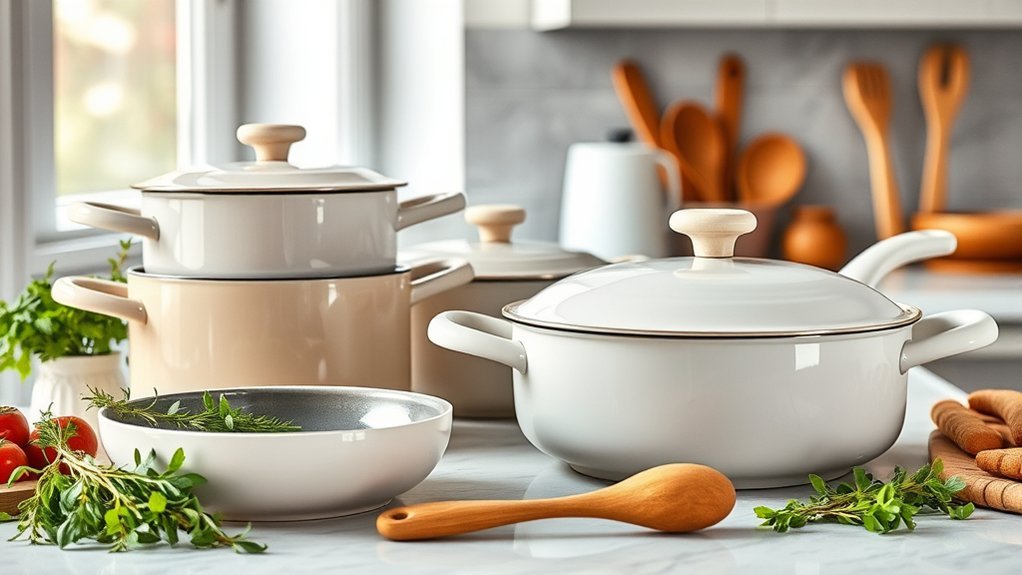
Ceramic cookware is a popular option for cooks who want easy food release and simple cleanup without a traditional PTFE nonstick coating. Most products sold as ceramic cookware are actually metal pans coated with a glass-like ceramic nonstick finish. They work especially well for eggs, pancakes, fish, vegetables, and other foods cooked over low to medium heat, but their performance, safety claims, oven limits, and durability vary by product.
Quick Answer
Most modern ceramic cookware is aluminum or stainless steel coated with a silicon-based sol-gel nonstick finish. It can provide excellent initial food release and easy cleanup, but it generally performs best over low to medium heat. PFAS-free, induction, dishwasher, and oven-safe claims should always be verified for the specific product.
Key Takeaways
- Most cookware marketed as “ceramic” is ceramic-coated metal rather than solid ceramic.
- Ceramic nonstick coatings commonly use sol-gel technology and can offer very good food release when new.
- Many ceramic-coated products are marketed as made without PFAS or PTFE, but verify the exact manufacturer’s material statement rather than relying on the word “ceramic.”
- Low to medium heat, soft utensils, gentle hand washing, and avoiding empty high-heat preheating can help preserve the coating.
- Induction compatibility, dishwasher suitability, oven temperature, and coating durability vary substantially between products.
What Is Ceramic Cookware?
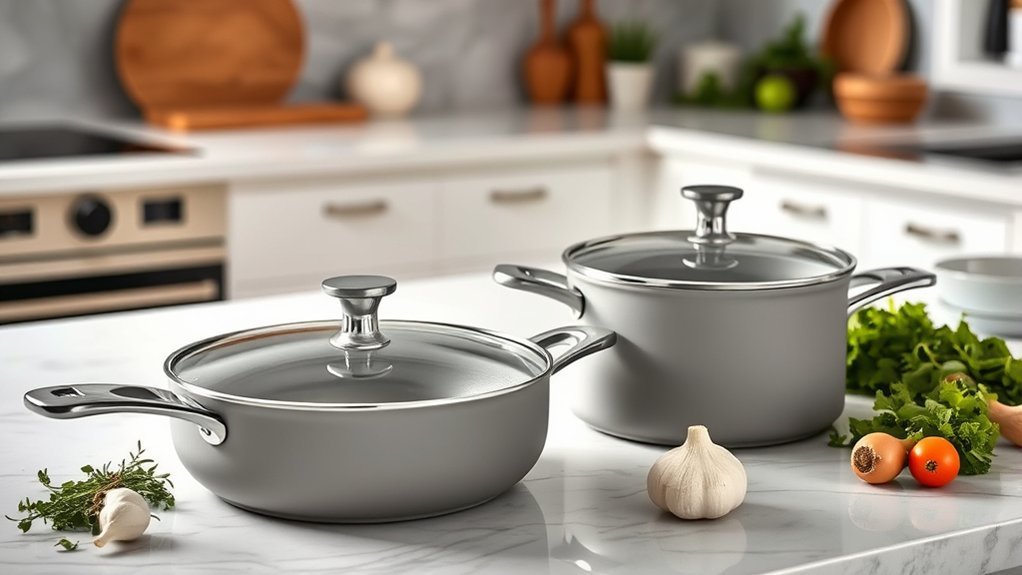
In everyday shopping language, ceramic cookware usually means aluminum or stainless steel cookware with a thin ceramic-style nonstick coating bonded to the cooking surface. The metal body gives the pan its shape and contributes most of its heating behavior, while the coating provides the smooth food-release surface.
Many modern ceramic coatings use sol-gel technology, which creates a glass-like silicon-based network on the metal substrate. These coatings differ from conventional PTFE nonstick coatings, although exact ceramic formulations vary among manufacturers.
Most cookware sold as ceramic is actually ceramic-coated metal cookware, so the coating and the underlying pan construction both matter.
Ceramic-coated cookware is often chosen for eggs, pancakes, fish, vegetables, reheating, and other low- to medium-heat cooking where easy food release is useful. A small amount of butter or oil can still improve browning, flavor, and release.
Note: “Ceramic,” “ceramic nonstick,” and “ceramic-coated” are often used loosely in marketing. Always read the construction and material description for the exact pan you are considering.
Ceramic Cookware vs. Ceramic-Coated Cookware
Solid ceramic cookware and ceramic-coated cookware are different products even though both may be described simply as ceramic.
| Feature | Solid Ceramic | Ceramic-Coated |
|---|---|---|
| Construction | Ceramic body rather than a metal pan with a thin coating | Usually aluminum or stainless steel with a ceramic-style surface coating |
| Heating behavior | Depends on the ceramic body and design | Determined mainly by the metal body, thickness, and base construction |
| Food release | Varies by surface and product | Usually very good when the coating is new and properly used |
| Damage concerns | Can chip or crack and may be vulnerable to thermal shock | Coating can scratch, wear, stain, or gradually lose release |
| Induction use | Product-specific | Requires an induction-compatible magnetic base |
For most shoppers, the term ceramic cookware refers to the ceramic-coated type. This article therefore focuses mainly on ceramic nonstick coatings applied over metal pans.
What Ceramic Cookware Coatings Are Made Of
Ceramic nonstick coatings are commonly based on silicon-containing sol-gel chemistry. The manufacturing process turns liquid precursor materials into a thin, glass-like coating that is bonded and cured onto a metal pan.
The exact formula is not universal. Different coating systems may use different silanes, silica-containing ingredients, pigments, reinforcing materials, binders, and other additives. For that reason, the word “ceramic” alone does not tell you the complete chemical composition of a pan.
Coating Ingredients
Silicon- and silica-based components are common in ceramic nonstick systems, but the finished coating is better understood as an engineered organic-inorganic coating system rather than simply a layer of sand or pure silica.
Some manufacturers publish detailed claims stating that their ceramic coatings are made without intentionally added PFAS or PTFE. Others provide less information. If avoiding a particular substance is important to you, look for a clear material disclosure or credible testing statement for the exact product.
Lead and cadmium should also be treated as food-contact safety issues rather than assumptions based on cookware type. The U.S. Food and Drug Administration’s lead guidance and cadmium guidance explain that manufacturers of food-contact products are responsible for complying with applicable safety requirements.
Sol-Gel Process
Sol-gel technology is widely used for ceramic nonstick coatings. A liquid coating mixture is applied to the prepared metal surface and then cured so that it forms a hard, thin film.
| Stage | What Happens |
|---|---|
| Surface preparation | The metal substrate is cleaned and prepared so the coating can bond properly. |
| Liquid coating | A sol containing the coating ingredients is applied to the cookware. |
| Network formation | Chemical reactions create the glass-like ceramic coating structure. |
| Curing | The coating is hardened and bonded to the metal using a manufacturer-specific curing process. |
Manufacturing cure temperature should not be confused with the temperature at which you can safely use the finished pan. Oven and stovetop limits depend on the finished cookware, including its coating, base, handles, lids, and other components.
Safety and Performance
A ceramic-coated pan can perform very well for everyday nonstick cooking, but safety and performance should be considered separately.
- Material claims: Check the exact manufacturer’s statement if you specifically want cookware made without intentionally added PFAS, PTFE, lead, or cadmium.
- Heat control: Follow the manufacturer’s heat recommendations. Low to medium heat is commonly recommended to help protect ceramic release performance.
- Utensils: Wood, silicone, and other nonabrasive utensils generally reduce scratching.
- Cleaning: Gentle washing and complete removal of cooked-on oils help keep the surface performing well.
Why Ceramic Cookware Feels So Nonstick
New ceramic cookware can feel extremely slick because the coating is engineered to have a smooth, low-adhesion cooking surface. Its initial release can be excellent for foods such as eggs, pancakes, fish, and vegetables.
However, nonstick behavior is not caused by smoothness alone. The chemistry and structure of the coating also matter. A 2025 peer-reviewed study comparing ceramic sol-gel and PTFE coatings found that ceramic coatings could provide strong initial release, but the tested PTFE surface maintained more consistent nonstick performance through repeated cooking cycles.
Smooth Ceramic Surface
The ceramic finish creates a relatively smooth interface between food and the pan, which contributes to easy release. That does not mean the ceramic coating is responsible for even heating. Heating uniformity depends much more on the pan’s metal body, thickness, shape, and burner contact.
A thick aluminum body, for example, may spread heat effectively whether it carries a ceramic coating or another cooking surface. Thin cookware can develop stronger temperature differences regardless of the type of nonstick finish.
Sol-Gel Nonstick Coating
The sol-gel coating provides the easy-release surface associated with most modern ceramic nonstick cookware. Unlike PTFE coatings, many commercially available ceramic nonstick systems are specifically marketed as made without PFAS or PTFE.
That claim should still be verified on the specific product. A coating name or the word “ceramic” should not be treated as a substitute for a manufacturer’s material disclosure.
Low-Heat Food Release
Ceramic pans are especially useful for foods that do not require aggressive high-heat cooking. Eggs, pancakes, fish, vegetables, and reheated foods are good examples.
A small amount of oil or butter can help with flavor, browning, and release. Avoid assuming that a ceramic pan must always cook completely oil-free.
Pro Tip: If food starts sticking to a ceramic pan that was previously slick, first remove any invisible cooked-on oil residue with the cleaning method approved by the manufacturer. Surface buildup can reduce release even when the coating is not visibly damaged.
Is Ceramic Cookware Safe to Use?
Well-made ceramic-coated cookware intended for food contact can be appropriate for everyday use when it is used according to the manufacturer’s instructions. The important distinction is that safety claims should be verified for the individual product rather than assumed from the word “ceramic.”
Many leading ceramic nonstick brands state that their coatings are made without intentionally added PFAS or PTFE. Buyers who specifically want that feature should look for clear documentation from the manufacturer.
Lead and cadmium deserve similar care. FDA guidance makes clear that lead and cadmium are food-contact concerns and that cookware manufacturers are responsible for the safety of products sold for food use.
Warning: Do not use decorative pottery, visibly damaged ceramic vessels, or cookware labeled as unsuitable for food contact for cooking or food storage. If a manufacturer issues a safety recall or FDA warning for a cookware product, stop using the affected item.
It is also inaccurate to assume that ceramic is automatically safe while PTFE is automatically unsafe. The German Federal Institute for Risk Assessment states that adverse health effects are not expected from properly used PTFE-coated cookware. Its main warning is against strongly overheating empty PTFE cookware.
For either cookware type, use the pan within its rated temperature range and follow its cleaning and utensil instructions.
Benefits of Ceramic Cookware for Everyday Cooking
Ceramic-coated cookware has several practical advantages, especially for gentle everyday cooking.
Ceramic cookware’s main advantage is convenient food release at low to medium heat, not an automatic guarantee of superior health or durability.
- Easy initial food release: New ceramic coatings can release eggs, pancakes, vegetables, and fish with little effort.
- Simple cleanup: When the coating is in good condition, most residue can be removed with warm soapy water and a soft sponge.
- Less oil when desired: The low-stick surface can allow cooks to use relatively small amounts of oil or butter, although fat may still improve flavor and browning.
- Lightweight options: Many ceramic-coated pans use aluminum bodies and are easier to lift than heavy cast iron cookware.
- Wide design range: Ceramic-coated cookware is available in many exterior colors and finishes.
- PFAS-free options: Numerous manufacturers offer ceramic coatings specifically marketed as made without intentionally added PFAS or PTFE.
Where Ceramic Cookware Falls Short
The biggest drawback is that the easy-release performance of a ceramic coating can decline before the metal body of the pan has worn out. This can happen even when the surface does not visibly peel.
Independent testing also shows that durability varies substantially between ceramic-coated products. Some resist abrasion well, while others lose food-release performance sooner. Consumer Reports therefore evaluates individual pans rather than treating every ceramic coating as equivalent.
Common limitations include:
- Nonstick performance can fade: Repeated heating, residue buildup, abrasion, and ordinary wear can make food stick more over time.
- High heat may shorten useful coating life: Many manufacturers recommend low to medium heat for routine cooking.
- Metal utensils can scratch the surface: Wood or silicone tools are usually the safer choice.
- Dishwasher cleaning may reduce longevity: Some ceramic cookware is labeled dishwasher-safe, but hand washing is often recommended to preserve the finish.
- Not every model works on induction: The pan needs a magnetic induction-compatible base.
- Oven ratings vary: Pan bodies, handles, knobs, and lids may have different maximum temperatures.
A 2025 peer-reviewed comparison found that the tested PTFE coating retained consistent release better than the tested ceramic sol-gel coatings across repeated cooking cycles. That does not make every PTFE pan more durable than every ceramic pan, but it supports treating ceramic nonstick as a coating whose release properties can gradually decline.
Best Uses for Ceramic Cookware
Ceramic cookware works best when the cooking job matches the strengths of the coating.
| Good Uses | Usually Better in Another Pan |
|---|---|
| Eggs and omelets | Very high-heat steak searing |
| Pancakes and crepes | Frequent broiling unless explicitly permitted |
| Fish and delicate proteins | Cooking that requires aggressive scraping with metal tools |
| Vegetables | Long empty-pan preheating |
| Reheating leftovers | Techniques that repeatedly push the pan to extreme temperatures |
Ceramic vs. PTFE Nonstick vs. Stainless Steel
| Feature | Ceramic Nonstick | PTFE Nonstick | Stainless Steel |
|---|---|---|---|
| Food release | Excellent when new; may decline with use | Excellent and often longer-lasting when properly cared for | Not inherently nonstick; technique matters |
| High-heat cooking | Usually not the preferred use | Avoid strong overheating, especially when empty | Well suited to browning and searing |
| Coating | Sol-gel ceramic-style coating | Fluoropolymer coating | Usually uncoated cooking surface |
| Durability | Varies; release can decline with time | Varies; coating still requires careful use | Can last many years because there is no nonstick coating to wear out |
| Best suited to | Eggs, pancakes, fish, gentle everyday cooking | General low-stick cooking | Searing, sautéing, pan sauces, long-term versatility |
No one material is best for every task. Many kitchens use stainless steel for high-heat and general-purpose cooking while keeping one nonstick pan for delicate foods.
How to Care for Ceramic Cookware
Proper care can slow the decline in ceramic nonstick performance. The manufacturer’s instructions should take priority because formulations and cookware construction differ.
Moderate heat, gentle utensils, complete cleaning, and careful storage are the four most useful habits for preserving ceramic cookware.
- Use low to medium heat: Ceramic-coated cookware usually does not require maximum burner settings for ordinary cooking.
- Avoid prolonged empty heating: Add food or cooking fat after the short preheat recommended by the manufacturer.
- Use soft utensils: Silicone, wood, and nylon tools are less likely to scratch the cooking surface.
- Let the pan cool before washing: Sudden temperature changes can stress cookware and its components.
- Hand wash when possible: Warm water, mild dish soap, and a soft sponge are generally the gentlest routine.
- Remove all oil residue: Thin layers of polymerized cooking oil can make the surface feel sticky even when the coating is still present.
- Protect stacked pans: Use a pan protector or soft cloth between pieces so metal bases do not grind against coated surfaces.
Current Caraway care guidance and GreenPan guidance likewise emphasize moderate heat, gentle utensils, and nonabrasive cleaning for their ceramic-coated products.
How to Clean Stubborn Residue
Start with warm water, dish soap, and a soft sponge. If grease or residue remains, soak the cooled pan for a short period and clean it again gently.
If the manufacturer’s care instructions permit it, a mild baking-soda paste can help loosen stubborn residue. Avoid steel wool, abrasive powders, sharp scrapers, and aggressive scouring unless the manufacturer explicitly approves them.
Do not automatically combine vinegar and baking soda as a standard cleaning treatment. The two react with each other, and the resulting mixture is not necessarily the best cleaner for a ceramic nonstick surface.
Can Ceramic Cookware Go in the Dishwasher?
Some ceramic-coated pans are labeled dishwasher-safe, while others are specifically hand-wash only. Even where dishwasher use is permitted, manufacturers may still recommend hand washing because strong detergents and repeated dishwasher cycles can shorten the useful life or appearance of a coating.
Check the instructions for your exact pan rather than applying one rule to all ceramic cookware.
How to Choose the Right Ceramic Cookware
Look beyond color and marketing claims. Construction, material disclosure, heat limits, and compatibility are more important to long-term usefulness.
- Check the coating disclosure: If PFAS or PTFE avoidance is a priority, look for a clear manufacturer statement that applies to the exact product.
- Check food-contact claims: Prefer established manufacturers that provide meaningful safety or testing information rather than relying only on the word “nontoxic.”
- Inspect the pan body: A substantial aluminum or multi-material body can provide more useful heat distribution than an extremely thin pan.
- Verify induction compatibility: Look for an induction symbol or a stated magnetic base if you use an induction cooktop.
- Read the complete oven rating: The lid or handle may have a lower temperature limit than the pan body.
- Check dishwasher guidance: “Dishwasher-safe” and “dishwasher recommended” are not the same thing.
- Review warranty terms: Determine whether normal loss of nonstick performance is covered or considered ordinary wear.
- Match the pan to your cooking style: Ceramic is most useful when you regularly cook delicate foods at low to medium heat.
When Should Ceramic Cookware Be Replaced?
There is no universal replacement schedule. A pan used every morning may wear differently from one used twice a month.
Consider replacement when the coating is extensively chipped or peeling, the metal substrate is exposed, the pan is badly warped, or food release has deteriorated enough that the pan no longer performs its intended job even after thorough cleaning.
Normal discoloration alone does not necessarily mean a pan is unsafe, but visible structural damage deserves closer attention. Follow any replacement guidance provided by the manufacturer.
Frequently Asked Questions
Is Ceramic Cookware Good for You?
Ceramic-coated cookware can be a practical choice for everyday cooking, especially for people who want easy food release at low to medium heat. It is not automatically healthier than every other cookware material. If avoiding PFAS, lead, or cadmium matters to you, verify the specific manufacturer’s material and testing claims.
Which Is Better, Ceramic or Stainless Steel Cookware?
They suit different jobs. Ceramic-coated cookware is easier for eggs, pancakes, fish, and other delicate foods. Stainless steel handles browning, searing, pan sauces, and higher-heat cooking better and has no nonstick coating that gradually loses release. Many cooks use both.
What Are the Downsides of Ceramic Cookware?
The main drawback is that nonstick performance can decline with repeated use. High heat, abrasive cleaning, metal utensils, cooked-on oil, and ordinary coating wear can make food release worse. Ceramic-coated pans are therefore generally less permanent than uncoated stainless steel or cast iron cookware.
What Is the Healthiest Cookware You Can Use?
There is no single healthiest cookware material for every person or cooking method. Stainless steel, cast iron, glass, solid ceramic, ceramic-coated cookware, and properly used nonstick cookware can all have appropriate uses. Choose reputable food-contact cookware and use it within the manufacturer’s temperature and care instructions.
Does Ceramic Cookware Work on Induction?
Only some ceramic cookware works on induction. Ceramic coating itself does not make a pan induction-compatible. The cookware needs a magnetic base designed to work with an induction cooktop. Check the product specifications or induction symbol before buying.
Is Ceramic Cookware Dishwasher-Safe?
It depends on the product. Some manufacturers permit dishwasher use, while others require hand washing. Even when a pan is labeled dishwasher-safe, gentle hand washing may help preserve the coating’s appearance and nonstick performance.
Conclusion
Ceramic cookware can be an excellent tool for low- to medium-heat cooking when easy food release and simple cleanup are priorities. Most modern ceramic cookware is actually a metal pan with a sol-gel ceramic nonstick coating, and its performance depends on both the coating and the construction underneath it.
The biggest trade-off is durability. Ceramic coatings can begin with excellent release but gradually become less slick with repeated use, high heat, abrasive cleaning, or residue buildup. There is no universal one- or two-year replacement deadline because products and cooking habits vary considerably.
Before buying, verify the specific pan’s PFAS or PTFE claims, food-contact safety information, induction compatibility, oven limit, dishwasher guidance, and warranty. Then use moderate heat, nonabrasive utensils, gentle cleaning, and careful storage to get the best performance from the coating.
Sources
- U.S. Food and Drug Administration — Lead in Food and Foodwares — food-contact and cookware lead safety guidance.
- U.S. Food and Drug Administration — Cadmium in Food and Foodwares — cadmium requirements and food-contact responsibilities.
- German Federal Institute for Risk Assessment — PTFE Cookware Questions and Answers — proper-use safety and overheating guidance for PTFE cookware.
- Results in Engineering — Ceramic Sol-Gel vs. PTFE Nonstick Coatings — 2025 peer-reviewed comparison of release and durability.
- Consumer Reports — Nonstick Durability Testing — independent testing of coating wear and food-release performance.
- Caraway — Ceramic-Coated Cookware Care and Cleaning — current manufacturer guidance on heat, utensils, washing, and storage.

6 thoughts on “What Is Ceramic Cookware? Meaning, Uses & Key Facts”