
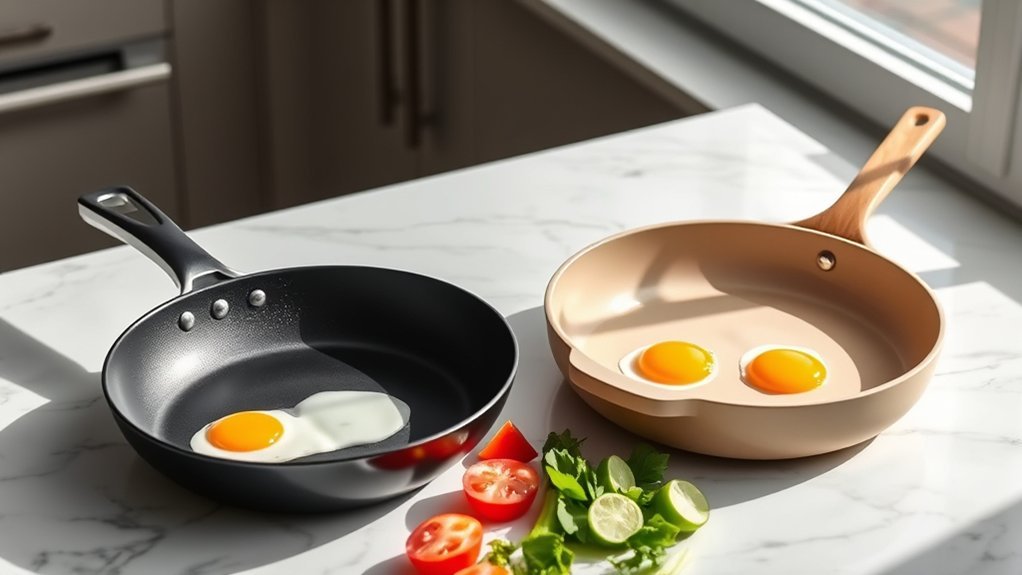
Ceramic-coated and traditional PTFE nonstick pans both make delicate foods easier to cook, but they use different coating technologies. Most ceramic nonstick pans use a mineral-based sol-gel coating, and many current products are specifically sold as PTFE- and PFAS-free. Traditional nonstick uses PTFE, which generally provides more consistent food release over repeated use. Neither coated surface should automatically be treated as a high-heat searing pan, and the better choice depends on coating preferences, cooking temperature, care habits, and how long you expect the nonstick performance to last.
Quick Answer
Ceramic-coated cookware is a good fit if you want a pan specifically labeled PFAS- and PTFE-free and accept that its slickness may fade sooner. Traditional PTFE nonstick usually offers more durable, predictable release. Modern PTFE cookware is considered safe when used as directed, but it should not be preheated empty or overheated.
Key Takeaways
- Most “ceramic” frying pans are metal pans with a ceramic-style coating, not cookware made entirely from ceramic.
- PTFE is a fluoropolymer within broad PFAS definitions; PFOA is a different chemical that was historically used during fluoropolymer manufacturing.
- PTFE nonstick generally keeps its easy-release performance longer, while ceramic provides a fluoropolymer-free option when the product is explicitly labeled PFAS/PTFE-free.
- Neither coating is the ideal default for repeated high-heat searing; stainless steel, cast iron, or carbon steel is usually better suited to that job.
- Coating life depends more on heat, cleaning, utensils, frequency of use, and the individual product than on a fixed number of years.
What’s the Difference Between Ceramic and Nonstick?
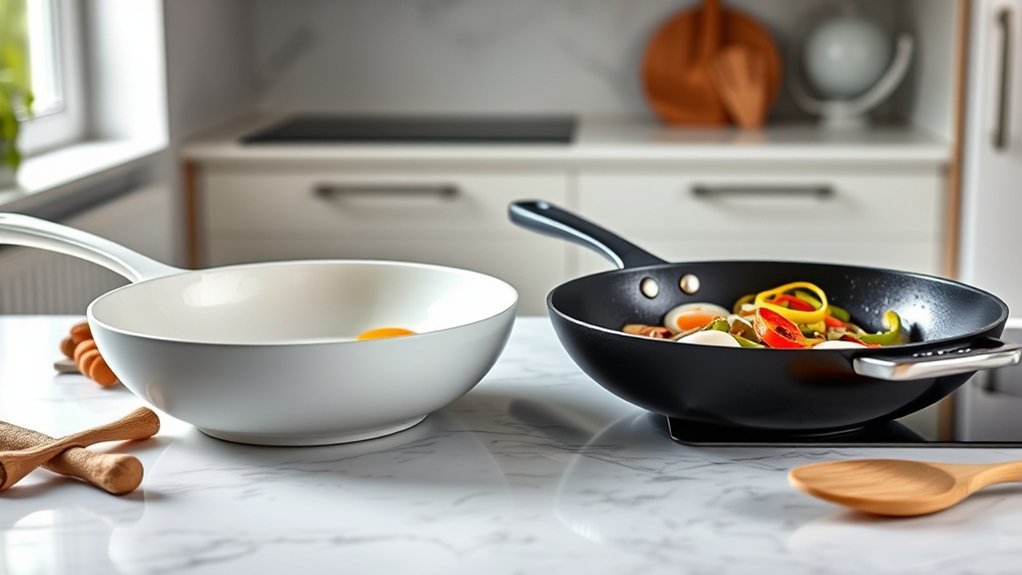
In this comparison, ceramic cookware means ceramic-coated nonstick cookware unless stated otherwise. These pans normally have an aluminum or stainless-steel body covered by a hard, glass-like coating produced with sol-gel technology. Formulations vary by manufacturer, so a shopper who specifically wants to avoid fluoropolymers should look for an explicit PFAS-free and PTFE-free statement from the brand.
Traditional nonstick cookware normally uses PTFE, or polytetrafluoroethylene, a fluoropolymer valued for its extremely low-friction surface. PTFE itself falls within broad definitions of PFAS used by agencies such as Health Canada and Germany’s Federal Institute for Risk Assessment.
PFOA is not the same thing as PTFE. PFOA was historically used as a processing aid in some fluoropolymer manufacturing. The U.S. Environmental Protection Agency’s PFOA Stewardship Program led participating major manufacturers toward eliminating PFOA and related chemicals from emissions and product content by 2015.
| Factor | Ceramic-Coated Nonstick | Traditional PTFE Nonstick |
|---|---|---|
| Cooking surface | Usually a sol-gel ceramic-style coating over metal | PTFE fluoropolymer coating over metal |
| PFAS/PTFE status | Many products are PFAS/PTFE-free; verify the exact product | Contains PTFE, a fluoropolymer within broad PFAS definitions |
| Food release | Often excellent when new but may decline sooner | Typically more consistent over repeated use |
| Best heat range | Usually low to medium for longest coating life; follow manufacturer limits | Low to medium; avoid empty-pan overheating and high heat |
| Best use | Eggs, pancakes, vegetables, reheating, gentle sautéing | Eggs, fish, pancakes, reheating, and delicate foods |
Ceramic-Coated vs 100% Ceramic Cookware
Ceramic-coated cookware should not be confused with solid ceramic cookware. A ceramic-coated frying pan is normally a metal pan with a relatively thin coating on the food-contact surface. Solid ceramic cookware is made primarily from ceramic material throughout and behaves differently in terms of heating, weight, impact resistance, and thermal shock.
This distinction also matters for safety discussions. Regulatory warnings about lead or cadmium in some ceramic glazes do not mean every modern ceramic-nonstick coating has the same issue. Health Canada explains that improperly manufactured ceramic, enamel, or glass cookware can present lead or cadmium concerns, so purchasing food-contact cookware from a reputable manufacturer remains important.
Note: “Ceramic” by itself is not enough to establish a product’s chemistry. If avoiding PTFE or PFAS is important to you, check the manufacturer’s materials statement for the exact pan rather than relying only on the word ceramic.
Is Ceramic Safer Than Traditional Nonstick?
It is more accurate to say that the two coatings have different material profiles than to declare one universally safer. A ceramic-coated pan that is specifically certified or described by its manufacturer as PFAS- and PTFE-free allows buyers to avoid fluoropolymer coatings. That can be a valid purchasing preference.
Modern PTFE cookware, however, should not be described as inherently unsafe. The U.S. Food and Drug Administration says PFAS used for approved nonstick cookware coatings are polymerized and tightly bound during manufacturing, and studies show negligible amounts capable of migrating from the coating to food.
The main avoidable risk with PTFE cookware is severe overheating. Health Canada advises against preheating an empty nonstick pan and recommends avoiding temperatures above 260°C/500°F. Germany’s Federal Institute for Risk Assessment reports that PTFE can begin decomposing at around 360°C/680°F and above.
Those figures are not contradictory: 500°F is a practical consumer-use ceiling intended to keep the pan well away from severe overheating, while roughly 680°F describes conditions at which PTFE decomposition becomes a significant concern.
Warning: Never leave an empty PTFE-coated pan heating unattended. Use low to medium heat, ventilate the kitchen, and follow the pan manufacturer’s temperature limits. Gas and induction burners can heat an empty pan especially quickly.
| Safety Question | Practical Answer |
|---|---|
| Does ceramic avoid PTFE? | Many ceramic-nonstick products do, but verify the exact manufacturer’s PFAS/PTFE statement. |
| Is modern PTFE cookware considered safe? | Regulators such as FDA and BfR say adverse health effects are not expected when suitable PTFE cookware is used as intended. |
| Can PTFE be overheated? | Yes. Do not preheat it empty or expose it to very high temperatures. |
| Are ceramic products automatically lead- and cadmium-free? | No blanket assumption should be made. Buy food-contact cookware from reputable manufacturers with clear materials or testing information. |
Ceramic Cookware Pros and Cons
Ceramic-coated cookware combines easy-release cooking with the option to avoid PTFE when the manufacturer explicitly identifies the coating as PFAS-free. It is especially attractive for eggs, pancakes, vegetables, and other foods normally prepared over low to medium heat.
The primary trade-off is durability of the nonstick effect. Ceramic coatings can remain physically intact while gradually becoming less slick, particularly after repeated high heat, abrasive cleaning, cooking-spray buildup, or rough utensil use.
Ceramic Coating Benefits
- PFAS/PTFE-free options: Many major ceramic-nonstick brands specifically manufacture coatings without fluoropolymers.
- Strong initial food release: Eggs, pancakes, and delicate foods can release with relatively little added fat when the surface is new and clean.
- Easy cleanup: A well-maintained ceramic coating normally wipes clean with mild soap and a soft sponge.
- Design variety: Ceramic-coated cookware is widely available in lighter colors and decorative finishes that are less common with conventional PTFE pans.
- Broad construction options: Depending on the base, ceramic-coated pans may work on gas, electric, ceramic-glass, or induction cooktops.
Induction compatibility is determined by the pan’s construction and magnetic base rather than by the ceramic coating itself, so always check the exact model.
Ceramic Coating Drawbacks
The biggest drawback is that the easy-release effect can decline sooner than the coating’s appearance suggests. A ceramic pan may look intact yet require progressively more oil because microscopic changes, residue, or wear have reduced its slickness.
A 2025 laboratory study comparing five sol-gel ceramic coatings with PTFE found that the PTFE coating maintained more consistent nonstick performance through repeated cooking cycles. Results varied among the ceramic formulations, so the research should not be treated as a lifespan guarantee for every pan.
Ceramic also should not be assumed to benefit from aggressive heat. For example, GreenPan’s care guidance recommends low-to-medium heat, silicone or wooden utensils, and gentle cleaning to maximize coating life.
Dishwasher claims vary by brand. Even when a pan is labeled dishwasher-safe, hand-washing often places less stress on a coated cooking surface.
Traditional Nonstick Cookware Pros and Cons
Traditional PTFE nonstick cookware remains popular because of its predictable food release. It works especially well for eggs, fish, pancakes, reheating, and other low- to medium-heat tasks where preventing sticking matters more than creating a hard sear.
Modern PTFE pans sold by major manufacturers are generally made without PFOA as a manufacturing aid, but PFOA-free does not mean PFAS-free: PTFE itself is a fluoropolymer within broad PFAS definitions.
The major limitation is temperature. PTFE pans should not be left empty over a hot burner or used for uncontrolled high-heat cooking. Many cookware manufacturers also recommend silicone, nylon, or wooden utensils because deep scratches and rough treatment shorten coating life.
A minor scratch should not be described as a poisoning emergency. BfR states that accidental ingestion of tiny detached PTFE particles is not expected to cause adverse health effects because PTFE is inert and is not digested. Even so, a pan with extensive peeling, flaking, exposed substrate, severe warping, or badly degraded food release has reached the point where replacement is sensible.
Which Pan Performs Better in Daily Cooking?
For day-to-day low- and medium-heat cooking, PTFE nonstick generally has the advantage in long-term food release. Ceramic-coated pans can be impressively slick when new, but their low-friction performance often changes sooner with repeated use.
The difference does not mean every PTFE pan will outlast every ceramic pan. Coating formulation, pan construction, cleaning, heat exposure, utensils, cooking sprays, and frequency of use all matter.
Daily Food Release
For eggs, fish, crepes, and pancakes, both surfaces can perform extremely well when new. The distinction becomes more noticeable after repeated cooking and cleaning cycles.
A 2025 laboratory comparison found that PTFE retained more consistent nonstick release than the five sol-gel ceramic coatings tested after repeated cooking cycles.
The study does not establish an exact number of household years, but it supports the practical observation that traditional PTFE is usually the stronger choice when long-lasting easy release is the main priority.
Long-Term Durability
There is no reliable universal rule that a ceramic pan lasts exactly one, two, or three years while a PTFE pan lasts five or ten. A pan used twice a month on low heat faces very different wear from one used twice a day on a powerful burner.
Instead, judge durability by usable performance. A coating is approaching the end of its practical life when food sticks persistently despite proper cleaning and technique, the surface peels or chips extensively, the metal underneath becomes exposed, or the pan warps enough to heat or sit unevenly.
Pro Tip: Low-to-medium heat usually protects both types of coating better than repeatedly heating the pan as fast as possible. Let the pan cool before washing it, and use silicone, nylon, or wooden utensils unless the manufacturer specifically approves something else.
How Long Do Ceramic and Nonstick Pans Last?
The honest answer is that there is no dependable fixed lifespan for either coating. Usage conditions matter more than a calendar estimate.
| Condition | What It Means |
|---|---|
| Food begins sticking more often | Deep-clean first. If performance does not recover, the nonstick effect may be wearing out. |
| Ceramic surface chips badly | Replacement is sensible when the cooking surface is extensively damaged or the substrate is exposed. |
| PTFE coating peels or flakes extensively | The pan has lost coating integrity and should be replaced for normal cooking performance. |
| Pan is severely warped | Replace it if the base no longer sits safely or heats evenly. |
| Surface remains smooth and releases food normally | There is no need to replace a functional pan simply because it reached an arbitrary age. |
PTFE often retains low-friction cooking performance longer than ceramic-style coatings, but both are consumable surfaces rather than permanent cookware finishes.
Are Ceramic or Nonstick Pans Good for High-Heat Searing?
Neither coated category is the ideal default for repeated high-heat searing. A pan can have a high oven-safe rating while its manufacturer still recommends moderate stovetop heat to protect the coating. Oven-safe ratings also account for handles, lids, bonding materials, and overall construction, so they should not be interpreted as permission to leave an empty coated skillet over maximum burner heat.
For steaks, hard browning, wok-style cooking, and other jobs that benefit from sustained high surface temperatures, consider stainless steel, cast iron, or carbon steel. These uncoated materials do not depend on a nonstick layer for their cooking surface and are better suited to many high-heat techniques when used correctly.
How Do You Care for Ceramic and Nonstick Pans?
Proper care can make a major difference to both ceramic and PTFE-coated cookware.
- Use moderate heat: Low to medium is the safest default unless the manufacturer’s instructions specifically allow something different.
- Avoid empty-pan overheating: This is especially important with PTFE cookware.
- Choose gentle utensils: Silicone, nylon, and wooden tools reduce scratching.
- Wash gently: Mild dish soap and a soft sponge are safer for coatings than steel wool or harsh abrasive pads.
- Let the pan cool: Avoid moving a very hot pan directly into cold water, which can stress or warp the cookware.
- Watch cooking sprays: Some ceramic manufacturers discourage aerosol sprays because residue can carbonize and reduce food release.
- Protect stacked pans: A cloth, felt protector, or soft towel between pans helps prevent abrasion.
- Follow model-specific instructions: Dishwasher safety, oven limits, broiler use, and induction compatibility vary by pan.
Best Ceramic and Traditional Nonstick Pans
No single pan is automatically “best” for every cook, and product specifications change. The examples below show current ceramic, PTFE, and alternative products that illustrate the differences discussed in this guide. Prices shown are manufacturer-listed U.S. prices checked on September 17, 2026 and can change.
- Caraway 10.5-Inch Fry Pan: listed at $125. Caraway describes its ceramic coating as made without PTFE, PFOA, PFAS, lead, or cadmium and rates the pan oven-safe up to 550°F.
- Kyocera Ceramic PFAS-Free Fry Pans: the current U.S. lineup lists the 8-inch pan at $58, 10-inch at $68, and 12-inch at $79. Kyocera describes them as free of PTFE, PFOA, lead, cadmium, fluorine, and heavy metals.
- Tramontina Pots & Pans Aluminum Nonstick Fry Pan: currently listed from $22.95. The manufacturer confirms a reinforced nonstick cooking surface, but the listing reviewed does not identify it as PTFE, so buyers who care about exact coating chemistry should verify the specific model rather than assuming.
- All-Clad NS Pro Nonstick: a current example of conventional fluoropolymer cookware. All-Clad explicitly identifies its coating as three-layer PTFE nonstick and recommends low-to-medium heat.
- Misen Carbon Nonstick: Misen’s current version is marketed as a coating-free cooking surface rather than a conventional PTFE or ceramic coating, so it should not be treated as a direct example of either category in this comparison.
For ceramic, prioritize clear materials disclosure and realistic care instructions. For PTFE, look for a reputable manufacturer, appropriate construction for your cooktop, and clear temperature guidance rather than choosing solely on price.
Which Pan Is Right for You?
| Priority | Ceramic-Coated | PTFE Nonstick |
|---|---|---|
| Avoiding fluoropolymer coatings | Choose a product explicitly labeled PFAS/PTFE-free | Not suitable for this priority because the cooking surface contains PTFE |
| Long-lasting food release | Usually weaker over repeated use | Generally stronger |
| Eggs and delicate foods | Very good when the coating is performing well | Excellent and usually more consistent over time |
| Repeated high-heat searing | Not the preferred tool | Not the preferred tool |
| Care tolerance | Benefits greatly from gentle heat, utensils, and cleaning | Also needs gentle utensils, cleaning, and strict heat control |
| Induction | Depends on the pan’s base | Depends on the pan’s base |
Choose ceramic-coated cookware when avoiding PTFE is a major priority and you are comfortable treating the surface gently. Choose conventional PTFE when dependable, long-lasting food release for low- and medium-heat cooking matters more. If most of your cooking involves aggressive browning or high temperatures, an uncoated stainless-steel, cast-iron, or carbon-steel pan may suit the job better than either one.
Frequently Asked Questions
What Is the Downside of Ceramic Cookware?
For ceramic-coated nonstick cookware, the main downside is that the easy-release performance can fade sooner than it does on a good PTFE pan. High heat, abrasive cleaning, cooking-spray residue, and rough utensils can accelerate the change. Ceramic-coated pans therefore reward gentle use even when the visible coating still looks intact.
Is Ceramic Coating Healthier Than Non-Stick?
There is no sound basis for declaring every ceramic coating universally healthier than modern PTFE cookware. Ceramic is useful if you specifically want a pan verified as PFAS/PTFE-free. FDA and BfR guidance indicates that properly manufactured PTFE cookware is not expected to harm consumers when it is used as intended and not severely overheated.
What Is the Healthiest Cookware You Can Use?
There is no single universally healthiest cookware material. Durable uncoated options such as stainless steel, cast iron, and carbon steel avoid a nonstick coating, while glass and verified food-safe ceramic can suit other cooking jobs. Each material has trade-offs involving reactivity, weight, maintenance, heat control, and allergies, so the best choice depends on the food and the cook.
Do Professional Chefs Use Ceramic Pans?
Some professional cooks use ceramic or other nonstick pans for specific delicate foods, but there is no credible basis for claiming that a fixed percentage such as “1 in 5” relies on ceramic as a primary pan. Commercial kitchens often favor stainless steel, carbon steel, cast iron, and heavy-duty aluminum because they withstand intensive heat, cleaning, and handling.
Can You Use Ceramic Pans on High Heat?
Follow the exact manufacturer’s instructions. Although some ceramic-coated pans have high oven-safe ratings, manufacturers commonly recommend low-to-medium stovetop heat to preserve nonstick performance. An oven-safe temperature is not the same as a recommendation to preheat an empty skillet over maximum burner heat.
When Should You Replace a Ceramic or Nonstick Pan?
Replace a coated pan when it is extensively peeling or chipping, the underlying metal is exposed, the pan is severely warped, or food-release performance remains poor despite proper cleaning and use. A fixed calendar age is less useful than the actual condition and performance of the cooking surface.
Conclusion
Ceramic-coated and traditional PTFE nonstick cookware both work well for gentle everyday cooking, but their advantages are different. Ceramic is the clearer fit when you deliberately want a product verified as PFAS- and PTFE-free, while PTFE generally provides more durable and predictable food release. Modern PTFE cookware is considered suitable for normal food-contact use when used correctly, but empty-pan overheating should be avoided. Ceramic coatings also benefit from moderate heat and gentle care. For repeated high-temperature searing, an uncoated stainless-steel, cast-iron, or carbon-steel pan is usually a better tool than either coated option.
Sources
- U.S. Food and Drug Administration — Questions and Answers on PFAS in Food — explains authorized nonstick food-contact coatings and PFAS migration.
- Health Canada — The Safe Use of Cookware and Bakeware — covers PTFE heat precautions, PFOA, and ceramic/glaze safety.
- German Federal Institute for Risk Assessment — PTFE Non-Stick Cookware FAQ — covers intended use, overheating, decomposition temperature, and damaged coatings.
- U.S. Environmental Protection Agency — PFOA Stewardship Program — documents the U.S. phaseout history of PFOA and related long-chain PFAS manufacturing uses.
- Research in Engineering, 2025 — Ceramic Non-Stick Coatings vs PTFE — compares nonstick release and durability of five sol-gel ceramic coatings with PTFE.
- GreenPan — Ceramic Cookware Care & Use — manufacturer guidance on moderate heat, utensils, oils, and cleaning.

1 thought on “Is Ceramic Cookware Better Than Nonstick? Key Differences, Pros & Cons”