
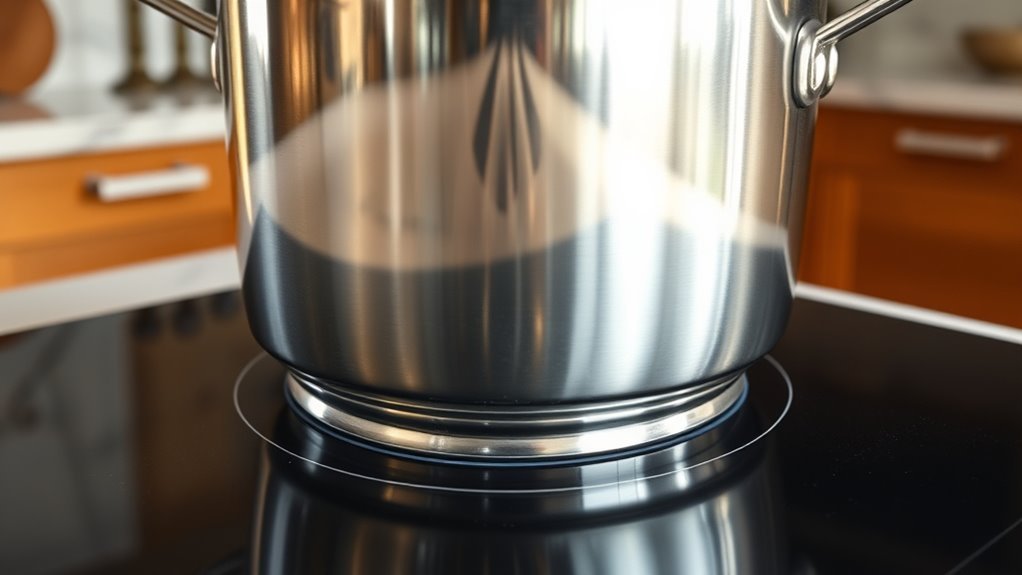
When you’re checking cookware for induction compatibility, look for a coiled-wire, zigzag, or series-of-loops symbol stamped on the base—manufacturers may also print “induction ready.” You’ll want to verify with a magnet and assess base flatness and thickness too, since markings alone aren’t foolproof. Keep going to learn the three quick checks, how to decode bottom stamps, and what metals reliably work on induction.
3 Quick Checks to Confirm Induction Compatibility
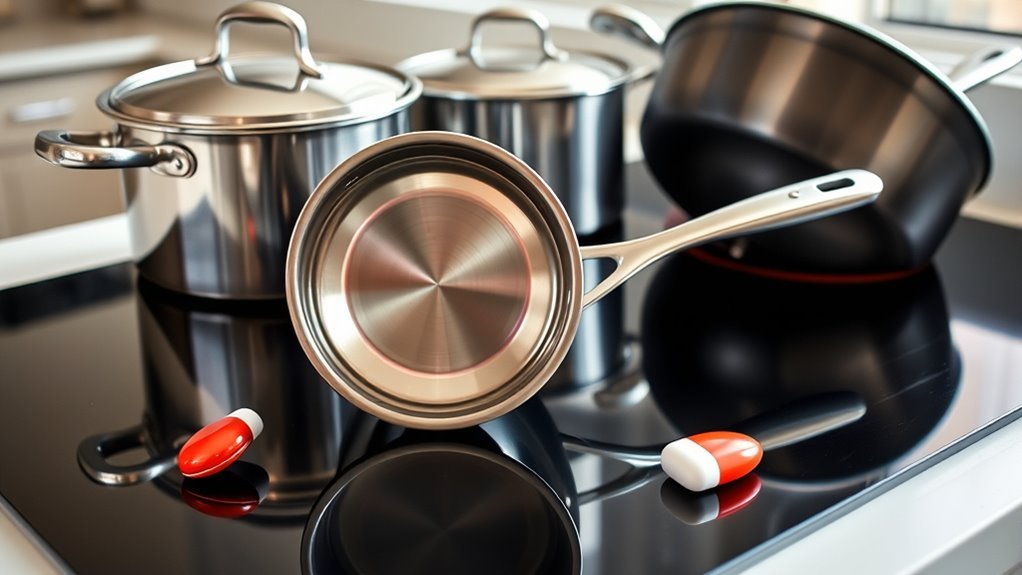
Want to know quickly whether a pan will work on induction? You’ll run three precise checks.
First, inspect the base for the Induction Cookware Symbol — a coil or zigzag — which signals designed induction compatibility and simplifies selection for liberated, efficient kitchens.
Second, verify ferromagnetic material via the magnet test; if a magnet adheres, the pan can couple with induction cooktops.
Third, assess physical coupling and performance: confirm the cookware base diameter matches the cooktop’s heating zone closely, ascertain multi-layered bottoms contain a magnetic layer, and check the base is a true flat surface with no warping.
These factors govern heat transfer and cooking efficiency; mismatched diameter, warped base, or absent magnetic layers will reduce power detection and thermal uniformity.
Use these checks together for decisive, technical confirmation so your cookware serves reliability, speed, and the freedom to cook without compromise.
Magnet Test: Confirming Induction Compatibility
Although a visual symbol helps, the simplest lab-style check is the magnet test: press a small magnet against the cookware base—if it sticks firmly, the pan contains enough ferromagnetic material to couple with an induction cooktop.
You’ll still inspect the cookware base for the induction symbol, but the magnet test gives quick, actionable confirmation of compatibility for induction cookware.
- Use a small neodymium or fridge magnet on the center and edges of the cookware base.
- If magnet adhesion is strong, the ferromagnetic layer is likely sufficient for induction cooking.
- Weak or intermittent sticking suggests thin or discontinuous ferromagnetic layers; avoid relying on such cookware for consistent heat distribution.
- When possible, prefer cookware with thick, multi-layer bases to maximize cooking efficiency and uniformity under induction.
This method empowers you to validate induction compatibility directly, freeing you from ambiguous labels and ensuring reliable induction cooking performance.
Practical Checks: Flatness, Base Thickness & Handle Limits
After you’ve confirmed ferromagnetism with a magnet, check the cookware’s flatness, base thickness and handle limits to guarantee reliable induction performance.
Inspect flatness by setting the cookware base on a flat surface; any wobble causes uneven contact with heating zones, noise on glass-ceramic, and reduced efficient energy transfer.
Set cookware on a flat surface—any wobble means uneven contact, noise on glass-ceramic, and poorer energy transfer.
Measure base thickness: thicker cookware base improves heat retention and stability but slows initial response on induction cooktops; thin bases heat quickly but risk hotspots.
Verify induction compatibility by ensuring the cookware base diameter matches the cooktop’s zone to avoid error codes and energy loss.
Assess handle limits: confirm plastic or riveted components tolerate temperatures similar to the metal body to prevent melting or failure under high-heat use.
Use the magnet test to confirm magnetic properties across the entire base, not just the rim.
These practical checks—flatness, base thickness, handle limits—keep your induction cookware functional, safe, and aligned with liberated, performance-driven cooking.
Decoding Bottom Stamps: Oven, Temp & Induction Marks
Think of the bottom stamps on your cookware as a compact instruction panel: they tell you whether the piece is oven-safe, the maximum temperature it can handle, and if it’s induction-ready (often shown as a coiled spring or the word “Induction”).
You’ll scan bottom stamps to identify induction cookware symbol and temperature ratings; these marks establish compatibility with specific cooking environments and safe usage limits. If a symbol is missing, don’t assume induction compatibility—perform a magnet test to verify.
- Inspect: locate bottom stamps that state oven-safe status and numeric temperature ratings.
- Identify: find the induction cookware symbol (coiled spring/zigzag) or the word “Induction” for clear designation.
- Verify: use the magnet test as a pragmatic backup for induction-ready cookware identification.
- Choose: match cookware types and stamps to your cooking environments to guarantee compatibility and safe usage.
Which Metals and Bases Work on Induction
You’ll need cookware with ferromagnetic metals—like cast iron or magnetic stainless steel—because only those generate the eddy currents induction requires.
Many induction-ready pans use multi-layer magnetic bases (steel bonded to aluminum or copper) to combine rapid heating with even distribution.
Use a magnet on the base: if it sticks, the cookware and its composite layers will engage an induction cooktop.
Ferromagnetic Metals Only
Because induction relies on magnetic fields to heat cookware, only ferromagnetic metals—like cast iron and many stainless steels—will work reliably on induction cooktops.
You’ll choose induction cookware whose cookware base contains ferromagnetic metals to guarantee direct energy transfer to the pan rather than wasted heat. Look for the induction symbol on the bottom as confirmation, and perform a magnet test: if a magnet sticks, it’s compatible cookware.
Match base diameter to the heating zone for efficient operation and to avoid error codes.
- Cast iron: excellent magnetic coupling and stable heating.
- Stainless steel (magnetic grades): durable, induction-ready when marked.
- Aluminum/copper: non-ferromagnetic unless fitted with a magnetic base.
- Magnet test: quick field check for compatibility.
Multi-Layer Magnetic Bases
When you need even heat and induction compatibility, choose cookware with a multi-layer magnetic base: a ferromagnetic outer layer (usually magnetic stainless steel or cast iron) bonds to a high-conductivity core of aluminum or copper, combining magnetic coupling for induction with superior lateral heat distribution and retention. You’ll look for the induction symbol on the base and perform a magnet test to confirm the ferromagnetic base. Multi-layer magnetic bases give you a flat base for ideal contact, efficient energy transfer, and cooking smoother results. You free yourself from uneven pans by choosing layered constructions that balance responsiveness and heat retention.
| Feature | Benefit |
|---|---|
| Stainless steel outer | Durability, induction coupling |
| Aluminum/copper core | Heat distribution |
| Flat base | Contact, efficiency |
| Induction symbol | Compatibility |
| Magnet test | Quick verification |
Buying & Troubleshooting When Symbols Are Missing
If a pot or pan lacks the familiar coiled-spring induction mark, don’t assume it’s incompatible—verify it directly with a magnet and by checking the product specs or manufacturer.
You’ll want to confirm induction cookware compatibility through objective checks before you buy. Use a magnet test: if the magnet sticks firmly to the base, the cookware will likely work on an induction hob.
Missing symbols can signal weak safety standards or lower-quality materials, so insist on documentation. High-end cookware sometimes omits clear induction symbols; still verify via product specifications or manufacturer confirmation.
Missing induction markings may indicate poor standards—demand documentation, but still verify specs or ask the manufacturer.
- Perform a magnet test on the base to assess ferromagnetic response.
- Review product specifications online for explicit induction compatibility.
- Contact the manufacturer for certification and safety standards details.
- If uncertain, avoid purchase or choose tested, clearly marked items.
Follow these troubleshooting steps to reclaim autonomy over safe, reliable induction cooking.
Frequently Asked Questions
How Do I Tell if My Cookware Is Induction?
You check induction cookware by doing a magnet test: if a magnet sticks, you’ve got magnetic materials suitable for induction.
Stainless steel and cast iron usually pass; copper pots and aluminum pans without a magnetic base won’t.
Also inspect base flatness and size for proper heat distribution and induction efficiency.
Do cookware testing for even heat distribution to guarantee cooking performance and reliable, liberated kitchen results.
What Cookware Cannot Be Used on Induction?
You can’t use non magnetic materials on induction—think Victorian airships aside.
Aluminum cookware, copper pots, glass cookware, ceramic pans and many thin or warped pieces lack induction compatibility and won’t couple to the field. If a magnet won’t stick, avoid them.
Cast iron and many stainless steel items work if labels confirm induction compatibility and flatness.
Prioritize solid heat distribution, verified cookware labels for reliable liberated cooking choices.
What Is the Logo for an Induction Cooker?
The logo for an induction cooker is a coiled spring or zigzag line, often labeled “Induction.”
You’ll use induction cookware types that match cookware material compatibility; benefits of induction include heat distribution efficiency, energy savings induction, induction safety features, and easier cleaning induction surfaces.
For induction vs gas, follow induction cooking tips to avoid myths: induction cooking myths often overstate limits, but proper pans free you and enhance liberation through precise, efficient control.
What Is the Symbol for an Induction?
The symbol’s a coil-like spiral or zigzag; you’ll recognize it instantly. Imagine a small spring etched on the base to show induction cooking and cookware compatibility.
You’ll confirm with magnetic materials—if a magnet sticks, heat distribution, energy efficiency, cooking speed and safety features will follow.
Design considerations and maintenance tips are minimal; you’ll enjoy liberated user experience, precise control, and durable performance without compromise.
Conclusion
You’ve got the tools to tell whether cookware will work on induction: look for the coiled-wire or zigzag symbol on the base, try a magnet test, and check flatness and base thickness. If markings are missing, verify materials (cast iron, magnetic stainless) and test on the cooktop or ask the maker. Don’t guess—measure and confirm, because when push comes to shove you need reliable heat transfer for safe, efficient induction cooking.
