
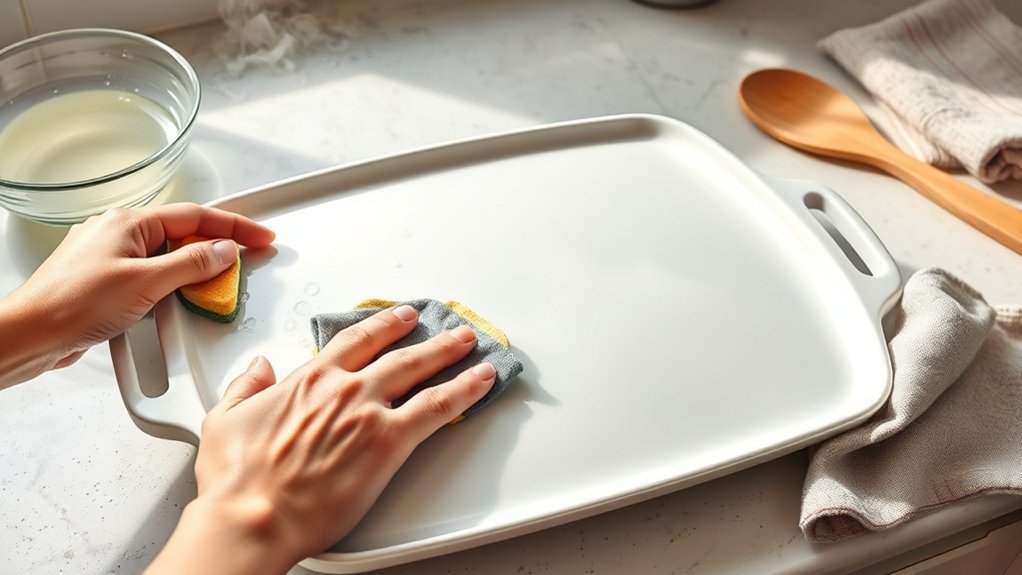
A ceramic griddle is easiest to clean when you use gentle tools, mild dish soap, and the cleaning method specified for your exact model. Turn the appliance off, unplug electric models, let the cooking surface cool to a safe temperature, remove loose food, and wash without metal tools or abrasive cleaners. For burnt residue, soaking or a mild baking soda paste may help if the manufacturer permits it.
Quick Answer
To clean a ceramic griddle, turn it off, unplug it if electric, and let it cool. Wipe away loose food, then use warm water, mild dish soap, and a soft cloth or non-abrasive nylon pad. Treat stubborn residue gently, rinse or wipe clean as your manual directs, and dry everything thoroughly before storage.
Key Takeaways
- Check the owner’s manual first because some ceramic griddles have removable, immersible, or dishwasher-safe parts while others do not.
- Use mild dish soap, soft cloths, nylon or plastic pads, and silicone, wood, or nylon utensils.
- Avoid steel wool, metal scrapers, harsh abrasives, and aggressive scouring.
- Use baking soda only when your griddle manufacturer permits it, and scrub lightly.
- Avoid excess cooking oil, overheated oil, and cooking sprays that can create sticky buildup on many ceramic coatings.
- Dry the cooking plate, grease tray, control connection, and other cleaned parts fully before reassembly or storage.
At a Glance
| Time Required | About 10–20 minutes, plus cooling time |
| Difficulty | Easy |
| Tools Needed | Soft cloth or sponge, silicone or wooden utensil, non-abrasive nylon/plastic pad, mild dish soap, and optional baking soda if approved by the manufacturer |
| Cost | Usually under $5 using common household cleaning supplies |
Why Ceramic Griddles Need Special Care
Ceramic griddles need gentle care because a ceramic nonstick coating can still be scratched, chipped, worn, or covered by cooked-on oil residue. It should not be treated like a bare steel or cast-iron griddle.
Current manufacturer guidance is consistent on several basics. Blackstone warns E-Series owners against abrasive cleaners, abrasive tools, metal utensils, and prolonged excessive heat. Hamilton Beach’s ceramic griddle manual likewise recommends hot soapy water and a plastic or nylon pad instead of metal scouring pads or abrasive cleansers.
Food residue and overheated oil can also reduce release performance. Cleaning after each use prevents grease and crumbs from repeatedly heating and forming a harder film.
The goal is therefore not aggressive scrubbing. It is to remove residue with the least abrasive method that works.
Ceramic nonstick is easier to protect when residue is removed early and metal tools, abrasive pads, cooking-spray buildup, and unnecessary high heat are avoided.
Check Your Griddle Type Before Cleaning
Before adding water or soap, identify which parts of the griddle can safely be removed or washed. Ceramic griddles vary considerably in construction.
- Detachable temperature control: Remove it only as directed by the manufacturer and keep the control, cord, and plug dry.
- Removable cooking plate: Some plates can be washed separately or immersed after electrical components are removed.
- Fixed electric base: Do not immerse a fixed electrical base unless the manual explicitly states that it is immersible.
- Grease tray or drip cup: Remove and clean it separately. Some trays are dishwasher-safe even when the griddle itself is not.
- Dishwasher-safe components: Follow the manual. Dishwasher guidance is model-specific rather than universal.
Warning: Never immerse a power cord, plug, temperature control, electrical connector, or fixed electrical base in water. If you are unsure whether the cooking plate or body can be immersed, clean it with a damp cloth and consult the model’s owner manual.
What You Need to Clean a Ceramic Griddle
Keeping a ceramic griddle in good condition requires only a few basic cleaning supplies. Gather a soft cloth or sponge, mild dish soap, a nylon or plastic non-abrasive pad, and a silicone, wooden, or plastic utensil for loosening food.
Baking soda can be useful for stubborn discoloration on ceramic nonstick surfaces when the manufacturer permits it. Both Oster and GreenPan describe baking-soda cleaning for their ceramic nonstick products, but your griddle’s own instructions take priority.
Turn an electric griddle off, unplug it, and allow it to cool before wet cleaning. Hamilton Beach specifically instructs users to unplug and let its Durathon ceramic griddle cool completely before cleaning.
Unplug an electric griddle and let it cool before wet cleaning, and keep its power control and plug out of water.
For a first-use cleaning, most manufacturers call for washing or wiping the cooking surface with warm soapy water, rinsing or wiping away the soap as appropriate for the model, and drying it thoroughly before cooking.
Pro Tip: Start with the least aggressive cleaning method. Warm water, mild soap, and a soft cloth remove most fresh residue. Move to a nylon pad or manufacturer-approved baking-soda paste only when ordinary wiping is not enough.
How to Clean a Ceramic Griddle After Cooking
Once the ceramic griddle is turned off, unplugged if electric, and cool enough to clean safely, remove loose food with a soft cloth, silicone spatula, or wooden utensil. Do not attack residue with a metal scraper simply because metal scrapers are commonly used on bare steel griddles.
If food is stuck, soften it with a damp cloth or paper towel for a few minutes. On removable or immersible plates, the manufacturer may instead allow a short soak in warm soapy water. Do not soak electrical components.
Add a small amount of mild dish soap to a damp sponge or non-abrasive pad and wipe the cooking area. Use light pressure rather than vigorous scrubbing. Then rinse the removable plate or wipe away soap with a clean damp cloth according to your model’s instructions.
| Step | Action |
|---|---|
| 1 | Turn off, unplug if electric, and allow the surface to cool safely |
| 2 | Remove loose food with a soft or non-metal tool |
| 3 | Soften stuck residue with a damp cloth or an approved soak |
| 4 | Wash gently with mild soap and a soft or nylon pad |
| 5 | Rinse or wipe away all cleaner as the manual directs |
| 6 | Dry the cooking plate and electrical connection areas completely |
Clean the grease tray or grease cup at the same time. Dispose of cooled grease appropriately, wash the removable tray with warm soapy water, and use a dishwasher only when the manufacturer identifies that component as dishwasher-safe.
Dry every cleaned part thoroughly before reassembly or storage. In particular, keep a removable heat-control receptacle dry before reconnecting the control.
Remove Burnt-On Food Without Scratching
When burnt-on food remains after routine washing, give moisture time to loosen it before adding more force. Lay a damp cloth or paper towel over the residue for several minutes, or use a manufacturer-approved soak if the plate can be immersed.
If the owner’s manual allows baking soda, mix a small amount with water to form a soft paste. Spread it over the stain and let it sit for several minutes. Then wipe with a damp cloth or scrub lightly with a non-abrasive plastic or nylon pad.
Do not use steel wool, metal scouring pads, knives, razor blades, griddle bricks, or aggressive scraping on a ceramic nonstick coating unless the manufacturer specifically authorizes that tool for that exact surface.
If the residue does not lift after one gentle treatment, repeat the softening process rather than pressing harder. Repeated heavy pressure can turn a cleaning problem into permanent coating damage.
Clean Sticky Residue and Grease Buildup
Sticky residue often comes from oil that has polymerized or carbonized on the cooking surface. Cooking sprays can be especially troublesome on some ceramic coatings because tiny droplets and additives can bake into a stubborn film. Blackstone and GreenPan both warn against spray-oil buildup on their ceramic nonstick surfaces.
Begin with warm water and mild dish soap. If a film remains and the manufacturer permits baking soda, apply a thin paste, let it rest briefly, and wipe or lightly scrub with a soft non-abrasive pad. Rinse or wipe the surface until no cleaner remains, then dry it completely.
| Step | Action |
|---|---|
| 1 | Wash away ordinary grease with mild dish soap |
| 2 | Soften persistent residue with moisture |
| 3 | Use an approved baking-soda paste if needed |
| 4 | Scrub lightly with a soft, nylon, or plastic pad |
| 5 | Rinse or wipe clean and dry fully |
If the griddle still feels sticky after it is genuinely clean, look at cooking habits as well as cleaning. Excess oil, cooking spray, repeated maximum-heat cooking, and letting grease remain on the plate between uses can all contribute to recurring buildup.
Can You Use Baking Soda on Ceramic?
Often, yes—but check the manufacturer’s instructions first. Several makers of ceramic nonstick products specifically recommend a baking-soda-and-water paste for discoloration or stubborn residue. That does not make it an automatic rule for every ceramic-coated appliance.
- Mix baking soda with enough water to form a soft paste.
- Apply it only to the stained or sticky area.
- Let it rest for several minutes rather than letting it dry into a hard crust.
- Wipe with a damp soft cloth or scrub lightly with an approved plastic or nylon pad.
- Rinse or wipe away all baking soda.
- Dry the griddle completely before the next use.
Avoid combining baking soda with metal scrapers or aggressive pressure. The purpose of the paste is to loosen residue while reducing the need for hard scouring.
Note: “Ceramic” can refer to different coating systems and even to ceramic-glass cooktops, which require different cleaning methods. Follow guidance written for your griddle’s specific cooking surface.
How to Dry and Store Your Griddle Properly
The ceramic griddle should be dried completely after cleaning. Use a soft, lint-free cloth or paper towel to remove remaining moisture from the cooking plate, underside, edges, handles, and grease-management parts.
For electric griddles, pay particular attention to the area where the temperature control or power connector attaches. It must be dry before the control is reinstalled or the appliance is plugged in.
Store the griddle in a cool, dry place. Avoid placing heavy cookware directly on a ceramic cooking surface because movement and pressure can scratch or chip the coating.
Dry Surface Completely
Once the ceramic griddle has been cleaned, wipe every cleaned area dry. Hidden moisture around edges, drip-tray channels, handles, or electrical receptacles can create storage problems and, around electrical connections, a safety concern.
- Wipe the cooking surface, edges, and corners.
- Dry the grease tray or grease cup separately.
- Check the underside if the cooking plate was washed.
- Keep the power cord, plug, and temperature control dry.
- Do not reconnect a detachable control until its receptacle is completely dry.
- Keep heavy cookware off the ceramic surface during storage.
If stubborn residue is noticed while drying, return to gentle cleaning rather than putting the appliance away with food or grease still attached.
Store in a Cool, Dry Place
After cleaning, store the griddle where it will stay dry and protected from impacts. If it has a removable temperature control, follow the manual’s storage instructions so the probe or connector is not bent or damaged.
If items must be stored near the griddle, avoid dragging them across the ceramic surface. A soft protective cover or pad can reduce dust and abrasion, provided it is clean, dry, and does not trap moisture.
Outdoor ceramic griddles should receive any additional weather-protection steps specified by their manufacturer.
Common Ceramic Griddle Cleaning Mistakes
Avoiding common cleaning mistakes helps preserve a ceramic griddle’s nonstick surface and useful life. The biggest problems usually come from using a cleaning method intended for bare steel on a coated ceramic surface.
- Using metal scrapers or steel wool: These can scratch or chip ceramic nonstick.
- Scrubbing with abrasive powders: Aggressive abrasives can wear the coating.
- Washing electrical components: Cords, plugs, temperature controls, and non-immersible bases must stay dry.
- Assuming every model is dishwasher-safe: Dishwasher compatibility varies by model and component.
- Cleaning a very hot plate with cold water: Sudden temperature changes can stress cookware and should be avoided unless the manufacturer specifically instructs otherwise.
- Using cooking sprays: Some ceramic manufacturers warn that spray oils can leave carbonized residue and hurt release performance.
- Cooking at unnecessarily high heat: Prolonged excessive heat can accelerate coating wear on some ceramic griddles.
- Leaving grease in the tray: Old grease creates odors, sticky deposits, and additional cleanup later.
Let the griddle cool as its manual directs, clean residue before it repeatedly reheats, and use tools designed for nonstick surfaces.
If discoloration appears, first determine whether it is simply cooked-on grease or actual coating damage. Stains may often be cleaned, but scratches, chips, peeling, or exposed substrate should not be “repaired” by increasingly aggressive scouring.
What to Do If the Ceramic Coating Is Scratched or Damaged
Stop using abrasive methods if the surface has visible scratches, chips, peeling, or exposed metal. Cleaning cannot restore a coating that has physically worn away.
Check the manufacturer’s warranty and replacement-part guidance for your model. If a removable cooking plate is available, replacing the plate may be more appropriate than continuing to scrub a damaged nonstick layer.
Light discoloration by itself is different from coating failure. If the surface is still smooth and intact, follow the manufacturer’s stain-removal procedure. If the coating is physically lifting or flaking, contact the manufacturer before further use.
How to Keep a Ceramic Griddle Nonstick
Keeping a ceramic griddle nonstick starts with gentle cleaning after each use, before grease and food residue can repeatedly heat and carbonize.
Use wooden, silicone, nylon, or other manufacturer-approved utensils while cooking. Avoid cutting food directly on the ceramic plate.
Use only as much cooking oil as the food requires. There is no universal need for 3–4 tablespoons. A small amount of liquid cooking oil or butter is normally enough for foods that need added fat, while cooking sprays should be avoided when the manufacturer warns against them.
Do not confuse a ceramic coating with a bare steel griddle. Most coated ceramic griddles do not need the repeated high-heat oil-polymerization process known as seasoning.
Gentle Daily Cleaning
A ceramic griddle stays easier to use when fresh residue is removed after every cooking session. Once the appliance has been shut down and is safe to clean, wipe away food and grease before they harden.
- Use mild dish soap for ordinary grease when the manual permits it.
- Use a soft cloth, sponge, or non-abrasive nylon pad.
- Dry the surface and removable parts thoroughly.
- Cook with wood, silicone, nylon, or other non-metal utensils.
- Avoid harsh chemicals unless specifically approved for the model.
- Use moderate cooking temperatures whenever the recipe allows.
Consistent gentle cleaning is more effective than occasionally attacking heavy buildup with aggressive tools.
Avoid Abrasive Tools
Soft cleaning tools help preserve a ceramic griddle’s nonstick finish. Use non-metal cleaning pads or soft cloths for routine wiping, and switch to a nylon or plastic pad only when extra cleaning action is necessary.
Avoid steel wool, metal scouring pads, griddle bricks, knives, and harsh scouring powders unless the manufacturer specifically approves a product for that ceramic surface.
Cooking tools matter too. Wooden, silicone, nylon, or plastic utensils reduce direct contact damage. Ceramic coatings can be durable, but they are not immune to scratches or chips.
Frequently Asked Questions
Do You Use Oil on a Ceramic Griddle?
You can use a small amount of cooking oil or butter when the food needs it, but there is no universal requirement to add 3–4 tablespoons. Too much oil can leave residue, especially if it overheats. Avoid aerosol or spray oils when your griddle manufacturer warns against them. A thin maintenance coat after cleaning should be used only when the model’s instructions specifically recommend it.
Can You Use Dawn Dish Soap on a Griddle?
Yes, Dawn or another mild dish soap is generally suitable for ceramic nonstick griddles when the owner’s manual allows dish soap. Use only a small amount with a soft cloth, sponge, or non-abrasive pad. Rinse or wipe away all soap afterward. The important requirement is a mild, non-abrasive detergent rather than a particular brand.
Does a Ceramic Griddle Need to Be Seasoned?
Usually no. A coated ceramic griddle already has a nonstick cooking surface and generally does not need the high-heat oil seasoning used on bare steel or cast iron. Some manufacturers recommend wiping on a very small amount of oil after cleaning for storage protection, but that is a model-specific maintenance step rather than traditional seasoning.
How Do You Clean a Blackstone Ceramic Griddle?
For a Blackstone E-Series or another Blackstone model with a ceramic-coated plate, follow Blackstone’s ceramic-surface instructions rather than the seasoning procedure for its steel griddles. Blackstone recommends hand washing with mild dish soap, avoiding abrasive cleaners and metal tools, and avoiding excessive prolonged heat. The E-Series ceramic surface does not require traditional steel-griddle seasoning.
Can You Put a Ceramic Griddle in the Dishwasher?
Only if the manufacturer says that your specific griddle or removable plate is dishwasher-safe. Some ceramic cooking plates are dishwasher-safe, while other manufacturers require hand washing. A removable grease tray may also be dishwasher-safe even when the cooking plate is not. Never put a power cord or temperature control in a dishwasher.
Why Is My Ceramic Griddle Sticky After Cleaning?
Sticky performance may come from a thin layer of carbonized oil rather than ordinary food. Wash the surface thoroughly with mild soap and use a manufacturer-approved deep-cleaning method if necessary. To prevent the problem from returning, avoid excessive oil, cooking sprays that leave residue, and unnecessarily high heat.
Conclusion
Proper ceramic griddle care is mostly about using less force, not more. Unplug electric models before cleaning, protect electrical components from water, use mild soap and non-abrasive tools, and clean grease before it repeatedly cooks onto the surface.
Do not assume every ceramic griddle can be soaked, placed in a dishwasher, treated with baking soda, or oiled after cleaning. Those details depend on the manufacturer and model. Current guidance from major ceramic-nonstick manufacturers consistently supports avoiding metal tools, abrasive cleaning, residue buildup, and unnecessary high heat.
With those habits, a ceramic griddle stays easier to clean and its nonstick surface has the best chance of lasting as designed.
Sources
- Hamilton Beach Durathon Ceramic Griddle Use & Care Guide — electrical safety, cooling, hot-soapy-water cleaning, nylon/plastic pads, and drip-tray care.
- Blackstone: How Do I Cook with and Care for My E-Series Griddle? — current ceramic E-Series cleaning and maintenance guidance.
- Blackstone: Why Is Food Sticking to My E-Series or Camping Griddle Surface? — abrasive tools, cooking sprays, buildup, and excessive-heat guidance.
- GreenPan Care & Use — ceramic nonstick heat, utensil, cleaning, oil, and storage guidance.
- Oster Ceramic Nonstick Care Guidance — manufacturer-supported baking-soda paste method for stubborn ceramic-nonstick residue.