
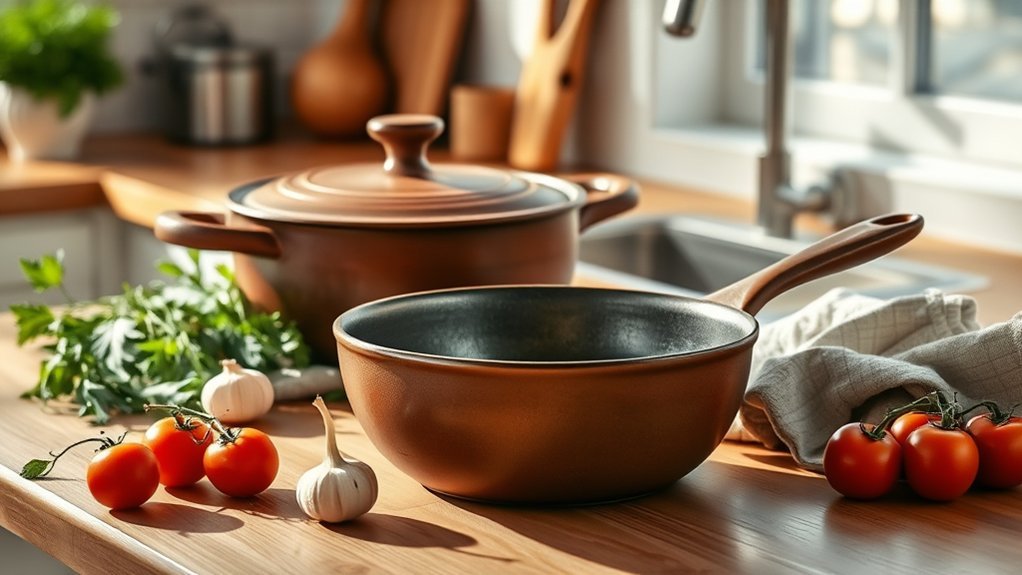
Ceramic cookware can be a practical choice for cooks who want an easy-release cooking surface, simple cleanup, and colorful designs. Most products sold as ceramic nonstick are actually metal pans coated with a ceramic-style sol-gel layer. They work best with moderate heat, gentle utensils, and careful cleaning. Their main drawback is that the slick coating can lose performance sooner than durable uncoated cookware, so buying the right pan and caring for it properly matter.
Quick Answer
Ceramic cookware offers easy food release, quick cleanup, and many PFAS-free options, but its nonstick coating can wear faster than stainless steel or well-maintained PTFE cookware. Use low to medium stovetop heat, soft utensils, gentle washing, and the manufacturer’s temperature limits to preserve performance.
Key Takeaways
- Most ceramic nonstick pans have an aluminum or stainless-steel body covered by a thin ceramic-style coating rather than being made entirely from ceramic.
- Ceramic coatings usually provide excellent food release when new, but their slickness can decline with heat, abrasion, residue buildup, and repeated use.
- Low to medium burner heat, silicone or wooden utensils, and gentle cleaning can help the coating last longer.
- Oven-safe temperature and recommended stovetop heat are different specifications, so always follow the limits for the exact pan, handle, and lid.
- Check coating disclosures, induction compatibility, oven ratings, warranty terms, and the pieces you will actually use before buying a set.
What Ceramic Cookware Is
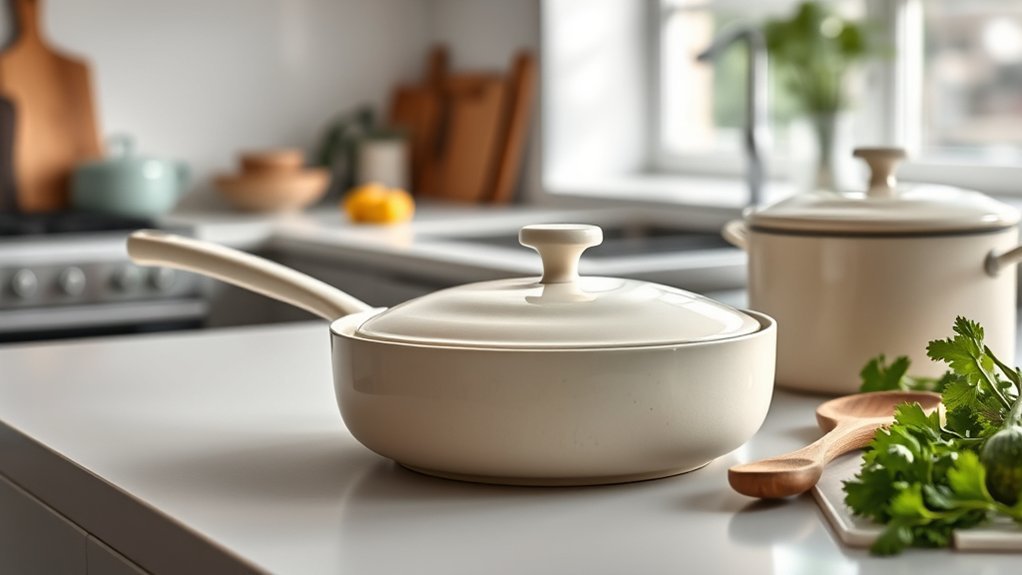
Most modern ceramic nonstick cookware is not a solid ceramic pot. It typically uses an aluminum or stainless-steel body covered with a thin ceramic-style coating. Research on commercially available ceramic cookware has identified silicate-based coating matrices applied over metal cookware bodies.
The metal underneath provides most of the pan’s strength and heat response, while the coating creates the smooth cooking surface. Many ceramic nonstick coatings are produced with a sol-gel process based on inorganic materials such as silica compounds.
“Ceramic cookware” often means a ceramic-coated metal pan, not a pan made entirely from ceramic.
Ceramic-Coated vs. Fully Ceramic Cookware
Ceramic-coated cookware has a metal structure and a relatively thin nonstick coating. That is the type discussed throughout most of this guide.
Fully ceramic or glazed ceramic cookware is different. It may be made primarily from fired ceramic material or use a ceramic glaze. Government food-safety guidance notes that improperly manufactured glazed ceramic products can present lead or cadmium concerns, so products intended for cooking should come from reputable sellers and comply with applicable food-contact rules.
Health Canada recommends using cookware according to the manufacturer’s intended-use instructions and provides separate safety guidance for ceramic, metal, and nonstick cookware.
Ceramic Cookware Pros
One major advantage of ceramic cookware is its smooth initial nonstick surface. Eggs, pancakes, fish, and other delicate foods can release with relatively little added fat when the coating is clean and in good condition.
The cooking surface is also usually easy to clean. Fresh food residue often wipes away with warm water, dish soap, and a soft sponge.
Many ceramic-coated pans use aluminum bodies, which heat quickly and respond rapidly when burner settings change. The exact heating performance depends on the pan’s thickness, construction, and base design.
Another attraction is that many ceramic nonstick products are marketed as PFAS-free. Buyers who specifically want to avoid fluoropolymer coatings should confirm that claim for the exact product rather than assuming every pan described as ceramic uses the same formulation.
Ceramic cookware also comes in a wide variety of colors and finishes, which can make it appealing for kitchens where appearance matters as much as basic function.
Some ceramic pans also have generous oven ratings. However, an oven-safe rating should not be confused with permission to use maximum burner heat. Handles, lids, silicone components, and coatings can all have different limits.
Ceramic Cookware Cons
The main disadvantage is that nonstick performance can decline. Heat stress, burnt-on oil, abrasive cleaning, rough utensils, and ordinary wear can make food release less reliable over time.
The coating also needs more careful treatment than bare stainless steel or cast iron. Scraping with sharp metal tools, cutting food directly in the pan, or stacking pans without protection can damage the surface.
Ceramic cookware is therefore best viewed as convenient coated cookware rather than permanent cookware. Its useful lifespan varies widely with coating formulation, construction, cooking frequency, and care.
Shorter Nonstick Lifespan
A ceramic pan’s slick surface may gradually lose its easy-release behavior as the coating accumulates wear or residue. There is no reliable universal rule stating that every ceramic pan fails after a particular number of uses or years.
A 2025 comparison of ceramic and PTFE nonstick coatings found meaningful differences among ceramic formulations. PTFE maintained stronger nonstick performance under some repeated-cooking and severe-wear tests, while certain ceramic formulations performed competitively under other wear conditions.
The practical lesson is that coating quality matters. A carefully used pan from one product line may retain useful performance much longer than a heavily heated or abrasively cleaned pan from another.
Prone to Scratching
Ceramic coatings can be damaged by metal utensils, knives, abrasive pads, and rough stacking. Small cosmetic marks do not necessarily make a pan unsafe, but severe coating loss can reduce food release and expose the underlying metal.
A laboratory study of commercially available ceramic cookware found increased migration of coating-related materials after simulated abrasion, with nanoscale titanium and silicon detected under the study’s most aggressive scratching condition. The research does not establish that normal use of ceramic cookware creates a health hazard, but it reinforces the value of avoiding severe mechanical damage.
Use silicone, wood, nylon, or other utensils approved by the manufacturer. If pans must be stacked, place a soft pan protector or towel between them.
Pro Tip: Do not use the pan itself as a cutting board. Even if a manufacturer describes its coating as scratch-resistant, a knife edge concentrates far more force on the surface than normal cooking utensils.
Limited High-Heat Use
Ceramic-coated cookware generally performs best over low to medium stovetop heat. High burner settings can overheat food and oil quickly and may shorten the useful life of the nonstick surface.
There is no single temperature such as 450°F that applies to all ceramic cookware. Oven ratings vary by model. Some current ceramic-coated pans are rated to 550°F or 600°F in an oven, while their lids or handles may have lower limits.
The safest approach is to check the exact manufacturer’s instructions for stovetop heat, oven use, broiling, lids, and handles.
Warning: Do not assume a high oven-safe rating means the pan should be heated empty over a high-output burner. Follow the manufacturer’s burner instructions and avoid unnecessary empty-pan overheating.
Best Ways to Use Ceramic Cookware
Ceramic cookware performs best when cooking methods are matched to the coating. Moderate heat is usually enough for eggs, vegetables, pancakes, fish, sauces, reheating, and many everyday sautéing jobs.
| Best practice | Why it helps |
|---|---|
| Use low to medium burner heat | Reduces unnecessary heat stress on the coating |
| Use a small amount of oil or butter when appropriate | Supports browning and food release |
| Use silicone, wood, or approved nylon utensils | Helps prevent scratches and gouges |
| Let the pan cool before washing | Reduces rapid temperature changes and makes handling safer |
| Hand wash when recommended | Avoids harsh dishwasher detergents and repeated mechanical exposure |
| Protect pans when stacking | Prevents one pan’s base from rubbing against another pan’s coating |
For oil, use the type appropriate for the recipe and temperature. Some ceramic cookware manufacturers specifically discourage aerosol cooking sprays because repeated use can leave difficult baked-on residue. Check the instructions for your pan.
For normal cleaning, let the cookware cool and use warm water, mild dish soap, and a soft sponge or cloth. If food is stuck, soaking or gently simmering water can help loosen it. Avoid steel wool and other aggressive abrasives unless the manufacturer specifically approves them.
When to Replace a Ceramic Pan
A loss of perfect slickness by itself does not always mean a pan must immediately be discarded. First clean the surface carefully because polymerized oil and food residue can cause sticking.
Replacement becomes more reasonable when the cookware has major peeling or flaking, extensive coating loss, exposed substrate, serious warping, a loose or damaged handle, or damage that prevents safe use. Follow the manufacturer’s warranty and replacement guidance when available.
Ceramic Cookware vs. Nonstick
The phrase traditional nonstick usually refers to cookware coated with PTFE. Ceramic and PTFE coatings can both provide easy food release, but they use different materials and have different performance characteristics.
Ceramic coatings often provide very strong initial release and appeal to buyers looking specifically for cookware marketed without PFAS. PTFE coatings have a long history of nonstick performance and can retain strong release properties when correctly used and maintained.
PTFE cookware should not be severely overheated. Germany’s Federal Institute for Risk Assessment states that adverse health effects are not expected from PTFE cookware when it is used as intended, but strongly heating an empty pan to extreme temperatures can decompose the coating and release hazardous gases.
That means the decision should not be reduced to “ceramic equals safe” and “PTFE equals unsafe.” Consider coating composition, cooking temperature, durability, maintenance, environmental preferences, and manufacturer instructions.
Ceramic Coatings Compared
Not every ceramic coating performs the same way. Differences in formulation, coating thickness, curing, reinforcement, and pan construction can affect nonstick behavior and wear resistance.
Research comparing several ceramic coatings with PTFE found that PTFE maintained lower food-release forces after repeated cooking cycles in the study, while some ceramic formulations achieved a better balance of nonstick performance and resistance to particular types of abrasion.
For buyers, this means broad material labels cannot predict the exact lifespan of a pan. Warranty terms, independent testing, construction quality, and real care instructions are more useful than promises that a ceramic coating will last a fixed number of years.
Nonstick Performance Tradeoffs
When new, both ceramic and PTFE cookware can release delicate foods very well. The tradeoff appears over time: ceramic coatings may become less slick as the surface experiences heat, residue buildup, and wear.
PTFE cookware can also be scratched or damaged and should likewise be protected from inappropriate utensils and extreme overheating. Neither material should be treated as indestructible.
If maximum lifespan is the priority and the cook is comfortable learning temperature control, stainless steel, carbon steel, or cast iron may be worth considering because they do not depend on a factory-applied nonstick coating for their basic cooking surface.
How to Choose the Right Ceramic Cookware Set
Choose ceramic cookware by looking beyond color and piece count. The most useful set is one whose sizes, heat-source compatibility, handles, lids, and care requirements match the way you actually cook.
- Confirm the coating disclosure. If avoiding PFAS or PTFE is important to you, look for a clear statement from the manufacturer for the exact product line.
- Check stovetop compatibility. Ceramic coating itself does not make a pan induction compatible. Induction requires a suitable magnetic base.
- Check oven and lid ratings separately. A metal pan body may tolerate more oven heat than its lid, handle, knob, or silicone components.
- Look at the base and body construction. Thicker, well-made cookware usually feels more stable and can distribute heat more predictably than extremely thin pans.
- Choose useful sizes. An 8-inch skillet is useful for small portions, while a 10- to 12-inch skillet gives more room for family meals and prevents crowding.
- Inspect the handles. They should feel secure and balanced when the pan is empty and loaded.
- Read the care instructions before buying. Some ceramic cookware is dishwasher-safe, while other products require hand washing.
- Check the warranty. Determine whether the coating is covered and what the manufacturer considers normal wear.
- Avoid paying for filler pieces. A smaller set containing pans you use every week can be better value than a large set filled with duplicate sizes.
Note: If you regularly sear steaks over very high heat, use metal utensils aggressively, or want cookware that can last for decades without a factory-applied nonstick layer, stainless steel, cast iron, or carbon steel may better match those needs.
Frequently Asked Questions
What Are the Disadvantages of Ceramic Cookware?
The main disadvantages are declining nonstick performance, sensitivity to scratches and residue buildup, and the need for more careful heat control than durable uncoated cookware. Coating lifespan varies by product and use, so ceramic cookware should not be assumed to last a fixed number of years.
What Is Better, Stainless Steel or Ceramic Pans?
Neither is better for every job. Ceramic is easier for eggs, pancakes, fish, and other foods that benefit from a slick surface. Stainless steel is more durable, tolerates aggressive browning and deglazing well, and does not depend on a nonstick coating. Many kitchens benefit from having both.
What Is the Healthiest Cookware You Can Use?
There is no single cookware material proven to be the healthiest choice for everyone. Stainless steel, cast iron, ceramic-coated cookware, glass, and other materials can all be appropriate when the product is intended for food contact, is in serviceable condition, and is used according to its instructions. Individual issues such as nickel sensitivity, coating condition, lead or cadmium in poorly made glazed ceramics, and overheating should also be considered.
Is It Healthy to Cook in Ceramic Cookware?
Ceramic-coated cookware can be a reasonable food-contact cooking surface when it comes from a reputable manufacturer and is used as directed. Avoid severe overheating and damaging the surface with abrasive tools. For fully ceramic or glazed cookware, buy products intended for food use and compliant with applicable lead and cadmium limits.
Conclusion
Ceramic cookware offers a useful balance of easy food release, fast cleanup, moderate-heat cooking, and attractive design. Its biggest limitation is that the nonstick coating is a wear surface rather than a permanent feature. Gentle utensils, sensible heat, careful washing, and proper storage can help preserve it.
Buyers should also distinguish ceramic-coated metal cookware from fully ceramic or glazed cookware, verify PFAS claims rather than assuming them, and check the specific oven, induction, lid, and handle ratings before purchase. For cooks who value effortless low- to medium-heat cooking, ceramic can be an excellent fit. For repeated high-heat searing or maximum long-term durability, an uncoated material may be more practical.
Sources
- Health Canada — The Safe Use of Cookware and Bakeware — cookware materials, nonstick heat guidance, and lead/cadmium considerations.
- German Federal Institute for Risk Assessment — PTFE Cookware Safety — normal-use and overheating guidance for PTFE-coated cookware.
- Food Control — Consumer Use Effects on Nanoparticle Release From Commercially Available Ceramic Cookware — ceramic coating construction and abrasion research.
- Results in Engineering — Ceramic Nonstick Coatings Compared With PTFE — 2025 comparative nonstick and wear testing.
- GreenPan — Care & Use — current manufacturer guidance on heat, utensils, oils, and cleaning for ceramic nonstick cookware.
- Caraway — Care & Cleaning — current ceramic-coated cookware temperature and maintenance guidance.

1 thought on “Is Ceramic Cookware Good? Pros, Cons & Best Uses”