
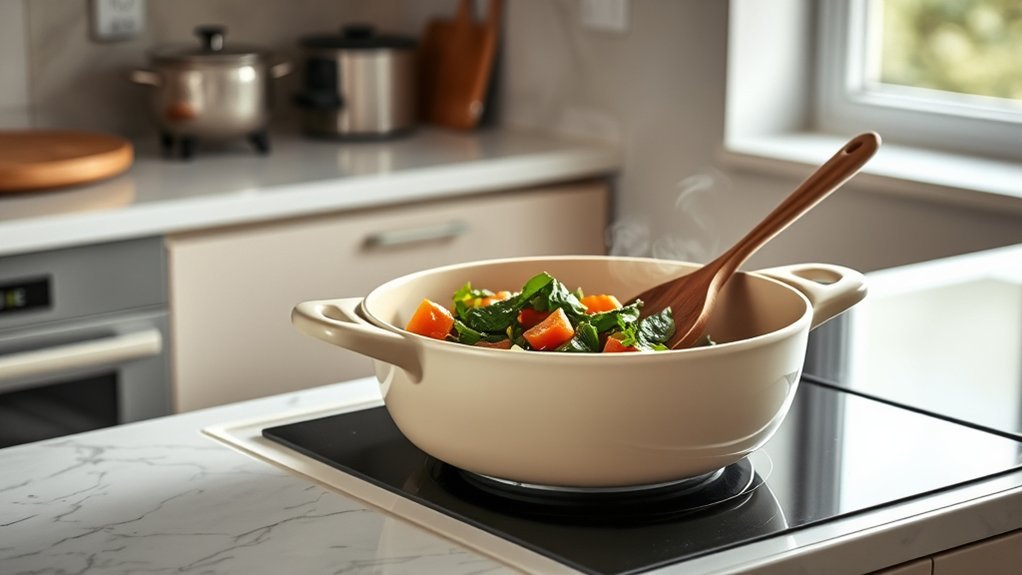
Ceramic cookware can be a good everyday choice, especially for eggs, pancakes, fish, reheating, and other foods cooked over low to medium heat. Most cookware sold as “ceramic nonstick” is actually a metal pan with a ceramic-style coating, while fully ceramic cookware is a different product. Ceramic-coated pans are convenient and easy to clean, but their nonstick performance can wear with use. Oven limits, induction compatibility, PFAS claims, and care instructions vary by model, so the manufacturer’s specifications matter.
Quick Answer
Ceramic cookware is good for everyday low-to-medium-heat cooking when you want easy food release and simple cleanup. Its biggest drawback is durability: ceramic nonstick performance can decline with high heat, abrasive cleaning, residue buildup, or rough utensils. Check each pan’s induction compatibility, oven limit, coating claims, and care instructions before buying.
Key Takeaways
- Ceramic-coated and fully ceramic cookware are different. Most nonstick ceramic pans have an aluminum or stainless-steel body beneath the coating.
- Low to medium heat is usually best for preserving ceramic nonstick performance.
- Specifications vary. Do not assume every ceramic pan works on induction or has the same oven-temperature limit.
- Many ceramic-coated products are marketed as PFAS-free, but verify the claim for the exact cookware you are considering.
- Gentle care matters. Hand washing, soft utensils, controlled heat, and careful storage can help the cooking surface last longer.
Is Ceramic Cookware Good for Everyday Cooking?
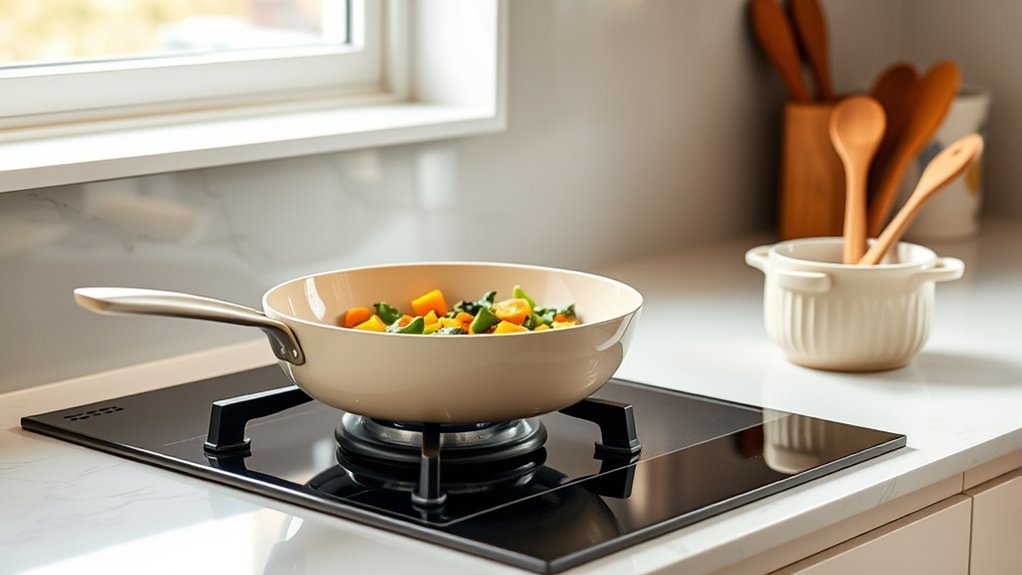
Yes, ceramic cookware can work well for everyday cooking, particularly when you use ceramic-coated nonstick pans for eggs, pancakes, vegetables, fish, grilled sandwiches, and other foods that do not require sustained high heat.
The smooth cooking surface can provide easy food release with a relatively small amount of oil or butter. Cleanup is also usually simple when the pan is washed soon after it cools.
Where ceramic-coated cookware becomes less suitable is heavy-duty cooking. Frequent high-heat searing, aggressive scraping, abrasive cleaning, and repeated overheating can reduce nonstick performance. A 2025 study comparing sol-gel ceramic coatings with PTFE found that coating formulations differed in durability and that the tested PTFE coating generally maintained nonstick performance longer under repeated cooking-cycle testing.
Note: “Ceramic cookware” is a broad label. A ceramic coating does not determine the pan’s oven limit, induction compatibility, dishwasher compatibility, or base material. Check the specifications for the exact product.
For cooks who value easy release and straightforward cleanup more than maximum durability or high-heat searing, ceramic-coated cookware can be a practical part of an everyday cookware set.
What Is Ceramic Cookware?
The term ceramic cookware can describe two different types of products, and knowing the difference prevents many of the common buying mistakes around this category.
Ceramic-Coated Cookware
Most ceramic nonstick skillets and saucepans sold for everyday stovetop cooking have a metal body covered by a ceramic-style nonstick coating. Aluminum is common because it heats quickly, while some pans add a stainless-steel plate or other magnetic base for induction cooking.
Modern ceramic nonstick surfaces are commonly produced with sol-gel coating technology. The exact formulation varies by manufacturer. GreenPan, for example, describes its Thermolon ceramic nonstick as starting with a sand derivative that is converted into a solution and applied to the pan.
Fully Ceramic Cookware
Fully ceramic cookware does not have the same metal core. For example, Xtrema describes its cookware as being made from ceramic materials without a metal core. That construction behaves differently from ceramic-coated aluminum cookware and may have different stovetop requirements.
This distinction is especially important for induction. Induction cooktops require compatible magnetic cookware. A ceramic coating by itself does not make a pan induction-ready.
Why Ceramic Cookware Appeals
Ceramic-coated cookware is popular because it combines a smooth cooking surface with relatively simple maintenance. For delicate foods, a good ceramic nonstick pan can make flipping, lifting, and serving easier than an uncoated pan.
| Feature | Practical Benefit |
|---|---|
| Smooth nonstick surface | Useful for eggs, pancakes, fish, and other delicate foods |
| Easy cleanup | Food residue often releases with warm soapy water and a soft sponge |
| PFAS-free options | Available from manufacturers that specifically make and test that claim |
| Many colors and finishes | More design choices than many traditional cookware lines |
| Stovetop-to-oven models | Useful when the manufacturer’s temperature rating permits oven use |
Many shoppers are also attracted to ceramic cookware because manufacturers offer models made without intentionally added PFAS. This should still be treated as a product-specific specification, not an automatic property of every pan carrying the word “ceramic.”
Where Ceramic Cookware Falls Short
The main limitation of ceramic-coated cookware is long-term nonstick durability. The pan itself may remain structurally usable while its original slick food-release performance gradually declines.
Common causes of premature performance loss include:
- Repeated cooking over heat higher than the manufacturer recommends.
- Burned-on oil or cooking-spray residue.
- Abrasive scrubbers or harsh cleaning methods.
- Sharp or rough utensils on coatings that are not rated for them.
- Stacking pans without protection between cooking surfaces.
- Thermal shock from exposing a very hot pan to much colder water.
High-heat searing is also not ceramic nonstick’s strongest use. Stainless steel, carbon steel, or cast iron is generally better suited to cooking methods that intentionally require very high surface temperatures.
Warning: Do not assume a generic oven limit for ceramic cookware. Current products vary substantially, and lids may have lower limits than pans. Check the manufacturer’s temperature rating before putting any cookware in the oven or under a broiler.
Is Ceramic Cookware Safe?
Cookware safety depends on the actual materials, manufacturing quality, condition of the cookware, and how it is used. A claim such as “ceramic,” “nonstick,” or “PFAS-free” does not by itself tell you everything about a product.
Many current ceramic-coated cookware manufacturers specifically advertise coatings made without PFAS. If avoiding intentionally added PFAS is important to you, look for a clear manufacturer statement and testing information for the exact collection rather than relying on the word “ceramic.”
It is also important not to turn that preference into the unsupported claim that all conventional nonstick cookware is unsafe. The U.S. Food and Drug Administration says certain polymerized PFAS are authorized for nonstick cookware coatings and that studies show negligible amounts capable of migrating from those coatings into food.
Heavy-metal claims also deserve product-specific verification. FDA guidance addresses lead and cadmium migration from ceramic food-contact products, and the agency has also warned retailers and distributors about certain cookware capable of leaching lead. Buying food-contact cookware from a reputable manufacturer with clear safety and testing information is more useful than assuming every item in a broad material category is identical.
The safest buying approach is to verify the exact product’s materials, food-contact claims, cooktop compatibility, oven limit, and care instructions rather than relying on a material label alone.
What to Check Before Buying Ceramic Cookware
A few specifications matter far more than marketing language. Before choosing a ceramic pan or cookware set, check the following:
- Construction: Is it ceramic-coated metal or fully ceramic?
- Coating disclosure: Does the manufacturer clearly state whether the cooking surface is made without PFAS, PTFE, lead, or cadmium?
- Induction compatibility: Look specifically for “induction compatible” if you use an induction cooktop.
- Oven limit: Check the maximum temperature for both the pan and its lid.
- Utensil guidance: Some modern coatings are advertised as metal-utensil safe, while others recommend silicone, nylon, bamboo, or wood.
- Cleaning instructions: Some lines are dishwasher safe, while others are hand-wash only. Even when a dishwasher is permitted, manufacturers may still recommend hand washing to extend coating life.
- Handle and lid materials: These parts can determine the cookware’s oven limit even when the pan body can tolerate more heat.
- Warranty: Read what is covered, especially whether normal loss of nonstick performance is excluded as wear.
For example, current GreenPan collections demonstrate why checking the model matters: some are rated to 400°F, while others are rated to 600°F and may have a lower temperature limit for their lids. Caraway currently lists a 550°F maximum for its ceramic-coated cookware.
How to Use Ceramic Cookware
Good care starts with the manufacturer’s instructions because coatings and construction vary. For most ceramic-coated nonstick pans, the following routine is a sensible starting point.
- Use low to medium heat. Ceramic-coated pans generally do not need maximum burner settings for eggs, vegetables, pancakes, fish, or reheating.
- Preheat only as directed. Some manufacturers allow a short low-to-medium empty preheat. Never leave an empty pan unattended on high heat.
- Add a small amount of suitable oil or butter. Choose the fat according to the recipe and cooking temperature rather than assuming one specific oil is required.
- Avoid aerosol cooking sprays if your manufacturer warns against them. Some brands note that spray residue can build up and reduce release performance.
- Use gentle utensils unless the cookware is specifically rated for metal tools. Silicone, wood, bamboo, and nylon are conservative choices for protecting the surface.
- Let the pan cool before washing. Avoid a sudden hot-to-cold temperature change.
- Wash gently. Warm water, dish soap, and a soft sponge are appropriate for most ceramic nonstick pans.
- Protect the surface in storage. Put a pan protector, towel, or other soft layer between pans when stacking them.
Pro Tip: If food starts sticking, first check for cooked-on oil residue before assuming the coating has completely failed. Follow the manufacturer’s approved deep-cleaning method rather than reaching immediately for steel wool or an abrasive cleaner.
When Should You Replace Ceramic Cookware?
There is no universal calendar date for replacing ceramic cookware. The useful life depends on coating formulation, cooking habits, cleaning, heat exposure, and how often the pan is used.
Consider replacing a ceramic-coated pan when:
- The nonstick performance has deteriorated enough that the pan no longer serves its intended purpose.
- The cooking surface is extensively peeling, flaking, or otherwise visibly failing.
- The pan has warped enough to sit unevenly or heat poorly on the cooktop.
- A loose handle, damaged base, or other structural problem creates a safety concern.
- The manufacturer specifically recommends replacement because of the type or extent of damage.
A small cosmetic mark does not automatically prove a pan is unsafe. For example, GreenPan states that scratches in its coating do not affect the safety of its pans. Because formulations differ, follow the guidance for your specific brand instead of applying one company’s statement to every ceramic product.
Ceramic vs. Stainless Steel, PTFE Nonstick, Cast Iron, and Glass
| Material | Best For | Main Tradeoff |
|---|---|---|
| Ceramic-coated nonstick | Eggs, pancakes, fish, gentle sautéing, easy cleanup | Nonstick performance can decline with wear and overheating |
| PTFE nonstick | Low-fat cooking and reliable nonstick performance | Must be used within manufacturer temperature and care limits; contains a fluoropolymer coating |
| Stainless steel | Browning, searing, sauces, deglazing, long service life | Requires more technique to prevent sticking; some nickel and chromium can migrate under certain conditions |
| Cast iron | High heat, searing, frying, oven cooking | Heavy and requires appropriate seasoning and care |
| Glass | Baking, roasting, microwaving, and oven reheating when the product is rated for those uses | Common glass bakeware is not suitable for stovetop flames or burners and must be protected from thermal shock |
No single material is automatically the best for every meal. Many kitchens work better with two or three materials: a ceramic or other nonstick skillet for delicate foods, stainless steel or cast iron for high-heat cooking, and glass for appropriate oven or microwave dishes.
Frequently Asked Questions
What Is the Downside of Ceramic Cookware?
The main downside of ceramic-coated cookware is that its easy-release performance can decline with use, especially after repeated overheating, abrasive cleaning, residue buildup, or rough utensil use. It is also not automatically induction compatible, dishwasher safe, or suitable for high oven temperatures, so specifications must be checked by model.
Is It Healthier to Cook on Stainless Steel or Ceramic?
Neither material is automatically healthier for everyone. A reputable ceramic-coated pan can provide convenient nonstick cooking, including PFAS-free options when the manufacturer specifically makes that claim. Stainless steel is highly durable and has no nonstick coating, although studies show that some nickel and chromium can migrate into acidic foods under certain conditions. People with a known nickel sensitivity may need to consider that factor when choosing stainless cookware.
Is It Better to Cook With Glass or Ceramic?
They serve different purposes. Ceramic-coated skillets are designed for stovetop tasks such as eggs, pancakes, fish, and gentle sautéing. Oven-safe glass is useful for baking, roasting, reheating, and microwave use when its manufacturer permits those methods. Common glass bakeware should not be used on stovetop burners, under direct flame, or where the manufacturer prohibits it.
What Is the Healthiest Cookware You Can Use?
There is no single cookware material that is healthiest for every person and cooking method. Stainless steel, cast iron, glass, ceramic-coated cookware, and properly used conventional nonstick cookware each have different strengths. Choose food-contact cookware from a reputable manufacturer, follow its temperature and care instructions, and select the material that fits the cooking method and any personal material sensitivities.
Conclusion
Ceramic cookware is a useful everyday option when easy food release, simple cleanup, and low-to-medium-heat cooking are priorities. Ceramic-coated pans are particularly convenient for eggs, pancakes, fish, vegetables, and similar foods, but they generally require gentler treatment than stainless steel or cast iron.
The key is to avoid treating “ceramic” as one universal specification. Check whether the cookware is ceramic-coated or fully ceramic, verify PFAS and material claims, confirm induction compatibility, follow the stated oven limit, and use the manufacturer’s care instructions. With those expectations, ceramic cookware can fill an important role without being asked to do every job in the kitchen.
Sources
- U.S. Food and Drug Administration — Questions and Answers on PFAS in Food — PFAS and authorized nonstick cookware coating context.
- U.S. Food and Drug Administration — Authorized Uses of PFAS in Food Contact Applications — migration and food-contact information for authorized PFAS uses.
- GreenPan — Cookware FAQs — ceramic nonstick heat, cleaning, utensil, and care guidance.
- Caraway — Care and Cleaning — manufacturer guidance for heat settings, hand washing, preheating, utensils, and storage.
- National Library of Medicine — Stainless Steel Leaches Nickel and Chromium Into Foods During Cooking — research on metal migration from stainless steel under specific cooking conditions.
- Research in Engineering — Sol-Gel Ceramic Non-Stick Coatings Compared With PTFE — 2025 comparative research on nonstick performance and durability.