
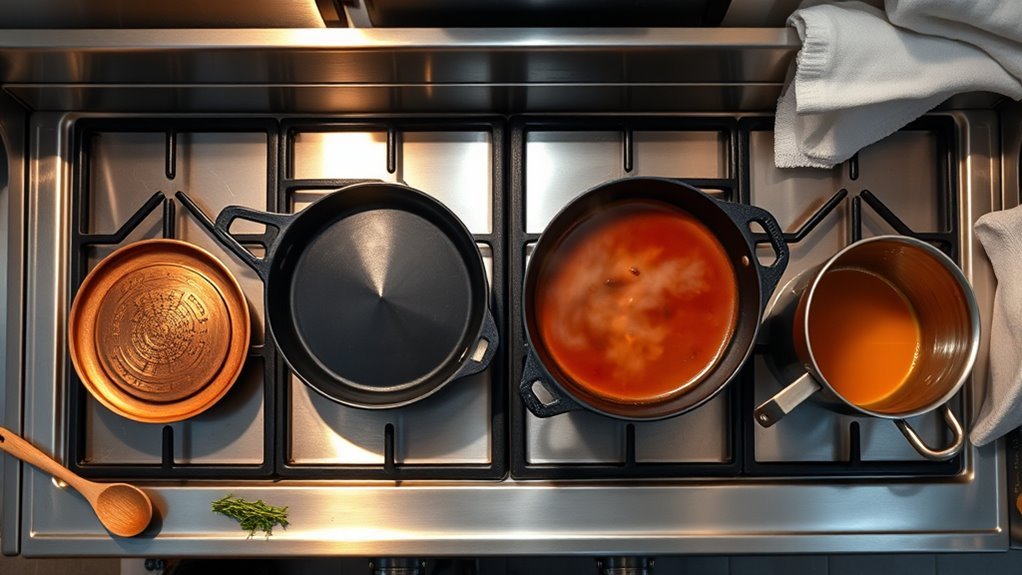
What saucepans do professional chefs use, and why do they choose certain materials? Professional kitchens rely on cookware that heats evenly, responds to temperature changes, and handles repeated cooking. Stainless steel, copper, cast iron, and nonstick saucepans all have their place. The best choice depends on the dish, your cooking style, and the level of heat control you need.
Quick Answer
Professional chefs commonly use multi-ply stainless steel saucepans for everyday cooking because they are durable, versatile, and easy to maintain. Copper saucepans offer precise temperature control for delicate sauces. Enameled cast iron works well for slow simmering, while nonstick saucepans suit gentle cooking and easy cleanup. All-Clad, Demeyere, Mauviel, and Le Creuset are established options.
Key Takeaways
- Choose multi-ply stainless steel for a durable saucepan that handles most everyday cooking tasks.
- Copper responds quickly to temperature changes but requires more maintenance and may not work directly on induction.
- Enameled cast iron retains heat and does not require the seasoning needed by bare cast iron.
- A 2- to 3-quart saucepan is a practical starting size for many home kitchens.
- Judge a saucepan by its construction, handle, lid, and cooking performance rather than the brand name alone.
Why Do Professional Chefs Prefer Stainless Steel Saucepans?
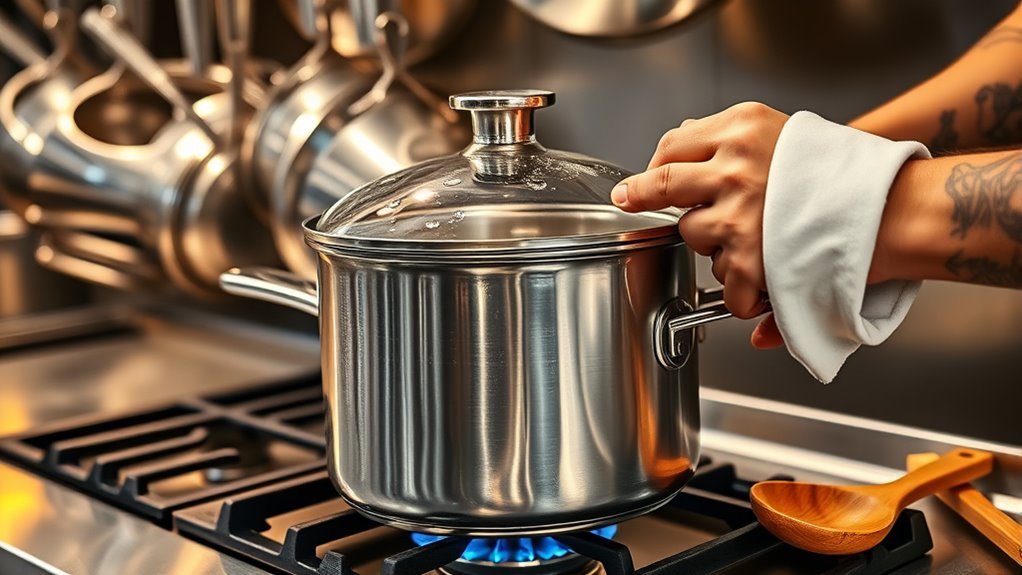
Stainless steel saucepans are popular in professional kitchens because they combine durability, versatility, and a non-reactive cooking surface. They handle simmering, boiling, reducing sauces, and preparing acidic foods without requiring a special coating.
However, the quality of the construction matters. Stainless steel itself is not an especially good heat conductor. High-performance saucepans use aluminum or copper to spread heat more evenly.
For example, the All-Clad D3 3-quart saucepan uses three bonded metal layers, including an aluminum core between stainless steel surfaces.
This construction offers several practical advantages:
- Even heating: The conductive core helps reduce hot spots that can scorch sauces.
- Durability: An uncoated stainless steel interior tolerates regular stirring and cleaning.
- Non-reactive cooking: Tomatoes, wine, and other acidic ingredients can simmer without direct contact with reactive bare metals.
- Versatility: Suitable models work on gas, electric, and induction cooktops.
- Easy maintenance: Food residue can usually be removed with warm water, dish soap, and gentle scrubbing.
Stainless steel also allows cooks to develop browned food residue, called fond, that can be dissolved with liquid to build flavorful sauces.
For most people, a well-made stainless steel saucepan is the best first purchase because it handles the widest range of tasks.
When Do Chefs Use Cast Iron Saucepans?
Cast iron saucepans work best when steady heat matters more than rapid temperature changes. Their thick construction stores heat, making them useful for slowly simmering soups, gravies, and rich sauces.
However, cast iron generally heats and cools more slowly than copper or aluminum-core stainless steel.
There are two main types to consider.
Bare Cast Iron Saucepans
Traditional cast iron develops a protective layer of seasoning through repeated cooking and proper care. This layer improves food release and helps protect the metal from rust.
A well-seasoned saucepan can last for generations. However, it requires drying and occasional seasoning to maintain its surface.
Long cooking sessions with acidic ingredients may affect the seasoning and allow iron to react with the food. Bare cast iron is therefore not always the best choice for extended tomato or wine reductions.
Enameled Cast Iron Saucepans
Enameled cast iron combines the heat retention of cast iron with a protective cooking surface. It does not require seasoning and is well suited to slow cooking.
The Le Creuset Signature saucepan, for example, uses enameled cast iron and has a rounded base that helps with stirring and reducing liquids.
Its tight-fitting lid also helps retain moisture during covered cooking.
Cast iron’s main drawback is weight. Its slower response also makes it less convenient for delicate sauces that need immediate temperature adjustments.
When Should Chefs Use Nonstick Saucepans?
Nonstick saucepans are useful when food tends to cling to the cooking surface. They are particularly convenient for gentle reheating, creamy mixtures, and recipes that need frequent stirring.
They also allow you to cook some foods with less added oil or butter.
Typical uses include:
- Preparing delicate milk-based sauces over gentle heat.
- Warming porridge or other foods that can stick during cooking.
- Reheating leftovers without excessive sticking.
- Cooking small portions of delicate foods with minimal added fat.
Nonstick saucepans are less suitable for aggressive browning, high-temperature cooking, and scraping up fond to make pan sauces.
They also require more careful handling than uncoated stainless steel.
Warning: Avoid overheating nonstick saucepans or leaving them empty on a hot burner. Excessive heat can damage the coating. Use the manufacturer’s recommended temperature range and replace cookware if its coating is badly damaged or peeling.
According to T-fal’s cookware care instructions, low to medium heat, gentle utensils, and non-abrasive cleaning help maintain nonstick performance.
Wooden, silicone, or other coating-safe utensils are practical choices. Metal utensils may scratch some coatings, although compatibility depends on the product.
For cooking eggs or pancakes, a nonstick frying pan is usually more convenient than a deep saucepan.
What Features Make a Professional-Quality Saucepan?
A professional-quality saucepan should heat evenly, remain stable on the burner, and feel comfortable during repeated use. You should examine its construction rather than choosing based on appearance alone.
These features have the greatest effect on everyday cooking.
Heavy, Evenly Constructed Base
A thick, conductive base helps distribute heat and reduces concentrated hot spots.
Look for multi-ply construction or a substantial bonded base. Fully clad cookware spreads conductive metal through the base and sidewalls, while impact-bonded designs concentrate the conductive layer in the bottom.
Both designs can work well, although performance depends on their materials and thickness.
Comfortable, Secure Handles
A saucepan should feel balanced when you lift it, pour liquid, or move it between burners.
Riveted and welded handles are both common. Check that the attachment feels secure and that the handle provides enough space for a comfortable grip.
Stainless steel handles may stay relatively cool during ordinary stovetop cooking, but they can become hot during extended heating.
A Well-Fitting Lid
A lid helps reduce evaporation when cooking rice, simmering soup, or keeping food warm.
For sauce reductions, you usually want to cook uncovered so excess moisture can escape.
Choose a lid that sits securely and can be lifted safely.
Useful Pouring Rim and Interior Shape
A flared rim helps you pour sauces and liquids with fewer drips.
Rounded interior corners make whisking easier because food is less likely to collect where the base meets the sides.
This feature is particularly useful when preparing custards, béchamel, and cheese sauces.
Practical Capacity
For everyday home cooking, saucepans in the 2- to 4-quart range cover many needs.
- 1 to 2 quarts: Small sauces, melted butter, and single portions.
- 2 to 3 quarts: Rice, vegetables, gravy, oatmeal, and general cooking.
- 3 to 4 quarts: Larger portions, soups, pasta, and batch cooking.
A larger saucepan provides more capacity but takes up more storage space and may feel heavier when full.
Which Saucepan Brands Are Trusted by Chefs?
Several established cookware brands offer saucepans designed for demanding cooking tasks. Their materials, construction, and price levels differ, so the right choice depends on what you cook most often.
- All-Clad: Known for bonded stainless steel cookware. Its D3 line combines a stainless steel cooking surface with an aluminum core for responsive, even heating.
- Demeyere: Offers premium stainless steel cookware with specialized bases and advanced surface treatments. The Demeyere Atlantis collection uses a seven-layer InductoSeal base in its straight-sided saucepans.
- Mauviel: Known for copper cookware designed for precise temperature control. Its stainless-lined copper saucepans are useful for delicate sauces and reductions.
- Cuisinart: Offers more accessible stainless steel options. The MultiClad Pro 3-quart saucepan uses triple-ply construction with an aluminum core and supports induction cooking.
- T-fal: Offers nonstick cookware suited to easy food release, everyday cooking, and straightforward cleanup.
- Le Creuset: Offers enameled cast iron saucepans for heat retention, slow simmering, and oven-to-stovetop versatility.
No single brand is the universal choice for every professional chef. Restaurant equipment needs also differ from those of home kitchens.
More expensive cookware may offer better construction or specialized performance, but the higher price is not always necessary for ordinary boiling and simmering.
How Does a Saucepan Affect Cooking Results?
The saucepan you choose affects how quickly food heats, how evenly it cooks, and how easily you can adjust the temperature.
These differences become most noticeable when preparing delicate sauces, browning ingredients, or simmering food for extended periods.
Why Is Heat Distribution Important?
Even heat distribution helps prevent one part of a sauce from burning while another remains undercooked.
This matters when cooking dairy-based mixtures, reducing stock, or preparing foods that need regular stirring.
Different saucepan materials behave differently:
- Multi-ply stainless steel: Uses conductive aluminum or copper layers to spread heat more evenly than plain stainless steel.
- Copper: Responds quickly when you increase or reduce burner heat.
- Cast iron: Stores substantial heat and changes temperature more slowly.
- Nonstick cookware: Offers easy food release, while heating performance depends on the metal beneath the coating.
Flat-bottomed cookware also helps maintain consistent contact with electric and induction cooking surfaces.
For sauces that scorch easily, combine a suitable pan with moderate heat and regular stirring.
How Does Saucepan Material Affect Flavor?
Saucepan material can influence flavor by changing how ingredients heat, brown, and react with the cooking surface.
Stainless steel is non-reactive in normal cooking, making it especially useful for tomato sauces, wine reductions, and other acidic recipes.
Copper provides rapid temperature adjustments that help you control delicate preparations.
However, copper cookware used for ordinary cooking generally needs a suitable lining. Stainless steel and tin are common lining materials.
Nonstick cookware reduces sticking but is less suitable for developing the browned residue used in many pan sauces.
That residue forms during browning through processes including the Maillard reaction, which creates complex aromas and flavors.
Cast iron performs well for steady heating, but bare cast iron can react with acidic food during long cooking sessions.
The best material depends on whether your priority is browning, gentle heating, or keeping the ingredient’s flavor unchanged.
Which Saucepans Should Aspiring Chefs Own?
You do not need a large collection of expensive saucepans to cook effectively. Start with one versatile saucepan and add specialized cookware when your recipes justify it.
These four options cover most cooking needs.
- A 3-quart stainless steel saucepan: A practical all-purpose choice for boiling vegetables, cooking rice, preparing soups, and reducing sauces. Multi-ply construction offers better heat distribution than thin, uncoated stainless steel alone.
- A 2-quart saucier: Its rounded sides make whisking and stirring easier. It is particularly useful for custards, cream sauces, risotto, and other dishes that need constant movement.
- A copper or copper-core saucepan: Suitable for cooks who frequently make delicate sauces and want rapid responses to temperature adjustments.
- A specialty saucepan: Choose nonstick for gentle, low-stick cooking or enameled cast iron for slower simmering and heat retention.
For a first purchase, prioritize the stainless steel saucepan. It offers the most flexibility without requiring the extra maintenance of copper or bare cast iron.
If you prepare sauces regularly, a saucier is a particularly useful second piece.
Pro Tip: Before buying a saucepan, hold the handle and imagine pouring with the pan full. A well-balanced saucepan with a comfortable grip can be more useful than a heavier premium model that is awkward to lift.
How to Choose the Right Saucepan Material
The best saucepan material depends on your cooking technique, maintenance preferences, and budget. Each option offers different advantages, so comparing them side by side makes the decision easier.
| Material | Best Use | Main Advantage | Main Drawback |
|---|---|---|---|
| Multi-ply stainless steel | Everyday cooking, simmering, reductions | Durability and versatility | Food may stick without proper technique |
| Copper | Delicate sauces and precise cooking | Fast temperature response | Higher cost and maintenance |
| Cast iron | Slow simmering and steady heating | Excellent heat retention | Heavy and slow to respond |
| Nonstick-coated metal | Gentle cooking and reheating | Easy food release and cleanup | Coating can wear with use |
Which Material Is Best for Different Cooking Tasks?
For general cooking, multi-ply stainless steel offers the strongest balance of durability and convenience.
If you regularly make delicate reductions, copper provides more responsive heat control. Its quick reaction to burner adjustments helps you manage temperatures without waiting as long for the metal to cool.
For hearty soups, gravy, and slow cooking, cast iron can maintain steady heat. Choose enameled cast iron if you want easier maintenance and a non-reactive cooking surface.
Nonstick cookware is useful for delicate foods, but its coating generally has a shorter service life than an uncoated metal cooking surface.
Why Does Heat Conductivity Matter?
Heat conductivity describes how readily a material transfers heat. It affects how fast a saucepan heats and how evenly heat spreads through its cooking surface.
Copper conducts heat very well, while aluminum also transfers heat efficiently. Stainless steel is less conductive, which is why high-quality stainless cookware often includes a conductive core.
Cast iron offers strong heat retention because of its mass and construction, but it does not respond as quickly as copper.
According to Mauviel’s official cookware guidance, its M’Heritage stainless-lined copper collection combines a copper body with a non-reactive stainless steel interior.
Traditional copper saucepans generally do not work directly on induction because copper is not magnetic. Induction-compatible copper designs require a suitable magnetic layer or an interface disk.
For stainless steel cookware, check the base rather than assuming every model works on induction. A magnetic base is necessary for direct induction cooking.
If you use induction, a properly designed multi-ply stainless steel saucepan is often the simplest choice.
Top Professional-Style Saucepans Worth Considering
Several established saucepan lines offer the construction and cooking features valued in demanding kitchens. These are useful examples to compare, although they should not be treated as a verified ranking of professional chefs’ personal favorites.
- All-Clad D3 Stainless Steel 3-Quart Saucepan: A versatile option with bonded tri-ply construction, a conductive aluminum core, and a stainless steel cooking surface. It suits everyday simmering, boiling, and sauce preparation.
- Demeyere Atlantis Stainless Steel Saucepan: Its straight-sided saucepan design uses a seven-layer InductoSeal base containing copper. The line includes a 2.25-quart option and is designed for efficient induction cooking.
- Mauviel M’Heritage Copper Saucepan: A specialized choice for responsive heat control. Its stainless steel lining suits ordinary sauce preparation, while its copper body conducts heat efficiently. Traditional versions require an interface disk for induction use.
- Le Creuset Signature Enameled Cast Iron Saucepan: A heavy-duty option with excellent heat retention, a rounded base, and a fitting lid. It is useful for slow simmering and covered cooking.
For a more affordable multi-ply stainless steel option, Cuisinart’s MultiClad Pro line is also worth comparing.
These choices cover different cooking priorities rather than competing to perform one identical task.
If you are unsure where to start, choose a stainless steel saucepan with a comfortable handle, reliable construction, and a capacity that matches your usual meals.
Frequently Asked Questions
What Pans Do Most Professional Chefs Use?
Professional chefs commonly use stainless steel cookware because it is durable, versatile, and suitable for many cooking techniques. They also use cast iron for heat retention, copper for responsive temperature control, and nonstick cookware for delicate foods. The exact combination depends on the kitchen and its menu.
Which Cookware Do Professional Chefs Use?
Professional chefs use different cookware for different tasks, including saucepans, frying pans, sauté pans, sauciers, and stockpots. Multi-ply stainless steel is useful for general cooking. Copper helps with delicate sauces, while cast iron and nonstick cookware handle more specialized tasks.
What Are Gordon Ramsay’s Favorite Pans?
Gordon Ramsay has publicly endorsed hybrid stainless steel and nonstick cookware for its versatility and cooking performance. His published cookware partnership documents that preference. However, it does not establish one particular saucepan as his universal favorite. Durable construction, reliable heat control, and comfortable handling remain useful qualities to prioritize.
What Does Bobby Flay Use for Cookware?
Bobby Flay has partnered on a cookware collection that includes stainless steel, nonstick, and cast iron products. The collection offers cookware for different cooking techniques. His documented partnership does not prove that a particular All-Clad saucepan is his personal favorite.
Conclusion
Professional chefs use different saucepans because no single material excels at every cooking task. Multi-ply stainless steel offers the best overall balance for everyday use, while copper, cast iron, and nonstick cookware provide advantages for specific techniques.
Start with a reliable 2- or 3-quart stainless steel saucepan. Then add specialized cookware based on the dishes you prepare most often.
Sources
- All-Clad D3 Stainless Steel Saucepan: Three-ply construction, aluminum core, and induction compatibility.
- Le Creuset Signature Saucepan: Enameled cast iron construction, heat retention, and saucepan features.
- T-fal Use and Care: Nonstick heating, utensil selection, and coating maintenance.
- Cuisinart MultiClad Pro 3-Quart Saucepan: Triple-ply stainless steel construction and cooking compatibility.
- Demeyere Atlantis Collection: Seven-layer InductoSeal base and stainless steel saucepan options.
- Mauviel Cookware FAQ: Copper conductivity, lining materials, maintenance, and induction limitations.
- Gordon Ramsay Cookware Partnership: Public endorsement of hybrid cookware.
- Bobby Flay Cookware Collection: Documented partnership and cookware materials.
