
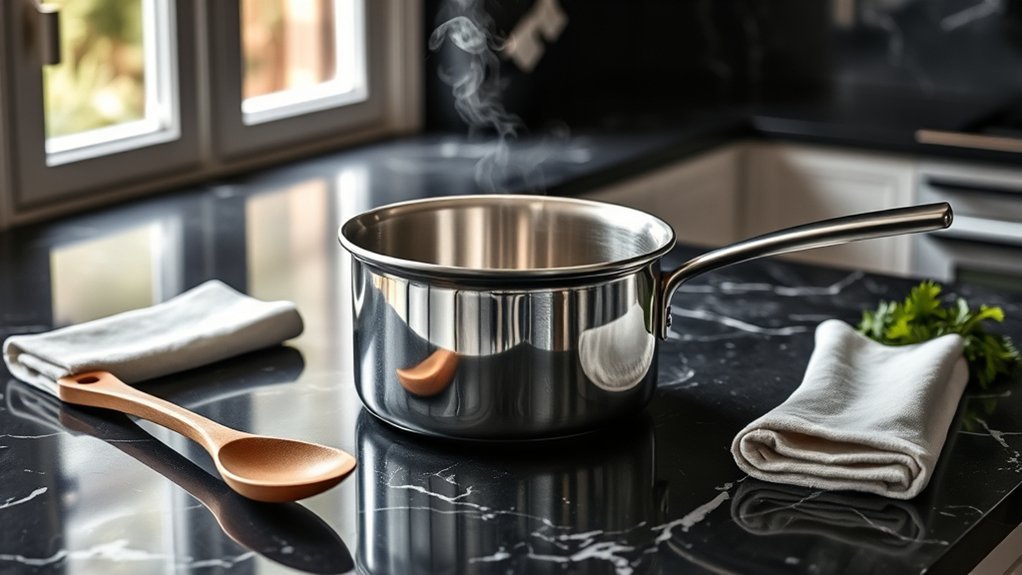
A saucepan is a deep cooking pan with relatively tall sides, a flat base, one long handle, and usually a lid. It is especially useful for sauces, soups, grains, oatmeal, reheating, boiling eggs, and other small-to-medium liquid-based jobs. For many households, a 2- to 4-quart saucepan covers most everyday cooking, but the best size and material depend on what you cook and which cooktop you use.
Quick Answer
A saucepan is a tall-sided pan with a flat bottom, long handle, and usually a lid. A 2-quart pan suits small portions, while a 3- to 4-quart model is more versatile for families. Look for sturdy construction, a comfortable handle, a well-fitting lid, and compatibility with your cooktop.
Key Takeaways
- A saucepan is best for boiling, simmering, reheating, grains, sauces, and smaller liquid-based recipes.
- A 2-quart saucepan is convenient for small portions; 3 to 4 quarts offers more flexibility for everyday cooking.
- Stainless steel, clad stainless steel, aluminum, nonstick, and cast iron all behave differently, so there is no single best material for every cook.
- Induction compatibility depends on a magnetic base, not simply on the pan being stainless steel or metal.
- Always follow the saucepan manufacturer’s heat, oven, utensil, dishwasher, and cleaning limits.
What Is a Saucepan?
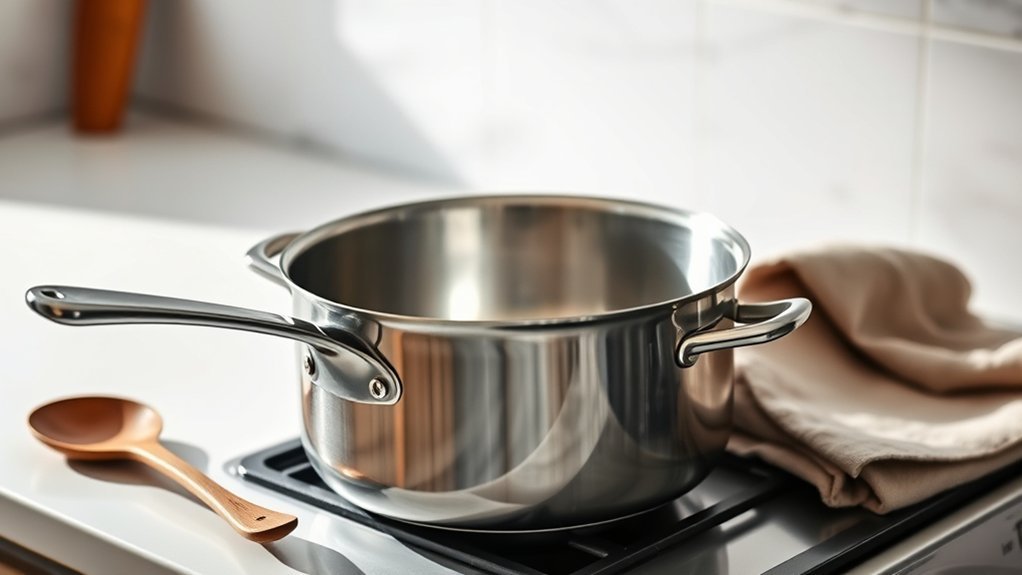
A saucepan is a relatively deep, straight-sided cooking vessel with a flat bottom and one long handle. Most models also include a lid. Its compact diameter and taller walls make it well suited to foods containing liquids because the sides help contain splashes while leaving enough depth for stirring and simmering.
Common saucepan materials include stainless steel, aluminum, hard-anodized aluminum, coated nonstick, and cast iron. Construction matters as much as the outer material. For example, many stainless-steel pans bond the steel to an aluminum or copper layer so heat spreads more effectively through the base or the entire body of the pan.
A good saucepan combines the right capacity with stable construction, comfortable handling, predictable heating, and compatibility with the cooktop you actually use.
A riveted, welded, or otherwise securely attached handle should feel stable when the pan is full. A well-fitting lid helps hold in heat and moisture. A flat base provides stable contact with the cooking surface, while the pan’s material, thickness, and construction determine how evenly and quickly it heats.
What Is a Saucepan Used For?
A saucepan is useful whenever you need more depth than a skillet but do not need the capacity of a large stockpot or Dutch oven. Typical saucepan uses include:
- Making sauces, gravy, custard, and reductions
- Cooking rice, oatmeal, quinoa, and other grains
- Reheating soup, stew, milk, or leftovers
- Boiling eggs or small portions of vegetables
- Cooking small portions of pasta or noodles
- Melting butter, chocolate, or other ingredients gently
- Heating canned foods and preparing small batches of soup
The tall sides help contain liquid and splatter, but evaporation is affected mainly by the exposed surface area, temperature, and whether the lid is on. A wider pan or saucier will usually reduce liquids faster than a narrow saucepan of similar capacity.
How to Choose the Right Saucepan Size
Choose saucepan capacity according to the amount you normally cook rather than simply buying the largest pan available. Capacity is usually listed in quarts or liters. The pan’s safe working volume is lower than its brim-full capacity because boiling and stirring require extra room.
| Size | Best Use |
|---|---|
| 1–1.5 quarts | Butter, small sauces, one serving of oatmeal, reheating small portions |
| 2–2.5 quarts | 1–2 servings, grains, sauces, eggs, soup, everyday small-batch cooking |
| 3–4.5 quarts | 2–4 servings, larger grain portions, pasta, soups, sauces, versatile everyday use |
| 5–7 quarts | Family-size soups, stews, larger sauces, meal prep; some brands classify these as saucepots rather than saucepans |
| Over 7 quarts | Large batches, stock, boiling pasta, and steaming; a stockpot or saucepot is often more practical at this size |
A smaller saucepan is lighter and easier to control for quick jobs. A medium 3- to 4-quart pan gives more room for stirring and can handle many family meals without becoming cumbersome. Large pans are useful when you regularly cook in batches, but they require more storage space and become substantially heavier when filled.
Pro Tip: If you plan to own only one saucepan, a 3- to 4-quart model is a practical starting point for many kitchens. Choose 2 quarts instead if you mostly cook for one or routinely make small sauces and portions.
Which Saucepan Material Should You Choose?
The best saucepan material depends on how you cook, how much maintenance you accept, and whether you prioritize rapid response, heat retention, easy cleanup, weight, or durability.
| Material | Advantages | Considerations |
|---|---|---|
| Clad stainless steel | Durable, corrosion-resistant, versatile, generally suitable for acidic foods | Can be heavier and more expensive; many stainless pans contain nickel |
| Aluminum | Lightweight, inexpensive, conducts heat well | Bare aluminum needs more care with acidic or salty foods; plain aluminum is not induction-compatible unless a magnetic base is added |
| Hard-anodized aluminum | Harder, more scratch-resistant surface than ordinary aluminum with good heat conduction | Induction and dishwasher compatibility vary by model |
| Nonstick-coated | Easy food release and convenient cleanup | Coatings have specific heat and utensil limits and eventually wear |
| Ceramic-coated nonstick | Easy-release cooking surface and easy cleanup | Coating chemistry and temperature limits vary; verify the manufacturer’s specifications rather than assuming every ceramic coating has the same composition |
| Bare cast iron | Excellent heat retention and long service life | Heavy; seasoning needs maintenance; prolonged acidic cooking can affect seasoning |
| Enameled cast iron | Strong heat retention without maintaining a bare-iron seasoning layer | Heavy, slower to respond, and enamel can chip if abused |
Health Canada’s cookware guidance notes that stainless steel is strong and corrosion-resistant, aluminum conducts heat well, and cast iron retains heat. It also recommends material-specific precautions rather than treating one cookware material as universally best or worst.
For stainless steel, tri-ply construction commonly means conductive aluminum or copper is bonded between stainless-steel layers. This lets the cooking surface retain stainless steel’s durability while the inner layer helps distribute heat. Some pans are fully clad up the sides; others use a bonded disc mainly across the base.
If chemical composition is a buying priority, read the exact manufacturer’s coating disclosure. The U.S. Food and Drug Administration notes that certain PFAS are still authorized for some nonstick cookware applications, so broad claims about every nonstick or ceramic product should be avoided.
Saucepan vs. Saucier: What Is the Difference?
A saucepan has relatively straight sides and defined corners where the base meets the walls. A saucier has rounded, sloping sides that make it easier to sweep a whisk or spoon through the entire cooking surface.
| Feature | Saucepan | Saucier |
|---|---|---|
| Sides | Straight and relatively tall | Rounded and sloped |
| Best for | Boiling, grains, soups, reheating, general liquid cooking | Whisked sauces, custards, risotto, reductions |
| Whisking | Corners can require extra attention | Rounded interior is easier to sweep cleanly with a whisk |
| Evaporation | Usually less exposed surface for a similar capacity | Often wider, which can speed reduction |
You do not necessarily need both. Choose a saucepan if boiling, reheating, grains, and general-purpose liquid cooking dominate your routine. Choose a saucier if you frequently whisk sauces, custards, or other foods that benefit from rounded corners.
Saucepan Features to Look For
When comparing saucepans, look beyond brand names and surface appearance. The details that matter most are the ones that affect handling, heating, pouring, and compatibility.
- Stable base: The pan should sit flat without rocking.
- Useful construction: A thick base or clad construction can improve heat distribution compared with very thin cookware.
- Secure handle: Rivets, welds, or other strong attachments should feel tight with no wobble.
- Comfortable balance: Make sure the empty pan does not already feel difficult to control; water and food add substantial weight.
- Well-fitting lid: A lid helps retain moisture and speeds many simmering or boiling tasks.
- Pouring lip or spout: Helpful for sauces, hot liquids, and draining.
- Internal measurement marks: Convenient for water, stock, milk, and other liquids.
- Helper handle: Particularly useful on larger saucepans that become heavy when full.
- Cooktop compatibility: Check gas, electric, glass-ceramic, and especially induction requirements.
- Oven rating: Verify the temperature limit for the pan, handle, lid, knob, and any silicone or plastic components.
A flat base supports stable contact with the burner, but it does not by itself guarantee even heating. Metal type, thickness, bonded layers, and the size of the burner relative to the pan also influence cooking performance.
Can a Saucepan Be Used on Induction or in the Oven?
Induction compatibility depends on the base. GE Appliances explains that induction cooking requires magnetic cookware. A simple check is to place a magnet against the bottom: if it sticks firmly, the cookware will generally work with induction. Cast iron and many stainless-steel pans qualify, while plain aluminum and copper usually need an added magnetic base. See the GE induction cookware guidance for more detail.
Oven compatibility is model-specific. An all-metal saucepan may tolerate far more oven heat than a pan with a plastic, silicone, wooden, or low-temperature lid component. Even glass lids can have a different rating from the pan itself.
Warning: Never assume a saucepan is induction-compatible, broiler-safe, or safe at a particular oven temperature because of its appearance. Check the manufacturer’s stated limits for the pan, lid, handle, and knob before use.
How to Care for a Saucepan
Proper saucepan care depends on the material. The safest general rule is to let the pan cool before washing, follow the manufacturer’s instructions, avoid sudden temperature changes, and dry cookware before storing it.
| Material | Routine Cleaning | Important Care |
|---|---|---|
| Stainless steel | Warm water, dish soap, sponge or soft cloth | Vinegar can help with rainbow discoloration or hard-water marks; avoid severe thermal shock |
| Traditional nonstick | Mild soap and soft sponge | Do not overheat or preheat empty unless the manufacturer specifically permits it; protect the coating from scratching |
| Ceramic-coated nonstick | Mild soap and nonabrasive sponge | Follow the manufacturer’s utensil, heat, and dishwasher instructions to protect the coating |
| Aluminum / hard-anodized aluminum | Mild soap and soft sponge unless the manufacturer specifies otherwise | Avoid damaging the surface; Health Canada recommends low-to-medium heat for ordinary aluminum and limits prolonged acidic or salty food contact |
| Bare cast iron | Wash, dry promptly, and maintain the seasoned surface | Do not leave wet; seasoning protects the iron from rust |
| Enameled cast iron | Warm soapy water and a nonabrasive sponge | No seasoning is required; avoid thermal shock and impacts that may chip enamel |
All-Clad’s stainless-steel care guidance recommends warm soapy water for ordinary cleaning and suggests white vinegar for discoloration or mineral spots. That is more precise than using vinegar as the default cleaner every time.
For nonstick cookware, Health Canada recommends avoiding empty preheating and high temperatures and following the manufacturer’s instructions. It also gives separate precautions for aluminum, stainless steel, cast iron, copper, ceramic, and other cookware materials.
For storage, place a soft protector between stacked pans when needed, especially with nonstick or enameled finishes. Inspect handles, knobs, lids, and rivets periodically. A loose handle, badly warped base, severely damaged coating, or chipped cooking-surface enamel deserves attention before the pan is used again.
Frequently Asked Questions
Which Brand of Saucepan Is Considered the Best?
There is no single best saucepan brand for every cook. All-Clad is a well-known premium stainless-steel option, while Cuisinart, T-fal, Calphalon, Le Creuset, and many other manufacturers offer different materials and price levels. Compare the exact model’s construction, size, weight, handle comfort, lid, oven rating, induction compatibility, warranty, and care requirements instead of buying on brand name alone.
Which Pans Should You Stay Away From?
Avoid cookware with loose handles, unstable or badly warped bases, severely damaged nonstick coatings, chipped cooking-surface enamel, or unknown food-contact suitability. Bare aluminum and pans with plastic handles are not automatically bad choices, but aluminum needs material-specific care and plastic or silicone components can restrict oven and broiler temperatures.
How Do I Tell What Size Saucepan I Have?
Check the bottom, handle, packaging, or manufacturer’s markings for a capacity in quarts or liters. If no capacity is listed, add measured water with a measuring jug until the pan reaches the brim and total the volume. That gives an approximate full capacity; the practical cooking capacity will be lower because boiling and stirring need headroom.
What Are the Only Three Pans You Need?
There is no universal three-pan set, but a practical minimalist kitchen could use a 3- to 4-quart saucepan, a 10- to 12-inch skillet, and a roughly 5- to 6-quart Dutch oven or stockpot. Together they cover simmering, boiling, frying, searing, braising, soups, and many one-pot meals. Adjust the sizes to household size and cooking style.
What Is the Difference Between a Saucepan and a Saucier?
A saucepan normally has straight walls and more defined interior corners. A saucier has rounded, sloping sides that are easier to sweep with a whisk or spoon. Saucepans are excellent for boiling, grains, reheating, and general liquid cooking, while sauciers are especially convenient for custards, risotto, gravy, and reductions that need frequent stirring.
Can You Put a Saucepan in the Oven?
Sometimes. Oven safety depends on the exact saucepan and all of its parts. Stainless-steel or cast-iron bodies can often tolerate substantial heat, but handles, nonstick coatings, glass lids, silicone pieces, plastic components, and knobs may have lower temperature limits. Always use the manufacturer’s stated oven and broiler rating.
Conclusion
A saucepan is one of the most useful pieces of cookware because it handles sauces, grains, soups, reheating, boiling, and many other everyday jobs without taking up the space of a large pot. The right choice depends on capacity, construction, material, handle comfort, lid design, cooktop compatibility, and care requirements.
For many households, a well-built 3- to 4-quart saucepan is a versatile starting point, while smaller pans are easier for single portions and larger pans suit batch cooking. Whatever material you choose, follow its specific cleaning and heat limits, keep handles and coatings in good condition, and store the pan carefully. Regular maintenance can keep a quality saucepan dependable for many years.
Sources
- Health Canada — The Safe Use of Cookware and Bakeware — material safety and care guidance for aluminum, stainless steel, cast iron, ceramic, copper, and nonstick cookware.
- U.S. Food and Drug Administration — Questions and Answers on PFAS in Food — current information on authorized PFAS uses in food-contact applications, including certain nonstick cookware coatings.
- GE Appliances — Induction Cooktop Guidance — magnetic cookware requirements and the magnet test for induction compatibility.
- All-Clad — Cookware Care and Use Guide — stainless-steel cleaning, heat use, discoloration treatment, and general cookware maintenance.
- Lodge Cast Iron — Enameled Cast Iron Cleaning and Care — enameled cast-iron cleaning, heat precautions, storage, and confirmation that enamel does not require seasoning.

1 thought on “A Saucepan: Complete Guide & Helpful Tips”