
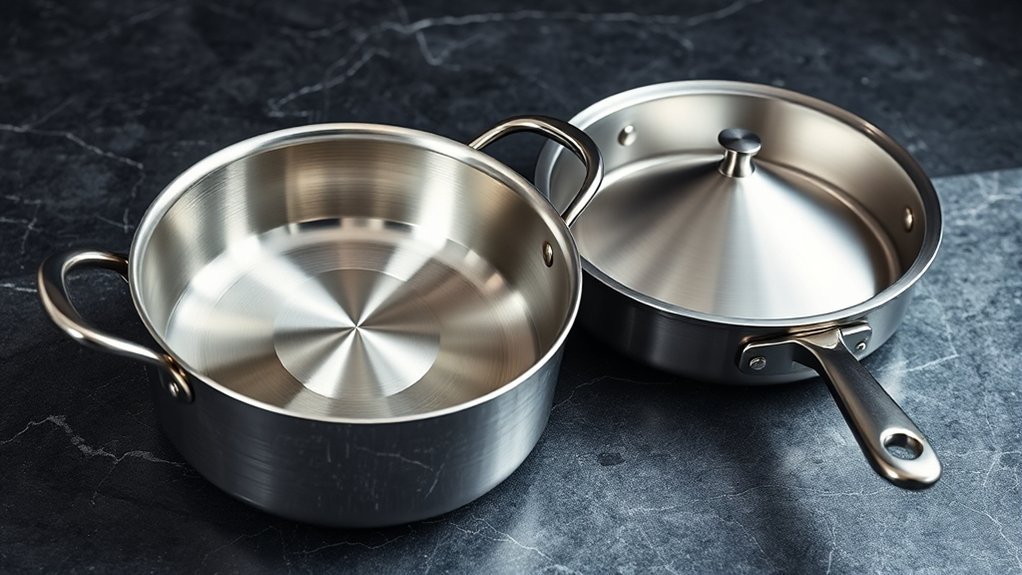
All-Clad cookware uses different combinations of stainless steel, aluminum, copper, graphite, and nonstick coatings depending on the collection. Its best-known stainless lines bond multiple metals together so each material does a specific job: stainless steel provides a durable cooking surface, while more conductive core materials spread heat across the pan. Understanding those layers makes it much easier to compare D3, D5, Copper Core, G5, and All-Clad’s current nonstick options.
Quick Answer
Most All-Clad stainless cookware combines an 18/10 stainless-steel cooking surface with one or more heat-conductive cores. D3 uses aluminum, D5 adds a stainless-steel core, Copper Core adds copper, and G5 uses graphite. Current nonstick collections use clad or hard-anodized metal with either PTFE or ceramic cooking surfaces, depending on the line.
Key Takeaways
- D3 Stainless uses three bonded layers: a stainless-steel cooking surface, an aluminum core, and a magnetic stainless-steel exterior.
- D5 Stainless uses five layers with aluminum around a stainless-steel core for steadier, more even heating.
- Copper Core uses copper plus aluminum for rapid response, while G5 uses a lightweight graphite core.
- Current PTFE nonstick products contain PFAS; All-Clad also sells ceramic nonstick options for buyers who want a non-PTFE cooking surface.
- Care limits vary by collection: many clad stainless pieces are oven/broiler safe to 600°F and hand-wash-only, while current NS Pro PTFE pans are generally rated to 500°F.
What Is All-Clad Cookware Made Of?
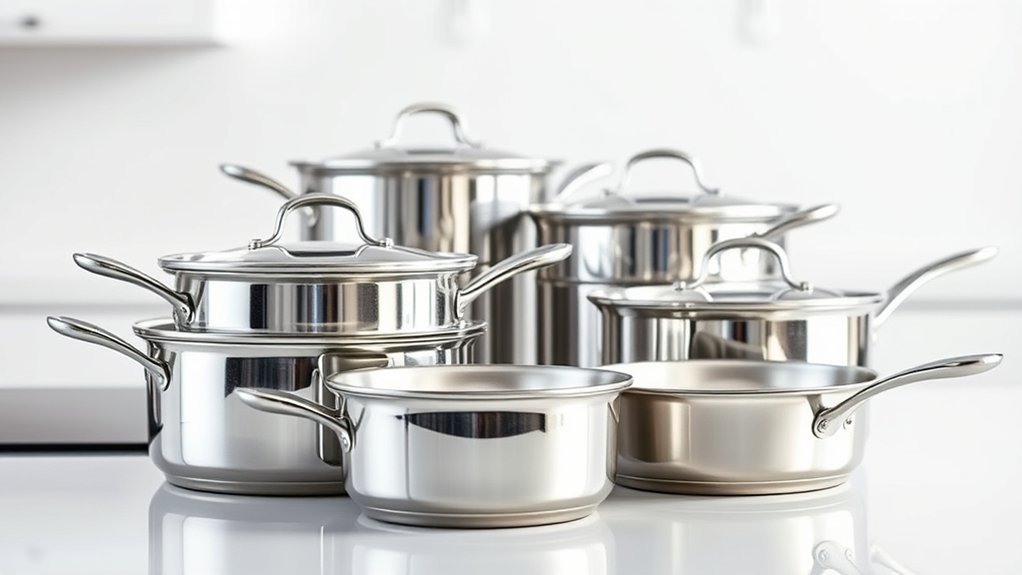
All-Clad’s clad stainless cookware is built from multiple metals bonded together from the base to the sides of the pan. The cooking surface is high-quality stainless steel, while aluminum, copper, stainless steel, or graphite may be used inside the bonded structure to change how quickly and evenly the cookware heats.
All-Clad states that its stainless cooking surface is made from high-quality 18/10 stainless steel. The “18/10” designation refers to approximately 18% chromium and 10% nickel. Chromium helps stainless steel resist corrosion, while nickel contributes to corrosion resistance and the smooth, stable cooking surface.
The conductive layer beneath that stainless surface varies by collection. All-Clad’s current stainless-steel comparison lists D3 with an aluminum core, D5 with aluminum surrounding a stainless-steel core, Copper Core with copper between aluminum layers, and G5 with graphite between aluminum layers.
Note: In clad stainless cookware, the aluminum, copper, or graphite core is enclosed within the bonded structure. Food normally contacts the stainless-steel cooking surface rather than the internal aluminum or copper core.
All-Clad also sells nonstick cookware. Current PTFE-coated products use a nonstick cooking surface over a metal body, while ceramic collections use a ceramic nonstick interior. The exact construction, oven limit, induction compatibility, and cleaning instructions therefore depend on the specific collection rather than the All-Clad brand as a whole.
How All-Clad’s Bonded Layers Work
Bonded cookware combines metals because no single cookware material provides every desirable property. Stainless steel is durable, corrosion resistant, and relatively non-reactive, but it conducts heat more slowly than aluminum or copper. Aluminum spreads heat rapidly. Copper responds especially quickly to burner adjustments, while graphite offers high thermal conductivity at relatively low weight.
Instead of attaching a conductive disc only to the bottom, All-Clad’s major clad stainless collections bond the conductive layers through the pan body. This helps spread heat across the base and up the sides rather than concentrating it directly above the burner.
The outside layer is also important. Cookware designed for induction needs a magnetic exterior that can interact with an induction cooktop’s electromagnetic field. All-Clad uses an induction-compatible stainless-steel exterior on its major clad stainless collections.
The practical result is a stainless-steel cooking surface supported by more conductive materials underneath. That combination allows cooks to use stainless steel for browning, searing, simmering, and sauce work while reducing the uneven heating associated with a thick pan made from stainless steel alone.
Which All-Clad Line Uses Which Material?
The main All-Clad collections differ primarily in the number of bonded layers and the conductive material placed inside them. The table below summarizes the current constructions described by All-Clad.
| Collection | Main Construction | Main Characteristic |
|---|---|---|
| D3 Stainless | 3-ply: stainless-steel interior, aluminum core, stainless-steel exterior | Fast, even heating with comparatively lighter construction |
| D5 Stainless | 5-ply: stainless steel, aluminum, stainless-steel core, aluminum, stainless steel | Steady, highly even heating with greater mass |
| Copper Core | 5-ply: stainless steel, aluminum, copper, aluminum, stainless steel | Rapid response to temperature changes |
| G5 Graphite Core | 5-ply: stainless steel, aluminum, graphite, aluminum, stainless steel | Fast heat response with lower weight |
| NS Pro PTFE Nonstick | Heavy-gauge aluminum with PTFE nonstick and, on most pieces, a stainless induction base | Easy food release and cleanup |
| Ceramic Nonstick | Hard-anodized aluminum body with ceramic nonstick interior, depending on collection | Nonstick cooking without a PTFE cooking surface |
D3 Stainless Construction
D3 Stainless uses tri-ply construction. The stainless-steel cooking surface provides durability and a stable surface for browning and acidic foods. The central aluminum layer conducts heat much more rapidly than stainless steel, while the outer stainless-steel layer provides durability and induction compatibility.
According to the current All-Clad D3 product specifications, D3 stainless cookware is compatible with induction and other common stovetops and is oven and broiler safe up to 600°F. Current D3 stainless product pages also specify hand washing.
D3 is therefore the simplest of All-Clad’s major clad stainless constructions. Its aluminum core gives it relatively quick response without the additional layers and weight of D5.
D5, Copper Core, and G5 Materials
D5 Stainless uses five bonded layers. Its stack places a stainless-steel core between two aluminum layers and surrounds that structure with stainless steel. All-Clad describes the design as providing especially even, steady heat. Current D5 stainless cookware is induction compatible, oven and broiler safe to 600°F, and labeled hand-wash-only.
Copper Core is also five-ply, but the center is copper. Aluminum sits on either side of the copper, with stainless steel forming the cooking surface and exterior. Copper conducts heat rapidly, so this construction responds quickly when burner output rises or falls. That responsiveness is especially useful for sauces, reductions, and other techniques where quick temperature adjustment matters.
G5 Graphite Core uses five layers consisting of a stainless-steel cooking surface, aluminum, a graphite core, another aluminum layer, and a stainless-steel exterior. The graphite helps move heat rapidly while keeping the cookware lighter than many thick multi-ply designs.
All four clad stainless constructions—D3, D5, Copper Core, and G5—are designed for induction use. Their behavior differs because aluminum, copper, graphite, and the additional stainless layers transfer and store heat differently.
Why Do Stainless Steel and Aluminum Heat So Evenly?
Stainless steel and aluminum work well together because they solve different problems. Stainless steel provides the tough cooking surface; aluminum moves heat efficiently through the pan.
Stainless Steel Shell
All-Clad uses stainless steel for the cooking surface because it is durable, corrosion resistant, and suitable for a wide range of foods. It can tolerate the high surface temperatures needed for browning and searing, and it does not rely on a disposable nonstick coating.
| Property | What It Does | Practical Benefit |
|---|---|---|
| 18/10 stainless cooking surface | Resists corrosion and provides a durable food-contact surface | Suitable for searing, sauces, acidic foods, and everyday cooking |
| Magnetic stainless exterior | Works with an induction field | Broad cooktop compatibility |
| Bonded construction | Keeps conductive core material in close contact with the stainless layers | More even heating through the pan body |
Stainless steel alone is not an exceptionally fast heat conductor. The conductive core beneath it is what allows clad cookware to spread burner heat more evenly.
Aluminum Core Heat Transfer
Aluminum conducts heat far more efficiently than stainless steel, which is why it appears in D3, D5, Copper Core, and G5. In D3, aluminum is the main conductive core. In D5, Copper Core, and G5, aluminum works with another internal material to tune the pan’s heat response.
When a burner heats the bottom of the cookware, the aluminum spreads that energy laterally through the bonded body. This reduces extreme temperature differences between the area directly over the burner and surrounding portions of the cooking surface.
That more uniform surface temperature can make browning, sautéing, simmering, and sauce work easier to control. It does not eliminate the need to match burner size and heat level to the pan, but it helps reduce pronounced hot spots.
What Makes Copper Core and Nonstick Different?
Copper Core and nonstick cookware are designed around different priorities.
Copper Core uses stainless steel, aluminum, and copper in a five-ply structure. The copper center reacts quickly to changes in burner output, making the pan well suited to cooks who want precise control during sauce making, sautéing, searing, or reductions. The food-contact surface remains stainless steel rather than exposed copper.
PTFE nonstick cookware focuses on easy release. Eggs, fish, pancakes, and other delicate foods generally require less added fat and are easier to lift from the pan. All-Clad currently states that its PTFE-coated cookware contains PTFE for its nonstick properties. Its chemical disclosure also identifies PTFE-coated products as containing PFAS.
Current NS Pro PTFE cookware typically uses heavy-gauge aluminum, a PTFE nonstick surface reinforced with a ceramic-plasma layer, and a stainless-steel induction base on most pieces. Some square and rectangular pieces do not have that induction base and therefore are not induction compatible.
All-Clad also sells ceramic nonstick collections. These provide a nonstick cooking surface without PTFE and may appeal to buyers specifically trying to avoid PTFE-based coatings.
Warning: Do not leave PTFE-coated cookware empty over high heat. Follow the temperature and burner guidance supplied with the specific pan. All-Clad currently recommends low to medium heat for NS Pro and warns against overheating an empty pan.
A 2025 assessment from Germany’s Federal Institute for Risk Assessment states that adverse health effects are not expected when PTFE cookware is used as intended. Its main warning is severe overheating, particularly an empty PTFE-coated pan, because decomposition can occur at very high temperatures.
How to Choose the Best All-Clad Line for Your Cooking Style
The best construction depends on whether you value lower weight, steadier heat, rapid response, or easy food release.
- D3 Stainless: A strong general-purpose choice for cooks who want fully clad stainless cookware with relatively quick response and less weight than thicker five-ply designs.
- D5 Stainless: Suits cooks who prefer a heavier pan with steady, forgiving heat and do not mind somewhat slower temperature changes.
- Copper Core: Best matched to cooking techniques where rapid burner response matters, such as sauces, reductions, and temperature-sensitive sautéing.
- G5 Graphite Core: Designed for cooks who want rapid heat transfer with less weight than many conventional multi-ply pans.
- PTFE Nonstick: Useful for eggs, fish, pancakes, reheating, and other jobs where easy release is more important than very-high-temperature cooking.
- Ceramic Nonstick: An option for buyers who want a nonstick surface while specifically avoiding a PTFE cooking surface.
Pro Tip: You do not have to use one cookware material for every task. A clad stainless skillet or sauté pan handles searing and pan sauces well, while a smaller nonstick pan can be reserved for eggs and other delicate foods.
Care requirements should also influence the choice. Current D3 and D5 stainless product pages call for hand washing and permit oven/broiler use up to 600°F. Current NS Pro pans are generally rated to 500°F, with lids typically limited to 350°F, and All-Clad recommends gentler utensils and hand washing to preserve the nonstick surface even when an item is described as dishwasher safe.
Frequently Asked Questions
What Is the Lawsuit Against All-Clad?
The consolidated class-action litigation involved certain D3, D5, and LTD cookware sold as dishwasher-safe. Plaintiffs alleged that dishwasher cleaning could cause bonded layers near the rim to separate and create sharp edges. All-Clad denied the allegations. A federal judge granted final approval to the class settlement on February 17, 2023. The settlement provided several forms of relief for qualifying class members, including replacement cookware and certain cash or credit options. The federal court opinion also records that All-Clad removed the disputed dishwasher-safe representations from affected marketing and packaging. Current D3 and D5 stainless product pages instruct owners to hand wash the cookware.
Is All-Clad Cookware Toxic Free?
“Toxic free” is not a precise cookware standard. All-Clad’s uncoated stainless lines use stainless steel and internal conductive materials such as aluminum, copper, or graphite rather than a nonstick cooking coating. Its current PTFE nonstick products contain PTFE, which All-Clad identifies as a PFAS. All-Clad also sells ceramic nonstick products without a PTFE cooking surface. Buyers who want to avoid a particular substance should choose by the documented materials rather than relying on broad “non-toxic” marketing terms.
Is All-Clad Really Worth the Money?
Whether All-Clad is worth its price depends on what you value. Its clad stainless lines provide bonded construction, induction compatibility, replaceable-free metal cooking surfaces, and a limited lifetime warranty, but less expensive fully clad cookware can also perform well. D3 is often the simplest All-Clad entry point, while D5, Copper Core, and G5 charge more for different heat-response characteristics. Compare the construction, weight, handle design, warranty, and price rather than assuming the most expensive line will be best for every cook.
What Is the Least Toxic Cookware?
There is no single scientifically established “least toxic” cookware material for every person and cooking method. If the goal is specifically to avoid PFAS-based nonstick coatings, uncoated stainless steel, cast iron, carbon steel, and glass are common coating-free options. Each has different maintenance and cooking characteristics. PTFE cookware can also be used safely when manufacturer instructions are followed and severe overheating is avoided.
Does All-Clad Stainless Cookware Contain Aluminum?
Yes. Aluminum is an important conductive layer in D3, D5, Copper Core, and G5. In these clad stainless collections, however, the aluminum is inside the bonded pan body. Food normally contacts the stainless-steel interior rather than the aluminum core.
Can All-Clad Cookware Go in the Dishwasher?
Check the instructions for the exact collection. Current D3 and D5 stainless product pages say hand wash only. Some current nonstick products are described as dishwasher safe, but All-Clad still recommends washing them with soap and a sponge to preserve the coating and appearance. Do not rely on old packaging or care advice for a different All-Clad line.
Conclusion
All-Clad cookware is not made from one universal material. Its clad stainless collections combine a stainless-steel cooking surface with conductive internal layers chosen for different performance goals: D3 uses aluminum, D5 combines aluminum with a stainless-steel core, Copper Core adds highly conductive copper, and G5 uses graphite. Current nonstick cookware adds another choice between PTFE-based and ceramic cooking surfaces.
For most buyers, the important question is therefore not simply whether a pan is “stainless steel” or “nonstick,” but what lies beneath the cooking surface, how quickly that structure responds to heat, and what care limits come with it. Matching those material differences to the way you actually cook is the most useful way to choose between All-Clad lines.
Sources
- All-Clad — Stainless Steel Cookware Comparison — current D3, D5, Copper Core, and G5 layer structures.
- All-Clad — D3 Stainless 3-Ply Cookware — D3 construction, induction compatibility, oven/broiler rating, and current care instructions.
- All-Clad — D5 Stainless 5-Ply Cookware — D5 construction, performance, oven/broiler rating, and current care instructions.
- All-Clad — Nonstick and Chemical Safety Disclosures — PTFE and PFAS disclosures for current nonstick products.
- German Federal Institute for Risk Assessment — PTFE Cookware Safety — current risk assessment and overheating guidance.
- U.S. District Court for the Western District of Pennsylvania — In re All-Clad Metalcrafters — February 17, 2023 settlement approval and dishwasher-safe litigation history.
