
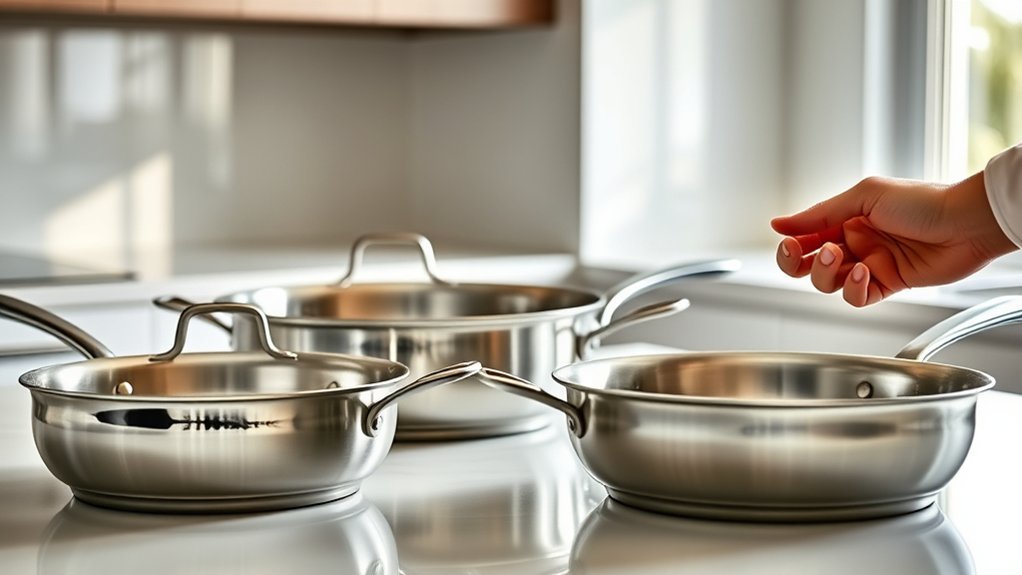
No, stainless steel pans are not all the same. The cooking surface may look similar, but differences in steel grade, core material, total thickness, cladding, shape, weight, handles, and manufacturing can change how a pan heats and feels. Ply count matters, but a well-built 3-ply pan can outperform a poorly designed 5-ply pan because the number of layers does not reveal their thickness or composition.
Quick Answer
Stainless steel pans differ in much more than appearance. Look at the cooking-surface steel, conductive core, total thickness, fully clad or disc-bottom construction, weight, handle design, induction compatibility, and care requirements. A higher ply count does not automatically mean a better pan; the complete construction determines how it performs.
Key Takeaways
- 18/10 stainless steel is a common premium cooking-surface material, but the aluminum or copper inside the pan does most of the heat spreading.
- 3-ply vs. 5-ply is not a simple quality ranking. Thickness, core design, and bonding matter just as much.
- Fully clad cookware carries its bonded layers up the sidewalls; disc-bottom cookware concentrates the conductive material under the base.
- Made In Stainless Clad, All-Clad D3, and All-Clad D5 use different constructions, handles, finishes, and care instructions.
- A magnet can help check induction compatibility, but it cannot reliably tell you whether a cooking surface is 304 or 316 stainless steel.
Made In vs. All-Clad: Which Is Better?
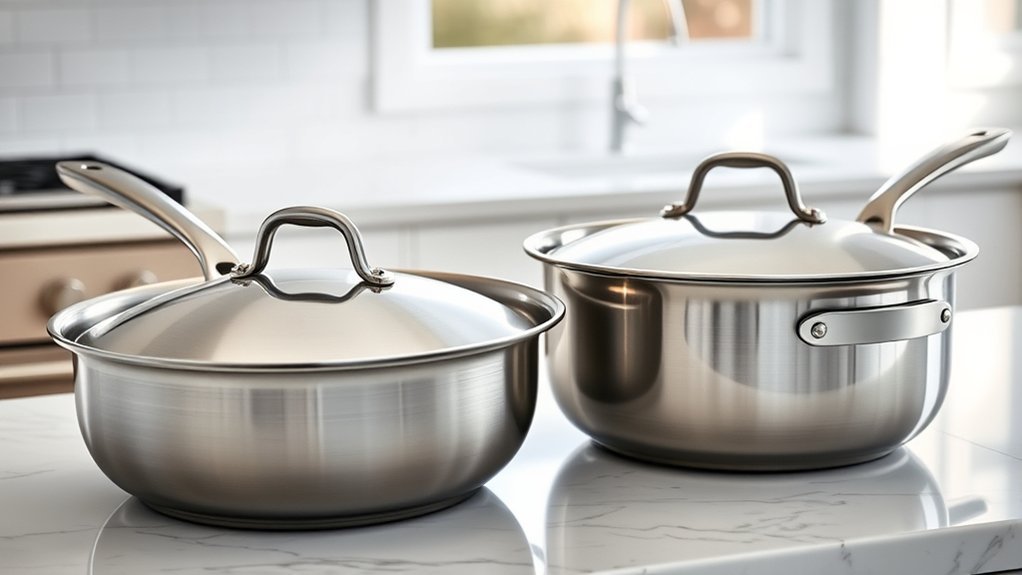
Made In and All-Clad both sell premium fully clad stainless steel cookware, but there is no single brand-wide winner because All-Clad itself offers substantially different collections. The most useful comparison is between specific lines such as Made In Stainless Clad, All-Clad D3, and All-Clad D5.
| Feature | Made In Stainless Clad | All-Clad D3 | All-Clad D5 |
| Construction | 5-ply fully clad | 3-ply fully clad | 5-ply fully clad |
| Conductive core | Aluminum and aluminum-alloy layers | Aluminum core | Alternating stainless-steel and aluminum layers |
| Cooking surface | 304-grade 18/10 stainless steel | 18/10 stainless steel | Stainless steel |
| Induction | Compatible | Compatible | Compatible |
| Handle approach | Hollow Stay Cool Handle design | Classic double-riveted handle | Larger double-riveted handle |
| Best comparison point | 5-ply construction with relatively high oven-temperature capability on current uncoated Stainless Clad pieces | Simpler tri-ply construction with fast, even heating and lower mass than heavier All-Clad lines | Additional bonded layers designed for very even heating and temperature control |
Made In states that its Stainless Clad cookware uses five bonded layers, including a 304-grade 18/10 stainless cooking surface and conductive aluminum layers. All-Clad D3 uses fully bonded tri-ply construction with an aluminum core, while All-Clad D5 uses five bonded layers.
The useful question is not simply “3-ply or 5-ply?” It is how much conductive metal the pan contains, how thick the complete body is, and whether the layers run from the base all the way to the rim.
All-Clad has produced bonded cookware in Pennsylvania since 1971, giving the brand a long manufacturing history. Made In is newer, but its current Stainless Clad line uses premium fully clad construction and is designed for professional and home-kitchen use.
Price should be compared only between equivalent pieces or sets. Promotions, set sizes, and collections change frequently, so a fixed brand-wide price range can become inaccurate quickly. Check the current manufacturer listings rather than assuming one brand is always cheaper.
What Makes Made In and All-Clad Different?
Made In and All-Clad differ most clearly in construction, handle design, finish, product-line variety, care instructions, and oven specifications.
Made In’s core stainless line is built around 5-ply Stainless Clad construction. Its cooking surface is 304-grade 18/10 stainless steel, the conductive interior includes aluminum and aluminum alloy, and the exterior includes magnetic ferritic stainless steel for induction use.
All-Clad offers several stainless collections rather than one construction. D3 is the brand’s classic fully bonded tri-ply line. D5 adds additional bonded layers and is available in finishes that include polished and brushed stainless, depending on the product.
Handle design also varies by collection. Standard All-Clad D3 uses a long, double-riveted handle shaped for a secure grip, while D3 Everyday uses a redesigned comfort handle. Made In uses a hollow Stay Cool Handle design intended to slow heat transfer from the pan body. Whether one feels better than another depends on hand size, grip style, pan size, and the weight of the food being lifted.
Pro Tip: When comparing two stainless pans, hold them by the main handle and then lift them with a few pounds of food or water inside if a store demonstration allows it. Empty-pan weight alone does not tell you how balanced a skillet or sauté pan will feel when full.
Finish should also be compared by collection rather than brand. All-Clad sells both polished and brushed stainless products, so describing the entire brand as polished is inaccurate. Decorative handle finishes are also available on some Made In products.
Steel Grades and Ply Construction
Two specifications are often mixed together when people shop for stainless cookware: steel grade and ply construction. They describe different parts of the pan.
18/10 stainless steel is shorthand for a stainless composition containing roughly 18% chromium and 10% nickel. Premium cookware commonly uses 304-series stainless steel on the food-contact surface because it offers strong corrosion resistance, durability, and good resistance to acidic foods.
The Nickel Institute identifies Type 304 as one of the best-known nickel-containing stainless steels and notes that 300-series austenitic grades are widely used for kitchen sinks, pots, and pans.
Type 316 stainless steel adds molybdenum and generally offers better resistance to pitting and chloride-rich environments than 304. That can be valuable in demanding industrial or marine environments, but it does not automatically make a frying pan heat more evenly. In clad cookware, heat spreading comes primarily from the conductive metal bonded to the stainless steel.
Ply count describes how many metal layers are bonded together. A common tri-ply design sandwiches aluminum between stainless-steel layers. Five-ply cookware uses five layers, but the materials and thicknesses vary by manufacturer.
Note: “5-ply” does not mean “five equally thick layers,” nor does it guarantee that a pan contains more conductive metal than every 3-ply pan. The total thickness and composition of those layers matter.
Fully Clad vs. Disc-Bottom Construction
Fully clad cookware carries its bonded metal structure from the base up the sidewalls. This allows the sides to participate in heat transfer, which is useful for sautéing, reducing sauces, and cooking foods that contact more than the flat bottom.
Disc-bottom cookware bonds a conductive disc to the base while leaving much of the sidewall as relatively thin stainless steel. A well-made disc-base pot can work very well for boiling water, making stock, or other tasks concentrated at the bottom. It is not automatically inferior, but its heat pattern differs from fully clad cookware.
When comparing pans, ask whether the construction is fully clad, what the conductive core is made from, and how thick the complete pan body is rather than looking at ply count alone.
Why Some Pans Heat Faster and More Evenly
A stainless steel pan’s heat behavior depends mainly on its conductive core, thickness, geometry, and mass. Stainless steel is durable and corrosion resistant but is not used alone in most premium cookware because aluminum and copper transfer heat much more efficiently.
A thicker conductive layer can spread heat across a larger area before it reaches the food, helping reduce sharp hot spots. Added mass can also make temperature changes more gradual. The tradeoff is that a heavier pan may take longer to respond to burner adjustments and can be harder to lift.
Metal Core Conductivity
At the center of many clad stainless steel pans is aluminum, copper, or a combination of conductive metals. Their job is to move heat across the base and sidewalls while stainless steel provides the durable cooking surface and exterior structure.
All-Clad D3 uses an aluminum core between stainless-steel layers. Made In Stainless Clad uses multiple internal aluminum and aluminum-alloy layers. All-Clad D5 combines alternating stainless-steel and aluminum layers.
The practical result is that two pans labeled “stainless steel” can react differently to the same burner. One may come up to temperature quickly, while another may change temperature more slowly but hold it more steadily when cold food is added.
Core thickness is especially important. A pan with a substantial conductive layer can distribute heat more effectively than a pan whose marketing emphasizes layer count but uses very thin layers.
Layer Count Matters
Layer count matters because it describes how the manufacturer has assembled the pan, but it should not be treated as a performance score.
A high-quality tri-ply pan can heat quickly and evenly when it uses a sufficiently thick aluminum core and full-wall bonding. A five-ply pan can use additional layers to alter heat spreading, rigidity, mass, and temperature response.
More layers can also change weight. That may be desirable for cooks who prefer a stable pan for searing, while someone who frequently tosses vegetables or lifts a skillet one-handed may prefer a lighter design.
The best comparison therefore considers the entire construction: core material, total thickness, fully clad or disc-base design, pan diameter, shape, weight, and handle geometry.
How to Keep Stainless Steel From Sticking?
Stainless steel is not naturally nonstick, but proper preheating and cooking technique greatly improve food release.
- Start with a clean, dry pan. Residue from earlier cooking can create areas where food catches.
- Preheat over low to medium or moderate heat. Premium clad stainless cookware usually does not require maximum burner output.
- Check the pan rather than the clock. A small drop of water should bead and move across a properly heated stainless surface instead of immediately sitting still or boiling away.
- Remove the test water, then add oil or cooking fat. Give it a moment to heat and become fluid or lightly shimmering.
- Dry the food. Surface moisture interferes with browning and can cause splattering.
- Add the food and leave it alone initially. Proteins often release more easily after a browned crust has formed.
- Turn the food when it releases. If it is firmly stuck, it often needs more cooking time rather than more force.
All-Clad’s stainless-steel cooking guidance similarly recommends preheating on low to moderate heat, adding oil once the pan is ready, and waiting for food to release naturally before turning it.
Warning: Stainless handles, helper handles, and lids can become hot, especially during oven use. Use dry oven mitts when needed, and do not put a very hot pan directly under cold water. Sudden thermal shock can contribute to warping.
There is no universal “2-3 minute” preheat time or “60-90 second” release time. Burner power, pan diameter, cookware thickness, food temperature, and the type of food all change the timing.
How Made In and All-Clad Clean Up
Both Made In and All-Clad stainless cookware benefit from prompt cleaning, mild dish soap, and thorough drying, but their current manufacturer instructions are not identical.
Made In says its Stainless Clad cookware can be washed in a dishwasher but recommends hand washing. Hand washing can help maintain appearance and avoids the cosmetic wear that repeated dishwasher cycles may produce.
Current All-Clad D3 product instructions specify hand washing. All-Clad also warns against steel wool, steel scouring pads, oven cleaner, bleach-containing cleaners, and sudden hot-to-cold thermal shock.
Most stainless discoloration is cosmetic. Rainbow heat tint, cloudy mineral deposits, and browned-on residue can usually be removed without damaging the cookware when the manufacturer’s recommended cleaning method is followed.
For rainbow or blue heat tint, diluted vinegar is commonly effective. For stubborn cooked-on residue, soak the pan or use a cleaner intended for stainless cookware with a non-scratching sponge or cloth.
A brushed surface may visually hide small marks better than a mirror-polished one, but finish varies by cookware collection. It is more accurate to compare the exact Made In or All-Clad model than to assign one finish to an entire brand.
Which Stainless Steel Pan Fits Your Kitchen?
The right stainless steel pan depends on what you cook, the size of your burners, how much weight you are comfortable lifting, and whether you use gas, electric, induction, or the oven.
Cooking Style Needs
For searing steaks, browning chicken, sautéing vegetables, and building pan sauces, a fully clad skillet or sauté pan is especially useful because the conductive layers distribute heat across more of the vessel.
A sauté pan has straighter walls and usually holds more liquid than a similarly sized skillet, which makes it useful for shallow braises, sauces, and dishes that need a lid. A stockpot is better suited to soups, pasta water, broth, and high-volume cooking.
If rapid burner adjustments matter to you, pay attention to the pan’s thickness and conductive core rather than assuming that the largest ply number will be the most responsive.
Size And Weight
Stainless skillets are commonly sold in sizes such as 8, 10, and 12 inches, with some lines extending outside that range. A larger pan provides more cooking area but also adds weight and requires a burner large enough to heat the base effectively.
An 8-inch pan works well for small portions or a single egg. A 10-inch skillet is a flexible everyday size for one or two people, while a 12-inch pan provides substantially more room for browning several portions without crowding.
Weight deserves as much attention as diameter. More mass can improve stability and reduce the temperature drop when food is added, but it also makes tossing, pouring, washing, and one-handed lifting harder.
Choose the lightest pan that still provides the heat behavior and capacity you want rather than assuming heavier is always better.
Brand And Construction
Brand reputation can be useful, but construction should drive the decision. Look for a durable stainless cooking surface, a substantial conductive core, solid bonding, a flat base, secure rivets or handle attachment, comfortable balance, and specifications that match your stove.
Both Made In and All-Clad use 18/10 or comparable premium stainless cooking surfaces in major stainless lines and combine them with conductive metals. Their specific layer arrangements differ, which is why comparing D3, D5, and Made In Stainless Clad is more useful than treating each brand as one pan.
Craftsmanship also shows up in details such as rolled or flared rims, helper handles, lid fit, wall shape, cooking-surface diameter, and how smoothly the pan sits on a flat cooktop.
Induction and Oven Compatibility
Induction cooking requires a magnetic layer that interacts with the cooktop. That magnetic material is commonly placed on the exterior of clad cookware. The food-contact surface can still be austenitic 18/10 stainless steel.
A simple magnet test is therefore useful for checking whether the bottom of a pan is likely to work on induction. It is not a reliable way to identify whether an unknown cooking surface is 304 or 316 stainless steel.
Current Made In Stainless Clad, All-Clad D3, and All-Clad D5 cookware are induction compatible. Oven-temperature limits differ by product and lid configuration, so check the specification for the exact piece rather than applying one temperature to an entire brand.
Frequently Asked Questions
Does It Matter What Stainless Steel Pan You Get?
Yes. Two pans can have stainless-steel cooking surfaces yet perform differently because of core material, total thickness, full-wall cladding, weight, base flatness, handle design, and manufacturing quality. A pan’s construction usually tells you more about heating performance than the words “stainless steel” alone.
What Is the Best Grade of Stainless Steel Cookware?
There is no single grade that makes an entire pan “best.” Type 304 or an 18/10 stainless cooking surface is a common premium choice because it is durable, corrosion resistant, and suitable for food contact. Type 316 offers stronger resistance to chloride corrosion because it contains molybdenum, but cookware heating performance still depends mainly on the conductive core and construction.
How Can I Tell if My Stainless Steel Is 304 or 316?
Check the manufacturer’s specification, model documentation, or material certification first. A magnet test cannot reliably distinguish 304 from 316 because both are austenitic stainless steels and their magnetic response can change after cold working. When exact alloy identification is necessary, professional positive material identification using methods such as X-ray fluorescence can analyze the alloying elements; the molybdenum content is one important distinction between 304 and 316.
Are Cheap Stainless Steel Pans Good?
Some inexpensive stainless pans are perfectly serviceable. Price alone does not determine quality. Check whether the pan is fully clad or disc-bottom, whether the base sits flat, the thickness and material of the conductive core, handle security, induction compatibility, warranty, and owner feedback about warping or uneven heating. Very thin pans are more likely to develop hot spots, but a lower price does not automatically mean poor cookware.
Is 5-Ply Stainless Steel Better Than 3-Ply?
Not automatically. Five-ply cookware contains five bonded layers and tri-ply contains three, but the label does not tell you how thick those layers are. A well-designed tri-ply pan with a substantial aluminum core can heat extremely evenly. Compare total thickness, core material, weight, construction, and handling rather than choosing by ply count alone.
Conclusion
Not all stainless steel pans are the same. The steel cooking surface affects corrosion resistance and durability, while the conductive core, thickness, and cladding have a much larger effect on heating behavior. Handle design, weight, induction compatibility, shape, and care instructions also influence day-to-day use.
Made In Stainless Clad, All-Clad D3, and All-Clad D5 all use premium bonded construction, but they reach that goal with different layer arrangements and designs. Instead of choosing by brand name or ply count alone, compare the exact pan’s materials, thickness, balance, cooking area, heat-source compatibility, and maintenance requirements.
Sources
- All-Clad — D3 Stainless 3-Ply Cookware — D3 construction, finish, handles, induction compatibility, oven rating, and care guidance.
- All-Clad — D5 Stainless 5-Ply Cookware — D5 construction and current collection specifications.
- Made In — Stainless Clad FAQs — 5-ply construction, 18/10 cooking surface, aluminum layers, and stainless composition.
- Made In — Stainless Clad Frying Pan — induction compatibility, oven use, handle design, dishwasher guidance, and warranty.
- Nickel Institute — Stainless Steel: The Role of Nickel — 304-series composition, nickel’s role, corrosion resistance, and cookware applications.
- Hitachi High-Tech — Positive Material Identification Guidance — alloy identification and the elemental differences used to distinguish 304 and 316 stainless steel.

1 thought on “Are All Stainless Steel Pans the Same? Complete Guide & Helpful Tips”