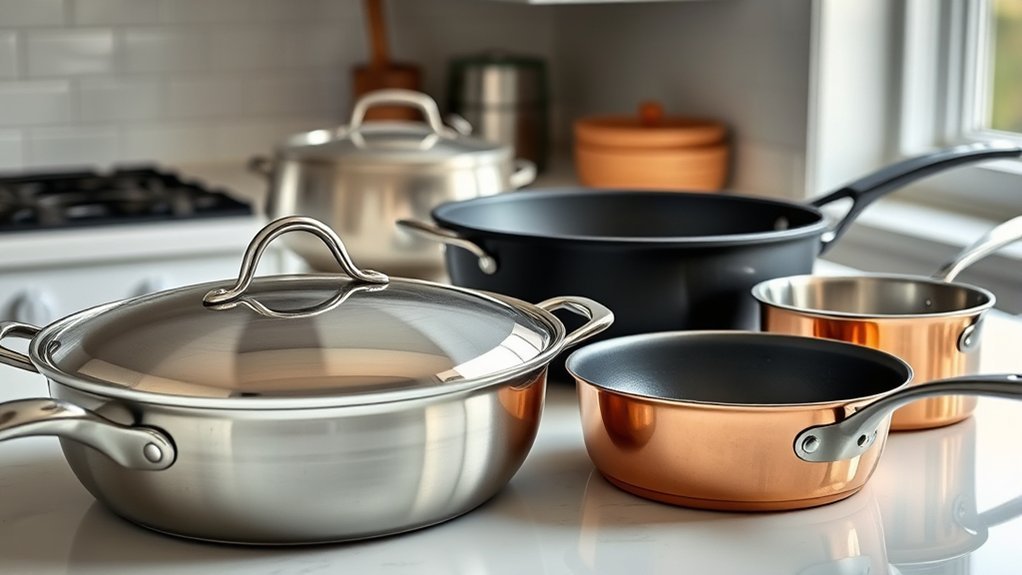
Good pans heat predictably, feel balanced in the hand, and match the cooking job. Stainless steel is a durable choice for browning, deglazing, sauces, and acidic foods, while nonstick makes eggs and other delicate foods easier to release. Cast iron holds heat extremely well for searing and baking. The best kitchen usually mixes materials instead of relying on one pan for everything. Before buying, compare construction, handle comfort, cooktop compatibility, oven rating, care requirements, and the sizes you will actually use.
Quick Answer
For most kitchens, the best combination is a clad stainless steel skillet for browning and sauces, a nonstick skillet for eggs and delicate foods, and either a cast iron skillet or Dutch oven for high-heat searing and slow cooking. Choose individual pans by cooking task, cooktop compatibility, weight, maintenance, and manufacturer-rated oven temperature.
Key Takeaways
- Clad stainless steel is the most versatile everyday choice for searing, sautéing, deglazing, sauces, and acidic foods.
- Nonstick is especially useful for eggs, pancakes, fish, and other foods that benefit from easy release.
- Cast iron and carbon steel suit high-heat cooking but need more care than stainless steel.
- Do not judge a cookware set by its advertised piece count because lids are commonly counted as separate pieces.
- Check the exact manufacturer’s instructions for induction compatibility, oven limits, dishwasher use, and nonstick care.
What Makes a Good Pan?
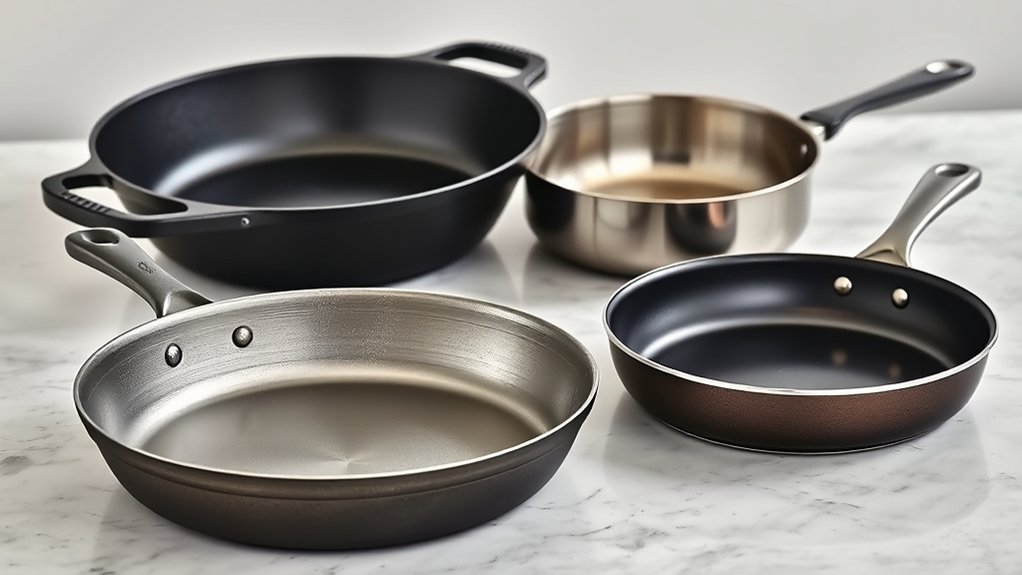
A good pan is defined first by how predictably it transfers heat. Consistent heat distribution reduces severe hot spots and makes browning, sautéing, simmering, and searing easier to control.
Material is only part of the story. Stainless steel itself is durable and nonreactive, but it is not an especially efficient heat conductor. High-quality stainless cookware therefore commonly bonds the steel to aluminum or copper, which improves responsiveness and heat distribution.
A nonstick surface is useful when easy release matters more than aggressive browning. Cast iron favors heat retention, while carbon steel combines a seasoned cooking surface with somewhat lighter, more responsive construction.
Also inspect the details that affect everyday use: a secure handle, comfortable balance, flat cooking surface, tight-fitting lid where appropriate, manageable weight, and compatibility with your cooktop. Oven safety should always be checked on the exact model because handles, lids, coatings, and construction can have different temperature limits.
Pro Tip: Instead of buying every pan in one material, build a small mixed collection. Stainless steel can handle most meals, while one nonstick pan and one high-heat pan such as cast iron or carbon steel cover jobs where stainless is less convenient.
Best Cookware Materials for Everyday Use
No single cookware material is best at every task. Stainless steel favors versatility and durability, nonstick favors easy release, cast iron favors heat retention, and carbon steel combines high-heat performance with a seasoned surface. Enameled cast iron and copper-core cookware fill additional niches.
| Material | Best For | Main Advantage | Main Tradeoff |
|---|---|---|---|
| Clad stainless steel | Searing, sautéing, sauces, acidic foods | Durable and highly versatile | Food can stick without proper heat and oil technique |
| PTFE nonstick | Eggs, pancakes, fish, delicate foods | Very easy release and cleanup | Coating eventually wears and high heat should be avoided |
| Ceramic-coated | Low-to-medium-heat everyday cooking | Easy initial release without PTFE in products specifically labeled that way | Release performance can decline as the coating wears |
| Cast iron | Searing, frying, baking, slow cooking | Excellent heat retention | Heavy and requires drying/seasoning care |
| Carbon steel | High-heat searing, stir-frying, eggs once seasoned | Responsive and develops a seasoned surface | Needs seasoning and protection from rust |
| Enameled cast iron | Braises, stews, soups, acidic recipes | Cast-iron heat retention without bare-iron seasoning | Heavy and enamel can chip if mishandled |
| Copper-core or lined copper | Sauces and temperature-sensitive cooking | Fast heat response | Usually expensive and may require more care |
Stainless Steel Durability
Built for years of steady use, stainless steel cookware resists rust and corrosion and does not rely on a disposable nonstick coating. High-quality pieces can remain useful for decades when they are not badly warped or physically damaged.
Many better-performing pans use tri-ply or multi-ply construction, combining stainless steel with a more conductive metal such as aluminum or copper. That construction improves heat response and reduces severe hot spots.
Stainless steel is also nonreactive, making it well suited to tomatoes, wine, vinegar, citrus-based sauces, and other acidic ingredients.
Cooktop and oven compatibility are model-specific. For example, All-Clad’s current D3 Everyday stainless cookware uses bonded tri-ply construction, works on induction, and is rated by the manufacturer for oven and broiler use up to 600°F. That rating should not be assumed for every stainless pan.
Nonstick Convenience
For everyday cooking, nonstick cookware offers a different advantage: easy food release with relatively little added cooking fat if desired. It is particularly convenient for eggs, pancakes, delicate fish, crepes, and reheating foods that tend to cling to bare metal.
PTFE and ceramic-coated cookware should not be treated as the same material. Some conventional nonstick pans use PTFE, while many ceramic-coated products are specifically marketed without PTFE. Always check the manufacturer’s material disclosure rather than assuming that “nonstick” means one particular chemistry.
The terminology around PFOA and PFAS also matters. The EPA’s PFOA Stewardship Program led participating companies toward eliminating PFOA and related long-chain chemicals from emissions and product content by 2015. That does not mean every modern PTFE pan is “PFAS-free.”
The FDA explains that certain polymerized PFAS are authorized for nonstick cookware applications and that studies show negligible amounts capable of migrating to food from these tightly bound coatings.
Warning: Follow the exact manufacturer’s heat limits for coated cookware. Avoid unnecessarily overheating an empty nonstick pan, and replace cookware when its cooking surface is badly damaged, peeling, or no longer functioning as intended.
Even heat distribution still matters because a poorly constructed nonstick pan can cook unevenly despite its easy-release surface. Use silicone, nylon, or wooden utensils when the manufacturer recommends them, and follow the stated cleaning instructions to extend coating life.
Cast Iron Heat Retention
Cast iron earns its place in everyday cookware through excellent heat retention. Once heated, it stays hot well, which helps when searing steak, frying, baking cornbread, or cooking foods that would otherwise cause a lighter pan’s temperature to fall sharply.
That same thermal mass means cast iron warms and cools more slowly than thinner cookware. It is therefore less responsive when a recipe requires rapid temperature changes.
With use and seasoning, bare cast iron develops a lower-stick cooking surface. It is extremely durable but needs protection from prolonged moisture.
Modern care is simpler than old kitchen folklore suggests. Lodge’s cast-iron cleaning guidance says ordinary dish soap is acceptable. Wash the pan, dry it completely, and apply a very thin film of oil when needed. Do not leave bare cast iron soaking in water or put it in the dishwasher.
Carbon Steel for High-Heat Cooking
Carbon steel deserves consideration for cooks who like cast iron’s seasoned surface but want a pan that generally responds faster and can be easier to maneuver. It is popular for searing, stir-frying, sautéing, and other high-heat tasks.
Like bare cast iron, carbon steel should be seasoned and kept dry to limit rust. Long simmering of very acidic ingredients can also weaken seasoning, so stainless steel or enameled cookware is usually more convenient for tomato-heavy or wine-heavy sauces.
Enameled Cast Iron
Enameled cast iron combines the heat retention of cast iron with a glass-like enamel cooking surface. It is especially useful in Dutch ovens for braising, stews, soups, beans, and long-cooked acidic dishes.
It does not require the same seasoning routine as bare cast iron, but it remains heavy and should be handled carefully to avoid damaging the enamel.
Why Stainless Steel Works for Searing
A quality clad stainless steel pan works well for searing because its conductive aluminum or copper core spreads heat while the stainless cooking surface tolerates browning, fond formation, and deglazing. The benefit comes from the whole construction, not from stainless steel being an unusually conductive metal on its own.
Its nonreactive surface also handles acidic ingredients such as tomatoes, wine, vinegar, and citrus-based sauces without the seasoning concerns associated with bare cast iron or carbon steel.
Stainless cookware is also well suited to repeated browning and deglazing when used within the manufacturer’s heat limits.
Even Heat for Browning
A well-made clad stainless steel pan provides the even heat needed for controlled browning. Fully bonded aluminum or copper layers help distribute energy across the cooking surface so proteins are less likely to develop an intensely dark patch in one area while remaining pale elsewhere.
Preheat the pan over moderate heat, then add an appropriate cooking fat and the food. Excessively high burner settings are rarely necessary with quality clad cookware.
When searing meat, allow enough time for a crust to form before repeatedly trying to lift it. Properly browned food often releases more readily from stainless steel than food that is moved too early.
The browned residue left behind, called fond, can then be dissolved with stock, wine, or another liquid to build a pan sauce.
Nonreactive for Acidic Foods
When acidic ingredients such as tomatoes, wine, or vinegar meet stainless steel, the cooking surface does not require the same restrictions as reactive bare metals or a seasoned iron surface.
That gives stainless steel several practical advantages:
- It works well for tomato, wine, vinegar, and citrus-based recipes.
- It supports high-quality browning and fond development.
- It can move from searing to deglazing in the same pan.
- It resists corrosion and does not depend on a seasoning layer for protection.
These qualities make clad stainless steel one of the most adaptable choices for a general-purpose skillet or sauté pan.
Durable for High Heat
Stainless cookware is often chosen for demanding stovetop work because there is no conventional nonstick coating to protect. However, maximum temperature, broiler compatibility, lid limits, and cleaning instructions still vary by model.
| Feature | Benefit |
|---|---|
| Tri-ply or multi-ply construction | Conductive internal layers improve heat distribution and response |
| Stainless cooking surface | Supports browning, fond development, and acidic ingredients |
| Model-specific oven rating | Lets the pan move from stovetop to oven when the manufacturer allows it |
| All-Clad D3/D5 examples | Current manufacturer pages rate these lines to 600°F and specify hand washing |
All-Clad’s current D3 Everyday and D5 specifications are useful examples of why buyers should check the exact product page rather than rely on a general rule: both are rated up to 600°F, including broiler use, and their current care instructions specify hand washing.
When Nonstick Pans Are the Better Choice
Nonstick pans are often the better tool when easy release is the priority. They can cook eggs, pancakes, crepes, tender fish, and similar foods with less sticking and can use relatively little added oil or butter when the recipe allows.
Using less cooking fat can be useful for a particular recipe, but a nonstick pan should not automatically be described as a “healthier” pan. Overall nutrition depends far more on the food, recipe, portions, and cooking method.
Good uses for nonstick include:
- Eggs and omelets that need a clean release.
- Pancakes, crepes, and other tender batters.
- Fish fillets and other foods that can tear easily.
- Fast everyday cooking where simple cleanup matters.
Use the pan within its manufacturer-rated temperature range. As one current example, All-Clad’s NS Pro PTFE cookware is rated to 500°F for pots and pans, while its lids have a lower rating. Other brands and coating types can have different limits.
Because every nonstick coating eventually wears, it usually makes more sense to reserve coated cookware for the jobs where its release properties provide a real advantage rather than making it the only cookware in the kitchen.
How Many Pans You Really Need
A well-equipped kitchen does not need a large collection. Three cooking vessels can cover many basic meals: a skillet for frying and sautéing, a saucepan for grains and sauces, and a larger pot or Dutch oven for pasta, soups, and batch cooking.
A well-equipped kitchen can start with three useful vessels: a skillet, a saucepan, and a larger pot or Dutch oven. Add specialty pieces only when your cooking habits justify them.
For greater versatility, many cooks add a nonstick skillet for eggs and a cast iron or carbon steel pan for high-heat cooking. That creates a practical four- or five-vessel collection without filling cabinets with rarely used pieces.
Be careful with cookware-set advertising. A “10-piece” set does not necessarily contain 10 pans. Lids are usually counted as pieces. For example, a current All-Clad D5 10-piece set contains six cooking vessels and four lids.
The right number therefore depends on cooking style, household size, storage, and frequency. Someone who braises, bakes bread, makes sauces, and cooks for a family may benefit from more shapes than someone preparing simple meals for one or two people.
Prioritize cookware that has a clear job in your kitchen rather than buying the largest set you can store.
What to Look for in a Cookware Set
When evaluating a cookware set, first decide which actual vessels you need. Material and construction matter more than the headline piece count.
- Useful vessels: A skillet, saucepan, sauté pan or Dutch oven, and stockpot cover a broad range of cooking tasks.
- Construction: For stainless cookware, bonded aluminum or copper layers improve heat distribution and response.
- Actual vessel count: Separate pans from lids and accessories when comparing set values.
- Cooktop compatibility: Confirm induction compatibility if you use or may switch to an induction range.
- Oven limits: Check the temperature rating for pans and lids separately.
- Maintenance: Decide whether you are comfortable with hand washing, seasoning, or coating-care restrictions.
- Weight and handles: A technically excellent pan is not useful if it feels too heavy or uncomfortable to lift safely.
Note: For induction cooking, look for explicit manufacturer confirmation rather than assuming every stainless pan will work. Induction requires a compatible magnetic base or exterior layer.
Cast iron can add excellent heat retention, while nonstick can simplify delicate cooking. A matching set can be convenient, but a mixed collection often gives better performance across different jobs.
The best purchase is not automatically the largest one. It is the combination of pieces that covers the cooking you actually do without unnecessary duplication.
Best Pan Sizes for Your Kitchen
Pan size should match both the amount of food and the burner or heating element. Crowding food into a small skillet traps moisture and can interfere with browning, while an unnecessarily large pan can be awkward for a small portion.
An 8-inch skillet works well for one or two eggs, a small portion, or quick reheating. A 10-inch skillet is a practical everyday size for one or two people, while a 12-inch skillet offers more room for family portions, multiple chicken pieces, or foods that need space to brown.
For liquids and sauces, a 2- to 3-quart saucepan covers many everyday jobs such as rice, oatmeal, reheating soup, boiling eggs, and making sauces.
An 8-inch skillet handles small portions, a 10- or 12-inch skillet covers most everyday frying and sautéing, and a 2- to 3-quart saucepan handles many routine liquid-based tasks.
For pasta, soup, stock, and larger batches, a 6- to 8-quart stockpot is a useful range for many households. A 5- to 7-quart Dutch oven can sometimes perform many of the same large-volume jobs while also handling braises and oven cooking.
Choose sizes around your normal portions rather than buying every available diameter.
How to Match a Pan to the Cooking Task
The easiest way to choose cookware is to start with the food rather than the material name.
- Steak and hard searing: clad stainless steel, cast iron, or carbon steel.
- Eggs and pancakes: nonstick or a well-seasoned carbon steel pan.
- Pan sauces: stainless steel, especially when fond and deglazing matter.
- Tomato or wine sauces: stainless steel or enameled cookware.
- Braising and stews: enameled cast iron, stainless steel Dutch oven, or another heavy covered pot.
- Fast temperature adjustment: quality clad stainless steel or copper-core cookware.
- Oven-to-table slow cooking: enameled cast iron is especially convenient.
- Low-maintenance delicate cooking: nonstick is usually easiest.
A pan that excels at one task may be inconvenient for another. That is why a small mixed-material collection is usually more practical than trying to identify one universally superior pan.
All-Clad Cookware Sets to Consider
All-Clad is one established premium cookware manufacturer, and its stainless lines illustrate the differences between common bonded constructions. It should be compared with other brands on price, weight, handles, included pieces, warranty, and care requirements rather than treated as the only good option.
The D3 Everyday Stainless line uses fully bonded tri-ply construction with an aluminum core. All-Clad’s current specification says it works with induction and is oven and broiler safe to 600°F. See the current D3 Everyday specifications.
The D5 Stainless line uses 5-ply bonded construction. Its current product page also lists induction compatibility and an oven/broiler limit of 600°F. See the current D5 specifications.
The Copper Core line combines stainless steel, aluminum, and a conductive copper layer for faster heat response. The manufacturer likewise lists current Copper Core cookware as induction compatible and oven/broiler safe to 600°F. See the current Copper Core specifications.
- D3 Everyday Stainless: tri-ply construction and comparatively straightforward everyday versatility.
- D5 Stainless: 5-ply construction with a heavier, more substantial build.
- Copper Core: premium 5-ply construction designed for faster temperature response.
- Set size: compare the actual pans and pots included rather than relying on the advertised piece count.
Current D3, D5, and Copper Core product pages also specify hand washing, so older blanket descriptions of these lines as dishwasher-safe should not be assumed to remain correct.
Prices can change substantially with collection, set size, and promotions. For evergreen buying advice, it is more useful to compare the current manufacturer price and the exact included vessels at the time of purchase than to rely on a fixed price range in an article.
Frequently Asked Questions
What Type of Pans Are Best?
There is no single best pan for every cooking method. Clad stainless steel is highly versatile, cast iron retains heat well, carbon steel suits high-heat cooking, and nonstick is easiest for eggs and delicate foods. A small mixed-material collection usually covers more tasks than one matching material.
What Are the Best Quality Pans?
Quality pans have solid construction, secure handles, a flat cooking surface, predictable heat behavior, and specifications that match the intended job. For stainless steel, fully clad construction is valuable. For coated cookware, inspect the coating, base construction, heat limit, and care requirements. Balance and comfortable weight matter as much as brand name.
What Pans Are the Healthiest to Cook With?
No cookware material is automatically the “healthiest” for every person or recipe. Stainless steel, cast iron, enameled cookware, and properly used nonstick cookware can all have appropriate kitchen roles. Choose undamaged cookware from reputable manufacturers, follow its temperature and care instructions, and replace badly deteriorated coated cookware.
What Brand Is the Best Cookware?
No cookware brand is best for every buyer. All-Clad is a well-established premium option for bonded stainless cookware, while other manufacturers compete at different prices and with different handle shapes, weights, warranties, coatings, and materials. Compare the exact pan rather than choosing on brand reputation alone.
Is Stainless Steel Better Than Nonstick?
Stainless steel is better for browning, fond, pan sauces, acidic ingredients, and long service life. Nonstick is better when effortless release is the priority, especially for eggs, pancakes, and delicate fish. Many kitchens benefit from owning both.
What Size Frying Pan Is Best for Everyday Cooking?
A 10-inch skillet is convenient for smaller households and everyday portions, while a 12-inch skillet provides more room for family meals and better spacing when browning several pieces of food. An 8-inch pan is useful as a secondary pan for eggs and small portions.
Conclusion
Choosing the right pan is less about finding one universally superior material and more about matching the tool to the task. Clad stainless steel is a strong everyday workhorse for browning, acidic foods, and sauces. Nonstick earns its place for eggs and delicate foods, while cast iron or carbon steel handles high-heat cooking well. Start with a few useful sizes, check model-specific oven and cooktop specifications, and add specialty cookware only when your cooking habits justify it. A small collection of well-chosen pans is usually more useful than a large set filled with duplicate pieces.
Sources
- U.S. Food and Drug Administration — Questions and Answers on PFAS in Food — PFAS terminology, authorized nonstick cookware uses, and migration information.
- U.S. Environmental Protection Agency — 2010/2015 PFOA Stewardship Program — background on the phaseout of PFOA and related long-chain chemicals.
- Lodge Cast Iron — How to Clean Cast Iron — current washing, drying, oiling, soap, and rust-prevention guidance.
- All-Clad — D3 Everyday Stainless — tri-ply construction, induction compatibility, oven rating, and current care instructions.
- All-Clad — D5 Stainless — 5-ply construction, set contents, oven rating, induction compatibility, and care instructions.
- All-Clad — Copper Core — copper-core construction, heat-response design, induction compatibility, and oven rating.