
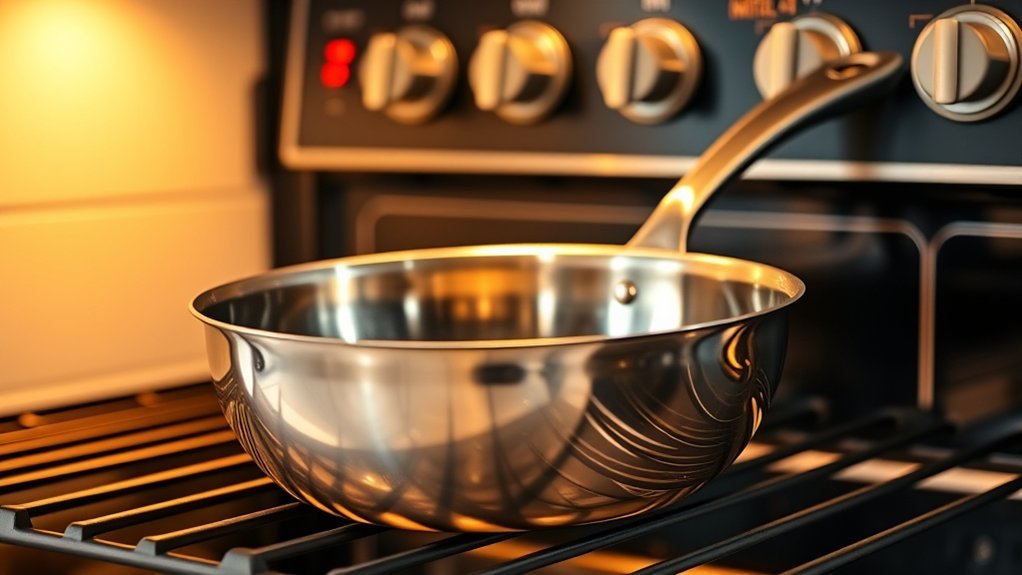
Yes. All-Clad’s fully bonded stainless steel cookware is generally oven- and broiler-safe up to 600°F (315°C), including current D3, D5, G5, and Copper Core collections. The main exceptions are accessories and other cookware materials: glass lids are limited to 350°F, while nonstick cookware has lower product-specific limits. Always check the exact piece before using very high heat.
Quick Answer
All-Clad fully bonded stainless steel cookware is oven- and broiler-safe up to 600°F. Stainless-steel lids can also handle up to 600°F, while glass lids are limited to 350°F. Nonstick collections usually have lower limits, commonly 450–500°F, so check the specific product before oven or broiler use.
Key Takeaways
- Fully bonded All-Clad stainless cookware is generally oven- and broiler-safe to 600°F.
- All-Clad lists stainless-steel lids to 600°F and glass lids to 350°F.
- Nonstick cookware varies by collection and is commonly rated between 450°F and 500°F; many nonstick pieces should not go under a broiler.
- Stainless handles remain within the cookware’s oven rating but become extremely hot, so oven mitts are essential.
- Preheating stainless steel is recommended, but use low-to-moderate stovetop heat and do not leave an empty pan heating for an extended time.
Can All-Clad Stainless Steel Go in the Oven?
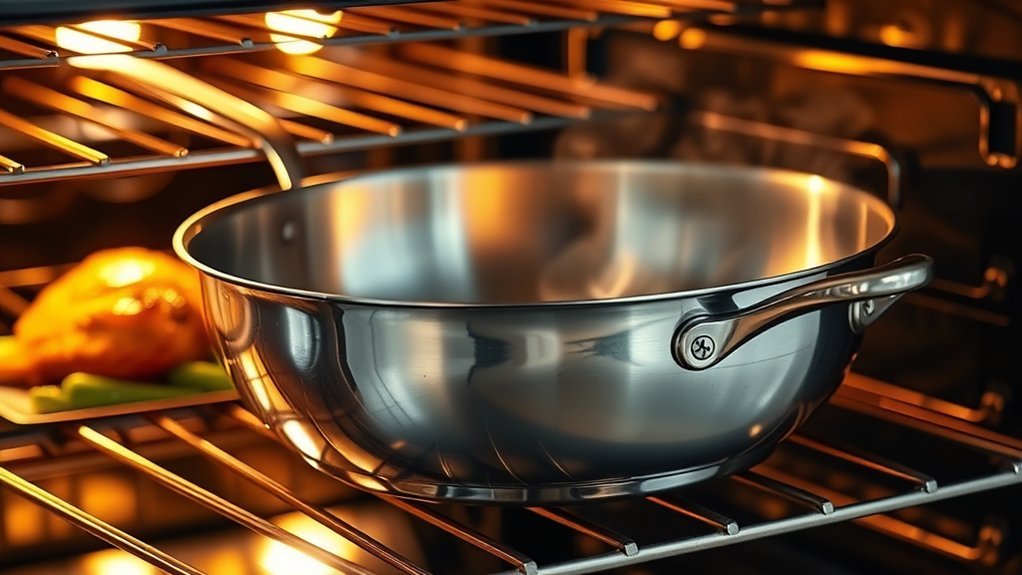
Yes. According to All-Clad’s current cookware guidance, its fully bonded stainless steel collections can go in an oven or under a broiler at temperatures up to 600°F (315°C).
That rating applies to current bonded stainless collections such as D3, D5, G5, and Copper Core. Their multilayer construction combines stainless steel with heat-conductive core materials such as aluminum, copper, or graphite, depending on the collection.
The important distinction is that the pan’s rating does not automatically apply to every lid or accessory used with it. A stainless-steel lid can have a different rating from a glass lid, and a nonstick All-Clad pan can have a lower temperature limit than a fully bonded stainless pan.
| All-Clad piece | Typical maximum | Broiler use |
|---|---|---|
| Fully bonded stainless cookware | 600°F | Yes, up to the rated limit |
| Stainless-steel lid | 600°F | Follow the cookware’s instructions |
| Glass lid | 350°F | No high-heat broiling |
| Nonstick cookware | Usually 450–500°F, depending on collection | Often not recommended; check the specific product |
Note: Product-specific instructions take priority over a general brand-wide limit. If the bottom of the pan, packaging, manual, or current product page lists a lower maximum temperature, follow that lower rating.
How Hot Can All-Clad Get in the Oven?
All-Clad rates its fully bonded stainless steel cookware for oven and broiler use up to 600°F. That is high enough for most roasting, baking, braising, oven-finishing, and broiling applications.
All-Clad also notes that extended oven exposure above 500°F can cause stainless steel to change color. The resulting blue, gold, or rainbow tint is generally cosmetic and does not by itself mean the cookware has lost its cooking performance.
All-Clad fully bonded stainless cookware is rated to 600°F, although prolonged exposure above 500°F can cause cosmetic discoloration.
The 600°F rating is a maximum temperature limit, not a recommendation to cook everything at maximum heat. A recipe that calls for 350°F, 400°F, or 450°F should still be cooked at that specified temperature.
For a current comparison of bonded collections, see All-Clad’s cookware collection comparison.
Which All-Clad Parts Aren’t Oven-Safe?
The main issue is not that every accessory is completely unsafe in an oven; it is that different components have different temperature limits.
Glass lids are the clearest example. All-Clad currently limits its glass lids to 350°F. A bonded stainless pan may therefore be safe at 450°F or 500°F while the glass lid used with it is not.
Nonstick cookware also has lower limits than fully bonded stainless cookware. Current All-Clad products vary, with some nonstick collections rated to 450°F and others to 500°F. Many nonstick collections are also not intended for broiler use.
All-Clad’s fully bonded stainless cookware does not use a generic silicone-covered handle with a 400°F limit. Its stainless cookware generally uses stainless-steel handles. Those handles remain compatible with the pan’s oven rating, but they conduct enough heat to become dangerously hot during oven use.
Warning: Treat every handle and lid handle as hot after the cookware has been in an oven. Use dry oven mitts or heat-resistant gloves, and do not rely on the handle feeling cool during normal stovetop cooking.
Accessories, specialty pieces, bakeware, and older discontinued collections may have their own instructions. Check the exact item rather than assuming all products carrying the All-Clad name share the same limit.
How Do You Use All-Clad in the Oven Safely?
Start by confirming the temperature rating of the pan and every component attached to or covering it. A 600°F stainless pan does not make a 350°F glass lid safe at 500°F.
When a recipe begins on the stovetop, controlled preheating is appropriate. All-Clad recommends preheating stainless cookware on low to moderate heat, then adding oil and food once the pan reaches cooking temperature. What should be avoided is leaving an empty pan sitting over strong heat for an extended period.
Pro Tip: Do not confuse a pan’s 600°F oven rating with the burner setting needed for stovetop cooking. Bonded stainless retains heat efficiently, so medium or lower burner settings are usually sufficient for searing and sautéing.
Oven Temperature Limits
D3, D5, G5, Copper Core, and other fully bonded stainless pieces covered by All-Clad’s current guidance can generally be used in an oven or broiler up to 600°F.
Stainless-steel lids can also be rated to 600°F, while glass lids are limited to 350°F. Nonstick cookware requires a product-specific check because its maximum can be lower and broiler use may be prohibited.
If the cookware is going from a stovetop directly into an oven, remember that every exposed metal surface will continue heating. Long handles, helper handles, lid handles, and rims should all be treated as hot.
Safe Oven Handling
Use two hands and suitable oven mitts for large sauté pans, Dutch ovens, stockpots, or any piece containing hot liquid. A heavy pan becomes harder to control when it is full.
After cooking, place the pan on a stable, heat-resistant surface. Allow it to cool naturally before washing. Putting a very hot stainless pan directly under cold water can cause rapid contraction and may warp the cookware.
Do not put a hot pan where someone might grab the handle without realizing it has just come from the oven. Turning the handle inward or placing a dry mitt over it can provide a visible reminder that the metal remains hot.
What Are the Best Oven Uses for All-Clad?
Fully bonded All-Clad stainless cookware is especially useful for recipes that begin on a stovetop and finish in an oven. The same pan can brown meat, build a sauce, braise food, roast vegetables, or finish a dish without transferring everything to a separate baking vessel.
Its aluminum, copper, or other conductive core material—depending on the collection—helps distribute heat while the stainless cooking surface provides durability for browning and deglazing.
Searing And Sautéing
Searing and sautéing are useful stovetop-to-oven techniques with All-Clad stainless steel. For best results, preheat the pan gradually over low to moderate heat rather than immediately using the highest burner setting.
Add enough oil to coat the cooking surface once the pan is hot. When food is placed in properly heated stainless steel, it may initially stick. Proteins often release more easily after a browned crust develops.
| Action | Result | Note |
|---|---|---|
| Preheat gradually | More even cooking surface | Use low-to-moderate heat |
| Add oil, then food | Improved browning and release | Avoid burning the oil |
| Sear | Brown crust and fond | Let food release naturally before turning |
| Move to oven | Controlled interior cooking | Stay within the pan and lid limits |
This technique works particularly well with steaks, chops, chicken, fish that can tolerate oven finishing, and thicker vegetables. After searing, the pan can be moved directly to a preheated oven if every component is rated for the selected temperature.
Broiling And Oven Finishing
Fully bonded All-Clad stainless cookware can also be useful for broiling because All-Clad currently rates these collections for broiler use up to 600°F.
Remove a glass lid before broiling. If a recipe needs a covered pan, verify that the lid is stainless steel and rated for the same conditions.
- Preheat the oven or broiler as directed by the recipe.
- Use only cookware and lids rated for the selected temperature.
- Keep nonstick cookware out of the broiler unless the exact product instructions specifically allow it.
- Use oven mitts for all handles after oven or broiler exposure.
- Allow the cookware to cool naturally before washing.
Common stovetop-to-oven uses include finishing thick cuts of meat, roasting chicken pieces, baking gratins, braising, and developing additional browning on vegetables.
What Should You Avoid With All-Clad at High Heat?
Avoid treating the cookware’s 600°F oven rating as a reason to use maximum heat during every stage of cooking.
Controlled preheating of stainless steel is recommended. What should be avoided is leaving an empty pan on a hot burner for an extended period, especially at a very high burner setting. Excessive heat can cause discoloration and may damage or warp cookware.
Preheat All-Clad stainless steel gradually; do not leave an empty pan unattended over strong heat for an extended period.
Do not use a glass lid above its 350°F limit, and do not expose a nonstick piece to oven or broiler temperatures beyond the exact product rating.
Metal utensils are acceptable on All-Clad’s fully bonded stainless cooking surfaces according to the manufacturer. However, aggressive scraping can create cosmetic marks. On nonstick cookware, use nylon, silicone, plastic, or wooden utensils to protect the coating.
Sudden temperature changes are another avoidable risk. Do not take a very hot pan from the oven and immediately run cold water over it. Let it cool first.
Finally, do not assume a blue or rainbow tint automatically means the pan has been ruined. High temperatures can discolor stainless steel, particularly above 500°F, without necessarily changing its cooking performance.
How Do You Clean All-Clad After Oven Use?
Allow All-Clad stainless steel cookware to cool before cleaning. Once it is safe to handle, rinse loose food away with warm water and wash the pan with warm, soapy water and a sponge or soft cloth.
All-Clad’s current care and use guidance recommends a nylon scrubbing pad for more difficult stainless-steel cleanup and advises against steel wool, steel scouring pads, oven cleaner, bleach, and harsh detergents.
- For ordinary residue, use warm water, dish soap, and a soft sponge.
- For burnt food, add baking soda and water, bring it to a boil, and loosen the residue with a wooden spoon.
- For stubborn marks, use a nonabrasive, non-chlorine stainless cleaner such as Bar Keepers Friend or Bon Ami according to its instructions.
- For blue or rainbow discoloration, wipe the stainless surface with white vinegar and a soft cloth or sponge.
- For cloudy hard-water deposits, All-Clad recommends boiling a 1:1 solution of white vinegar and water.
- Rinse thoroughly and dry promptly to reduce water spotting.
Never put a very hot pan directly under cold running water. That rapid temperature change can contribute to warping.
How Do You Keep All-Clad Stainless Steel Looking New?
Routine cleaning is the simplest way to maintain the polished finish. Wash away cooking films after use, rinse thoroughly, and dry the cookware rather than leaving mineral-rich water to evaporate on the surface.
If burnt fat, protein residue, or heat stains remain after normal washing, use a cleaner designed for stainless steel rather than aggressive steel wool or harsh chemicals. All-Clad specifically lists nonabrasive products such as Bar Keepers Friend, Bon Ami, and its own cookware cleaner for difficult stainless-steel stains.
White vinegar can help remove rainbow discoloration and mineral deposits. These marks are commonly cosmetic rather than structural.
When stacking cookware, pan protectors or a soft separator can reduce scuffs. Store each piece dry to limit water spots and unnecessary staining.
Careful heat management matters as much as cleaning. Gradual preheating and avoiding prolonged overheating can reduce discoloration while helping the cookware remain flat and predictable.
Frequently Asked Questions
Why Is All-Clad Being Sued?
If you are referring to the widely reported All-Clad multidistrict litigation, it was not an oven-safety case. Consumers alleged that certain D3, D5, and LTD stainless cookware had been marketed as dishwasher-safe even though dishwasher cleaning could contribute to deterioration that exposed sharp stainless edges. The federal court approved a class settlement in February 2023. The case is listed by the U.S. District Court for the Western District of Pennsylvania as MDL No. 2988.
Can All Stainless Steel Pans Go in the Oven?
No. A stainless-steel cooking surface does not guarantee that the entire pan is oven-safe. Handles, knobs, lids, nonstick coatings, adhesives, decorative parts, and other materials can lower the maximum temperature. Check the manufacturer’s oven rating for the complete pan before using it in an oven.
What Brand Is Better Than All-Clad?
There is no cookware brand that is automatically better for every cook. Alternatives such as Mauviel, Calphalon, and Cuisinart offer different materials, constructions, weights, prices, handles, warranties, and product ranges. Compare the exact cookware line rather than the brand name alone. For oven use, prioritize the stated temperature limit, lid construction, handle design, weight, and whether the cookware is broiler-safe.
Why Is Everything Sticking to My All-Clad Pan?
Sticking often happens when stainless steel is too cool or overheated, the food is very cold or wet, too little cooking fat is used, or food is turned before it has browned enough to release. Preheat the pan gradually on low-to-moderate heat, add oil, dry the food surface, avoid overcrowding, and give proteins time to form a crust before trying to move them.
Conclusion
All-Clad fully bonded stainless steel cookware is highly versatile for oven cooking because current collections such as D3, D5, G5, and Copper Core are generally rated for oven and broiler use up to 600°F. The limiting factor may instead be the lid or another component: glass lids are limited to 350°F, and nonstick cookware has lower product-specific limits.
For safe use, preheat stainless steel gradually rather than blasting it with unnecessary stovetop heat, use oven mitts whenever a pan has been in the oven, keep glass lids away from high-temperature cooking, and let hot cookware cool naturally before washing. Those habits protect both the user and the cookware while preserving the benefits of stovetop-to-oven cooking.
Sources
- All-Clad Customer Service & Product Support — current oven, broiler, lid, collection, and handle guidance.
- All-Clad Care & Use Guide — stainless-steel preheating, oven temperatures, cleaning, thermal-shock, discoloration, and utensil guidance.
- All-Clad Cookware Collection Comparison — current bonded stainless and nonstick collection specifications.
- U.S. District Court for the Western District of Pennsylvania — MDL No. 2988 — official docket information for the All-Clad cookware marketing and sales practices litigation.

4 thoughts on “Can All-Clad Stainless Steel Go in the Oven? Oven-Safe Temperatures & Tips”