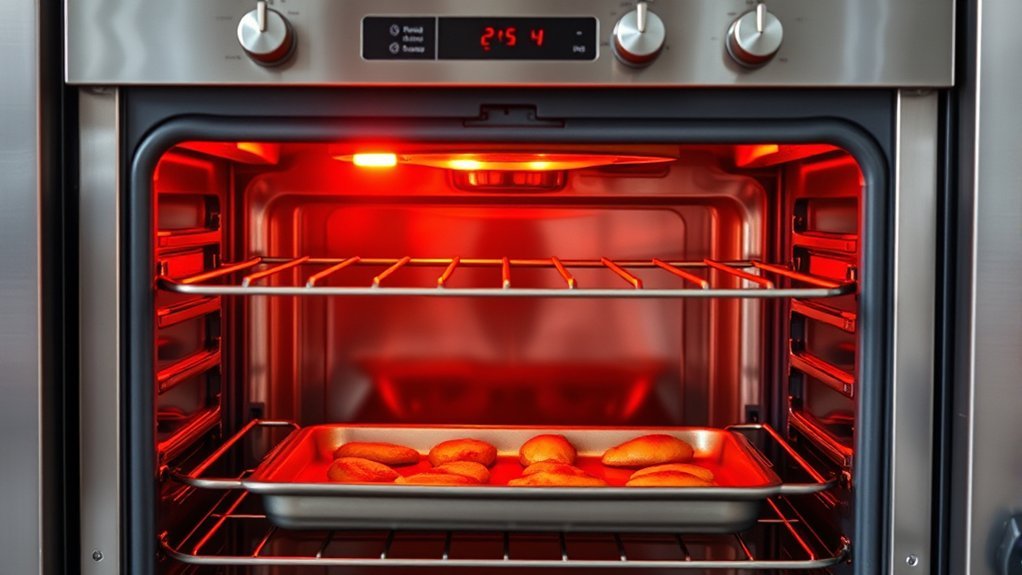
Broiling in an oven means cooking food with intense radiant heat from above, usually from an electric broil element or gas flame. It is designed for fast browning, searing, melting, and crisping. Broiling works especially well for thin meats, fish, vegetables, bread, and finishing dishes, but food needs close attention because the surface can brown very quickly.
Quick Answer
Broil is an oven setting that exposes food to strong direct heat, usually from above. Unlike baking, which surrounds food with more even heat, broiling concentrates heat on the surface for quick browning and crisping. Keep food close enough to brown but follow your oven manual for rack position, preheating, and whether the door stays open or closed.
Key Takeaways
- Broil uses direct radiant heat for fast browning, searing, melting, and crisping.
- Thin foods usually broil more evenly than thick cuts because the exterior heats much faster than the center.
- A rack position roughly 3–5 inches from the element is a common starting point, but your oven manual and recipe should control.
- Use sturdy broiler-safe metal cookware and avoid glass, parchment paper, and cookware not specifically rated for broiling.
- Do not rely on time or appearance alone for meat and poultry; use a food thermometer.
At a Glance
| Time Required | Often 5–20 minutes for many broiled foods, depending on thickness, rack position, and oven |
| Difficulty | Easy, but requires close monitoring |
| Tools Needed | Broiler-safe metal pan or broiler pan, tongs, oven mitts, and a food thermometer for meat, poultry, or fish |
| Cost | No special cost beyond the food if you already have suitable cookware and a thermometer |
Warning: Do not assume the oven door should stay open while broiling. Many modern ovens require closed-door broiling, while some older models use a partly open broil position. Follow the instructions for your exact appliance. Never leave food unattended under a hot broiler.
What Does Broil Mean in an Oven?
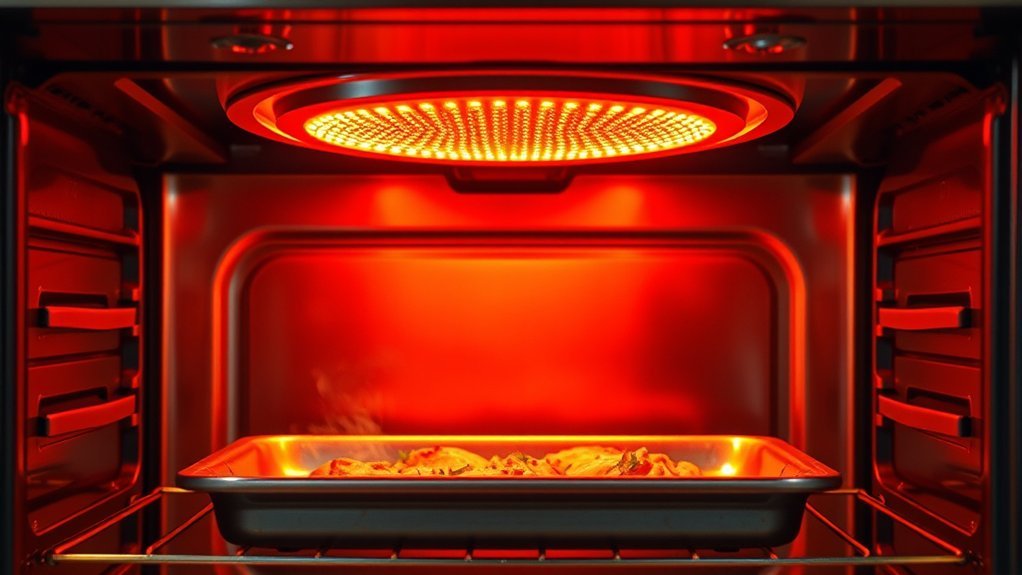
Broiling means exposing food to intense direct heat so the surface browns quickly. In most conventional ovens, the broil element or flame is above the food, making the method similar to upside-down grilling.
Broiling concentrates powerful radiant heat on the food’s surface, which is why it can brown or char food much faster than ordinary baking.
Broiling is useful when you want rapid surface browning rather than slow, even heating through a large piece of food. Common uses include searing thin steaks, cooking fish fillets, blistering peppers, browning cheese, crisping bread, and finishing casseroles.
Many ovens provide High Broil and Low Broil. High applies more intense heat for fast searing and browning. Low reduces the intensity or cycles the broiler differently, which can help thicker foods cook longer before the exterior burns.
Broiler layouts differ. In many ranges and wall ovens, the broil element is at the top of the oven cavity. Some gas ranges instead have a dedicated broiler drawer below the main oven.
Use sturdy cookware that the manufacturer specifically approves for broiling. Ordinary glass bakeware should not be placed under direct broiler heat.
How Does an Oven Broiler Work?
An oven broiler uses direct radiant heat rather than relying mainly on hot air surrounding the food. Electric ovens typically energize an upper heating element, while gas designs may use a burner or flame.
Because the food faces the heat source directly, its surface temperature rises quickly. That encourages browning, caramelization, blistering, and light charring while keeping overall cooking time relatively short.
- Thin meat can develop a browned exterior quickly.
- Fish can cook rapidly while developing color on the surface.
- Vegetables can blister and caramelize.
- Cheese and bread can brown in only a few minutes.
Rack position has a major effect. Moving food closer to the broiler increases heat intensity at the surface; moving it farther away slows browning and gives the center more time to cook.
The broil element may also cycle on and off in some ovens. That is normal and depends on appliance design, door position, temperature controls, and the selected broil mode.
Where Is the Broiler Setting?
The Broil setting is selected from the oven controls. The actual heat source is usually located at the top of the oven cavity, although some ranges have a dedicated broiler drawer beneath the oven.
Many newer ovens offer High and Low broil settings. For example, some GE ovens use a High Broil setting around 550°F and a Low Broil setting around 450°F, but this is not universal. Broiler design and control temperatures vary by model.
Many full-size ovens benefit from roughly five minutes of broiler preheating before food is added. Whirlpool, for example, recommends about five minutes for many models. Other ovens and recipes may specify a different procedure, so check your owner’s manual before assuming that preheating is required.
Note: If your range has a broiler drawer, do not use that cavity as storage while the broiler or oven is operating. Remove pans or other stored items before heating the appliance.
Broil vs. Bake: What’s the Difference?
Broiling concentrates strong radiant heat directly on one side of the food, while baking uses a more moderate oven environment to heat food more evenly and gradually.
Broiling is therefore better for fast surface color, caramelization, and crisping. Baking is better when food needs time for the center and exterior to cook together.
| Broil | Bake |
|---|---|
| Strong direct radiant heat | More even surrounding heat |
| Fast surface browning | Slower, more uniform cooking |
| Best for thin foods and finishing | Best for breads, cakes, casseroles, and thicker dishes |
| Requires frequent checking | Usually more forgiving |
Heat Source Differences
During broiling, the main cooking energy comes from the broil element or burner and reaches the exposed surface directly. During baking, the oven maintains a broader heated environment, often cycling heating elements as needed to maintain the selected temperature.
Broil controls on many ovens operate at very high settings, but there is no single universal broiler temperature. Some models offer High and Low settings rather than one fixed temperature.
- Broil: concentrated radiant heat directed at the food.
- Bake: more even heating throughout the oven cavity.
- Result: broil favors surface browning; bake favors more even internal cooking.
Cooking Speed and Browning
Broiling generally creates a darker crust faster than baking because the food sits much closer to an intense heat source. This is useful for caramelizing vegetables, browning cheese, crisping toppings, and searing thin proteins.
The same speed is also why food can burn quickly. A dish that needs only another minute of browning should be watched continuously rather than left unattended.
Best Uses for Each
Choose broil when the main goal is browning or quick cooking near the surface. Choose bake when food needs a longer, more even cooking period.
- Broil: steaks, thin chops, fish fillets, chicken cutlets, shrimp, vegetables, toast, melted cheese, and browned casserole toppings.
- Bake: cakes, breads, cookies, casseroles, larger roasts, and dishes that need steady internal heating.
- Combination approach: bake a dish until nearly done, then broil briefly to brown or crisp the top.
What Foods Are Best for Broiling?
Thin, evenly sized foods are usually the easiest foods to broil because they can cook through before the exterior burns.
Steaks, thin pork chops, fish fillets, chicken cutlets, and shrimp can all work well, provided their internal temperature is checked when food-safety guidance applies.
Vegetables such as asparagus, bell peppers, tomatoes, zucchini, onions, and broccoli can develop browned edges and concentrated flavor under direct heat.
Broiling is also useful for finishing foods. It can melt and brown cheese on French onion soup, crisp a casserole topping, toast garlic bread, or caramelize the surface of fruit such as pineapple.
Very thick foods are more challenging because the exterior can brown before the center is ready. Lower broil intensity, a lower rack position, or another cooking method followed by a brief broil may work better.
How Should You Set Up the Oven Rack?
Rack position controls how aggressively the broiler heats the food. Whirlpool gives a general starting guideline of roughly 3–5 inches between the food and broil element, but the correct position varies by oven, food thickness, and desired browning.
- Move thin foods closer to the element when they need quick browning.
- Place thicker or uneven foods farther away so the interior has more time to cook.
- If food is browning too fast, move the rack lower or use Low Broil if your oven provides it.
- For a dish that is already cooked and only needs a browned top, place it closer to the element and watch continuously.
Pro Tip: Adjust the rack before turning on the broiler. Moving a hot rack while the broiler is glowing makes burns more likely and is harder than setting the correct position while the oven is cool.
Which Pans Are Safe for Broiling?
Use cookware specifically designed to withstand direct high heat. Good choices commonly include broiler pans, sturdy stainless-steel pans, heavy metal baking sheets, and cast iron.
A broiler pan with a slotted grid is particularly useful for meat because grease drains below the food instead of pooling near the heat source.
Aluminum foil can be used with many metal broiler pans, but it should not block the grid’s drainage openings. If foil covers a slotted broiler grid, mold it tightly to the grid and make matching openings so grease can drain.
Do not line the bottom of the oven with foil unless the appliance manufacturer specifically instructs you to do so.
Safe Broiling Materials
- Broiler pan and grid: designed to tolerate broiler heat and allow fat to drain.
- Cast iron: handles very high heat well when the entire pan, including handles, is oven-safe.
- Stainless steel: generally suitable when the manufacturer rates the pan for broiler use.
- Heavy metal sheet pans: useful for vegetables and other lower-fat foods when rated for high heat.
- Aluminum foil: useful for lining appropriate metal cookware when drainage openings remain clear.
Always check the cookware manufacturer’s temperature and broiler-use instructions, especially when a pan has coated surfaces, plastic or silicone handles, bonded parts, or decorative finishes.
Pans to Avoid
Glass bakeware should generally not be placed under a broiler. Pyrex specifically warns against using its glassware under direct broiler heat because direct heat can damage the dish.
Ordinary coated or nonstick pans should also be avoided unless the manufacturer expressly states that the entire pan is broiler-safe at the temperature and distance you plan to use. Handles and coatings can have lower heat limits than the metal base.
Parchment paper and wax paper should not be used under a broiler. Reynolds states that its parchment paper is not intended for use with a broiling unit because direct broiler heat exceeds its normal oven-use conditions.
Warning: Never place paper, plastic containers, plastic wrap, or other materials near the broiler unless their manufacturer specifically approves them for that use. Direct radiant heat can exceed the limits of materials that are otherwise labeled oven-safe.
Should You Use High or Low Broil?
Use High Broil when you want fast searing, charring, melting, or surface browning. Use Low Broil when food needs more time for the center to cook before the exterior becomes too dark.
- High Broil: thin steaks, vegetables, toast, cheese toppings, and quick finishing.
- Low Broil: thicker meat, bone-in pieces, or foods that brown before they cook through.
- Rack position: moving food closer increases browning even without changing the broil setting.
Not every oven has both settings. If yours offers only one broil mode, control the intensity mainly through rack position and cooking time.
How Long Should You Broil Common Foods?
Broiling time varies considerably with food thickness, rack distance, oven design, starting temperature, and whether the broiler was preheated. Treat cooking times as starting points rather than safety endpoints.
| Food | Approximate Broiling Guide | Safety / Doneness Check |
|---|---|---|
| Thin fish fillets | Often about 5–10 minutes total, depending on thickness | Fish: 145°F, or follow current food-safety guidance |
| Chicken cutlets | Often about 8–12 minutes total, turning when appropriate | Poultry: 165°F |
| 1-inch steak | Often roughly 8–15 minutes total, depending on desired doneness and broiler | FoodSafety.gov recommends 145°F plus a 3-minute rest for whole beef cuts |
| Pork chop | Time varies widely with thickness; begin checking early | 145°F plus a 3-minute rest |
| Shrimp | Often a few minutes per side | Cook until flesh is pearly or white and opaque |
| Asparagus or sliced peppers | Often about 5–10 minutes, turning as needed | Cook to desired tenderness and browning |
| Pineapple or banana | Usually only a few minutes | Remove when caramelized but not scorched |
For meat, poultry, and fish, a thermometer is more reliable than color or time alone. According to FoodSafety.gov, whole cuts of beef and pork should reach 145°F (63°C) followed by a three-minute rest, poultry should reach 165°F (74°C), and fish should reach 145°F (63°C).
Some recipes use lower temperatures for particular steak doneness levels, but those temperatures do not replace the USDA consumer safe-minimum recommendation.
How Do You Keep Broiled Food From Burning?
Preventing burned food comes down to rack position, heat setting, food thickness, and frequent observation.
If the surface darkens too quickly, move the rack farther from the element or switch to Low Broil if available. For foods that need substantial internal cooking, consider cooking them partly with another method and using the broiler only at the end for browning.
Excess grease can also create smoke and flare-up risk. Use a broiler pan or rack that allows fat to drain, and keep the oven reasonably clean before high-heat cooking.
Sugar-heavy barbecue sauces, glazes, and marinades can scorch rapidly. Drain excess marinade and consider adding sweet sauces near the end of cooking rather than exposing them to intense heat for the entire broiling period.
Rack Distance Matters
The closer food sits to the broiler, the faster its exposed surface heats. A general 3–5-inch gap works for many foods, but thicker items often benefit from more distance.
Instead of applying one rack position to everything:
- place thin foods closer for quick searing;
- move thicker foods farther away;
- lower delicate foods if their edges darken too quickly;
- finish near the element only when rapid browning is the goal.
Watch Broiling Closely
Broiling requires close attention because strong radiant heat can turn a browned surface into a burned one very quickly.
Check food frequently, especially during the final minutes. Use oven mitts and tongs when turning or removing food, and keep combustible materials away from the hot element or flame.
Do not automatically leave the oven door open. Current appliance instructions differ. GE notes that most of its newer ranges and modern wall ovens use closed-door broiling, while certain older electric models use an open broil position. Some Whirlpool models turn the broil element off when the door opens.
Always follow the door-position instructions in your specific owner’s manual. If the manual requires a closed door, keep it fully closed during broiling.
Frequently Asked Questions
When should you use broil on an oven?
Use broil when you need fast, high-intensity surface heat. It works well for browning thin meats, cooking fish, blistering vegetables, melting cheese, crisping bread, caramelizing fruit, and finishing casseroles. For thick foods, another cooking method followed by a short broil is often easier to control.
What do you use broil for on an oven?
Broil is used for rapid browning, searing, melting, crisping, and light charring. Common examples include steaks, chicken cutlets, fish fillets, shrimp, asparagus, peppers, garlic bread, cheese toppings, and foods that need a browned finish after baking.
Do I leave the oven door open when broiling?
Only if your oven manufacturer specifically instructs you to do so. Many modern ovens require the door to remain closed, while some older electric models have a partly open broil position. Gas ovens commonly require closed-door broiling. Check the owner’s manual for your exact model rather than using one rule for every oven.
Is broil top heat or bottom heat?
In a conventional oven cavity, broiling normally uses direct heat from the upper element or burner, so it is considered top heat. Some ranges instead place a dedicated broiler burner in a drawer below the main oven. In either design, the food faces a direct radiant heat source.
Do you need to preheat the broiler?
Many ovens benefit from a short broiler preheat. Whirlpool commonly recommends about five minutes on its full-size ovens, but model instructions vary. Follow your oven manual and recipe because some foods or appliances use a different procedure.
Can you put parchment paper under the broiler?
No. Parchment paper is intended for ordinary oven temperatures, not direct broiler heat. Reynolds specifically states that its parchment paper should not be used with a broiling unit. Use suitable metal cookware or foil according to the pan and oven manufacturer’s instructions instead.
Conclusion
Broiling is a fast cooking method that uses intense direct radiant heat to brown, sear, melt, char, or crisp food. It is especially useful for thin proteins, vegetables, bread, cheese toppings, and finishing dishes after baking.
The best results come from matching the rack position and broil setting to the food’s thickness, using broiler-safe cookware, and watching the food closely. Do not assume that every broiler operates at the same temperature or uses the same door position.
For meat, poultry, and fish, use a food thermometer rather than cooking time alone. Current FoodSafety.gov guidance calls for 145°F with a three-minute rest for whole cuts of beef and pork, 165°F for poultry, and 145°F for fish.
Sources
- FoodSafety.gov — Safe Minimum Internal Temperatures — safe internal temperatures for beef, pork, poultry, fish, and other foods.
- GE Appliances — Oven Door Position During Broil — open-door versus closed-door broiling guidance and model differences.
- Whirlpool — What Is a Broiler? — general broiling method, rack distance, and preheating guidance.
- Pyrex — Frequently Asked Questions — manufacturer warning against using Pyrex glassware under a broiler.
- Reynolds Kitchens — Parchment Paper Safety — parchment temperature limitations and warning against broiler use.

2 thoughts on “What Does Broil Mean in an Oven? How It Works”