
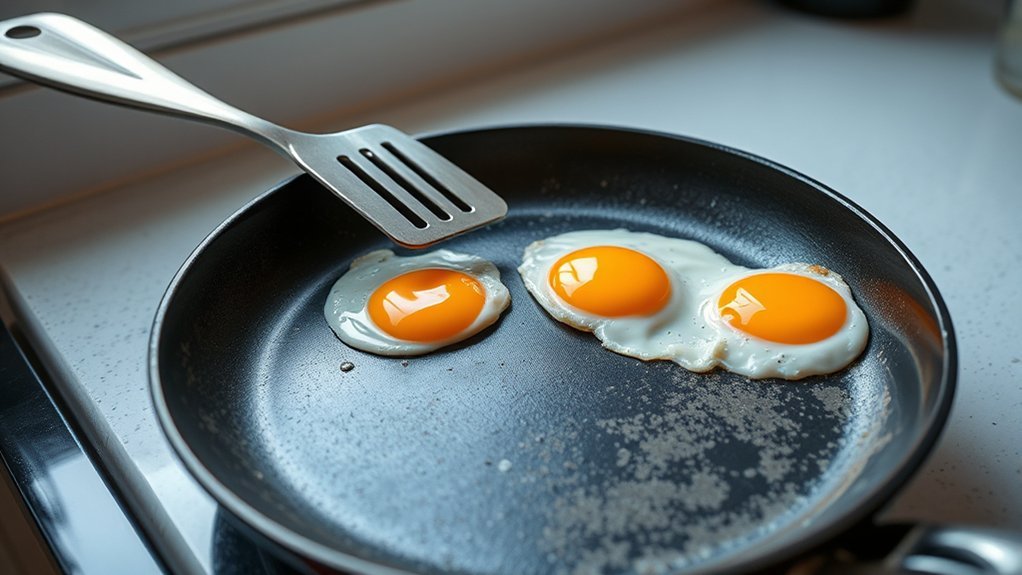
A pan is usually considered nonstick when it has a manufactured low-friction coating, such as PTFE or ceramic nonstick, that helps food release with less oil and easier cleanup. The most reliable way to identify that coating is to check the pan’s manufacturer, model number, packaging, or official specifications. Color, texture, water beading, and egg release can provide clues, but none proves the coating type by itself. Condition matters too: persistent sticking, peeling, blistering, exposed base metal, or serious warping can mean the pan has reached the end of its useful life.
Quick Answer
The best way to tell whether a pan is nonstick is to check its label, model number, or manufacturer specifications for PTFE, fluoropolymer, ceramic nonstick, or similar coating language. Appearance and food release are only clues. Replace a pan if its coating is peeling, blistering, badly worn through, or exposing the metal underneath.
Key Takeaways
- Manufacturer markings and product specifications are more reliable than judging a pan by color or water droplets.
- PTFE, ceramic nonstick, seasoned cast iron, carbon steel, and hard-anodized aluminum can all behave differently even when they look similar.
- PFOA-free does not mean the same thing as PTFE-free or PFAS-free.
- Cleaning baked-on oil can improve sticking problems, but a worn manufactured coating cannot be rebuilt with oil or seasoning.
- For PTFE cookware, avoid empty high-heat preheating and follow the manufacturer’s temperature limit.
At a Glance
| Time Required | 5–10 minutes |
| Difficulty | Easy |
| Tools Needed | Good lighting, manufacturer/model information, soft sponge, and optionally a silicone spatula for a low-heat food-release check |
| Cost | Usually $0 unless the pan needs replacement |
How to Tell If a Pan Is Nonstick
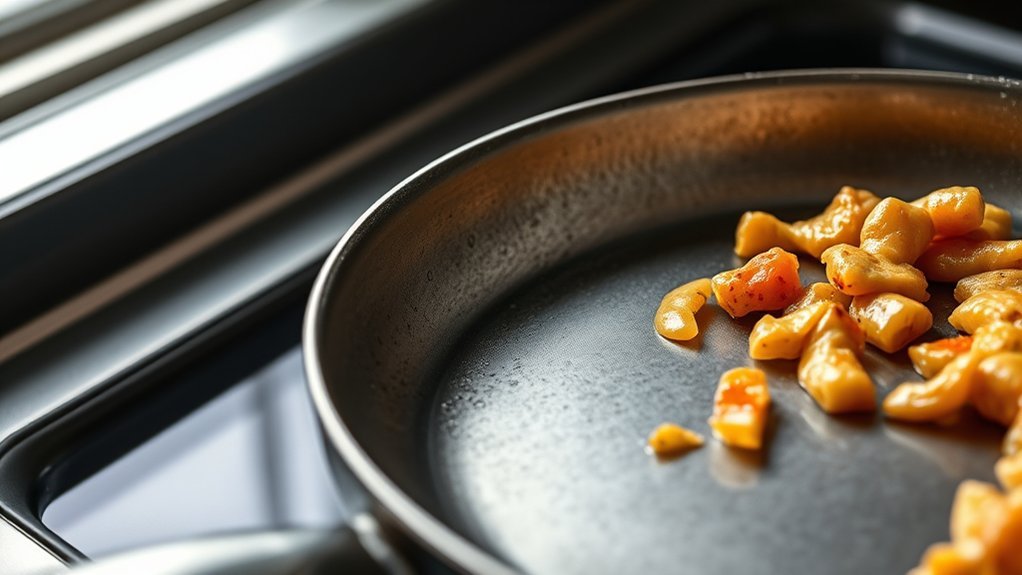
The most reliable way to identify a nonstick pan is to start with information supplied by its manufacturer rather than judging the cooking surface by appearance alone. Look on the underside, handle, packaging, or product documentation for terms such as PTFE, fluoropolymer, ceramic nonstick, nonstick coating, or a proprietary coating name.
If you can find a brand and model number, search the manufacturer’s official product page or manual. This is especially useful because a dark gray or black surface does not automatically mean PTFE. Hard-anodized aluminum can also be dark, while cast iron and carbon steel become dark after seasoning.
- Inspect the pan while it is cool and clean. Look for an even surface rather than judging by color alone.
- Find manufacturer markings. Check the bottom, handle, packaging, or original manual for the brand and model.
- Look for coating terminology. PTFE, fluoropolymer, ceramic nonstick, and proprietary coating names are stronger evidence than appearance.
- Check the surface condition. Peeling, blistering, exposed metal, deep wear, or severe warping indicates a problem even if the pan was originally nonstick.
- Use performance only as a secondary clue. If the pan is intact and its instructions allow it, a properly cooked egg over low-to-medium heat should release with little resistance from an effective nonstick surface.
A few drops of water on a cool pan may bead more readily on some low-energy coatings, but this is not a definitive identification test. On a hot pan, water can skate across many materials because of rapid vapor formation, so a hot-water droplet test does not prove that the pan has a nonstick coating.
Pro Tip: Do not scrape, scratch, cut, or perform a homemade “peel test” to identify a coating. A brand name, model number, manual, or manufacturer specification can often answer the question without damaging the pan.
How Nonstick Coatings Work
A manufactured nonstick coating reduces the attraction between food and the cooking surface. Traditional nonstick cookware often uses PTFE, a fluoropolymer with very low friction. The U.S. Food and Drug Administration explains that authorized PFAS-containing nonstick coatings are highly polymerized and bonded to cookware during manufacturing, with studies showing negligible migration from these coatings into food under their intended use. See the FDA’s information on authorized PFAS food-contact applications.
Many products marketed as ceramic nonstick instead use a sol-gel coating, commonly based on silica-containing chemistry. Exact formulations differ among manufacturers, so ceramic nonstick should not automatically be described as a specific titanium-and-silica formula. Likewise, a pan should only be called PFAS-free when reliable product information supports that claim.
| Surface type | What it is | How it releases food | Important clue |
|---|---|---|---|
| PTFE nonstick | Fluoropolymer coating applied over a metal pan | Very low-friction surface | Manufacturer may list PTFE, fluoropolymer, or a proprietary coating name |
| Ceramic nonstick | Usually a silica-based sol-gel coating | Smooth coating provides easy release when intact | Often marketed as PTFE-free; exact chemistry varies |
| Seasoned cast iron or carbon steel | Bare metal with layers of polymerized cooking fat | Seasoning creates a lower-stick cooking surface | Not the same as a factory-applied PTFE or ceramic coating |
| Hard-anodized aluminum | Aluminum with a hardened oxide surface; some pans also receive a separate nonstick coating | Depends on whether an additional coating is present | Dark color alone does not confirm PTFE or ceramic |
The performance of a factory-applied coating depends heavily on its condition. Abrasion, overheating, accumulated cooking residue, and normal wear can all reduce food release over time.
How to Tell If a Nonstick Pan Is Worn Out
A worn nonstick pan usually shows a combination of physical damage and declining cooking performance. Persistent sticking after proper cleaning is one clue, but visible coating failure is more important.
- Peeling or flaking: sections of coating are visibly lifting away.
- Blistering: bubbles or raised areas suggest loss of adhesion between the coating and pan.
- Exposed base metal: deep wear has removed the coating in one or more areas.
- Heavy scratching: numerous deep scratches have substantially damaged the cooking surface.
- Severe loss of release: food sticks despite correct heat, a clean surface, and normal use of fat.
- Warping: the pan rocks or no longer sits flat enough to heat properly.
Minor cosmetic marks are different from widespread delamination. The German Federal Institute for Risk Assessment states that accidentally swallowing tiny particles released from a scratched PTFE coating is not expected to harm consumers because PTFE is inert and is not digested. However, a substantially damaged pan may cook poorly, continue deteriorating, and be difficult to identify if its construction is unknown, so replacement is sensible when the coating is peeling, blistering, or worn through. See the BfR assessment of PTFE-coated cookware.
Age alone is not a reliable discard test. The U.S. EPA’s 2010/2015 PFOA Stewardship Program asked participating companies to work toward eliminating PFOA and related chemicals from emissions and product content by 2015. EPA also notes that existing stocks and some imported articles could still have contained PFOA. Therefore, “made before 2015” does not automatically prove that an individual pan contains PFOA. See the EPA PFOA Stewardship Program fact sheet.
Are Nonstick Pans Safe to Use?
Modern nonstick cookware should be evaluated by its specific material, condition, and intended-use instructions rather than by a simple “safe” or “toxic” label. The FDA reports that authorized highly polymerized PFAS coatings used on nonstick pots and pans have negligible migration into food. Correct use is still important, particularly with PTFE cookware.
Health Canada advises against preheating empty nonstick cookware and recommends avoiding high heat, giving approximately 260°C/500°F as an example. BfR reports that PTFE can decompose and release hazardous gases at temperatures around 360°C/680°F and above. A cookware manufacturer’s stated limit may be lower, so its instructions should take priority.
Warning: Do not leave an empty PTFE-coated pan over high heat. Use low-to-medium heat for normal stovetop cooking, ventilate the kitchen, and stay within the manufacturer’s stated stovetop and oven temperature limits.
- Keep the cooking surface clean so residue does not overheat and burn.
- Use wood, silicone, nylon, or another utensil recommended by the manufacturer.
- Avoid deliberately heating an empty pan for extended periods.
- Inspect peeling, blistered, or exposed areas before further use.
- Follow the product’s oven-safe temperature rather than assuming every nonstick pan has the same limit.
Note: “PFOA-free,” “PTFE-free,” and “PFAS-free” are not interchangeable. PFOA is one PFAS formerly used in manufacturing; PTFE is a fluoropolymer included within broad PFAS definitions. Check the exact wording and supporting information for the individual product.
For a PTFE pan in normal household use, preventing empty-pan overheating is more useful than trying to judge safety from the color of the coating alone.
What Makes a Pan Nonstick?
A pan’s nonstick performance comes from a surface that reduces how strongly food adheres. With conventional nonstick cookware, that surface is usually a factory-applied PTFE or ceramic coating. With cast iron and carbon steel, a lower-stick surface can instead develop through layers of polymerized seasoning.
The base metal still matters because it determines weight, heat distribution, responsiveness, and durability. Aluminum is common beneath nonstick coatings because it conducts heat well, while some cookware uses stainless steel construction with one or more bonded layers.
Water and oil may bead on low-energy surfaces, but beading should not be used as the sole proof that a particular chemical coating is present. Cleanliness, temperature, surface treatment, and seasoning also affect how liquids behave.
Nonstick Coating Types
Several cooking surfaces can provide easier food release, but they are not chemically identical.
- PTFE or fluoropolymer coating: usually very slick when intact and designed for low-to-medium-heat cooking.
- Ceramic nonstick: typically a sol-gel coating whose exact formulation varies by manufacturer.
- Seasoned cast iron: develops layers of polymerized fat instead of relying on a factory-applied synthetic nonstick coating.
- Seasoned carbon steel: uses the same general seasoning principle but on thinner, more responsive steel.
- Hard-anodized aluminum: has a hardened oxide surface and may or may not also have a separate PTFE or ceramic nonstick layer.
Terms such as “granite,” “stone,” “diamond,” or “titanium” on packaging often describe appearance, reinforcement, or proprietary technology rather than identifying the entire coating chemistry. Check the manufacturer’s detailed material specifications when composition matters.
How Nonstick Works
At the surface level, nonstick cookware works by reducing the tendency of proteins, starches, and other food components to bond tightly to the pan. PTFE achieves very low surface friction, while ceramic coatings use a different inorganic-organic surface system to provide release.
| Condition | What Happens | Best Response |
|---|---|---|
| Coating is clean and intact | Food releases with relatively little resistance | Continue normal low-to-medium-heat use |
| Grease or residue has built up | Surface may feel sticky even though the coating remains intact | Clean gently and thoroughly |
| Surface has deep scratches or worn-through areas | Release becomes uneven and the coating may continue deteriorating | Inspect closely and replace if substantially damaged |
| Pan is overheated | Coating performance can decline; extreme PTFE overheating can produce hazardous gases | Stop heating, ventilate, allow the pan to cool, and follow manufacturer guidance |
| Pan is warped | Burner contact and heat distribution become uneven | Replace if warping interferes with stable, even cooking |
A coating that has physically worn away cannot be restored to its original factory thickness at home.
How to Restore a Worn Nonstick Pan
First determine whether the pan is truly worn or merely covered with cooking residue. Baked-on oil, food film, and residue around rivets can make an otherwise intact nonstick surface feel sticky.
If the coating is still continuous, cleaning may improve food release:
- Let the pan cool completely. Avoid putting a very hot pan directly under cold water.
- Soak it briefly if necessary. Warm water and mild dish soap can soften cooked-on residue.
- Wash with a soft sponge or cloth. Do not use steel wool, harsh scouring powders, or abrasive pads unless the manufacturer specifically allows them.
- Rinse and dry thoroughly. Check the dry surface under good light for peeling, blistering, or exposed base metal.
- Test it during normal cooking. Use low-to-medium heat and the amount of fat appropriate for the food and the manufacturer’s instructions.
For stubborn residue, consult the pan manufacturer’s cleaning instructions before using baking soda or any specialty cleaner. Some manufacturers permit a mild baking-soda paste, while others recommend different methods.
Pro Tip: If cleaning restores easy food release and the coating remains smooth and intact, residue was probably the problem. If sticking remains severe and the coating is visibly worn through, no household seasoning treatment can rebuild the original manufactured coating.
Applying oil may temporarily lubricate a cooking surface, but it does not repair missing PTFE or ceramic material. Likewise, aerosol cooking spray should not be treated as a coating-restoration product; some sprays can leave residue that becomes difficult to remove.
If peeling, blistering, substantial flaking, or exposed metal is visible, replacement is the practical solution.
How to Care for a Nonstick Pan
Proper care slows wear and helps a nonstick coating maintain its release properties. The manufacturer’s instructions always take priority because coatings, handles, oven limits, and dishwasher compatibility vary.
For everyday use, low-to-medium heat, non-abrasive utensils, careful cleaning, and protected storage are sensible defaults. Avoid unnecessarily heating an empty pan and do not use it beyond its rated temperature.
Gentle Cleaning Methods
Allow the pan to cool before washing it. Mild dish soap, warm water, and a soft sponge or cloth are usually sufficient because intact nonstick cookware should not require aggressive scrubbing.
If residue remains, a short soak can loosen it. Avoid assuming that “dishwasher-safe” and “best cleaned in a dishwasher” mean the same thing: some cookware is technically dishwasher-safe, but hand-washing may still be recommended to preserve appearance and coating life. Follow the manufacturer for the specific pan.
- Cool the pan before washing.
- Use mild dish soap and a soft sponge or cloth.
- Soak stubborn residue instead of scraping it with metal.
- Avoid steel wool and harsh abrasive cleaners unless specifically approved.
- Dry the pan and inspect the surface periodically for coating failure.
Preventing Coating Damage
Everyday habits have a large effect on how long a nonstick surface remains useful. Health Canada recommends following the manufacturer’s intended use and specifically advises against empty high-heat preheating of nonstick cookware.
| Action | Purpose |
|---|---|
| Use wood, silicone, nylon, or manufacturer-approved utensils | Reduce unnecessary scratching |
| Use low-to-medium heat for routine cooking | Reduce heat stress on the coating |
| Avoid prolonged empty preheating | Prevent rapid overheating |
| Hand-wash gently when practical | Limit abrasive wear and harsh detergent exposure |
| Place a towel or pan protector between stacked pans | Prevent storage scratches |
| Inspect the coating periodically | Catch peeling, blistering, exposed metal, or severe wear early |
Frequently Asked Questions
How Do I Tell if My Pan Is Nonstick or Not?
Check the manufacturer name, model number, packaging, or official specifications first. Look for terms such as PTFE, fluoropolymer, ceramic nonstick, or a proprietary coating name. A smooth dark or speckled surface and easy egg release can support the identification, but appearance alone is not conclusive because hard-anodized aluminum, cast iron, and seasoned carbon steel can also be dark.
What Causes Nonstick Pans to Stick?
Common causes include baked-on oil or food residue, normal coating wear, scratches, overheating, and using cooking methods outside the manufacturer’s recommendations. Clean the pan gently first. If the coating remains intact and release improves, residue was likely the problem. If the coating is worn through, peeling, or blistering, cleaning cannot rebuild it.
How Do I Know if My Non-Stick Pan Is Toxic?
Do not judge a pan as “toxic” simply because it contains PTFE or falls within a broad PFAS definition. The FDA says authorized highly polymerized PFAS nonstick coatings have negligible migration into food under their intended use. For PTFE cookware, the more practical precautions are to avoid empty high-heat preheating, follow the manufacturer’s temperature limit, ventilate the kitchen, and replace cookware with substantial peeling or coating failure.
Should I Throw Away My Non-Stick Pans?
Replace a nonstick pan when the coating is peeling, blistering, substantially worn through, exposing base metal, or performing poorly despite thorough cleaning and correct use. Severe warping is another reason to replace it. Age by itself is not a reliable test, although an old unlabeled pan with unknown history and significant wear may be easier and more practical to replace.
Does PFOA-Free Mean the Pan Is PFAS-Free?
No. PFOA is one member of the PFAS family. PTFE is a fluoropolymer that also falls within broad PFAS definitions. Therefore, a PTFE-coated pan can be PFOA-free without being PFAS-free. If avoiding PFAS is important to you, look for a specific PFAS-free claim supported by detailed manufacturer information or appropriate testing.
Can I Restore a Worn Nonstick Coating?
You can sometimes improve a sticky but intact surface by removing cooked-on grease and residue with manufacturer-approved cleaning methods. You cannot rebuild missing PTFE or ceramic coating at home with oil, spray, or seasoning. If the manufactured coating is peeling, blistering, or worn through to the metal, replace the pan.
Conclusion
The most dependable way to determine whether a pan is nonstick is to identify its manufacturer, model, and stated surface material rather than relying on color or water droplets alone. PTFE and ceramic coatings provide manufactured nonstick performance, while seasoned cast iron and carbon steel achieve easier release differently. If an intact pan starts sticking, careful cleaning may remove residue and restore normal performance. If the coating is peeling, blistering, worn through, or the pan is badly warped, however, the original surface cannot be rebuilt at home and replacement is the practical choice. Proper heat, gentle utensils, careful washing, and protected storage can slow future wear.
Sources
- U.S. Food and Drug Administration — Authorized Uses of PFAS in Food Contact Applications — supports information about polymerized nonstick coatings and migration into food.
- U.S. Environmental Protection Agency — 2010/2015 PFOA Stewardship Program — documents the PFOA phaseout timeline and limitations of a simple 2015 cutoff.
- Health Canada — The Safe Use of Cookware and Bakeware — supports guidance on nonstick cookware, empty-pan heating, ventilation, and the 260°C/500°F high-heat precaution.
- German Federal Institute for Risk Assessment — PTFE Non-Stick Cookware Assessment — supports information about overheating, PTFE decomposition, normal intended use, and accidentally ingested coating particles.
- Results in Engineering — Sol-Gel Ceramic Non-Stick Coatings Study (2025) — supports discussion of ceramic coating formulation and differences in nonstick durability compared with PTFE.