
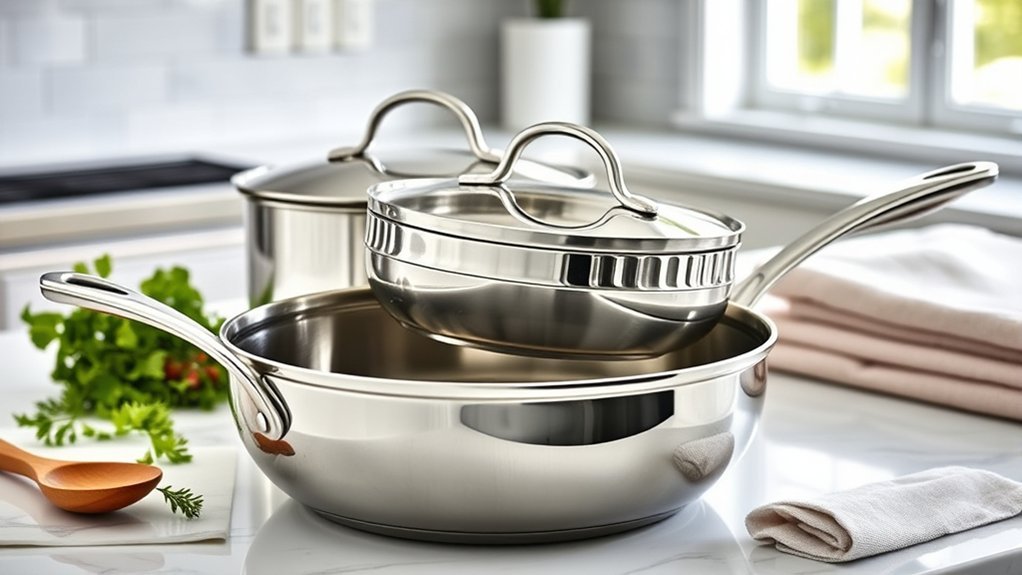
Clad cookware combines two or more metals in one bonded cooking vessel so each material can do what it does best. Stainless steel commonly forms the durable cooking and exterior surfaces, while aluminum, copper, or another conductive material helps spread heat. Fully clad cookware carries those bonded layers through the sidewalls, while disk-bottom cookware concentrates its conductive layers mainly in the base.
Quick Answer
Clad cookware is made by bonding different metals into one pan or pot. Fully clad cookware extends those bonded layers from the base up the walls, while disk-bottom cookware places most of its conductive material underneath. Good performance depends on the metals, thickness, weight, and design—not simply whether a pan has three, five, or more layers.
Key Takeaways
- “Clad” means different metals are bonded together; “fully clad” means that layered construction continues up the sidewalls.
- Aluminum and copper spread heat much more effectively than stainless steel, while stainless steel provides durability and a practical cooking surface.
- Ply count alone does not determine quality. Material type, conductive-layer thickness, total mass, shape, and build quality matter more.
- Disk-bottom cookware is not automatically inferior; a thick, well-engineered base can perform very well, especially in saucepans and stockpots.
- For induction, confirm that the pan has a magnetic exterior or base specifically rated for induction use.
What Is Clad Cookware?
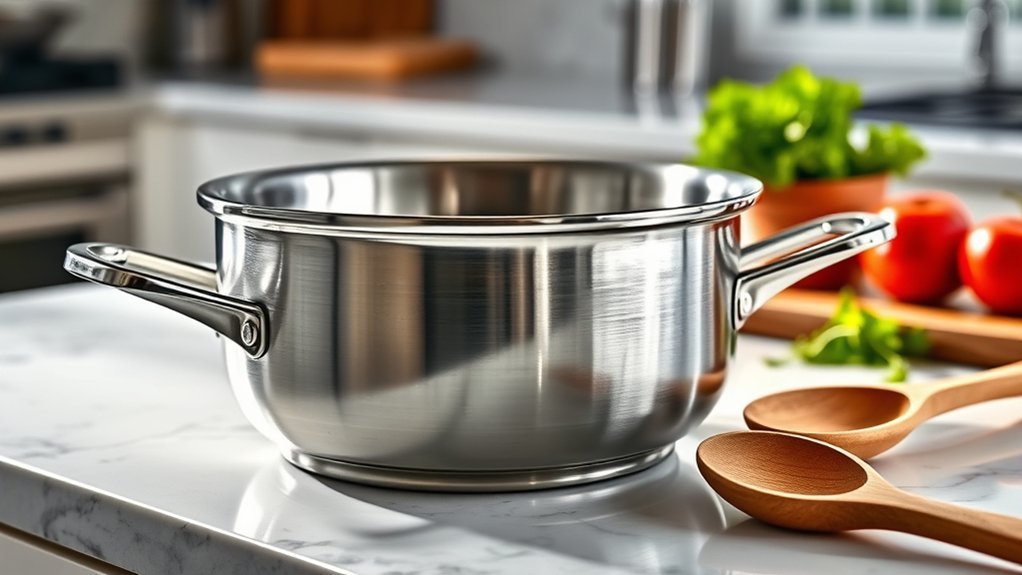
Clad cookware is made by permanently bonding two or more layers of different metals into a single cooking vessel. Stainless steel is commonly paired with aluminum or copper because the materials have complementary properties: stainless steel is durable and corrosion-resistant, while aluminum and copper spread heat efficiently.
The word clad does not, by itself, mean that only the bottom is layered. That distinction is important. In fully clad cookware, the bonded construction extends from the base up the sidewalls, usually to the rim. In disk-bottom or encapsulated-base cookware, a separate conductive disk is bonded to the bottom of a stainless-steel vessel.
Tri-ply and five-ply describe the number of bonded layers, but those numbers do not tell the whole story. Two pans with the same ply count can perform differently because of differences in aluminum or copper thickness, overall mass, pan diameter, wall thickness, and manufacturing quality.
Clad stainless cookware is especially useful for sautéing, searing, simmering, deglazing, pan sauces, braising, and other techniques that benefit from predictable heat distribution and a durable cooking surface.
How Clad Cookware Is Made
Clad cookware is manufactured by joining different metal layers so they behave as one structure during heating and cooling. Manufacturers use specialized bonding processes involving pressure, heat, rolling, or combinations of those techniques.
The exact construction varies by brand. A common tri-ply design places an aluminum core between an interior layer of stainless steel and an exterior layer of stainless steel. Five-ply designs add additional stainless-steel, aluminum, copper, graphite, or other layers depending on the performance goal.
The important point is not simply how many sheets are present. The cookware must maintain a strong bond through repeated heating and cooling while putting enough conductive material where it can effectively spread heat.
Metal Layers Bonded
A layered construction lets manufacturers combine metals with different strengths. Stainless steel provides a tough cooking surface and exterior structure, while aluminum or copper supplies much of the thermal conductivity.
A typical three-ply stainless pan therefore uses:
- Stainless-steel interior: durable cooking surface that tolerates browning, deglazing, and acidic ingredients well in normal culinary use.
- Aluminum or another conductive core: spreads burner heat across a wider area and responds to heat adjustments.
- Stainless-steel exterior: adds durability and, when a magnetic grade is used, can make the pan induction compatible.
Five-ply construction may divide those functions among additional layers. That can change weight, heat retention, responsiveness, and structural stiffness, but an extra layer is useful only when the materials and thicknesses serve a practical purpose.
Base-to-Rim Construction
In fully clad cookware, bonded layers continue from the bottom through the sidewalls. This allows conductive material to spread heat beyond the area directly over the burner.
That characteristic is especially useful in skillets, sauté pans, sauciers, and other vessels where food contacts both the bottom and lower sidewalls. It can also reduce the sharp temperature transition between the heated base and cooler upper walls.
Full-body cladding does not make a pan immune to damage. Excessive empty-pan heating and sudden thermal shock can still distort cookware. All-Clad, for example, warns that very high heat and sudden temperature changes can contribute to warping.
Warning: Do not plunge a very hot stainless-steel pan into cold water. Let it cool first. Rapid temperature changes can cause even premium clad cookware to warp.
Clad vs. Fully Clad Cookware
Clad cookware is the broad category: it uses bonded layers of different metals. Fully clad cookware is a specific type in which that layered structure continues through the walls. A pan with a separate bonded disk on its base is better described as disk-bottom or encapsulated-base cookware.
| Construction | Where conductive layers are located | Typical strength | Potential trade-off |
|---|---|---|---|
| Fully clad | Base and sidewalls | More continuous heat spreading across the vessel | Often costs more and may add weight |
| Disk-bottom | Primarily the base | A thick base can spread and retain heat very effectively | Sidewalls receive less help from the conductive core |
| Single-material stainless steel | No separate conductive core | Durable and simple | Stainless steel alone spreads heat less efficiently than aluminum or copper |
The best construction depends on the vessel and cooking style. Full cladding is particularly useful in skillets and sauté pans. A heavy disk base can work extremely well in saucepans and stockpots where most of the heat transfer takes place through the bottom.
Why Fully Clad Pans Cook Better
Well-designed fully clad pans can provide more continuous heat distribution because their conductive layer is not restricted to a disk under the bottom. Heat can spread laterally through the base and upward into the lower walls.
This is useful during sautéing and pan roasting, where ingredients may contact the sloped or vertical sides. It also helps a saucier or saucepan maintain a smoother temperature transition where sauces touch the walls.
Stainless steel typically forms the food-contact surface because it is durable, corrosion-resistant, and suitable for browning and deglazing. Aluminum or copper inside the bonded structure handles much of the heat spreading.
Many fully clad stainless-steel pans are induction compatible, but induction compatibility is not guaranteed merely because a pan contains stainless steel. The exterior or base must contain a magnetic material that couples with the induction element. Check the manufacturer’s specification or look for an induction symbol.
The most useful question is not “How many plies does this pan have?” but “What are those layers made of, how thick are they, and where do they extend?”
Do More Metal Layers Help?
More layers can help, but ply count alone is not a reliable measure of cookware performance. A three-ply pan with a substantial aluminum core can distribute heat extremely well, while a five-ply pan made with thin conductive layers may not provide a proportional improvement.
Construction variables that matter include:
- the type of conductive metal;
- the thickness of the aluminum, copper, graphite, or other heat-spreading material;
- the total mass of the pan;
- whether the layers extend through the walls;
- the pan’s diameter and geometry;
- the magnetic exterior used for induction;
- and the quality of the bond between layers.
Extra mass generally increases heat capacity, which can help a pan maintain temperature when cold food is added. The trade-off is that heavier cookware may feel slower to change temperature and harder to maneuver.
All-Clad’s current D3 Stainless line uses three-ply construction, while D5 Stainless uses five bonded layers. Both are designed as premium cooking systems, but their layer counts alone do not establish which is best for every cook.
Pro Tip: When comparing cookware, look beyond “3-ply” or “5-ply.” Compare weight, conductive-core material, full-body versus base-only construction, handle comfort, oven rating, warranty, and how the pan feels when you lift it one-handed.
When Disk-Bottom Pans Can Fall Short
Disk-bottom pans place most of their conductive material underneath the cooking vessel rather than extending it up the sides. That can create a larger temperature difference between the base and the walls, particularly when the bonded disk is undersized or thin.
However, disk-bottom construction is not inherently low quality. A thick, properly sized conductive base can deliver excellent heat spreading, heat retention, and induction performance. Premium examples exist, including Demeyere Atlantis saucepans with an InductoSeal base.
The practical question is therefore how well the base is engineered, how far it extends toward the perimeter, and whether strong sidewall heating matters for the cooking task.
Uneven Heat Distribution
A poorly designed disk-bottom pan can develop a pronounced temperature transition near the outer edge of its conductive disk. This is more likely when the disk is significantly smaller than the pan’s cooking surface.
Possible symptoms include:
- browning that is strongest in the central area;
- cooler zones near the outer perimeter;
- greater temperature differences between the bottom and sidewalls;
- and more frequent repositioning of food during searing.
A well-designed disk base can minimize these problems, so construction quality matters more than the label alone.
Slow Bottom Heating
A thick disk base may take longer to heat than a lighter pan because it contains more metal. That is not always a disadvantage. The same thermal mass can help the pan hold its temperature when food is added.
For quick temperature changes, a lighter aluminum-rich clad pan may feel more responsive. For simmering or maintaining steady heat, additional base mass can be useful.
Burner type also changes the result. A heavy magnetic base can work particularly well on induction, while a small gas flame may place more value on conductive material that extends beyond the center of the base.
Weak Wall Performance
Disk-bottom cookware usually has less conductive material in its walls than fully clad cookware. That means the walls may stay cooler than the base, which can matter in sauciers, sauté pans, and skillets where food contacts a broad portion of the vessel.
This does not necessarily make the walls structurally weak or likely to detach. Durability depends on the grade and thickness of the steel, how the base is attached, manufacturing quality, and how the cookware is used.
For a stockpot primarily used to boil water, make soup, or cook pasta, extensive sidewall cladding may offer less practical benefit than it does in a skillet used for searing and pan sauces.
How to Spot Quality Clad Cookware
Quality clad cookware should combine sound construction with a design that suits the way you cook. A “fully clad” or “bonded to the rim” description is useful, but it should not be the only buying criterion.
Check the following:
- Construction: confirm whether the conductive core runs through the full body or only the base.
- Core material: aluminum is common and effective; copper can provide excellent thermal responsiveness; specialty constructions may use graphite or other materials.
- Weight: enough mass can improve stability and heat retention, but excessive weight may become tiring.
- Flatness: the base should sit securely on a flat cooktop.
- Handle design: lift the pan if possible and check balance, grip, and clearance from the hot body.
- Induction compatibility: confirm it explicitly if you use an induction range.
- Oven limits: check the manufacturer’s temperature rating for both vessel and lid.
- Warranty: read the exclusions instead of relying only on the phrase “lifetime warranty.”
Full-body cladding is a useful quality feature, but metal choice, core thickness, pan geometry, workmanship, and ergonomics determine how useful that construction is in practice.
All-Clad currently backs its qualifying cookware with a limited lifetime warranty, subject to its stated terms and exclusions. Other brands use different coverage, so compare the actual warranty rather than assuming all premium cookware receives identical protection.
Best Uses for Clad Cookware
Fully clad cookware is especially versatile when a recipe needs both even heating and quick control over burner changes. It is well suited to searing, sautéing, pan roasting, sauces, reductions, shallow braising, and stovetop-to-oven cooking when the particular model is oven rated for the required temperature.
Stainless clad cookware also supports deglazing: browned food residue can be loosened with stock, wine, water, or another liquid to build a pan sauce.
It is less ideal when the cook specifically needs effortless low-fat release for fragile foods. Stainless steel can cook eggs and delicate fish successfully with proper heat and fat management, but a dedicated nonstick pan may be easier for those jobs.
Everyday Searing And Sautéing
Everyday searing and sautéing are among the strongest uses for fully clad stainless cookware. Conductive internal layers spread burner energy while the stainless-steel surface tolerates the temperatures needed for browning.
- Preheat over low to moderate or medium heat rather than blasting an empty pan on maximum heat.
- Pat meat or vegetables dry when strong browning is the goal.
- Add cooking fat after preheating according to the manufacturer’s instructions.
- Give proteins time to brown before trying to move them; many foods release more easily once a crust has formed.
- Deglaze the browned residue to make a sauce instead of scrubbing away flavor immediately.
All-Clad’s current stainless-care guidance likewise recommends controlled preheating rather than unnecessarily high burner settings.
Even Heat For Delicate Dishes
Clad cookware can also work well for sauces, custards, reductions, and other foods that benefit from steady, distributed heat. Conductive aluminum or copper helps reduce sharp temperature differences across the cooking surface.
Stainless steel is corrosion-resistant and generally suitable for cooking tomato, citrus, wine, and other acidic ingredients. It is more accurate, however, to call stainless steel highly corrosion-resistant rather than completely nonreactive.
Published research has measured nickel and chromium migration from stainless-steel cookware under some conditions, with results affected by alloy, acidity, cooking time, whether the cookware is new, and other variables. Another study using more typical one-hour cooking conditions found amounts below known allergy-triggering thresholds in its experiments.
Note: Most people use stainless-steel cookware without a special restriction. Someone with a diagnosed nickel sensitivity or a clinician-directed low-nickel diet may need more individualized guidance because stainless alloys commonly contain nickel.
Which All-Clad Collections Stand Out?
All-Clad currently sells several cookware constructions aimed at different priorities. The major stainless families should be compared by material and design rather than simply by price.
- D3 Stainless: classic three-ply construction with an aluminum core between stainless-steel layers. It is the straightforward fully bonded option for everyday stainless cooking.
- D3 Everyday: also based on All-Clad’s tri-ply technology, with design changes such as contoured handles and expanded cooking-surface geometry on applicable pieces.
- D5 Stainless: five-ply bonded construction using alternating stainless-steel and aluminum layers for a heavier, more thermally stable build.
- Copper Core: five-ply construction incorporating copper along with aluminum and stainless steel for fast heat response and precise temperature control.
- G5 Graphite Core: five-layer construction that incorporates graphite in the cooking-surface core to reduce weight and accelerate heating and cooling. All-Clad states that the graphite itself does not extend all the way to the rim, although the other bonded materials do.
- NS Pro Nonstick: a different category from the stainless fully bonded lines. Current NS Pro cookware uses heavy-gauge aluminum with a PTFE nonstick system reinforced with ceramic plasma; induction compatibility varies by piece.
Current construction details can be checked directly on All-Clad’s stainless cookware comparison, G5 Graphite Core page, and NS Pro collection page.
What to Check Before Buying All-Clad
Before buying All-Clad—or any premium clad cookware—match the construction to the task instead of assuming the most expensive line is automatically the correct choice.
Start with the vessel. A skillet benefits greatly from broad, even heat spreading. A saucepan may benefit from sidewall conductivity when making reductions and sauces. A large stockpot used mostly for water, soups, or pasta may not require the same construction as a fry pan.
Then compare weight and responsiveness. D3 offers a relatively simple tri-ply structure. D5 adds layers and mass. Copper Core emphasizes copper-assisted responsiveness, while G5 is designed around faster heating with lower weight.
Confirm cooktop compatibility. Current D3, D5, Copper Core, and G5 stainless products include induction-compatible designs, but buyers should still confirm the specification of the exact piece. Nonstick ranges and specialty shapes can differ.
Check care instructions. Manufacturer recommendations vary by collection and can change. For example, current All-Clad pages for some stainless products specify hand washing, while individual nonstick products have their own cleaning and utensil restrictions.
Read the warranty. All-Clad’s limited lifetime warranty covers qualifying defects in material, construction, or workmanship under its conditions, but excludes various forms of misuse, ordinary wear, high-heat damage, and other situations described in the warranty.
Finally, make sure you actually like the handle, balance, weight, lid, rim shape, and interior dimensions. Those details affect every cooking session and may matter more in daily use than an additional ply.
How to Care for Clad Cookware
Good care protects both cooking performance and flatness. Always follow the instructions for your specific brand and collection, because stainless, copper-containing, graphite-core, and nonstick cookware can have different care requirements.
- Wash new cookware before its first use.
- Avoid prolonged empty heating, especially over maximum burner output.
- Use a burner reasonably matched to the pan’s diameter.
- Let very hot cookware cool before exposing it to cold water.
- For stainless steel, soak stubborn residue and use non-abrasive cleaning methods recommended by the manufacturer.
- Do not assume every product from the same brand has the same dishwasher, broiler, utensil, or oven rating.
- Inspect bonded edges if cookware develops unusual roughness, separation, or deformation.
Proper heat management also improves cooking. Stainless cookware generally does not need maximum burner output for routine sautéing or searing because conductive inner layers distribute heat efficiently.
Frequently Asked Questions
What Is the Difference Between Stainless Steel and Clad?
Stainless steel describes a family of corrosion-resistant metal alloys. Clad describes a construction method in which different metals are bonded together. A clad pan can therefore have stainless-steel inner and outer layers with aluminum or copper inside. Stainless cookware may be fully clad, disk-bottom, or made using another construction.
Is Clad Cookware Safe?
Clad cookware from reputable manufacturers is widely used for normal food preparation, but safety depends on the materials and condition of the individual product. Stainless-steel cooking surfaces are durable and corrosion-resistant. Studies have measured some nickel and chromium migration under certain conditions, so people with significant metal sensitivities should consider individualized medical guidance. Damaged, delaminating, or unusually sharp cookware should be taken out of service and evaluated by the manufacturer.
Is All-Clad Really Worth the Money?
It can be worth the premium for cooks who value durable bonded construction, consistent heating, induction compatibility, oven versatility, and long warranty coverage. It is not necessary to buy the most expensive All-Clad line to get fully clad stainless cookware: D3 already uses base-to-rim tri-ply bonding. Value depends on which pieces you will use, their ergonomics, and whether a less expensive pan offers comparable construction for your needs.
What Is the Lawsuit Against All-Clad?
The major consolidated U.S. litigation involved allegations that certain All-Clad D3, D5, and LTD cookware had been marketed as dishwasher safe even though repeated dishwasher use could contribute to deterioration that exposed thin or sharp stainless-steel edges. Four cases were consolidated as In re All-Clad Metalcrafters, LLC, Cookware Marketing and Sales Practices Litigation, MDL No. 2988. The U.S. District Court for the Western District of Pennsylvania approved the class settlement on February 17, 2023. All-Clad denied wrongdoing in the settlement documents. The dispute was specifically about dishwasher-safe representations and the alleged sharp-edge issue, not a court finding that all All-Clad bonded cookware was defective.
Conclusion
Clad cookware combines different metals to balance durability, heat distribution, heat retention, and responsiveness. Fully clad construction extends the conductive structure through the walls and is particularly useful in skillets, sauté pans, sauciers, and other vessels where sidewall heating matters.
That does not make every fully clad pan superior to every disk-bottom pan. High-quality disk bases can deliver excellent performance, and the number of plies is only one part of the design. Buyers should pay closer attention to the metals used, conductive-layer thickness, total weight, pan geometry, induction compatibility, ergonomics, care requirements, warranty, and intended cooking task.
For All-Clad specifically, D3, D5, Copper Core, and G5 offer different approaches to bonded stainless cookware, while NS Pro serves a different nonstick use case. Choosing among them is easier when construction and handling matter more than marketing terms alone.
Sources
- All-Clad — Stainless Steel Cookware Collections — current D3, D5, Copper Core, and G5 construction information.
- All-Clad — NS Pro Nonstick Collection — current NS Pro materials and construction.
- All-Clad — Warranty Details — current limited lifetime cookware warranty information.
- ZWILLING / Demeyere — Atlantis Saucepan — example of premium cookware using a high-performance bonded base.
- Journal of Agricultural and Food Chemistry / PubMed — research on nickel and chromium migration from stainless-steel cookware under tested conditions.
- U.S. District Court for the Western District of Pennsylvania — February 17, 2023 opinion approving the All-Clad cookware class settlement.
