
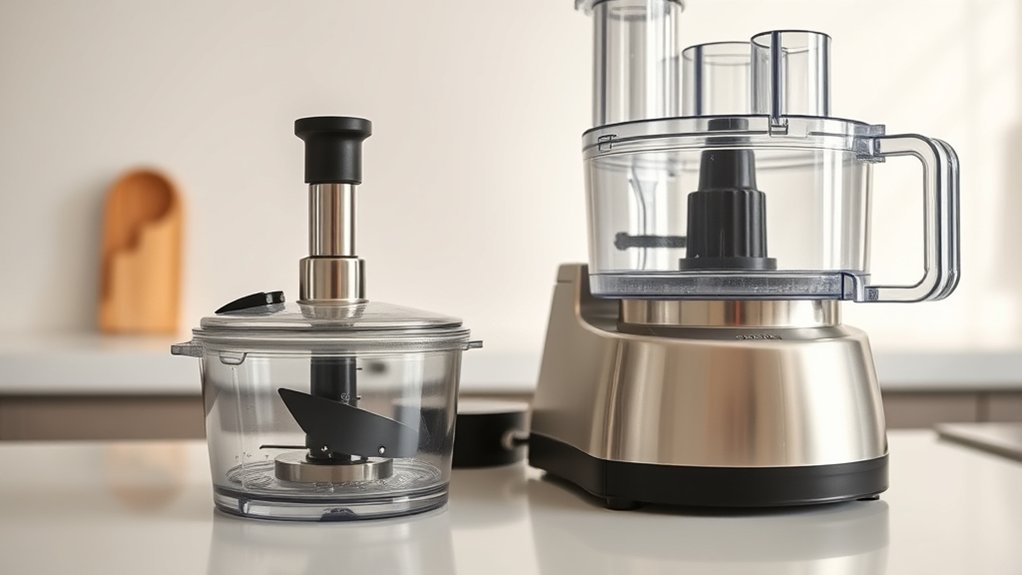
A food chopper and a food processor can both handle everyday chopping, but they are designed for different workloads. A chopper is usually smaller and simpler, making it useful for onions, herbs, nuts, sauces, and other small batches. A food processor typically adds a larger work bowl, feed tube, and extra blades or discs for slicing, shredding, mixing, and other preparation tasks.
Quick Answer
Choose a food chopper for quick, small-batch chopping, mixing, and puréeing with minimal storage and cleanup. Choose a food processor when you regularly prepare larger batches or need functions such as slicing and shredding. Some processors also knead dough, dice, or julienne when the appropriate blade or accessory is included.
Key Takeaways
- Food choppers are compact: many countertop electric models hold roughly 3–5 cups and focus on small batches.
- Food processors are more versatile: most add a feed tube and slicing or shredding discs as well as a multipurpose chopping blade.
- Features vary by model: dicing, julienning, dough kneading, whisking, and adjustable slicing are not universal.
- Choose by what you cook: batch size, required cuts, storage space, cleanup, and included accessories matter more than the appliance name alone.
Food Chopper vs. Food Processor
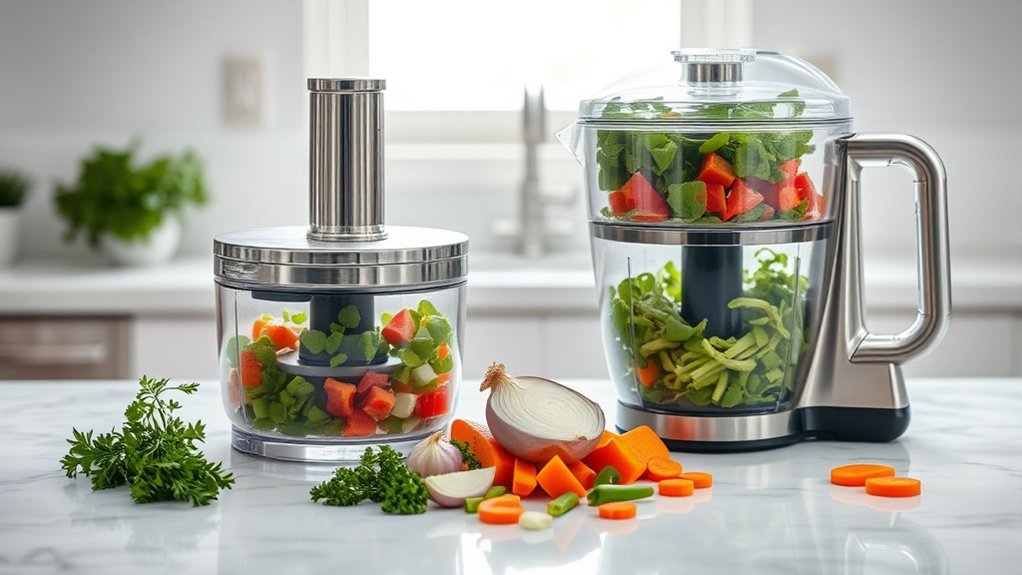
The main difference between a food chopper and a food processor is capacity and versatility. According to KitchenAid’s food processor and chopper guide, an electric chopper typically uses a smaller bowl and a multipurpose blade for chopping, mixing, and puréeing, while a processor usually adds a feed tube plus multiple blades or discs.
| Feature | Food Chopper | Food Processor |
| Typical size | Compact; many electric models are around 3–5 cups | Usually larger; residential models commonly span several sizes from small to large |
| Main blade system | Usually one multipurpose chopping blade; accessories vary | Multipurpose blade plus slicing, shredding, or other discs on many models |
| Feed tube | Usually no | Usually yes |
| Common tasks | Chopping, mincing, mixing, puréeing, small sauces and dips | Chopping, mixing, puréeing, slicing, shredding and larger-batch preparation |
| Model-dependent tasks | Whisking or emulsifying on compatible models | Dicing, julienning, adjustable slicing or dough kneading on compatible models |
| Storage and cleanup | Usually simpler because the appliance and accessory set are smaller | Usually needs more storage and may have more parts to wash |
| Best fit | Quick everyday prep and small quantities | Larger batches and recipes requiring several types of cuts |
The categories are not perfectly standardized. Manufacturers sometimes use terms such as mini processor, chopper, or chopper/grinder for compact appliances with overlapping features. For that reason, compare the work-bowl size, included blade and discs, feed tube, controls, and approved tasks rather than relying only on the product name.
The practical dividing line is usually simple: a chopper specializes in small, quick batches, while a food processor adds capacity and attachments for a wider range of preparation jobs.
What Is a Food Processor?
An electric food processor is a countertop appliance built around a work bowl and powered blade system. Most full-size designs also have a feed tube that guides ingredients toward slicing or shredding discs while the machine runs.
A processor’s multipurpose blade can usually chop, mix, and purée. Interchangeable discs commonly add slicing and shredding. Cuisinart’s food processor guide also describes slicing, shredding, chopping, and puréeing as core processor tasks, while noting that some models include a dough blade.
Additional functions depend on the machine. Certain processors offer dicing kits, julienne discs, adjustable slicing systems, whisking accessories, or dough blades, but these features should not be assumed to come with every model.
Capacity is another major advantage. KitchenAid’s processor size guide describes residential processors across a broad range, from roughly 6 cups at the smaller end to 16 cups or more for larger designs. A bigger bowl is useful for batch cooking, shredded vegetables, pie dough, dips, and meal prep that would require several rounds in a small chopper.
Pro Tip: If uniform slices or shreds are important, look for a processor with the specific slicing or shredding disc you need. A standard chopping blade cuts food by repeated contact and does not produce the same consistent slices as a dedicated disc.
What Is a Food Chopper?
A food chopper is a compact manual or electric tool designed mainly for smaller quantities. Electric countertop choppers commonly use one multipurpose blade that rotates inside a small bowl to chop, mince, mix, or purée food.
Many electric models fall around 3–5 cups, although capacities vary by brand and product. Hamilton Beach, for example, sells compact choppers intended for onions, herbs, nuts, garlic, sauces, and baby food, while KitchenAid offers 5-cup choppers for chopping, mixing, and puréeing.
- Chop onions, garlic, herbs, or nuts in small batches.
- Pulse ingredients for salsa while keeping some texture.
- Purée cooked vegetables or small amounts of sauce when the model permits it.
- Mix dips, dressings, pesto, or similar recipes.
- Use less cabinet or counter space than a typical full-size processor.
Some choppers add functions such as whisking, while manual choppers may use pull cords, plungers, or hand-operated cutting mechanisms rather than a motor. Because designs differ, the manufacturer’s instructions should determine what a specific machine can safely process.
Food choppers also tend to have fewer components than full-size processors, which can make them convenient when the main job is simply chopping one onion, a handful of herbs, or a small batch of dip.
When to Choose a Food Chopper
Choose a food chopper when most of your prep involves modest amounts of ingredients and you value a compact appliance that is quick to set up and put away.
A chopper is especially practical when you frequently prepare:
- onions, garlic, herbs, or nuts;
- small batches of salsa, pesto, hummus, or dressing;
- cooked fruit or vegetables for purées, when approved for your model;
- ingredients for one or two servings; or
- quick toppings and garnishes that do not require uniform slices.
It can also make sense in a kitchen with limited cabinet or counter space. Fewer attachments generally mean less equipment to store and fewer parts to handle during routine cleanup.
Price can favor a chopper because the design is usually simpler, but there is enough overlap between categories that price alone should not determine the choice. Compare the current price of specific models along with bowl size, warranty, included accessories, and the tasks each manufacturer approves.
Note: A chopper is not automatically the better tool just because the batch is small. If you need neat cucumber slices, grated carrots, or shredded cheese, a processor with the correct disc may still save more work.
When to Choose a Food Processor
A food processor is the stronger choice when you regularly need larger capacity or several types of food preparation from one appliance.
Consider a processor when you frequently want to:
- slice vegetables with a slicing disc;
- shred carrots, cabbage, potatoes, or cheese;
- prepare larger batches of chopped vegetables, dips, or sauces;
- mix or knead dough when the model includes an appropriate dough blade;
- use specialized dicing, julienne, or adjustable-slicing accessories on compatible machines; or
- feed ingredients continuously through a chute instead of stopping to refill a small bowl.
The larger appliance does require more storage space, and a processor with several discs and accessories may involve more setup and cleanup than a basic chopper. For people who use those extra functions regularly, however, the additional capability can replace several separate manual tools.
Can One Replace the Other?
There is considerable overlap. A food processor can usually perform the basic chopping, mixing, and puréeing jobs associated with an electric chopper, although a large bowl may feel excessive for a very small quantity.
A chopper can replace a processor for simple chopping and some small-batch mixing or puréeing. It generally cannot replace a processor when the recipe specifically requires a slicing disc, shredding disc, large work bowl, feed tube, or specialty attachment.
Which One Is Easier to Clean and Store?
A chopper generally wins on simplicity because it has a smaller bowl and fewer components. A processor may include a work bowl, lid, pusher, multipurpose blade, slicing disc, shredding disc, and additional accessories.
That does not mean every processor is difficult to clean. Many current models have dishwasher-safe removable components, but the correct cleaning method depends on the manufacturer. Check the manual before placing blades, discs, lids, or bowls in a dishwasher.
Warning: Food-processor and chopper blades are sharp. Turn the appliance off, unplug corded models before assembling, disassembling, or cleaning, keep hands and utensils away from moving blades, and handle removable blades carefully. Follow the safety instructions for your exact model.
How to Decide Between a Chopper and Processor
Focus on what you actually prepare each week. A chopper is usually enough if most jobs involve a handful of vegetables, herbs, nuts, or a small sauce. A processor becomes more useful when you repeatedly need uniform slicing, shredding, larger batches, or specialty attachments.
Before buying, check these five details:
- Capacity: Will the bowl hold your normal batch without repeated processing?
- Attachments: Does it include the exact slicing, shredding, dough, or other accessory you expect to use?
- Feed tube: Do you want to process vegetables or cheese through a chute?
- Storage: Do you have room for the appliance and its accessories?
- Cleanup: Are the removable parts easy to wash according to the manufacturer?
Frequently Asked Questions
Can a Food Chopper Be Used as a Food Processor?
A food chopper can replace a food processor for some small-batch jobs such as chopping onions, mincing herbs, mixing a dip, or puréeing a small amount of food when the model supports it. It generally cannot replace processor functions that require a feed tube, slicing or shredding disc, large bowl, dough blade, or another specialized attachment.
Why Don’t Chefs Use Chopper?
It is not accurate to say chefs never use food choppers. Tool choice depends on the job. A compact chopper can be useful for a small quantity of herbs, nuts, garlic, or sauce. For high-volume professional preparation, chefs may instead use full-size processors, commercial machines, knives, mandolines, or other equipment because those tools better match the required volume and cut.
Can I Chop Instead of Using a Food Processor?
Yes. A knife and cutting board can replace a processor for many basic chopping jobs, especially when the batch is small and perfectly uniform pieces are unnecessary. Manual chopping is less practical when a recipe calls for a large volume, very fine repeated chopping, shredded ingredients, uniform slices, or processing with a specialized disc.
Can I Use a Food Processor to Chop Vegetables?
Yes. Use the multipurpose blade and short pulses for chopped vegetables, stopping before the pieces become too fine. Cutting large vegetables into manageable, similarly sized pieces first can help produce more even results. For uniform slices or shreds, use the appropriate slicing or shredding disc instead of the chopping blade.
Is a Mini Food Processor the Same as a Food Chopper?
Sometimes the terms overlap. Manufacturers do not use the names in exactly the same way. Many mini processors and electric choppers have a small work bowl and one multipurpose blade, while other compact processors add a feed tube or shredding accessory. Compare the actual features instead of relying on the product label.
Which Is Better for Onions: a Food Chopper or Food Processor?
Both can chop onions. A food chopper is convenient for one or two onions because its smaller bowl is quick to use. A food processor is more practical when preparing a larger batch. With either appliance, pulse in short bursts and stop as soon as the pieces reach the desired size to avoid overprocessing.
Conclusion
A food chopper and a food processor overlap in basic chopping, mixing, and puréeing, but they are not interchangeable for every task. A chopper is compact and convenient for small batches. A processor usually provides a larger bowl, feed tube, and additional discs that make slicing, shredding, and other preparation methods possible.
If your routine is mostly onions, herbs, nuts, dips, and small portions, a chopper may be all you need. If you frequently batch-cook or want uniform slices, shredded ingredients, dough capability, or specialty attachments, compare full-size food processors instead. In either case, check the exact model’s capacity and included accessories because features vary considerably between manufacturers.
Sources
- KitchenAid — Food Processor vs. Food Chopper — differences in bowl size, feed tubes, blades, discs, and common functions.
- KitchenAid — Food Processor Sizes — typical chopper and residential food-processor capacity ranges.
- Cuisinart — Food Processor Guide — chopping, slicing, shredding, puréeing, and model-dependent dough functions.
- Hamilton Beach — Food Choppers — typical compact-chopper uses including chopping, mincing, mixing, sauces, and purées.
- KitchenAid Food Chopper Owner’s Manual — blade handling, unplugging, cleaning, and operating safety precautions.

1 thought on “Food Chopper vs. Food Processor: Are They the Same?”