
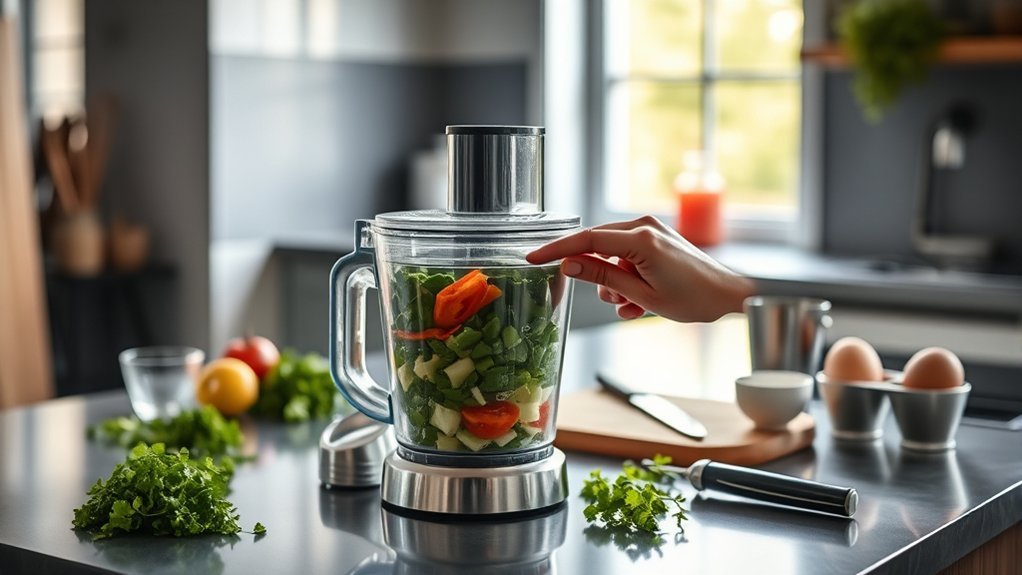
A food processor can chop, slice, shred, puree, mix, and knead in a fraction of the time many of those jobs take by hand. Safe use starts with assembling the machine while it is unplugged, choosing the correct blade or disc, preparing ingredients to a manageable size, and staying within your model’s capacity limits. Once the lid and bowl are locked correctly, use short pulses for precise chopping or continuous speed when the task calls for it.
Quick Answer
To use a food processor, assemble the bowl and correct blade or disc while the appliance is unplugged, lock the lid according to the manufacturer’s instructions, add properly sized ingredients without overfilling, and then plug it in. Use pulse for controlled chopping and continuous speed for tasks such as pureeing, slicing, shredding, or mixing when your model allows it.
Key Takeaways
- Assemble and disassemble the food processor while it is unplugged.
- Use the S-blade for chopping, mixing, and pureeing; use slicing and shredding discs for uniform cuts; use a dough blade only if your model includes or supports one.
- Cut large ingredients into manageable pieces and stay below the bowl, feed-chute, and liquid limits stated for your model.
- Use the supplied food pusher rather than hands, knives, or other utensils in the feed chute.
- Pulse when you need texture control and check the food frequently to prevent overprocessing.
- Turn the processor off, wait for the blade or disc to stop completely, and unplug it before opening, disassembling, or cleaning it.
At a Glance
| Time Required | About 5–10 minutes for basic setup and processing; recipe time varies |
| Difficulty | Easy |
| Tools Needed | Food processor, correct blade or disc, food pusher, and a nonmetal spatula if recommended by the manufacturer |
| Cost | No additional cost beyond ingredients and normal cleaning supplies if you already own the processor |
Set Up Your Food Processor
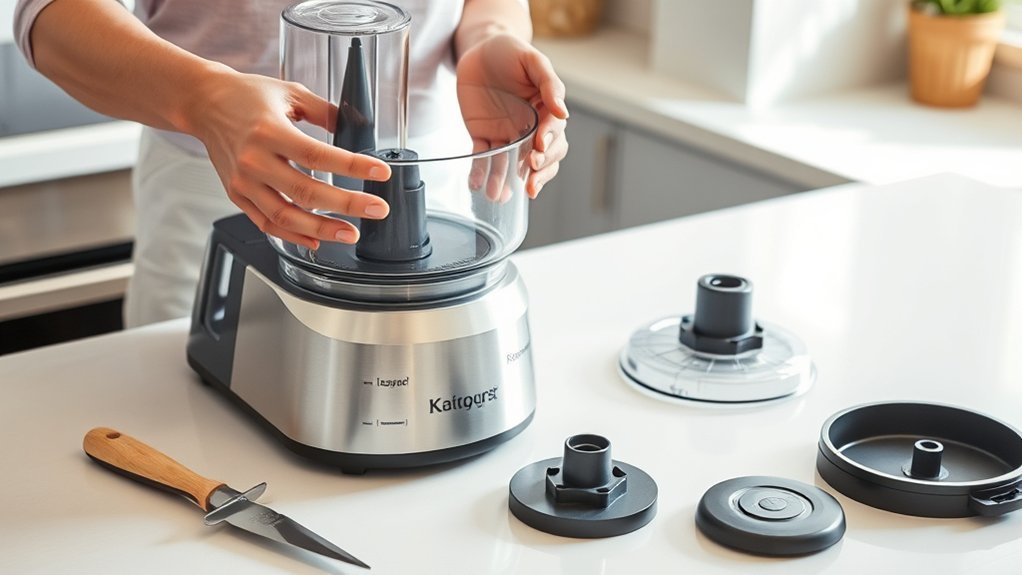
Start with the processor unplugged on a clean, dry, level countertop. If it is the first use, wash the removable food-contact parts according to the manufacturer’s instructions and dry them before assembly.
Place the work bowl on the motor base using the alignment marks, handle position, latch, or locking method designed for your model. Some processors twist into place, while others use snap-in or hinged systems, so do not force the bowl if it does not seat easily.
Next, install the drive adapter if your machine uses one, followed by the correct blade or disc. Attach the work-bowl cover and engage every required latch or interlock. Some models also require the large food pusher to be seated before the motor can operate.
Only after the bowl, attachment, lid, and any required pusher are correctly installed should the appliance be plugged into the outlet. KitchenAid’s current assembly guidance likewise instructs users not to plug in the processor until assembly is complete.
Warning: Food-processor blades and discs are extremely sharp. Keep the appliance unplugged while installing or removing them, hold discs by their hub or finger holes when provided, and never place your hands or another object into the feed chute while the motor can run.
Choose the Right Blade or Disc
The correct attachment depends on the result you want. Attachment names and available accessories vary, so use only parts approved for your specific food-processor model.
| Attachment | Best Uses | Key Tip |
|---|---|---|
| S-blade / multipurpose blade | Chopping vegetables, nuts, herbs, meat where permitted, mixing, pureeing, dips, sauces, and some doughs | Use short pulses when texture matters. |
| Slicing disc | Uniform slices of vegetables, fruit, and other suitable foods | Use the feed pusher with steady, moderate pressure. Thickness is adjustable only on models with an adjustable disc. |
| Shredding disc | Shredding vegetables and suitable cheeses | Chill softer cheese when needed and avoid packing the feed tube too tightly. |
| Dough blade | Mixing and kneading bread, pizza, pastry, or similar doughs when supported by the model | Follow the model’s maximum flour or dough capacity rather than using a universal batch size. |
Prepare Ingredients Before Processing
Good results begin before the motor starts. Remove pits, cores, tough stems, shells, bones, or other inedible hard material as required by the recipe. Cut large fruits, vegetables, meat, or cheese into pieces that fit comfortably in the work bowl or feed tube.
For chopping with an S-blade, relatively even pieces help the processor produce a more consistent texture. KitchenAid, for example, recommends roughly 1 to 1½-inch pieces for many fresh fruits and vegetables, although your recipe and processor size may call for something different.
Do not pack the work bowl or feed chute beyond the limit stated for the appliance. Overfilling can produce uneven chopping and may prevent a required food-pusher interlock from engaging.
Liquids require extra care. Never exceed the processor’s marked maximum liquid level or the limit stated in the owner’s manual. Too much liquid can leak around the blade shaft or onto the motor base.
Pro Tip: When chopping onions, herbs, nuts, vegetables, or similar foods, start with a few short pulses and check the texture. You can always process more, but you cannot reverse food that has already turned into paste.
How to Use a Food Processor
- Assemble the processor while unplugged. Install the work bowl, correct blade or disc, lid, and food pusher or interlock components required by your model.
- Prepare the ingredients. Cut large foods into manageable pieces and stay below the recommended bowl, feed-tube, or liquid limits.
- Plug in the processor. Make sure your hands are dry and the unit is stable before powering it.
- Select pulse, low, high, or another model-specific setting. Use pulse for short, controlled bursts and continuous processing where the recipe and attachment call for it.
- Check the texture frequently. Stop before food becomes finer or smoother than intended.
- Turn the unit off when finished. Wait until the blade or disc comes to a complete stop.
- Unplug before opening or disassembling. Remove the lid and attachments carefully before taking food from the bowl.
Do not try to bypass a safety interlock if the food processor will not start. A processor that refuses to operate often has a bowl, lid, latch, or food pusher that is not seated correctly.
How to Chop, Puree, Slice, and Shred
Chopping With the S-Blade
Place evenly sized ingredients in the work bowl without overfilling it. Close the lid, then use short pulses until the food reaches the size you want. Stop and scrape down the bowl with an appropriate spatula only after the machine is off, the blade has stopped, and the appliance is unplugged when your manual requires it.
Pulse control is especially useful for vegetables, salsa, nuts, herbs, breadcrumbs, and foods where a coarse or medium texture is preferred.
Pureeing and Mixing
Use the multipurpose blade for most purees, dips, sauces, and similar mixtures. Start by chopping the solid ingredients, then process longer until the texture becomes smooth. Add liquid only in the manner permitted by your processor and stay below its liquid limit.
For dressings or emulsions, some processors allow oil or another liquid to be drizzled through a small feed tube or pusher opening while the machine runs. Follow the specific instructions for your model rather than removing safety components to pour ingredients directly into the bowl.
Slicing and Shredding
Install the correct disc before securing the lid. Trim food so it fits the feed tube without being crushed or tightly wedged. Turn the processor on at the speed recommended for the food, then guide the ingredient with the supplied pusher.
Use steady pressure rather than forcing the food downward. Excessive pressure or an overpacked chute can produce irregular slices or shreds.
For long, narrow vegetables such as carrots or celery, a smaller feed tube can help hold the ingredient upright when the processor includes one.
Making Dough
If your processor supports dough, install the dough blade or other blade specified by the manufacturer. Add ingredients according to the recipe and processor instructions, and watch the mixture closely because food processors can develop dough quickly.
Do not assume one universal flour limit. Capacity varies substantially by bowl size, motor, blade, and model. Use the maximum flour or dough amount in your owner’s manual.
Pulse vs. Continuous Processing
The pulse function runs the blade in short bursts, making it useful when you want precise control. It is ideal for coarse chopping, nuts, crumb mixtures, salsa, and other foods that can become overprocessed quickly.
Continuous processing is more useful when you need a smoother texture or when an attachment is designed to operate while food passes through the feed chute. Purees, some sauces, slicing, shredding, and certain dough methods may use continuous operation.
The actual speed options differ by machine. Some processors have low, high, and pulse controls; others use a simpler on/off/pulse arrangement.
Foods to Avoid in a Food Processor
A food processor is powerful, but it should not be used for every ingredient. Avoid anything prohibited by your owner’s manual.
- Bones and other very hard inedible material: These can damage blades or the motor.
- Rock-hard frozen foods: If a food is too hard for the processor specified by the manufacturer, allow it to soften as directed before processing.
- Food above the maximum-fill line: Overloading can cause uneven results, leaks, or strain.
- Too much liquid: A food processor is not automatically a substitute for a blender. Follow the bowl’s liquid limit.
- Hands, knives, spoons, or improvised pushers in the feed chute: Use only the food pusher designed for the appliance while processing.
Note: Model capabilities vary. A technique that is safe for one processor may exceed the capacity or attachment limits of another, so the owner’s manual should take priority over general advice whenever the two differ.
Remove Processed Food Safely
When processing is complete, press the off control and wait until the blade or disc stops completely. Unplug the food processor before disassembling it.
If you used a slicing or shredding disc, remove the disc carefully before lifting out the bowl when your model’s instructions specify that sequence. Hold the disc by its hub or designated finger holes rather than touching the cutting edge.
For an S-blade, remove the blade or blade-and-adapter assembly carefully before scraping food from the work bowl unless your model is specifically designed to retain the blade while pouring.
Clean and Store Your Food Processor
Unplug the food processor before cleaning. Separate the lid, food pusher, blade or disc, adapter, and work bowl according to the model’s disassembly instructions.
- Wash removable food-contact parts with warm, soapy water unless the manufacturer gives different directions.
- Handle blades and discs carefully and avoid reaching blindly into soapy water where a sharp edge is hidden.
- If the parts are dishwasher safe, use only the rack position and cycle recommended by the manufacturer.
- Wipe the motor base and cord with a damp cloth and dry them. Never immerse the motor base in water.
- Dry parts before storing them in the processor, storage case, or another secure location where the blade edges cannot be accidentally touched.
If the processor has contacted raw meat, poultry, fish, or eggs, prevent cross-contamination by thoroughly cleaning food-contact parts before using them for ready-to-eat foods. USDA food-safety guidance recommends cleaning utensils and food-contact surfaces after contact with raw animal foods and sanitizing suitable food-contact surfaces when appropriate.
Food Processor Safety Tips and Common Mistakes
Food processor safety starts with the bowl, lid, attachment, and safety interlocks being properly assembled. Never force a component that does not fit or defeat an interlock so the motor will run.
- Do not assemble while plugged in. Connect power only after the machine is ready to operate.
- Never use your hand as a food pusher. Use the supplied pusher.
- Do not open a moving processor. Turn it off and wait for the blade or disc to stop completely.
- Do not overfill the bowl or feed tube. Leave enough room for ingredients to move and follow marked limits.
- Do not exceed the liquid limit. Excess liquid may leak toward the motor base.
- Do not force hard ingredients. Stop and unplug the processor before clearing a jam.
- Do not ignore strong odors or smoke. Turn the processor off and unplug it immediately if you see smoke, sparking, or another sign of an electrical or motor problem.
- Do not wash the motor base under running water. Wipe it instead.
The safest sequence is simple: assemble while unplugged, process with the lid and interlocks secured, wait for the blade to stop, then unplug again before disassembly.
Food Processor Troubleshooting
| Problem | What to Check |
|---|---|
| Processor will not start | Confirm the outlet works and that the bowl, lid, latches, and any required food-pusher interlock are correctly seated. Do not bypass the safety system. |
| Food chops unevenly | Cut ingredients more evenly, reduce the batch size, and use short pulses rather than continuously running the blade. |
| Slices or shreds are irregular | Do not overpack the feed tube or press too hard on the food pusher. Check that the disc is installed in the correct orientation. |
| Liquid leaks from the bowl | Stop and unplug the processor. Check assembly and confirm that the liquid is below the model’s maximum liquid level. |
| Processor stops during use | Turn it off. Check whether a latch or interlock shifted, whether the bowl was overloaded, and whether the model’s manual specifies a cooling period after motor overload. |
| Strong burning smell or visible smoke | Switch off and unplug the machine immediately. Do not continue using it until the cause is identified according to the manufacturer’s service guidance. |
Frequently Asked Questions
What Are Common Food Processor Mistakes?
Common mistakes include plugging in before assembly, using the wrong blade or disc, overfilling the work bowl, exceeding the liquid limit, forcing food through the feed tube, using continuous speed when a few pulses would give better control, and opening the lid before the blade has stopped. Another mistake is assuming every model assembles or operates the same way.
How to Use a Food Processor to Chop Vegetables?
Install the multipurpose or S-blade while the machine is unplugged. Cut vegetables into relatively even pieces, place a manageable batch in the bowl, secure the lid, and plug in the processor. Use short pulses and check the vegetables after each few bursts. Stop as soon as the pieces reach the size you need so they do not turn into a puree.
How Does a Manual Food Processor Work?
A manual food processor uses human-powered movement rather than an electric motor. Depending on the design, a crank, pull cord, push mechanism, or similar system turns the internal blades. Manual processors are useful for small chopping jobs and locations without convenient power, but their capacity and attachment options are usually more limited than those of a full-size electric processor.
How to Cook With a Food Processor?
A conventional food processor does not normally cook food with heat. Instead, it prepares ingredients for cooking by chopping vegetables, shredding cheese, pureeing cooked foods, making dips and sauces, mixing dough, grinding suitable nuts, or emulsifying dressings. After processing, cook the ingredients using the method required by the recipe.
Why Won’t My Food Processor Start?
First confirm that the outlet has power. Then unplug the processor and check whether the work bowl, lid, latch, blade or disc, and any required food-pusher interlock are assembled correctly. Many processors will not run when one of these safety components is out of position. If correct assembly and a working outlet do not solve the problem, follow the manufacturer’s troubleshooting or service instructions rather than bypassing the interlock.
Can You Use a Food Processor Instead of a Blender?
Sometimes, but the appliances are designed differently. A food processor is especially useful for chopping, slicing, shredding, dough, dips, and thick purees. A blender is generally better suited to high-liquid mixtures. If you process liquid in a food processor, stay below the appliance’s stated maximum liquid level and use only attachments approved for that task.
Conclusion
Using a food processor becomes straightforward once you follow a safe sequence: assemble it while unplugged, select the right blade or disc, prepare ingredients to the proper size, stay within the machine’s capacity limits, and use pulse or continuous processing according to the task. After processing, wait for the blade to stop, unplug the appliance, and clean each part according to the manufacturer’s directions. These habits improve consistency while protecting both the user and the machine.
Sources
- KitchenAid — How to Assemble the Food Processor — supports safe assembly, work-bowl installation, locking, and the instruction to assemble before plugging in.
- KitchenAid — How to Use the Food Processor — supports pulse operation, stopping procedure, and waiting for blades or discs to stop before opening.
- KitchenAid — Cleaning the Base and Attachments — supports unplugging before cleaning, base care, dishwasher guidance, and storage.
- Hamilton Beach — Food Processor Use & Care Guide — supports sharp-blade warnings, food-pusher safety, maximum-fill guidance, and troubleshooting.
- USDA Food Safety and Inspection Service — Cleaning and Sanitizing Guidance — supports cleaning and sanitizing food-contact surfaces to reduce cross-contamination.

1 thought on “How to Use a Food Processor: Simple Step-by-Step Guide”