
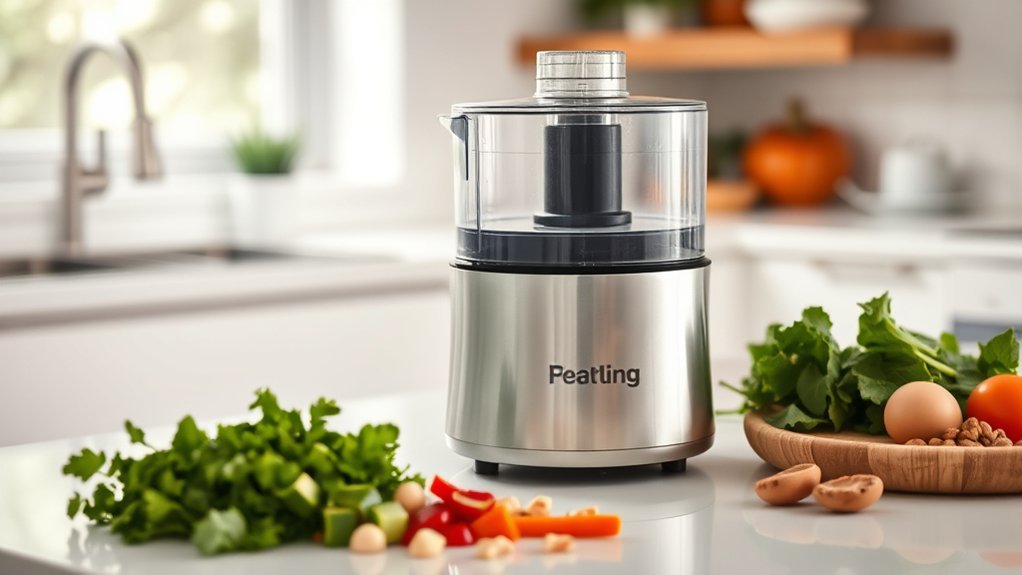
A food processor is a versatile electric kitchen appliance that chops, slices, shreds, grates, mixes, purées, emulsifies, and, on many models, kneads dough. It combines a motorized base with a work bowl and interchangeable blades or discs. Compared with a blender, a food processor gives you more control over solid and semi-solid ingredients, making it especially useful for everyday food preparation.
Quick Answer
A food processor is an electric prep appliance designed to chop, slice, shred, grate, mix, purée, emulsify, and sometimes knead food. Its wide bowl and interchangeable blades make it especially useful for vegetables, cheese, dough, dips, sauces, nuts, and other solid or semi-solid ingredients.
Key Takeaways
- Food processors excel at repetitive prep jobs such as chopping vegetables, shredding cheese, slicing produce, mixing dough, and making dips or sauces.
- The S-shaped blade handles most chopping and puréeing, while slicing and shredding discs process food through the feed tube.
- A blender is usually better for smoothies, drinks, and very liquid recipes; a food processor offers more cutting and texture options.
- Food choppers are generally smaller and simpler than full-size food processors, but many modern choppers are electric rather than manual.
- Always follow the manual for your model, keep hands away from moving blades, and use the supplied food pusher with the feed tube.
What Is a Food Processor?
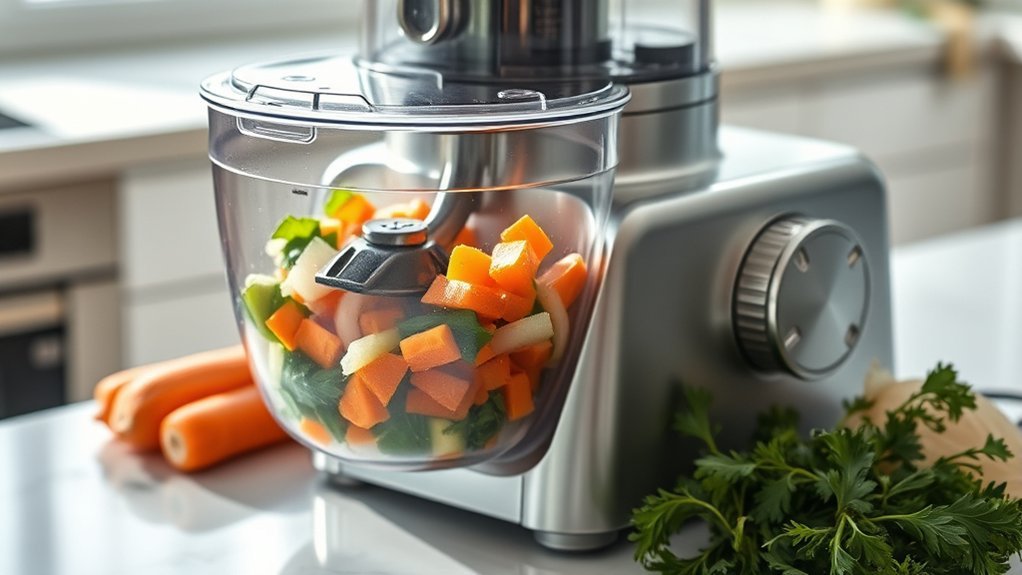
A food processor is a versatile electric kitchen appliance built to chop, slice, shred, grate, mix, purée, and emulsify ingredients using a motor, work bowl, blades, and interchangeable attachments.
One early milestone came from German manufacturer Electrostar. According to Starmix’s official company history, its high-speed Starmix food processor reached the market in 1948. Later developments in France helped create the familiar bowl-and-blade processors that became common in professional and home kitchens.
A typical modern unit includes a motor base, removable work bowl, locking lid, food chute, food pusher, and an S-shaped multipurpose blade. Many models also include slicing and shredding discs. These parts allow the machine to handle solid and semi-solid foods while giving the cook more control over the final texture.
A food processor can shorten repetitive meal preparation, especially when a recipe calls for large amounts of chopping, shredding, slicing, or mixing. It does not replace every kitchen tool, but it can handle a surprisingly wide range of prep jobs.
How a Food Processor Works
A food processor works by using an electric motor in the base to rotate a blade or disc. The attachment you install determines what happens to the food.
| Action | Typical Result |
|---|---|
| Chop | Coarse or fine pieces |
| Slice | Even slices |
| Shred | Thin strands of cheese or vegetables |
| Purée | Smooth or semi-smooth mixtures |
| Emulsify | Dressings, mayonnaise, and blended sauces |
| Knead | Mixed and developed dough, when the model supports it |
| Pulse | Greater control over texture |
With the S-blade installed near the bottom of the bowl, food circulates around the bowl and repeatedly contacts the blade. Short pulses are useful when you want to control the size of chopped ingredients. Continuous processing is better for tasks such as puréeing, emulsifying, or mixing a recipe until it reaches a uniform consistency.
Slicing and shredding discs work differently. They sit near the top of the bowl. Food passes through the feed tube and is pressed against the spinning disc with a food pusher. The prepared food then falls into the bowl below.
Food processors can make smooth mixtures, but a traditional blender is generally better for very liquid recipes and exceptionally smooth drinks or soups. KitchenAid’s food processor vs. blender guidance similarly distinguishes the processor’s cutting functions from the blender’s strength with liquid-rich recipes.
Pro Tip: When chopping vegetables, herbs, or nuts, start with short pulses instead of running the machine continuously. You can always make the pieces smaller, but you cannot reverse an ingredient that has already turned into paste.
Food Processor Parts and Attachments
Each part of a food processor has a specific job. The bowl holds ingredients, the locking lid contains them, the motor base supplies power, and the selected blade or disc performs the cutting or mixing.
Bowl, motor, blade, lid, feed tube, and food pusher work together to process ingredients quickly while keeping hands away from the cutting area.
| Part or Attachment | What It Does | Common Uses |
|---|---|---|
| Motor base | Turns the installed blade or disc | Powers every processing function |
| Work bowl | Holds ingredients | Chopping, mixing, puréeing, dough |
| S-shaped multipurpose blade | Chops, minces, mixes, and purées | Onions, herbs, pesto, hummus, nuts, pastry |
| Slicing disc | Cuts food into slices | Potatoes, cucumbers, carrots, onions |
| Shredding/grating disc | Produces strands or grated pieces | Cheese, carrots, cabbage |
| Dough blade | Mixes and kneads dough on supported models | Bread and pizza dough |
| Feed tube and pusher | Guides food safely toward a disc | Slicing and shredding |
The standard knife blade is the main attachment for chopping. Slicing and shredding discs expand the machine’s usefulness by producing more uniform cuts than the S-blade.
Some food-processor systems also support specialty attachments or combination accessories for functions such as juicing, whisking, dicing, or blending. These capabilities are model-specific, so check the manufacturer’s instructions rather than assuming every attachment will fit every processor.
Choosing the right attachment improves both speed and texture. It also reduces the temptation to force one blade to perform a job it was not designed to do.
What You Can Make With a Food Processor
A food processor can turn everyday ingredients into the foundations of many meals. The multipurpose blade can quickly chop onions, carrots, celery, garlic, herbs, nuts, and other ingredients that would otherwise require repeated knife work.
It can also process chickpeas, tahini, garlic, and lemon into hummus; combine basil, nuts, cheese, and oil into pesto; make salsa; grind breadcrumbs; blend dressings; prepare pastry; and mix many sauces and dips.
For baking, some models can mix or knead bread and pizza dough. A shredding disc can process cheese and vegetables, while a slicing disc can prepare potatoes, cucumbers, onions, carrots, and similar foods in consistent slices.
- Vegetable prep: chopped onions, shredded carrots, sliced potatoes, coleslaw
- Dips and sauces: hummus, pesto, salsa, mayonnaise, dressings
- Baking: pie dough, pastry, cookie mixtures, bread or pizza dough where supported
- Dry prep: breadcrumbs, chopped nuts, grated hard cheese
- Meal prep: larger batches of sliced or shredded produce
Commercial food processors perform similar jobs at a larger scale in restaurant and food-service kitchens. Home models focus on smaller batches and countertop convenience. In either setting, the important points are to stay within the machine’s capacity and choose the correct blade, disc, speed, and processing time.
Food Processor vs. Blender
A food processor and a blender overlap in a few tasks, but their designs favor different results. Food processors are especially useful for chopping, shredding, slicing, mixing, and working with dough or relatively thick mixtures. Blenders are built around a tall jar and are generally better at circulating liquid-rich ingredients into smooth drinks, soups, and purées.
The choice depends on the recipe. If you want sliced vegetables, shredded cheese, chopped nuts, pie dough, or coarse salsa, a processor is usually more useful. If you want a smoothie, blended drink, or very smooth liquid mixture, a blender is usually the better fit.
Key Texture Differences
Texture is one of the clearest differences between the two appliances. A food processor gives you controlled chopping, shredding, slicing, and grating, making it suitable for chunky salsa, minced vegetables, grated hard cheese, and dough.
The multipurpose blade can produce anything from coarse pieces to a fairly smooth purée depending on processing time. Pulsing lets you stop before the ingredients become too fine.
A blender relies on a liquid-friendly jar shape that helps ingredients circulate toward the blades. That design generally makes it better for smoothies, drinks, liquid sauces, and very smooth purées.
Both appliances can emulsify and purée certain recipes, so the distinction is not absolute. The deciding factors are usually the amount of liquid, desired texture, and whether you need slicing or shredding functions.
Best Uses For Each
| Task | Food Processor | Blender |
|---|---|---|
| Chopping vegetables | Excellent | Limited |
| Slicing and shredding | Excellent with discs | Not designed for it |
| Kneading dough | Possible on supported models | Generally not appropriate |
| Hummus and thick dips | Excellent | Possible, depending on model |
| Smoothies and drinks | Limited | Excellent |
| Liquid soups and sauces | Possible with model-specific limits | Usually better |
| Shredding cheese | Excellent | Not designed for it |
A food processor is therefore a strong choice when a recipe needs structure or several cutting functions. A blender is generally the better choice when the goal is a smooth, pourable result.
Choosing The Right Tool
Choosing the right appliance starts with the result you want rather than the name of the recipe.
- Choose a food processor for chopping, shredding, slicing, grating, thick dips, pastry, and supported dough recipes.
- Choose a blender for smoothies, drinks, liquid-rich soups, and very smooth sauces.
- Use a processor’s feed tube and discs when uniform slices or shreds are important.
- Use short pulses when you want to retain texture rather than create a purée.
If you regularly make both types of recipes, owning both appliances can be more practical than trying to force one machine to perform every task.
Food Processor vs. Food Chopper
A food processor and a food chopper can both chop ingredients, but they are not identical.
A full-size food processor usually has a larger bowl, a feed tube, an S-blade, and multiple discs or attachments for jobs such as slicing, shredding, grating, mixing, and sometimes kneading.
A food chopper is typically smaller and simpler. Many modern food choppers are electric, although manual pull-cord, push-down, and hand-operated choppers also exist. Electric choppers commonly handle small batches of onions, herbs, nuts, dips, and similar ingredients but usually lack the slicing and shredding discs found on full-size processors.
KitchenAid’s food processor and food chopper comparison similarly notes that processors generally have larger bowls, feed tubes, and a broader selection of blades.
For a handful of herbs, garlic cloves, or a small batch of nuts, a compact chopper can be more convenient and easier to clean. For larger-volume preparation or recipes requiring sliced and shredded ingredients, a full-size processor offers more flexibility.
How Food Processors Evolved
The history of the food processor includes several different machines and product lines rather than one uncontested invention date.
Electrostar’s official history says its Starmix high-speed food processor appeared in 1948. In France, Pierre Verdun and Robert Comte later developed a bowl-based food-preparation machine that helped establish the modern processor format. Magimix’s official history dates that development to 1961 and the professional Robot-Coupe launch to 1963.
Later products brought food processors into home kitchens, while designers such as Marc Harrison improved usability and accessibility.
Early Food Processor Models
The evolution of the food processor involved several important milestones:
- 1948: Electrostar says its high-speed Starmix food processor reached the market in Germany.
- 1961: According to Magimix, Pierre Verdun and Robert Comte developed a food-preparation machine using a blade at the bottom of a bowl.
- 1963: Magimix’s history dates the launch of the professional Robot-Coupe processor to this year.
- 1971: Magimix introduced a compact domestic food processor for home kitchens.
- 1974: Magimix says its food processor entered the UK market.
- Late 1970s: Food processors were becoming established consumer appliances in additional markets.
- 1980s: Multifunction kitchen machines, including Soviet Mriya models, reflected the wider international adoption of powered food-preparation systems.
These machines reduced repetitive chopping, shredding, mixing, and kneading work and helped turn motorized food preparation into a normal part of many kitchens.
Marc Harrison Redesign
In 1978, industrial designer and educator Marc Harrison redesigned the Cuisinart food processor with accessibility and usability in mind. Cranbrook Academy of Art identifies the resulting Cuisinart DLC-X redesign as a major example of Harrison’s accessible design work.
Features such as larger, easier-to-grasp handles, broad controls, strong visual contrast, and readable lettering reduced the need for precise finger movements and made the appliance easier to operate for a wider range of users.
Harrison later became closely associated with universal design. Rhode Island School of Design describes his wider work as part of an important movement toward products and environments that accommodate users with different physical abilities.
The redesign is significant because accessibility improvements did not merely create a specialized appliance. They helped produce a mainstream consumer product that was easier for many people to understand and operate.
Modern Appliance Development
Modern food processors build on those earlier ideas with safer interlocks, multiple bowl sizes, reversible discs, adjustable slicing systems, compact storage, dough blades, and, on some models, dicing or specialty accessories.
- 1948: Electrostar’s Starmix established an early high-speed food-processing system.
- 1961–1963: French development led to the professional Robot-Coupe processor described in Magimix’s history.
- 1971: Magimix brought a compact domestic version to home kitchens.
- 1978: Marc Harrison’s Cuisinart work demonstrated how accessibility could improve mainstream appliance design.
- Today: Food processors range from compact machines for small batches to large multifunction units with slicing, shredding, dough, and specialty attachments.
The basic principle remains familiar: a motor spins a purpose-built blade or disc so the cook can prepare ingredients quickly and with repeatable results.
How to Choose a Food Processor
Selecting a food processor depends on how much food you prepare, the recipes you make, available storage space, and which attachments you will actually use.
Choose a food processor for your normal batch size and cooking habits, not simply for the largest bowl or longest accessory list.
Choose the Right Capacity
A compact processor or chopper makes sense for herbs, nuts, garlic, sauces, and small households. Medium-size processors suit general meal preparation, while large processors are useful when cooking for several people, shredding large quantities of vegetables, making big batches, or working with dough.
A bowl that is much larger than your normal batch can sometimes handle tiny amounts poorly, while an undersized bowl may force you to work in several batches. Check both the stated bowl capacity and any separate liquid or dough limits in the manual.
Features Worth Checking
- Pulse control: useful for controlling chopped texture.
- Feed-tube width: a wider tube can reduce pre-cutting before slicing or shredding.
- Slicing and shredding discs: important if you regularly prepare vegetables or cheese.
- Dough capability: check the manufacturer’s batch limits if bread or pizza dough is a priority.
- Storage: consider where the bowl, discs, blade, and accessories will live.
- Cleaning: removable parts and simple lid designs can make frequent use less troublesome.
- Safety interlocks: the machine should operate only when its bowl and lid are correctly locked.
Prices vary substantially by capacity, construction, motor design, brand, and included accessories, so a fixed price benchmark quickly becomes outdated. Compare current models based on the functions you actually need.
How to Use a Food Processor
The exact assembly sequence differs by manufacturer, so your model’s manual should take priority. In general, however, the process is straightforward.
- Set the motor base on a stable, dry counter. Keep the unit unplugged while fitting or removing sharp accessories.
- Lock the work bowl onto the base.
- Install the correct blade or disc. Use the S-blade for most chopping, mixing, and puréeing; use the appropriate disc for slicing or shredding.
- Add ingredients. For chopping, cut very large pieces down to a size the machine can process evenly.
- Secure the lid. Most modern processors will not operate unless the bowl and lid are correctly locked.
- Use pulse or continuous operation as appropriate. Pulse for controlled chopping; run continuously when a recipe calls for a smoother or more thoroughly mixed result.
- For slicing or shredding, use the feed tube and supplied pusher. Never push ingredients toward a moving disc with your fingers.
- Stop and inspect the texture. Scrape the sides only after the blade has completely stopped.
- Unplug before removing the blade or disc. Lift sharp accessories carefully.
KitchenAid’s food processor operating guide likewise recommends selecting the correct attachment, locking the appliance together, and using pulse control when managing chopped texture.
Food Processor Safety and Cleaning
Warning: Food-processor blades and discs are extremely sharp. Never put your hand into a feed chute while the machine is running. Use the supplied food pusher, let the blade stop completely before opening the lid, and unplug the appliance before handling or removing sharp attachments.
Manufacturer safety instructions commonly require the work bowl and lid to be locked before operation and warn against defeating the safety interlock. Hamilton Beach’s food processor safety instructions, for example, also tell users to keep hands and utensils away from moving blades and discs and to use the food pusher rather than feeding food by hand.
After processing, unplug the appliance and remove the blade or disc carefully. Wash the bowl, lid, pusher, and accessories according to the manufacturer’s instructions. Some removable parts may be dishwasher-safe, while others may be better suited to hand washing.
Do not submerge the motor base. Wipe it with a damp cloth after disconnecting it from power. Dry blades and discs before storage, and keep their cutting edges protected so they do not injure someone reaching into a drawer or cabinet.
Foods and Tasks to Avoid
A food processor is versatile, but its limits depend on the model. Consult the manual before processing unusually hard, hot, sticky, frozen, or liquid-heavy ingredients.
- Very hot liquids: do not assume a processor bowl is designed for them. Follow the manufacturer’s temperature and liquid guidance.
- Overly large hard ingredients: cut them down before processing unless the manual specifically says otherwise.
- Fully frozen or extremely hard foods: these may damage blades, bowls, or motors on models not designed for them.
- Too much liquid: stay below the manufacturer’s liquid-fill limit to reduce leaks and splashing.
- Oversized dough batches: heavy dough can overload a motor if you exceed the model’s stated capacity.
Note: Capabilities vary significantly between models. If your processor is advertised for ice, frozen ingredients, hot foods, specialty doughs, or another demanding job, follow that model’s manual instead of relying on a general rule.
Common Food Processor Mistakes
- Overfilling the bowl: ingredients may circulate poorly and process unevenly.
- Running continuously when you should pulse: chopped foods can quickly become mushy.
- Using the wrong attachment: an S-blade will not create the same uniform slices as a slicing disc.
- Processing a tiny amount in an oversized bowl: ingredients may sit below or outside the blade’s effective cutting path.
- Ignoring maximum dough or liquid limits: this can create leaks, strain the motor, or reduce performance.
- Forcing food through the chute: use steady pressure with the food pusher rather than excessive force.
- Handling blades casually during cleaning: sharp edges can cause cuts even when the machine is unplugged.
Food Processor Limits and Best Uses
A food processor is at its best when speed, repeated cutting, and moderate-to-large batches matter. It can make quick work of chopping onions, slicing vegetables, shredding cheese, preparing coleslaw, mixing pastry, and producing meal-prep ingredients.
It is also useful for dips, sauces, dressings, batters, and thick purées, depending on the recipe and model.
- Best for chopping, slicing, shredding, grating, and other repetitive prep work.
- Useful for hummus, pesto, dressings, breadcrumbs, pastry, and many batters.
- Often less convenient than a blender for smoothies and very liquid recipes that need an exceptionally smooth finish.
- Requires careful pulsing when texture matters because ingredients can become over-processed quickly.
There are practical disadvantages. A food processor can be noisy, bulky, and more time-consuming to wash than a knife or grater for a very small job. Multiple discs and accessories also require storage.
For larger batches and repeated prep, however, the time savings can be substantial. The best use case is not every kitchen task; it is any task where the processor’s speed, repeatability, and attachment options are more useful than doing the work by hand.
Frequently Asked Questions
Is a blender the same as a food processor?
No. A blender is generally better for liquid-rich recipes such as smoothies, drinks, and very smooth soups or sauces. A food processor is better suited to chopping, slicing, shredding, grating, thick mixtures, and many dough or pastry tasks. Their capabilities overlap, but their bowl shapes and attachments are designed for different kinds of work.
What can I use if I don’t have a food processor?
A sharp chef’s knife can handle chopping and slicing, while a box grater works for shredded cheese and vegetables. A blender can handle many purées and liquid sauces, a mortar and pestle works for herbs and spices, and a manual or electric food chopper can handle small chopping jobs.
What will a food processor do?
A food processor can chop, slice, shred, grate, purée, mix, and emulsify ingredients. Depending on the model and attachments, it may also knead dough, dice vegetables, whisk ingredients, or perform other specialty tasks.
What are the disadvantages of a food processor?
Food processors can be noisy, bulky, and more complicated to clean than a knife or grater. They also take up storage space, have very sharp blades, and can over-process food quickly. Very small jobs may be faster to do by hand or with a compact chopper.
Can a food processor replace a blender?
Not completely. A processor can purée and blend many thick mixtures, but a blender’s tall jar and liquid circulation are generally better for smoothies, drinks, and very smooth liquid recipes. A processor provides functions such as slicing and shredding that a standard blender cannot perform.
Can you put hot food in a food processor?
Only if the manufacturer specifically allows it. Heat limits vary by bowl material and model, and hot liquids can create additional splash and burn risks. Check the appliance manual and allow ingredients to cool when required.
Conclusion
A food processor is a versatile prep tool for anyone who regularly chops vegetables, shreds cheese, slices produce, makes hummus or pesto, mixes pastry, or prepares larger batches of ingredients. Its real advantage is not simply speed: interchangeable blades and discs let one machine perform several repetitive preparation jobs with consistent results.
Choose a size that suits your normal batches, use the correct attachment, pulse when texture matters, and follow your model’s safety and capacity limits. A food processor will not replace a blender, knife, or every other kitchen tool, but for the tasks it handles well, it can make everyday cooking noticeably faster and easier.
Sources
- Starmix — Company History — supports the 1948 Starmix timeline.
- Magimix — Official History — supports the Pierre Verdun/Robert Comte, Robot-Coupe, domestic Magimix, and UK timeline.
- Cranbrook Academy of Art — Marc Harrison and Cuisinart — supports the accessibility-focused Cuisinart redesign.
- KitchenAid — Food Processor vs. Blender — supports appliance-function and texture comparisons.
- KitchenAid — How to Use a Food Processor — supports attachment selection, assembly, chopping, and pulse guidance.
- Hamilton Beach — Food Processor Safety Instructions — supports blade, food-pusher, lid-lock, and safe-operation guidance.

2 thoughts on “What Is a Food Processor? Meaning, Uses & Examples”