
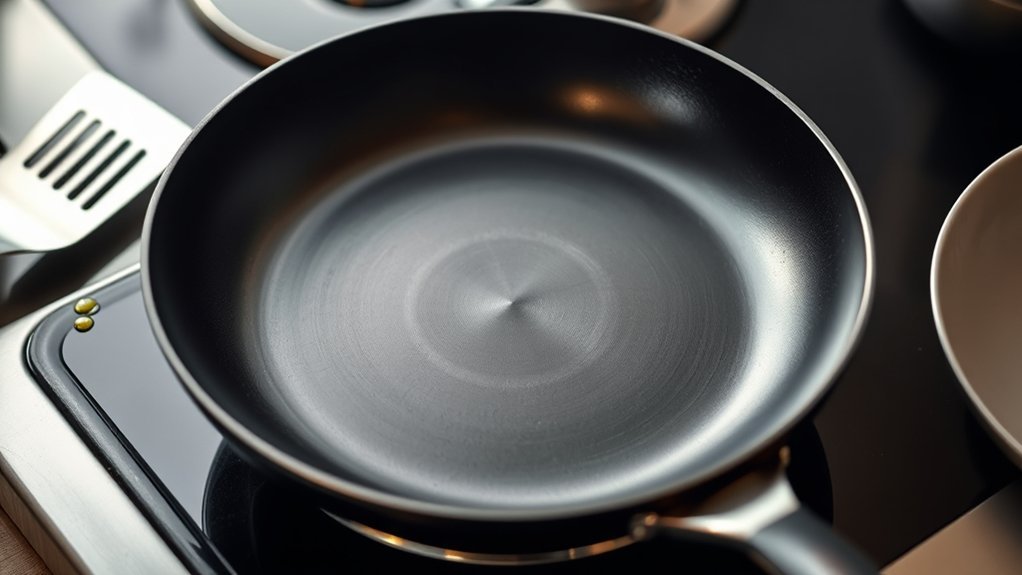
A frying pan that sits slightly higher in the middle is not automatically warped. Some cookware is intentionally made with a small amount of cold-state concavity so the base can move closer to flat as the metal expands during heating. However, a pronounced crown can also come from permanent distortion caused by uneven heating, excessive power, or thermal shock. The key is to check how the pan behaves on a level surface, when heated normally, and during cooking.
Quick Answer
A frying pan can be slightly higher in the middle for two reasons. Some manufacturers intentionally pre-curve the base so thermal expansion brings it closer to flat when hot. A pan can also become permanently warped from uneven or rapid heating. If it rocks, spins, or stays strongly crowned when hot, inspect it further.
Key Takeaways
- A small raised center can be intentional in some cookware, especially when the pan is cold.
- Oil moving toward the edges usually means the center of the cooking surface is physically higher than the perimeter.
- Rapid heating, oversized pans on small heating zones, and sudden cooling can contribute to permanent distortion.
- Induction is not automatically more even than gas; coil size, burner geometry, pan construction, and power level all matter.
- Judge a pan by its stability, manufacturer tolerance, and hot-state cooking performance rather than assuming every slight crown is a defect.
At a Glance
| Time Required | About 3–5 minutes for a basic flatness check |
| Difficulty | Easy |
| Tools Needed | Flat level surface, ruler or straightedge, and a small amount of oil or water |
| Cost | Usually $0 |
Why Are Frying Pans Higher in the Middle?
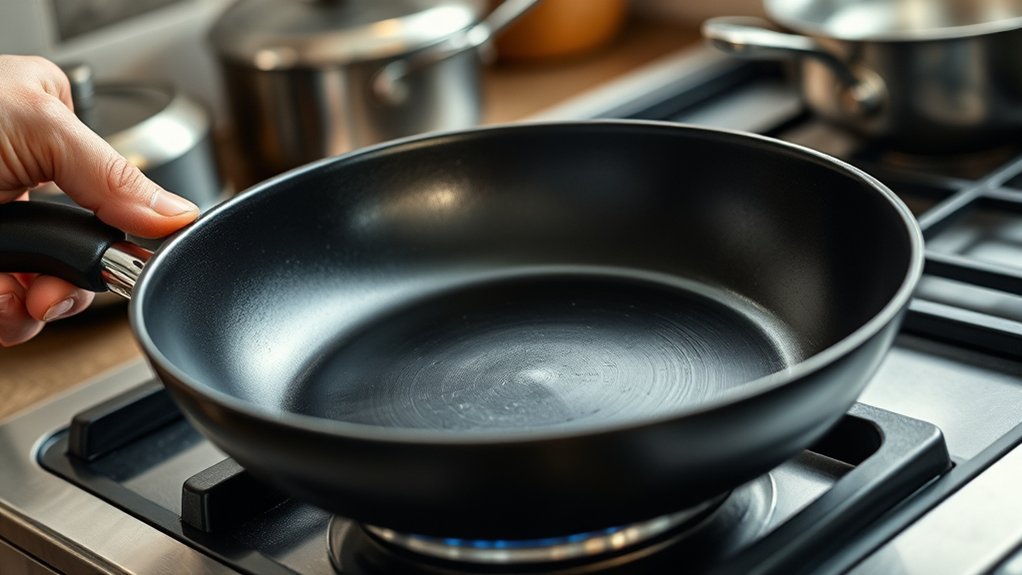
Some frying pans are intentionally manufactured with a slight cold-state concavity. In this design, the center of the exterior base sits a little farther from the cooktop when the pan is cold. As the metal heats and expands, the base can move closer to flat instead of bowing downward and becoming unstable.
This is a documented design feature in cookware from manufacturers such as Solidteknics, which says its pans use an engineered concave to allow for expansion. Hestan similarly explains that many clad cookware products may have slight concavity when cold.
However, not every raised center is intentional. Excessive or permanent curvature can result from uneven thermal expansion, very rapid heating, a heating zone that is too small for the pan, or sudden cooling. A warped pan may rock, spin, heat unpredictably, or keep sending oil toward one side or the perimeter even after it reaches normal cooking temperature.
Note: There is no universal rule that every frying pan must have less than a 3 mm center gap. Solidteknics uses more than 3 mm as a reason to contact the company about its own pans, but other manufacturers may use different tolerances. Check the instructions or warranty for your specific cookware.
Why a Slight Concave Helps Frying Pans
Metal expands as it heats. If a cookware base were to expand unevenly and bow downward, the center could become the lowest point touching a glass or induction cooktop, causing the pan to rock or spin. Some manufacturers compensate by forming a small amount of concavity into the cold base.
A small engineered concavity can give a cookware base room to move toward flat as the metal expands during normal heating.
- It allows controlled movement as the base warms.
- It can reduce the chance of the center bowing downward against a flat cooktop.
- It may improve stability after the pan reaches its intended cooking temperature.
- It gives the manufacturer a predictable allowance for thermal expansion.
The amount of concavity depends on the pan’s material, thickness, diameter, construction, and manufacturer specification. A perfectly flat cold base is therefore not automatically better, and a slightly concave base is not automatically better either. The correct shape is the one the cookware was engineered to have.
What Causes Liquid Pooling in a Frying Pan?
Liquid pools primarily because of surface shape and gravity. Oil, water, melted butter, or sauce moves toward the lowest point of the cooking surface. If the center of the pan is slightly higher than the perimeter, liquid may form a ring near the edges. If one side is lower, liquid may collect there instead.
A raised center can be an intentional part of the pan’s cold geometry, but it can also result from permanent deformation. The stove or countertop can also be slightly out of level, so pooling by itself does not prove the pan is defective.
Heat still matters because heating changes the dimensions of the metal. A pan that is intentionally concave when cold may become flatter as it warms, while a pan heated unevenly may temporarily or permanently distort.
Uneven Heating Effects
Uneven heating means one region of the pan changes temperature faster than another. Because hotter metal expands more than cooler metal, a strong temperature difference across the base can create mechanical stress.
This is especially relevant when a large pan sits over a much smaller heating zone or when an induction cooker delivers high power into a relatively small coil area. Repeated severe temperature differences can contribute to permanent deformation.
Practical control matters:
- Start at a moderate power level unless the manufacturer directs otherwise.
- Give a large or heavy pan time to warm across the base.
- Use a heating zone that reasonably matches the pan’s actual bottom diameter.
- Avoid maximum-power empty preheating unless the cookware maker specifically allows it.
These steps reduce large temperature differences across the base while still allowing the pan to reach normal cooking temperature.
Burner Size Mismatch
When the active heating area is much smaller than the base of the frying pan, the center can warm much faster than the outer portion. This creates a larger temperature gradient and therefore more uneven expansion.
The issue is especially important with induction. GE Appliances recommends matching cookware size to the induction burner and centering the pan over the marked cooking zone. de Buyer also advises matching the cooking surface to the burner and raising induction temperature gradually.
For burner matching, look at the flat bottom or induction-contact diameter, not only the pan’s advertised top diameter. A 12-inch frying pan may have a substantially smaller flat base.
Pro Tip: Measure the flat area on the underside of the pan when choosing a burner or induction zone. That measurement is more useful for heat matching than the wider rim-to-rim size printed on the cookware.
How Heat Sources Affect Frying Pan Shape
Gas, electric resistance, ceramic, and induction cooktops transfer energy to cookware differently. None guarantees perfectly even pan temperature. The final heat pattern depends on burner or coil geometry, pan size, material thickness, thermal conductivity, and power level.
A slightly concave base can help accommodate expansion in cookware designed that way, but good heating habits are still important regardless of the cooktop.
Gas Vs Induction Heat
Gas heats a pan through hot combustion gases and flame beneath the cookware. The heating pattern varies with burner diameter, flame shape, pan height above the burner, and how well the cookware spreads heat.
Induction produces heat within compatible magnetic cookware through an electromagnetic field. It can respond very quickly, but quick response does not mean perfectly uniform temperature. Research published in the International Journal of Applied Electromagnetics and Mechanics notes that uneven temperature distribution remains a challenge in domestic induction heating and that coil design strongly affects heating uniformity.
- Gas: heating pattern depends on flame and burner geometry.
- Induction: heating pattern depends heavily on coil size, coil design, pan magnetism, and power.
- Size match: both systems work better when the active heating area suits the pan base.
- Power changes: rapidly applying very high heat can create larger temperature differences across the cookware.
Neither gas nor induction should therefore be described as universally more uniform for every frying pan.
Uneven Heating And Warping
Uneven heating can gradually distort a frying pan’s base when different regions repeatedly expand by different amounts. Thin cookware can react quickly, while thicker or multilayer cookware behaves differently depending on its construction. No single material is completely immune to thermal stress.
| Sign | Possible Cause | What It Suggests |
|---|---|---|
| Pan rocks or spins | Base has bowed downward or become uneven | Possible permanent warping |
| Oil forms a ring at the edge | Center of cooking surface is higher | Could be intentional crowning or deformation |
| One-sided pooling | Pan, hob, or counter may be out of level | Check level before blaming the pan |
| Strong center hot spot | Small burner/coil or poor heat spreading | Possible burner-to-pan mismatch |
Because several conditions can create similar symptoms, use more than one test before deciding a pan is warped.
Does Burner Size Matter for Even Heating?
Yes. Burner or induction-zone size can materially affect how evenly a pan heats. A very small active zone under a wide base concentrates energy near the center while the outer metal warms more slowly.
The ideal match does not always mean identical advertised diameters. Frying pans are commonly sold by their top opening, while their flat bottom is smaller. On induction, the magnetic contact area is particularly important.
- Check the pan’s bottom-contact diameter.
- Choose the closest practical burner or induction-zone size.
- Center the cookware over the heating zone.
- Start at moderate power and increase as needed.
This approach reduces severe temperature gradients and generally provides more predictable browning and heat control.
Why Fast Heating Warps Frying Pans
Fast heating can distort cookware because the portion receiving the most energy expands before the rest of the pan reaches a similar temperature. If the temperature difference becomes large enough, mechanical stress develops across the base.
High-powered induction can create this situation quickly when a large pan is placed over a relatively small coil. A powerful gas or electric element can do the same if heat is concentrated in a small region.
Sudden cooling creates the opposite problem. The cooled area contracts faster than the hotter surrounding metal. All-Clad specifically advises allowing cookware to cool before washing and warns against putting a hot pan under cold water because thermal shock can cause warping.
Gradual preheating does not mean a pan must always stay on low heat. It means bringing the cookware up to the temperature needed for the recipe without subjecting a cold pan to unnecessarily extreme localized heat.
How to Prevent Frying Pan Warping
Preventing warping mainly requires avoiding severe temperature differences across the pan. Proper burner sizing, controlled preheating, and natural cooling are more useful than treating every pan with one fixed heat setting.
Heat the pan progressively, use a suitably sized heating zone, and let hot cookware cool naturally before washing.
- Preheat progressively rather than placing a cold, empty pan immediately on maximum power.
- Match the active heating zone to the pan’s bottom-contact area as closely as practical.
- Follow the cookware manufacturer’s heat limits and preheating instructions.
- Do not pour cold water into a very hot pan or immerse hot cookware in cold water.
- Let the pan cool on a heat-safe surface before cleaning.
- On induction, center the pan and avoid unnecessarily using boost mode for long empty preheats.
Warning: Do not try to correct a warped clad, coated, or nonstick pan by hammering, bending, clamping, or rapidly heating and cooling it. Those methods can damage bonded layers, coatings, handles, or the cookware structure. Contact the manufacturer if the distortion is significant.
Some brands give product-specific advice. Solidteknics, for example, recommends relatively gradual heating for its AUS-ION™ and nöni™ cookware. That recommendation should not be converted into a universal maximum-heat rule for every frying pan.
How to Tell Intentional Concavity From Warping
A slightly raised center does not prove the pan is damaged. Use a few simple checks together.
- Start with a known level surface. Place the cold pan on a flat glass cooktop, stone counter, or another surface you know is level.
- Check for rocking. Press lightly near opposite edges. A pan that rocks or spins may have bowed downward or become uneven.
- Use a straightedge. Place a ruler or straightedge across the underside. A small center gap may be intentional, but compare it with the cookware maker’s specifications rather than applying a universal number.
- Observe it during normal preheating. Some intentionally concave bases move closer to flat as they heat.
- Check oil behavior. If oil consistently races to the outer edge even after normal preheating on a level hob, the crown may be larger than intended.
If the pan is new and its shape seems excessive, contact the manufacturer before attempting to modify it. A company can tell you whether the curvature is within specification and whether warranty service applies.
Does Pan Material and Construction Affect Warping?
Yes, but construction matters as much as the material name. Aluminum, stainless steel, carbon steel, cast iron, copper, and multilayer combinations all expand when heated, but they do so at different rates and distribute heat differently.
Thickness also matters. A thin base reacts quickly to localized heating, while a heavier base usually changes temperature more slowly. Fully clad cookware contains bonded layers that spread heat differently from a single sheet of carbon steel or a disc-bottom pan.
That does not mean one construction can never warp. Hestan’s cookware guidance, for example, explains that different metals within clad cookware expand and contract at different rates and that sudden temperature changes can place stress on the structure.
The safest approach is to follow the heating and cooling guidance for the exact cookware you own rather than assuming all stainless steel, carbon steel, aluminum, or nonstick pans should be treated identically.
Signs Your Frying Pan Is Warped
A warped frying pan has changed shape enough to interfere with stability or cooking performance. The most convincing sign is persistent uneven contact on a verified flat surface.
Common signs include:
- The pan rocks or spins when gently pressed.
- The bottom has an obvious bulge, dip, or twisted area.
- Oil or batter consistently runs strongly to one side on a level cooktop.
- A pan that used to sit correctly now behaves differently.
- Heating has become noticeably uneven despite using the same burner and technique.
An oil ring around the outer edge is not enough by itself to prove warping because some cookware has an intentionally crowned interior when cold. Likewise, a small gap under the center of an exterior base may be part of the manufacturer’s design.
The strongest diagnosis combines physical instability, visible shape change, persistent cooking problems, and a result that falls outside the manufacturer’s normal specification.
What to Do About a Warped Frying Pan
If the pan appears warped, first determine whether the distortion actually affects safe, stable cooking. A small manufacturer-designed concavity may require no action at all. Permanent deformation that causes rocking, poor cooktop contact, severe pooling, or erratic heating deserves more attention.
- Place the pan on a confirmed flat surface and check for rocking.
- Compare its shape with the manufacturer’s instructions or tolerance.
- Try normal gradual preheating on a properly sized burner to see whether an intentional cold concavity reduces.
- Contact the manufacturer if a newer pan appears outside specification.
- Replace the pan if severe deformation makes it unstable or prevents reliable heating.
If a nonstick, ceramic-coated, or enameled pan has also developed cracked, flaking, or badly damaged cooking surfaces, replacement may be appropriate even if the base distortion itself is modest.
Avoid trying to force a multilayer or coated pan flat. Correcting the visible shape does not guarantee that internal bonded layers or coatings will remain intact.
Sources
- Solidteknics — The Concave in Our Pans — explains its engineered cold-state concavity, burner matching, gradual heating, and brand-specific 3 mm check.
- Hestan Culinary — Why Is My Pan Convex or Concave? — explains intentional concavity and thermal expansion in clad cookware.
- All-Clad — Care & Use — supports gradual heating and the warning against exposing hot cookware to cold water.
- de Buyer — Mineral B FAQ — provides manufacturer guidance on gradual induction heating and burner-size matching.
- GE Appliances — Induction Cookware Size and Shape — explains induction-zone sizing, centering, and bottom contact requirements.
- Wu et al. — Homogeneous Single-Coil Induction Heating Achieved by Structure Design — documents temperature-distribution challenges in domestic induction heating.
Frequently Asked Questions
What Frying Pans Should I Stay Away From?
Avoid pans that are visibly distorted, unstable on the intended cooktop, badly damaged, or incompatible with your heat source. A perfectly flat pan is not inherently bad, and a slightly concave pan is not inherently defective. For coated cookware, also avoid pieces with severely damaged, peeling, or flaking cooking surfaces.
Why Is My Pan Higher in the Middle?
The center may be slightly higher because the manufacturer intentionally formed the base to accommodate thermal expansion. It can also happen when a pan becomes permanently warped from uneven heating or thermal shock. Check stability, hot-state behavior, and the manufacturer’s specified tolerance before deciding it is defective.
What Is a Frying Pan With Higher Sides Called?
A wide pan with taller, mostly straight sides is usually called a sauté pan. It holds liquids and sauces better than a typical sloped frying pan. The term chef’s pan is also used for deeper cookware, but chef’s pans often have more rounded or sloped sides, so the names are not completely interchangeable.
Are Frying Pans Measured Across the Top or Bottom?
Frying-pan size is commonly based on the top opening, although exact measuring conventions vary by manufacturer. The bottom cooking or contact diameter is smaller and is the more useful measurement when matching the pan to a gas burner, electric element, or induction zone.
Is a Slightly Concave Frying Pan Base Normal?
It can be. Several cookware manufacturers intentionally design some pans with a small amount of concavity when cold so the metal has room to expand as it heats. The normal amount is product-specific, so use the manufacturer’s guidance instead of a universal millimeter limit.
Can a Warped Frying Pan Be Fixed?
Minor distortion may not need repair if the pan remains stable and performs normally, but forcibly flattening clad or coated cookware is not recommended. If the warp affects stability, heating, or the cooking surface, contact the manufacturer about warranty options or replace the pan.
Conclusion
A frying pan that is slightly higher in the middle can be completely normal, but the reason depends on the cookware. Some manufacturers intentionally build a small amount of cold-state concavity into the base so it can accommodate expansion during heating. A stronger or permanent crown may instead be a sign of warping.
The best test is practical: place the pan on a level surface, check for rocking, compare the base with a straightedge, heat it gradually on a suitably sized burner, and watch whether the shape and oil distribution improve. Avoid rapid temperature changes, follow the manufacturer’s heat guidance, and treat brand-specific tolerances as brand-specific rather than universal. If the pan remains unstable or badly distorted, contact the manufacturer or replace it rather than trying to force it flat.

1 thought on “Why Are Some Frying Pans Higher in the Middle? Reasons Explained & What to Do”