
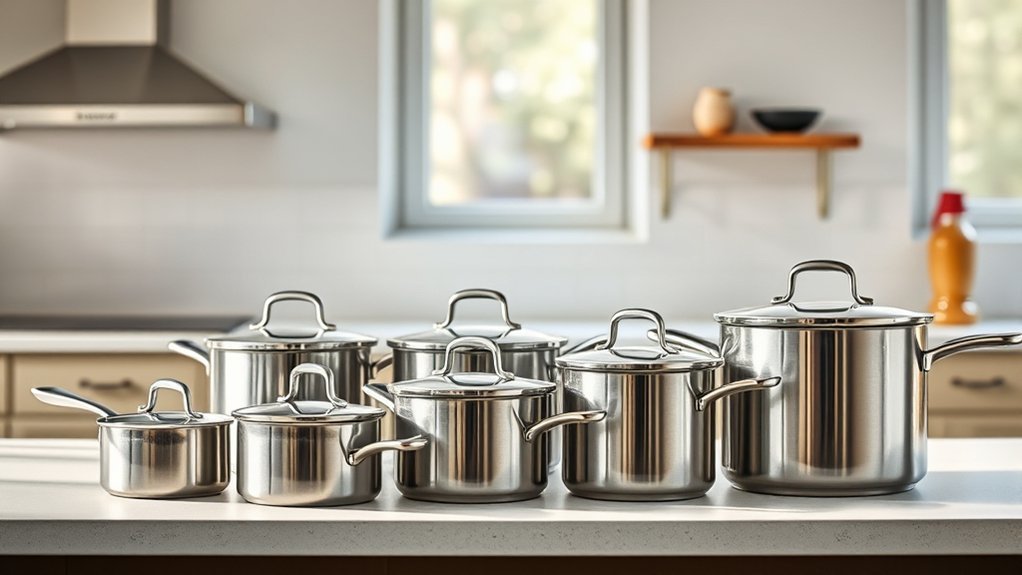
Cooking pots are usually identified first by capacity in quarts or liters, while diameter, depth, base width, and overall dimensions tell you whether a pot will fit a burner, lid, cabinet, or recipe. Because manufacturers do not all describe dimensions the same way, the most reliable approach is to identify the measurement you actually need and measure that part of the pot directly.
Quick Answer
Cooking pots are usually identified by capacity—quarts or liters—while diameter, depth, base diameter, and overall dimensions help with lids, burners, and storage. To measure an unmarked pot, record its dimensions and fill it with measured water. For cooking, leave enough headspace for the food and cooking method rather than assuming one universal fill percentage.
Key Takeaways
- Capacity is commonly listed in quarts or liters; 1 U.S. liquid quart equals about 0.946 liter.
- Measure opening diameter, interior depth, base diameter, and overall width separately because each answers a different question.
- A measured-water test is more dependable than a geometric formula for pots with tapered sides, rounded corners, or curved bases.
- Cooking headspace varies by recipe. Do not assume every pot has the same fixed “usable capacity” percentage.
At a Glance
| Time Required | 5–10 minutes |
| Difficulty | Easy |
| Tools Needed | Rigid ruler or tape measure, plus a marked liquid measuring cup or pitcher for capacity |
| Cost | $0 if you already own the measuring tools |
How Cooking Pots Are Measured
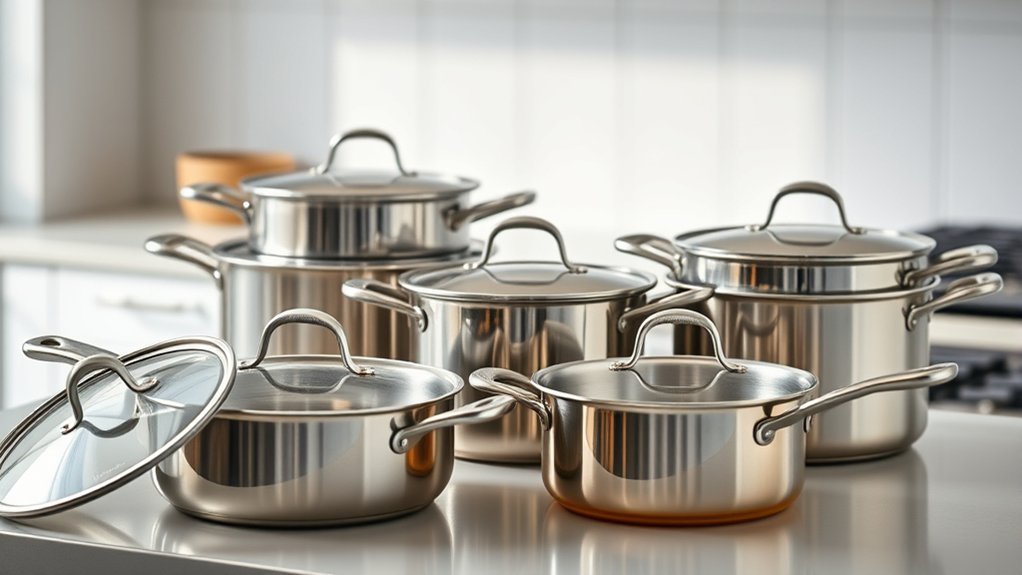
A cooking pot can have several different measurements, and no single dimension answers every question. Capacity tells you how much the vessel holds, the top opening helps with lid fit, the interior depth helps estimate volume, the base diameter matters for burner contact, and the outside dimensions determine storage clearance.
For your own measurements, record the inside opening diameter by measuring straight across the top opening through its center. Then measure interior depth from the inside bottom to the rim. If you are comparing published specifications, read the manufacturer’s labels carefully because “diameter” may refer to total diameter, an interior dimension, or the cooking surface.
Real manufacturer specifications show why that distinction matters. Made In, for example, separately publishes total diameter and cooking-surface diameter for its stockpots, while Le Creuset lists separate interior and exterior dimensions for its round Dutch ovens.
Base diameter is another useful measurement because it shows how much of the pot actually contacts a conventional cooking surface. For induction cooking, also follow the cooktop and cookware manufacturer’s compatibility guidance rather than assuming the widest outside dimension represents the magnetic contact area.
Pot Capacity in Quarts, Liters, and Usable Space
Pot capacity is commonly stated in U.S. liquid quarts in the United States and liters in metric markets. According to the NIST Guide to the SI, 1 U.S. liquid quart equals approximately 0.946353 liter.
| Size | Approx. metric equivalent | Typical context |
|---|---|---|
| 4 qt | 3.8 L | Smaller soups, grains, side dishes |
| 6 qt | 5.7 L | Everyday soups, stews, braises |
| 8 qt | 7.6 L | Pasta, stock, larger batches |
| 12 qt | 11.4 L | Large-volume cooking |
| 16 qt | 15.1 L | Very large batches and stock |
A pot’s labeled capacity and the amount you should cook in it are not necessarily the same. A pot filled to its brim has little room for stirring, bubbling, foaming, or adding ingredients. The amount of headspace you need depends on what you are cooking, so there is no single 75%, 80%, or other percentage that applies to every ordinary cooking pot.
Note: If you want to know both values, measure the pot once to the brim for approximate total capacity and again to the level you normally consider safe for the recipe. Label those figures separately so you do not confuse maximum volume with working volume.
How to Measure Pot Diameter and Depth
Start with the pot empty, cool, and sitting on a flat surface. A rigid ruler is easiest for smaller cookware; a tape measure works well for larger stockpots.
- Opening diameter: Measure straight across the inside of the top opening through the center. This is useful for understanding interior width and for beginning a lid-fit check.
- Interior depth: Measure vertically from the inside bottom surface to the top rim.
- Base diameter: Turn the empty pot over and measure the flat area that contacts the stovetop. Do not include rounded sidewalls that do not touch the cooking surface.
- Overall width: Measure the widest exterior point, including handles when cabinet, drawer, dishwasher, or oven clearance matters.
- Overall height: Measure from the bottom to the highest point of the assembled pot, including the lid knob if storage clearance is the concern.
These measurements should be recorded separately. A 10-inch opening, for example, does not mean the flat cooking base is also 10 inches wide.
Pro Tip: Measure twice and write down whether each figure is an inside, outside, base, or overall measurement. A bare number such as “10 inches” is easy to misinterpret later.
How to Check a Pot’s Capacity at Home
The most direct way to check an unmarked pot is the water-fill method. Place the pot on a level surface, pour in a known quantity of water from a marked measuring cup or pitcher, and keep a running total.
- Make sure the pot is cool, clean, and level.
- Add water in measured increments such as 1 quart, 1 liter, or 4 cups.
- Keep a written tally as you pour.
- For approximate maximum capacity, stop at the brim without spilling.
- Empty and dry the pot when finished.
This method automatically accounts for tapered walls, rounded bases, thick corners, and other shapes that make a simple cylinder calculation less accurate.
How to Estimate Capacity From Dimensions
If the pot has a nearly straight-sided cylindrical interior, its volume can be estimated from its interior diameter and depth. When measurements are in inches:
Approximate capacity (U.S. qt) = π × (interior diameter ÷ 2)² × interior depth ÷ 57.75
The divisor converts cubic inches to U.S. liquid quarts. This calculation is only an approximation when the pot has sloped walls, a rounded base, a thick rolled rim, or other irregular geometry.
With dimensions in centimeters, a similar estimate is:
Approximate capacity (L) = π × radius² × interior depth ÷ 1,000
Again, use interior dimensions. Exterior measurements include wall thickness and therefore overstate the space available inside the cookware.
For an irregular or tapered pot, measured water is usually more useful than cylinder math because it measures the actual interior volume rather than an idealized shape.
How Stock Pots, Saucepans, and Dutch Ovens Differ
Stockpots, saucepans, and Dutch ovens overlap in capacity, so their names describe shape and intended use as much as volume. Manufacturer lines vary, and the ranges below should be treated as common household examples rather than fixed standards.
Stock Pot Basics
Stockpots generally have relatively tall sides and two short handles. Household versions are commonly sold in capacities such as 6, 8, 12 quarts, and larger sizes. Their height and volume make them useful for stocks, soups, pasta water, and other large liquid-based batches.
A stockpot’s base width still matters. A very large pot on a much smaller burner may heat less evenly, so check both the pot’s flat base and the cooktop manufacturer’s guidance.
Saucepan Shape Differences
Saucepans are usually smaller than stockpots and normally have one long handle. Capacities around 1 to 4 quarts are common for household models, making them practical for sauces, grains, reheating, poaching, and smaller quantities of liquid.
The relatively modest diameter limits exposed surface area compared with a wide sauté pan or Dutch oven. That can be useful when you want controlled simmering without excessive evaporation.
- Saucepans suit smaller liquid-based jobs and controlled simmering.
- Stockpots emphasize depth and volume.
- Dutch ovens combine useful capacity with a broader, heavier cooking vessel.
- Actual dimensions and capacities vary by manufacturer and model.
Dutch Oven Design
Dutch ovens are typically wider and heavier than saucepans and are well suited to braising, stewing, roasting, baking, simmering, and other long-cooking tasks. Many are cast iron, although Dutch-oven-style vessels can use other constructions.
Capacity varies widely. Lodge’s Dutch-oven sizing guide, for example, covers multiple sizes rather than defining one universal 4- to 8-quart standard. Le Creuset likewise sells its round Dutch oven in several capacities.
Enameled cast iron models combine substantial heat retention with an enamel cooking surface. Their broad bases can also provide more browning area than a narrow saucepan of similar capacity.
How to Choose the Right Pot Size
Choose pot size by the food you cook most often, the number of servings, and the amount of room the recipe needs for stirring, boiling, or expansion. Household size alone is not enough to determine the right capacity.
As a rough example, a smaller 2- to 4-quart vessel can handle many side dishes and smaller meals; 4 to 6 quarts is a versatile range for many soups, stews, and braises; 6 to 8 quarts offers more room for pasta and batch cooking; and larger stockpots are useful when you routinely cook large quantities.
Those are practical starting points, not standards. Lodge, for example, describes roughly one quart per serving as a Dutch-oven shopping rule of thumb, while actual requirements vary by recipe.
Household Size And Use
For household use, think in terms of normal batch size rather than buying the largest pot that fits your cabinet.
- One or two servings: Smaller 2- to 4-quart pots often cover sauces, grains, vegetables, and compact meals.
- Several servings: A 4- to 6-quart pot is a flexible size for many everyday soups, stews, and braises.
- Family batches or pasta: A 6- to 8-quart vessel provides additional room for water and ingredients.
- Large-batch cooking: Stockpots of 12 quarts or more can be useful for large stocks, soups, seafood boils, or similar high-volume jobs.
Many kitchens work best with more than one size: a smaller saucepan for routine tasks and a larger pot for pasta, stock, or batch cooking.
Match Pot To Task
The same capacity can behave differently depending on shape. A wide pot exposes more food and liquid to the air, which can help browning and speed reduction. A taller, narrower pot provides less surface area relative to its depth and may be better suited to some simmering and boiling tasks.
Before buying, check:
- Recipe and batch size
- Flat base diameter versus burner or induction zone
- Overall width including handles
- Overall height with the lid installed
- Oven and cabinet clearance
- Weight when the pot is full
Warning: Do not choose home-canning equipment by quart capacity alone. The National Center for Home Food Preservation distinguishes boiling-water canners from pressure canners. Low-acid foods require an appropriate pressure-canning process, while boiling-water canners need a rack and sufficient depth to maintain the required water level above jars.
Which Measurement Matters for Lids, Burners, and Storage?
Different jobs require different measurements, which is why one “pot size” number can be misleading.
| What you need to check | Measurement that matters most |
|---|---|
| Approximate recipe capacity | Quarts or liters |
| Replacement lid | Top opening/rim geometry plus the lid manufacturer’s fit specification |
| Burner contact | Flat base diameter |
| Cabinet or drawer fit | Overall width and height, including handles and lid knob |
| Approximate geometric volume | Interior diameter and interior depth |
For a replacement lid, measure the pot opening carefully but also check the accessory maker’s stated fit method. Rolled rims, flanges, pouring lips, and non-round shapes can affect whether a nominally similar lid actually seats correctly.
Common Pot Sizing Mistakes and How to Avoid Them
The most common mistake is treating one measurement—usually the capacity label—as if it describes everything about the pot.
- Confusing maximum capacity with cooking level: Leave headspace appropriate to the food instead of filling a pot to the rim during active cooking.
- Mixing inside and outside dimensions: Interior measurements describe cooking space; exterior measurements describe physical fit.
- Ignoring the base: The top opening may be much wider than the flat area touching the burner.
- Using cylinder math on a tapered pot: Use measured water when the shape is not close to a straight-sided cylinder.
- Assuming materials determine capacity: Wall thickness, curvature, taper, and construction geometry matter more than the material name alone.
- Buying by household size alone: Match the pot to the recipes and quantities you actually prepare.
Accurate sizing reduces boilovers, overcrowding, poor burner matching, storage problems, and the frustration of discovering that a new lid or pot does not fit as expected.
Frequently Asked Questions
Are Pots Measured at the Top or Bottom?
It depends on what you are measuring. Capacity is normally expressed in quarts or liters. For your own dimensional measurements, the top opening gives interior width, while the bottom or base diameter tells you how much surface contacts the burner. Manufacturers may also publish total exterior dimensions, so check the specification label before comparing models.
Are Pans Measured From Top or Bottom?
Frying pans and skillets are commonly sold by a nominal diameter near the top opening, while their flat cooking surface is smaller. Exact conventions vary by manufacturer, so use the maker’s dimensional drawing when burner fit, lid fit, or precise interior area matters.
Is a 3 Quart Pan Medium or Large?
A 3-quart saucepan or saucier is often treated as a mid-size household vessel, but “small,” “medium,” and “large” are not universal cookware standards. Compare the actual capacity and dimensions instead of relying on those labels.
What Does a 10 Inch Pan Mean?
A 10-inch pan generally refers to a nominal diameter across the upper portion of the pan, excluding the handle. The flat cooking surface is usually smaller. Because brands publish dimensions differently, check the product specification if you need an exact inside diameter, base diameter, or lid size.
How Do I Measure a Pot for a Replacement Lid?
Measure straight across the pot’s top opening through the center, then compare that figure with the replacement-lid maker’s fitting instructions. Also inspect rolled rims, pouring spouts, and unusual shapes because two pots with similar nominal diameters may not accept the same lid.
Can I Safely Cook 6 Quarts of Food in a 6 Quart Pot?
Not necessarily. A 6-quart capacity describes volume, but cooking at or near the brim can leave too little room for stirring, bubbling, foaming, or expansion. Choose a larger vessel when the recipe needs substantial headspace rather than relying on a fixed percentage for every food.
Sources
- National Institute of Standards and Technology — NIST Guide to the SI, Appendix B.9 — U.S. liquid-quart and metric conversion factors.
- Made In — Stainless Steel Stock Pot Specifications — examples of total diameter, cooking-surface diameter, depth, and overall dimensions.
- Le Creuset — Round Dutch Oven Specifications — examples of capacity plus separate interior and exterior dimensions.
- Lodge Cast Iron — What Size Dutch Oven Do I Need? — manufacturer examples of Dutch-oven capacities and serving guidance.
- National Center for Home Food Preservation — Recommended Canners — requirements and distinctions for boiling-water and pressure canning equipment.
Conclusion
Cooking pots are measured in more than one way. Capacity in quarts or liters describes how much the vessel holds, while opening diameter, interior depth, base diameter, and overall dimensions answer different questions about cooking space, lid fit, burner contact, and storage.
For an unmarked pot, the simplest capacity check is to fill it with measured water. Geometric calculations can provide an estimate for a nearly cylindrical vessel, but measured water is more reliable for tapered or rounded cookware. When comparing products, check exactly which dimension the manufacturer is quoting instead of assuming every brand measures its cookware the same way.

3 thoughts on “How Are Cooking Pots Measured? Measurement & Size Guide”