
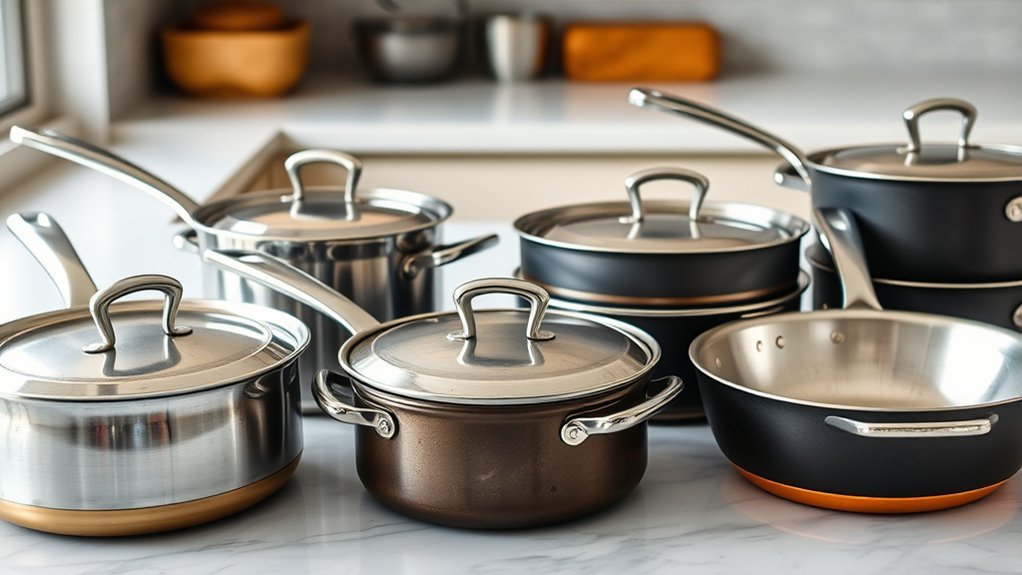
Saucepans are commonly made from stainless steel, aluminum, copper, cast iron, carbon steel, and metal with PTFE or ceramic nonstick coatings. The material affects how quickly the pan heats, how well it holds heat, how much it weighs, what foods it handles well, and how much care it needs. Construction matters just as much: many high-quality stainless steel saucepans contain an aluminum or copper core to spread heat more evenly.
Quick Answer
Most saucepans are made from stainless steel, aluminum, copper, cast iron, carbon steel, or coated metal. Stainless steel offers durability, aluminum heats quickly, copper responds rapidly to temperature changes, cast iron retains heat, and nonstick coatings simplify food release. Multi-ply pans combine metals to balance these strengths.
Key Takeaways
- Stainless steel is durable and corrosion resistant but usually performs better with an aluminum or copper core.
- Aluminum is lightweight and responsive; hard-anodized aluminum has a harder, more durable surface than untreated aluminum.
- PTFE and ceramic nonstick coatings improve food release but should be treated gently and used within the manufacturer’s heat limits.
- Copper provides excellent temperature response but normally needs a food-safe lining when used for general cooking.
- Construction and cooktop compatibility matter: tri-ply, fully clad, disc-base, and induction-compatible pans can behave differently even when their cooking surfaces look similar.
What Are Saucepans Made Of?
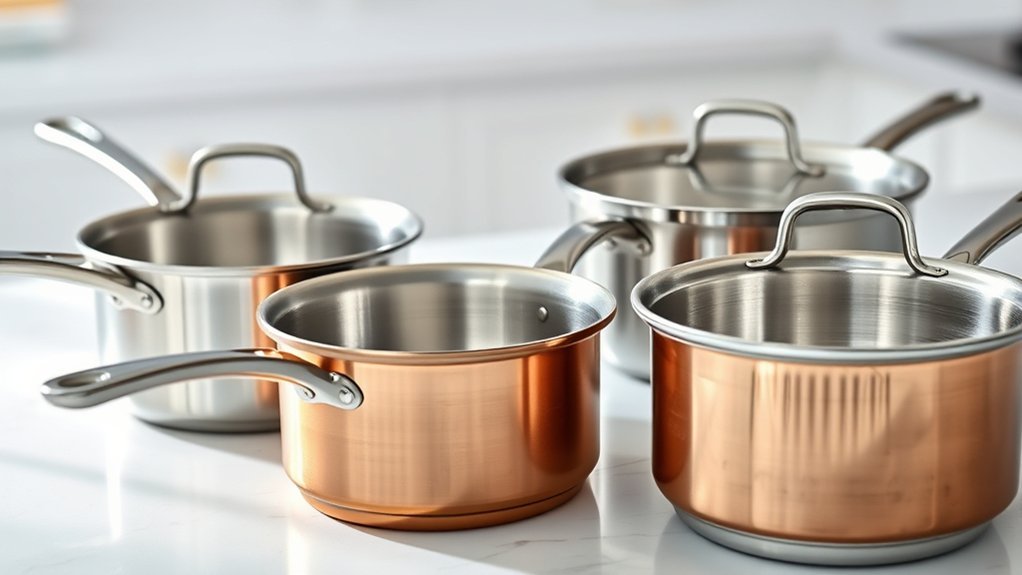
Saucepans can be made from one metal or from several bonded materials. Common choices include stainless steel, aluminum, hard-anodized aluminum, copper, cast iron, carbon steel, enameled metal, and metal pans with PTFE or ceramic nonstick coatings.
These materials do not perform identically. Stainless steel is strong and resistant to rust and staining. Aluminum conducts heat well and keeps weight down. Copper changes temperature quickly. Cast iron holds heat for a long time. Nonstick coatings reduce sticking but have different care and temperature requirements.
Health Canada notes that cookware materials can transfer substances to food under some conditions, so the type of material, food being cooked, condition of the cookware, and manufacturer’s instructions all matter.
| Material | Heat Behavior | Good For | Main Consideration |
|---|---|---|---|
| Clad stainless steel | Balanced when paired with a conductive core | Sauces, grains, boiling, reductions, everyday cooking | Heavier than aluminum; nickel-containing grades may not suit people with nickel allergies |
| Aluminum | Fast heating and responsive | Everyday boiling, sauces, reheating | Bare aluminum needs more care with acidic or salty foods |
| PTFE nonstick | Depends mainly on the metal body beneath the coating | Delicate or sticky foods and easy cleanup | Avoid empty high-heat preheating and abrasive utensils |
| Copper | Very fast response to heat changes | Temperature-sensitive sauces and reductions | Food-contact surface generally needs a suitable lining |
| Cast iron / enameled cast iron | Slow to change temperature; strong heat retention | Slow simmering and steady cooking | Heavy; bare iron needs seasoning while enamel can chip |
| Carbon steel | Responsive with moderate heat retention | General cooking where a seasoned surface is useful | Needs drying and seasoning to resist rust |
| Ceramic-coated metal | Determined mainly by the underlying metal body | Low-to-medium-heat cooking and easy release | Coating can lose release performance with wear and overheating |
Stainless Steel Saucepans: Durable and Versatile
Stainless steel saucepans are popular because the cooking surface is strong, corrosion resistant, and suitable for a broad range of foods. Stainless steel itself does not conduct heat as efficiently as aluminum or copper, so better-performing saucepans usually pair the steel with a conductive core or base.
A stainless steel saucepan’s heating performance depends heavily on what is beneath the cooking surface. An aluminum or copper core can spread heat much more effectively than stainless steel alone.
Stainless steel is useful for sauces, grains, vegetables, reductions, boiling, and reheating. Unlike bare cast iron or bare aluminum, it is generally a practical choice for acidic ingredients when used normally.
Many stainless cookware grades contain nickel. Health Canada advises people with a nickel allergy not to use cookware containing nickel. It also recommends adding salt after water has begun boiling to reduce the chance of pitting the stainless surface.
- Durability: resists rust, staining, and everyday wear.
- Versatility: works for simmering, boiling, browning, and deglazing.
- Conductive cores: aluminum or copper layers improve heat distribution.
- Maintenance: usually requires less upkeep than bare cast iron or carbon steel.
Dishwasher and oven compatibility vary by product, especially when glass lids, coated components, or heat-limited handles are used. Check the saucepan manufacturer’s care instructions rather than assuming all stainless cookware has the same limits.
Aluminum Saucepans: Lightweight and Fast Heating
Aluminum saucepans are valued for their low weight and rapid heat conduction. They respond quickly when burner settings change, making them useful for everyday boiling, reheating, sauces, and other tasks where easy handling matters.
Aluminum cookware may be bare, hard-anodized, clad with another material, or covered by a nonstick coating. Those constructions should not be treated as interchangeable. Hard anodizing creates a harder surface and reduces aluminum transfer compared with untreated aluminum, while a separate PTFE or ceramic layer is a coating added over the pan body.
Lightweight Handling
Aluminum’s relatively low weight makes a saucepan easier to lift, tilt, stir, and pour from, particularly when the pan is full. This can be useful in larger saucepans where the weight of food and liquid quickly adds up.
- Low weight makes routine lifting and pouring easier.
- Aluminum responds quickly when burner temperature changes.
- Hard-anodized surfaces are harder and more wear resistant than untreated aluminum.
- Aluminum cookware can also serve as the conductive core inside stainless steel pans.
Fast, Even Heating
Aluminum transfers heat efficiently, so a well-designed aluminum saucepan warms quickly. How evenly it cooks still depends on the thickness and shape of the pan, burner size, and whether the base has warped.
Bare aluminum deserves more care with food chemistry. Health Canada advises against prolonged cooking or storage of highly acidic or salty food in ordinary aluminum cookware and notes that worn or pitted cookware can transfer more material to food. Hard-anodized aluminum reduces this transfer and provides a more durable surface.
Note: FDA warnings about lead have involved specific imported aluminum, brass, Hindalium/Hindolium, and Indalium/Indolium cookware products. They do not mean that all aluminum cookware contains lead. Buy food-contact cookware from a traceable manufacturer and check current safety alerts when the product’s composition or origin is uncertain.
Nonstick Saucepan Coatings: Easy Release and Cleanup
A nonstick saucepan is normally a metal pan covered with a low-stick surface. The two categories consumers most often encounter are PTFE-based coatings and coatings marketed as ceramic nonstick. The coating controls food release, while the underlying aluminum, stainless-clad, or other metal construction contributes most of the pan’s heating behavior.
PTFE provides excellent food release and easy cleanup when cookware is used as intended. Germany’s Federal Institute for Risk Assessment states that adverse health effects are not expected from PTFE cookware used as intended, but warns against severe overheating, especially when a pan is empty.
Warning: Do not leave an empty PTFE-coated saucepan on a hot burner. Health Canada advises avoiding high heat above about 260°C/500°F for nonstick cookware, while BfR reports PTFE can begin decomposing at around 360°C/680°F. Follow the pan manufacturer’s lower limit whenever one is specified.
- Use silicone, wood, or other utensils approved by the manufacturer.
- Avoid abrasive pads that can shorten coating life.
- Do not assume a ceramic-coated saucepan and a solid ceramic vessel are the same construction.
- Replace a coated pan when the surface has extensive peeling, flaking, exposed substrate, or damage that prevents normal use.
Small particles accidentally released from scratched PTFE are not currently expected by BfR to cause adverse health effects when swallowed because PTFE is chemically inert. Even so, a substantially damaged coating no longer provides the performance the cookware was designed to deliver and is a reasonable reason to replace the pan.
Ceramic nonstick coatings avoid PTFE, but that does not make every ceramic-coated pan identical. Release performance, durability, heat limits, and the metal underneath vary by manufacturer.
Copper, Carbon Steel, and Ceramic Saucepans
Copper, carbon steel, and ceramic constructions fill different roles. Copper is chosen for fast temperature response. Carbon steel combines a relatively thin metal body with a seasoned surface. Ceramic may refer either to a coating over metal or to a solid/glazed ceramic vessel, and those products require different care.
Copper Heat Response
Copper transfers heat very efficiently and responds quickly when burner output changes. That responsiveness is useful for reductions, sugar work, dairy sauces, and other recipes where overshooting the target temperature can change the result.
Because copper can react with food, general-purpose copper cookware normally uses a food-contact lining such as stainless steel or tin. Health Canada advises against cooking or storing food in scratched or uncoated copper cookware and recommends repairing or replacing damaged inner coatings.
- Copper heats and cools quickly when heat input changes.
- A suitable lining separates reactive copper from food.
- Exterior polishing is largely cosmetic; the condition of the interior lining is more important for use.
- Copper alone is not normally compatible with standard induction unless the pan includes an induction-ready magnetic layer or base.
Carbon Steel and Ceramic Care
Carbon steel needs seasoning and prompt drying to limit rust. A small amount of mild soap can be used when necessary on seasoned carbon steel, followed by thorough drying and a very light coat of oil when appropriate.
Ceramic-coated metal cookware should generally be protected from abrasive cleaning, repeated overheating, and utensils that the manufacturer says may damage the surface. Its heat distribution comes mainly from the metal pan body beneath the coating.
Solid or glazed ceramic cookware is a different product category. Reputable food-contact ceramic is designed for cooking, but damaged, decorative, improperly manufactured, or unsuitable glazed ware can present lead or cadmium concerns. Do not use ceramicware marked as decorative or not intended for food.
How Saucepan Construction Changes Heating
Material names tell only part of the story. A stainless steel saucepan may have a conductive disc attached only to its base, or it may contain bonded conductive layers that continue up the sides. Two saucepans labeled “stainless steel” can therefore heat differently.
Disc-base construction concentrates a conductive layer in the bottom of the pan. It can work well for boiling and other tasks focused on bottom heat, but the sidewalls may respond differently from the base.
Fully clad construction bonds layers across the base and up the walls. This spreads conductive material through more of the saucepan body and can improve temperature consistency during sauce work.
Thickness also matters. A very thin conductive pan can heat quickly but may be easier to overheat or warp. A thicker construction generally changes temperature more slowly but can provide greater stability.
- Stainless steel: durable cooking surface, commonly paired with a conductive core.
- Aluminum: fast, responsive heat conduction.
- Copper: especially rapid temperature response.
- Cast iron: slower response with strong heat retention.
- Coatings: primarily change food release and surface care rather than replacing the thermal role of the pan body.
Clad vs. Tri-Ply Saucepan Construction
Clad describes bonded layers of different metals. Tri-ply is a specific three-layer construction. A common tri-ply arrangement uses stainless steel on the cooking surface, aluminum in the middle, and stainless steel on the exterior.
That means all tri-ply cookware is a form of layered or clad cookware, but “clad” does not automatically mean three layers. Five-ply and other bonded constructions also exist. The number of layers alone does not guarantee better cooking; the materials, thicknesses, geometry, and quality of bonding matter too.
All-Clad’s stainless cookware documentation, for example, describes three-ply designs with a stainless interior, aluminum core, and stainless exterior, as well as five-layer constructions using different combinations of conductive metals.
Layering lets a saucepan combine a durable food-contact surface with a more conductive metal inside the pan, helping reduce the weaknesses of a single-material construction.
Induction compatibility should be checked separately. A stainless exterior is useful only if the base is sufficiently magnetic for the cooktop.
Cooktop and Oven Compatibility
Gas and conventional electric cooktops can heat most metal saucepan materials, but induction requires compatible cookware. The U.S. Department of Energy recommends a simple check: if a magnet sticks firmly to the flat bottom of the pan, the cookware should work on a conventional induction cooktop.
- Cast iron and enameled cast iron: normally induction compatible because the underlying iron is magnetic.
- Many stainless saucepans: induction compatible when they have a magnetic exterior or base.
- Plain aluminum and copper: generally need an added magnetic base or layer for standard induction.
- Coated cookware: compatibility depends on the metal body beneath the coating.
Pro Tip: Do not judge oven safety from the pan material alone. Glass lids, phenolic knobs, silicone parts, wooden handles, and nonstick coatings may have lower temperature limits than the metal saucepan body.
Which Saucepan Material Fits Your Cooking Style?
The most suitable saucepan depends on what you cook, how quickly you want the pan to respond, its weight, your cooktop, and how much maintenance you are willing to do.
Clad stainless steel is a strong all-purpose choice. Aluminum is useful when light weight and rapid heating matter. Nonstick can simplify delicate or sticky foods. Copper gives very fast temperature response. Enameled cast iron works well when steady heat retention is more important than low weight.
Matching Material to Cooking
- General sauces, grains, vegetables, and boiling: clad stainless steel offers broad versatility.
- Fast everyday heating: aluminum or hard-anodized aluminum responds quickly and is easy to lift.
- Sticky or delicate food: PTFE or ceramic-coated cookware reduces food adhesion when used within its heat limits.
- Temperature-sensitive sauces: lined copper responds very quickly to heat adjustments.
- Slow simmering: cast iron or enameled cast iron holds heat steadily.
- Seasoned-metal cooking: carbon steel can provide a durable surface but requires drying and seasoning.
Care, Heat, and Durability
Stainless steel normally offers the lowest maintenance among long-lived metal saucepan materials. Bare aluminum is easy to handle but needs more consideration with acidic or salty food. Hard-anodized aluminum adds surface durability.
Copper requires attention to the condition of its food-contact lining. Bare carbon steel and cast iron can last for decades but rely on drying and seasoning. Enameled cast iron removes the seasoning requirement but introduces the possibility of chipped enamel.
Nonstick cookware provides the easiest release but should be viewed as a coated product whose cooking surface can wear over time. Gentle utensils, moderate heat, and proper cleaning help extend its useful life.
How to Care for Different Saucepan Materials
Care instructions should always start with the manufacturer’s directions because handles, lids, coatings, and finishes vary even within the same material category.
- Stainless steel: wash with ordinary dish detergent and a suitable sponge or cloth. Remove stuck-on residue without unnecessarily gouging the surface.
- PTFE or ceramic nonstick: avoid empty high-heat preheating, abrasive cleaners, and utensils prohibited by the manufacturer.
- Bare aluminum: use mild detergent and non-abrasive tools; avoid prolonged storage of acidic or salty foods.
- Hard-anodized aluminum: protect the anodized surface from deep scratches and follow manufacturer cleaning instructions.
- Cast iron: wash, dry promptly, and maintain seasoning. Mild dish soap is acceptable for ordinary cleaning.
- Carbon steel: clean without prolonged soaking, dry promptly, and maintain a light seasoned surface.
- Copper: protect the interior lining and avoid abrasive cleaning that exposes the copper underneath.
- Enameled cast iron: use non-abrasive cleaning methods and avoid impacts or sudden temperature changes that could damage enamel.
Lodge’s current cast-iron care guidance specifically confirms that soap is acceptable. The more important precautions are avoiding prolonged soaking, drying the cookware thoroughly, and maintaining the seasoning.
When to Replace a Saucepan Body or Coating
A saucepan does not need to be discarded simply because it looks old. Replacement makes sense when damage prevents safe, stable, or intended use and cannot be reasonably repaired.
- Severely warped base: replace the pan when it rocks, becomes unstable, or makes poor contact with the cooktop.
- Loose or damaged handle: tighten or repair it if the design allows; replace the pan if the handle cannot be made secure.
- Extensively peeling or flaking nonstick surface: replace the saucepan when the coating is badly deteriorated or the underlying material is exposed.
- Chipped interior enamel: stop using an enameled pan when the food-contact enamel is substantially chipped and the manufacturer advises replacement.
- Worn copper lining: have suitable cookware professionally relined where practical or replace it if copper is exposed to food.
- Cracks or structural damage: replace cast iron, ceramic, or metal cookware that is cracked or otherwise structurally unsound.
Ordinary surface rust on bare cast iron is different. It can often be scrubbed away and the pan reseasoned rather than discarded.
Note: If an unfamiliar metal saucepan has no reliable manufacturer information, questionable composition, or appears on a safety recall, stop using it until its food-contact safety can be confirmed. The FDA has issued current warnings for specific imported cookware products found capable of leaching lead.
The FDA’s imported-cookware alert lists affected products and is the appropriate place to check the current warning rather than assuming an entire cookware material is unsafe.
Frequently Asked Questions
What Is the Healthiest Material for Cooking Pans?
There is no single saucepan material that is universally the healthiest. Reputable stainless steel, cast iron, enameled cookware, aluminum, and properly used nonstick cookware can all have a place in a kitchen. Choose cookware intended for food contact, keep it in good condition, consider allergies such as nickel sensitivity, and follow the manufacturer’s temperature and care instructions.
What’s the Difference Between a Pan and a Saucepan?
“Pan” is a broad cookware term. If a saucepan is being compared with a frying pan or skillet, the saucepan normally has taller, straighter sides and often a lid, making it well suited to liquids, sauces, boiling, and simmering. A frying pan is shallower with a wider cooking surface and is better suited to frying and sautéing.
How Do I Know if My Pan Is Aluminum or Not?
Check the manufacturer’s label, model information, packaging, or stamped markings first. Aluminum is usually relatively lightweight and bare aluminum is non-magnetic, but those clues are not conclusive because clad pans and aluminum pans with magnetic induction plates combine several metals. Do not scratch a coated saucepan simply to identify the material.
What Is the Least Toxic Type of Cookware?
There is no evidence-based universal “least toxic” cookware category. The more useful standard is to choose reputable cookware intended for food contact and use it within its design limits. Stainless steel, cast iron, enameled cookware, properly manufactured ceramic, aluminum, and modern nonstick cookware each have material-specific benefits and precautions.
Do All Stainless Steel Saucepans Work on Induction?
No. A stainless saucepan needs a sufficiently magnetic base or exterior layer to work with a standard induction cooktop. Place a magnet against the bottom: if it sticks firmly, the saucepan should normally be induction compatible. Manufacturer markings remain the best confirmation.
Are Aluminum Saucepans Safe to Cook With?
Food-contact aluminum cookware from a reputable manufacturer can be used as directed. Health Canada recommends avoiding prolonged cooking or storage of highly acidic or salty foods in ordinary aluminum cookware and replacing badly worn or pitted pieces. Hard-anodized aluminum has a harder surface and reduces aluminum transfer. Consumers should also follow current product-specific recall and safety alerts.
Conclusion
Saucepans are made from stainless steel, aluminum, copper, cast iron, carbon steel, ceramic materials, and coated metals because each construction solves a different cooking problem. Stainless steel provides durability, aluminum adds fast heat transfer and low weight, copper gives rapid temperature response, cast iron retains heat, and nonstick coatings simplify food release.
For many kitchens, a clad stainless steel saucepan provides a useful balance of durability and heating performance, but there is no single material that suits every cook. Check the pan’s complete construction, food-contact surface, weight, maintenance requirements, induction compatibility, and manufacturer heat limits before choosing. Proper care matters as much as material choice for keeping a saucepan useful over the long term.
Sources
- Health Canada — The Safe Use of Cookware and Bakeware — aluminum, anodized aluminum, copper, stainless steel, cast iron, ceramic, and nonstick safety guidance.
- German Federal Institute for Risk Assessment — PTFE Cookware Guidance — PTFE overheating, intended use, and scratched-coating guidance.
- U.S. Department of Energy — Induction Cooking — induction operation and the cookware magnet test.
- Lodge Cast Iron — Cleaning and Care — soap, drying, rust prevention, and seasoned cast-iron maintenance.
- U.S. FDA — Imported Cookware Lead Warning — current product-specific warnings about cookware capable of leaching lead.
- All-Clad — Stainless Steel Cookware Construction — examples of tri-ply and multi-ply bonded stainless steel construction.

5 thoughts on “What Are Saucepans Made of? Materials & Construction Explained”