
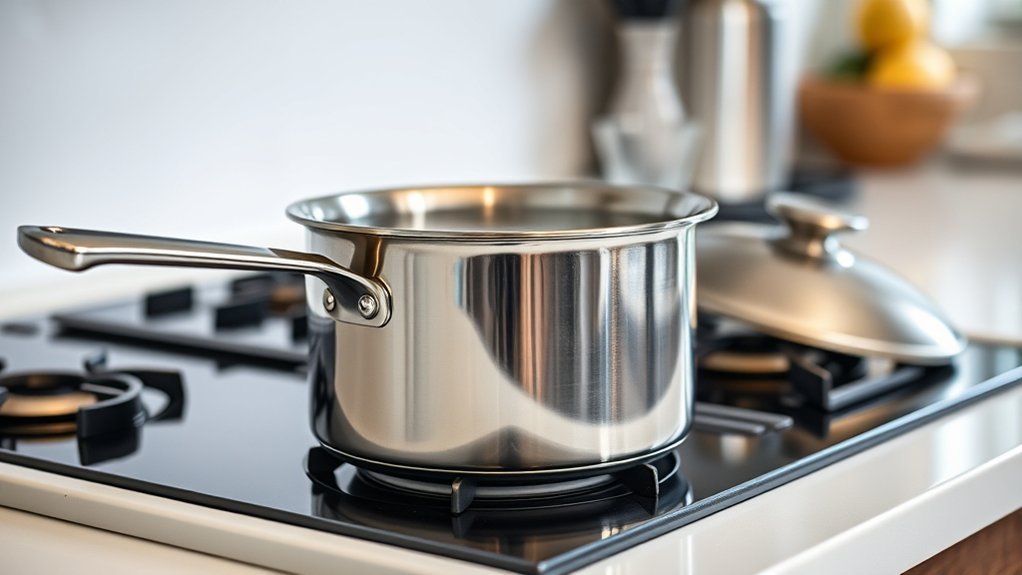
A medium saucepan usually means a long-handled saucepan in the 2- to 3-quart range, or about 1.9 to 2.8 liters. That is a useful kitchen convention rather than a universal manufacturing standard, so exact diameter and height vary by brand and design. This size works well for sauces, rice, grains, vegetables, soup, reheating, and other everyday jobs where a small saucepan feels cramped but a large pot is unnecessary.
Quick Answer
A medium saucepan is commonly about 2 to 3 quarts. A 2-quart model is compact, a 2.5-quart model sits near the middle, and a 3-quart model gives extra room for boiling and stirring. There is no universal diameter or height, so check the manufacturer’s actual dimensions when fit matters.
Key Takeaways
- 2 to 3 quarts is the common medium range, but “medium” is not a standardized cookware measurement.
- Physical dimensions vary even among pans with similar capacity, so check the model’s top diameter, base, depth, and overall size.
- A 2-quart saucepan favors smaller batches; 2.5 quarts is a flexible midpoint; 3 quarts gives more headroom for grains, pasta, soup, and boiling.
- Material construction, handle comfort, lid fit, cooktop compatibility, weight, and oven limits can matter as much as capacity.
- For recipes that simply call for a “medium saucepan,” use a pan that holds the ingredients comfortably with enough empty space to stir and control bubbling.
What Is a Medium Saucepan?
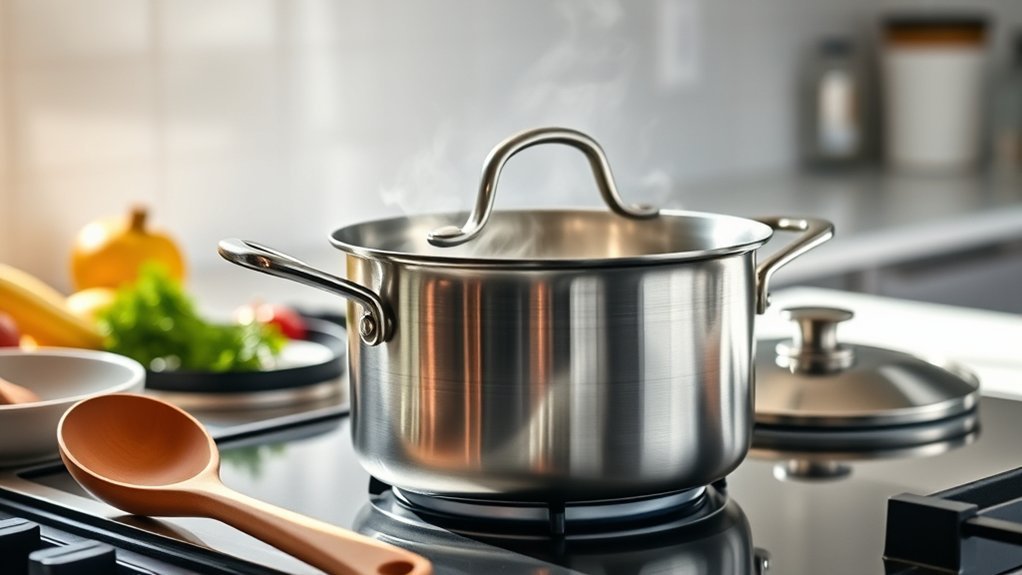
A medium saucepan is a relatively deep cooking vessel with one long handle and usually a fitted lid. In everyday U.S. cookware terminology, it commonly holds about 2 to 3 quarts.
That range is a convention, not a mandatory standard. For example, GreenPan currently groups 2-, 2.5-, and 3-quart models within its medium saucepan selection. Other manufacturers may organize their cookware differently, so the capacity printed in quarts or liters is more useful than the word “medium” alone.
Its tall sides make a saucepan well suited to liquids and foods that need contained simmering. Common uses include boiling vegetables, cooking rice and grains, reheating soup, making sauces, warming milk, boiling eggs, and preparing modest portions of pasta.
The long handle gives one-handed control for stirring and pouring, while a fitted lid helps retain heat and moisture when cooking grains, steaming, or simmering.
Note: “Medium” describes a general size class. If a recipe, shelf, drawer, burner, or induction zone requires an exact fit, use the saucepan’s stated capacity and manufacturer dimensions instead of relying on the label.
Medium Saucepan Size and Capacity
A 2- to 3-quart capacity is the most useful working definition of a medium saucepan. That equals roughly 1.9 to 2.8 liters.
Capacity describes how much the vessel can physically contain, but it should not be confused with safe working volume. A saucepan filled almost to its rim leaves little room for stirring, foaming, or vigorous boiling. Foods such as pasta, oatmeal, milk, and starchy grains need extra headroom because they can foam or expand.
- 2 quarts: useful for sauces, reheating, oatmeal, eggs, smaller portions of rice or grains, and other compact jobs.
- 2.5 quarts: a flexible middle size for side dishes, sauces, grains, vegetables, and modest soup portions.
- 3 quarts: offers more stirring and boil-over room and is especially useful when cooking larger grain portions, soup, vegetables, or small amounts of pasta.
Serving count cannot be determined from pan size alone. Two quarts of sauce, soup, cooked rice, or pasta represent very different numbers of portions. For that reason, “2 to 4 servings” is best treated as a rough small-batch guideline rather than a fixed capacity rule.
Medium Saucepan Dimensions
There is no single diameter or height shared by every medium saucepan. Capacity may be similar while the shape changes considerably between brands.
Capacity is the best first measurement for identifying a medium saucepan; diameter and height should be treated as model-specific dimensions.
Real products illustrate the variation. Made In lists its current 2-quart stainless saucepan at about 7 inches in total diameter and 4 inches deep. Le Creuset lists a 2.25-quart enameled cast-iron saucepan with interior dimensions around 7.1 inches across and 4.1 inches high. Calphalon lists a 2.5-quart model with an 8.5-inch diameter.
Those examples show why a rigid rule such as “all medium saucepans are 6½ to 7½ inches across” can be misleading.
When comparing dimensions, check which measurement the manufacturer is giving:
- Top diameter: width across the open rim.
- Cooking-surface diameter: flat interior area at the bottom.
- Base diameter: exterior portion contacting the burner or cooktop.
- Depth: interior distance from the cooking surface to the rim.
- Total height: may include the lid or handle angle rather than pan depth alone.
- Total length: normally includes the long handle.
These distinctions matter when matching a pan to a compact cabinet, induction zone, small burner, dishwasher rack, or oven.
What You Can Cook in a Medium Saucepan
With roughly 2 to 3 quarts of capacity, a medium saucepan handles many everyday foods without occupying the space of a stockpot or Dutch oven.
It works particularly well for rice, quinoa, oatmeal, couscous, sauces, gravy, custards, vegetables, boiled eggs, soup, broth, reheating leftovers, and warming liquids. A 3-quart model can also handle modest pasta portions when enough water and headroom are available.
For sauces, the relatively tall walls help contain splatter and reduce the exposed surface area compared with a broad skillet. That can make controlled simmering and reduction easier.
A compatible steamer insert can expand the saucepan’s role to steaming vegetables or other foods. Always use an insert intended to fit the pan securely and keep sufficient water beneath it so the saucepan does not boil dry.
For milk, oatmeal, rice, pasta, or other foods that can foam, choose the larger pan when deciding between two capacities. The extra empty space is often more useful than filling a smaller saucepan close to its rim.
Warning: Do not treat the saucepan’s maximum physical capacity as its recommended boiling level. Leave enough headroom for stirring, expansion, and bubbling, especially with milk, pasta, oatmeal, rice, or other starchy foods.
Medium Saucepan vs. Small and Large Sizes
A medium saucepan sits between compact saucepans used for very small jobs and larger saucepans intended for bigger batches. The exact category boundaries vary by manufacturer, but the following ranges are useful for comparison.
| Size | Common Capacity | Typical Uses |
| Small | About 1 to 1.5 qt; some brands may include 2 qt | Butter, milk, single portions, small sauces, reheating |
| Medium | Commonly 2 to 3 qt | Rice, grains, vegetables, sauces, soup, eggs, modest pasta portions |
| Large | Often 4 qt and above | Larger batches, family portions, more boiling water |
A smaller saucepan is easier to lift and wastes less space for tiny quantities. A larger saucepan gives more working room and reduces boil-over risk when preparing bigger batches. A medium saucepan is popular because it falls between those two needs.
If you regularly cook one small serving, 2 quarts may be enough. If you frequently prepare several portions or cook foods that expand or foam, 3 quarts is usually the more forgiving choice.
How to Choose the Right Saucepan Size
Choosing the right saucepan size starts with the foods and quantities you prepare most often rather than a fixed diameter rule.
- Match capacity to your usual batch. Choose 2 quarts for smaller jobs, 2.5 quarts for a compact all-purpose option, or 3 quarts when extra headroom is useful.
- Leave room above the food. A saucepan should not need to be filled to the brim to complete routine recipes.
- Check the actual diameter and depth. Manufacturer dimensions are more reliable than assuming all medium pans share one shape.
- Check the base against your cooktop. This is especially useful with induction, where the magnetic base must work with the cooking zone.
- Choose a secure lid. A well-fitting lid is useful for grains, steaming, reheating, and controlled simmering.
- Test handle comfort when possible. The pan should remain controllable when it contains hot liquid.
If a recipe says only “medium saucepan,” a 2- to 3-quart pan is a sensible starting point. More importantly, the ingredients should fit comfortably with room for stirring and bubbling.
Pro Tip: When choosing between two saucepan sizes for the same recipe, use the larger one if the ingredients foam, expand, or require frequent stirring. Extra headroom is usually easier to manage than a pan that is nearly full.
Best Medium Saucepan Materials and Features
The best material depends on how the saucepan will be used. Common options include stainless-clad cookware, aluminum-based nonstick, ceramic-coated cookware, and enameled cast iron.
Construction is as important as the name of the surface material. For example, many high-performance stainless saucepans bond stainless steel around a more conductive aluminum or copper core. All-Clad describes the aluminum core in its D3 stainless saucepan as the component that provides fast, even heating.
Beyond material, useful features include a comfortable handle, a fitted lid, a stable base, an easy-pouring rim, suitable weight, and compatibility with the cooktop and oven temperatures you intend to use.
Best Materials
- Stainless-clad cookware: durable and versatile. Fully clad designs commonly place conductive aluminum or copper between stainless-steel layers to improve heating response and evenness.
- Aluminum: lightweight and responsive to temperature changes. It is often anodized, coated, or incorporated as the conductive core inside clad cookware.
- Nonstick cookware: useful for foods where easy release and simpler cleanup are priorities. Follow the manufacturer’s utensil, heat, cleaning, and oven-use instructions to protect the coating.
- Enameled cast iron: heavier but strong at retaining heat and maintaining a steady simmer. Le Creuset, for example, describes its 2.25-quart enameled cast-iron saucepan as providing strong heat distribution and retention.
No single material is best for every cook. Stainless-clad cookware favors durability and broad versatility, lightweight aluminum-based designs are easier to maneuver, nonstick can simplify delicate or sticky foods, and enameled cast iron favors heat retention.
Key Features
A useful medium saucepan should balance capacity, stability, heat control, and handling.
- Handle: should feel secure when the pan is full. “Stay-cool” or “cool-touch” claims apply under specific use conditions, so oven mitts may still be needed.
- Lid: should fit securely without making the saucepan awkwardly heavy.
- Rim: a flared or rolled rim can make pouring liquids cleaner.
- Base: should sit flat and match the intended cooktop.
- Weight: heavier pans may feel stable but are harder to lift when full.
- Oven rating: check the manufacturer’s limit for the pan, handle, and lid rather than assuming every part has the same heat rating.
- Cleaning requirements: verify whether the model is dishwasher-safe or whether handwashing is recommended.
PFAS-free ceramic-coated products are also available for cooks who specifically prefer that construction. That preference should not be translated into a blanket claim that every PFAS-free surface is inherently safer than every conventional nonstick surface. The U.S. Food and Drug Administration states that authorized PFAS used in certain nonstick cookware coatings are highly polymerized and that studies show negligible amounts capable of migrating to food.
Cooktop and Burner Fit
Physical fit matters in addition to capacity. On gas and conventional electric cooktops, a burner that roughly matches the base helps direct heat where it is needed. On induction, the saucepan must also have a compatible magnetic base.
Do not assume that the advertised top diameter equals the base diameter. A saucepan can flare outward, taper inward, or have rounded walls. If induction-zone compatibility is important, check the manufacturer’s base measurement or compatibility guidance.
Common Medium Saucepan Size Variations
Medium saucepans commonly appear around the 2- to 3-quart range, although manufacturers may use different product categories and shapes. Some cookware lines also offer 3.5-quart models that function much like an oversized medium or compact large saucepan.
This variation is normal because two pans can hold the same volume while having different proportions. One may be narrow and deep; another may be wider and shallower.
For that reason, capacity is the best starting point for classification, while physical dimensions determine how the saucepan fits your burner, storage space, recipes, and handling preferences.
Common Quart Ranges
- 2 quarts: compact and useful for reheating, sauces, oatmeal, eggs, smaller grain portions, and other modest batches.
- 2.5 quarts: a flexible midpoint that provides more room without becoming cumbersome.
- 3 quarts: gives additional headroom for rice, pasta, vegetables, soup, sauces, and foods prone to bubbling.
- 3.5 quarts: sometimes marketed or used as a larger everyday saucepan, depending on the cookware line.
If you want one saucepan to cover the widest range of everyday tasks, capacity and comfortable handling are generally more important than whether the manufacturer literally calls the product “medium.”
Height And Diameter
Height and diameter vary with design. The often-cited dimensions of roughly 3½ to 4½ inches deep and around 6½ to 7½ inches across describe some medium saucepans, but they should not be treated as universal specifications.
For example, a current Made In 2-quart stainless saucepan is listed at 7 inches in total diameter and 4 inches deep. A Le Creuset 2.25-quart saucepan lists a 7.1-inch interior diameter and 4.1-inch interior height. Other designs can be wider.
A narrower, taller saucepan exposes less liquid surface area than a broad, shallow pan of similar capacity. That can affect evaporation and reduction speed. A wider opening, meanwhile, can make stirring and adding ingredients easier.
Measuring Variations Accurately
Because exact measurements vary by manufacturer, measure the feature that actually matters for your purpose.
- Measure straight across the inside of the top rim for interior top diameter.
- Measure the flat exterior bottom if burner or induction-zone fit matters.
- Measure interior depth from the cooking surface to the rim.
- Check the manufacturer’s listed capacity rather than estimating it from diameter alone whenever possible.
- Include the handle and lid when checking cabinet, oven, or dishwasher clearance.
This approach is more dependable than assuming that every pan labeled “medium” has the same shape.
How to Measure a Saucepan at Home
To measure a saucepan at home, first look at its bottom, packaging, manual, or manufacturer listing for a capacity marking in quarts or liters. If that information is unavailable, measured water can provide a practical estimate.
Place the empty saucepan on a stable, level surface and add water using a known measuring jug or quart measure. Keep track of the volume added. This tells you approximately how much the vessel holds.
Do not assume that this brim-level volume is the amount you should actually cook. Boiling food needs empty space above the ingredients.
For physical dimensions, use a tape measure or ruler:
- Measure across the open rim for top diameter.
- Measure the exterior flat bottom separately when cooktop fit matters.
- Measure from the interior base to the rim for depth.
- Measure from the far rim to the end of the handle for total storage length.
If a round saucepan has nearly straight vertical sides, circumference divided by π (approximately 3.1416) can provide a rough diameter estimate. Likewise, the cylinder formula can provide a rough volume estimate. However, real saucepans often taper or have rounded corners, so direct water measurement or manufacturer specifications are more accurate.
Medium Saucepan Buying Tips
Start with capacity, then evaluate construction and handling. For most people looking specifically for a medium saucepan, a model between 2 and 3 quarts is the logical range to compare.
A good saucepan should also fit the way you cook. Someone who mainly reheats soup may prioritize light weight and easy cleanup, while someone who regularly makes reductions or grain dishes may place more value on even heating, a secure lid, and controlled pouring.
Capacity and Size Range
Choose capacity according to the work the pan must do:
- Choose 2 quarts when storage is limited or most jobs are small.
- Choose about 2.5 quarts for a compromise between compact handling and additional room.
- Choose 3 quarts if you regularly want extra stirring space or cook foods that foam and expand.
- Check exact dimensions if the pan must fit a particular induction zone, cabinet, dishwasher, oven, or storage rack.
A recipe calling for a medium saucepan normally does not require an exact fraction of a quart. The practical goal is to use a vessel that contains the ingredients comfortably and provides enough headroom for the cooking method.
Material and Handle Features
Material affects weight, responsiveness, heat retention, cleaning, and durability.
Fully clad stainless cookware typically combines a durable stainless cooking surface with a more conductive core such as aluminum. Aluminum-based pans tend to be lighter and heat responsively. Nonstick surfaces prioritize easy release. Enameled cast iron is heavier but holds heat effectively for steady simmering.
Handle construction matters because a saucepan containing hot liquid becomes considerably heavier. Look for a secure attachment, comfortable shape, and enough clearance to grip safely. Remember that a handle described as stay-cool on the stovetop can still become hot near the pan, over another burner, or in the oven.
A well-fitting lid can reduce evaporation, while a rolled or flared pouring rim helps with sauces and hot liquids. Check whether the lid is glass or metal, whether replacement parts are available, and whether the lid changes the saucepan’s oven-temperature limit.
Other Features Worth Checking
- Cooktop compatibility: especially induction compatibility.
- Maximum oven temperature: including the lid and handle.
- Dishwasher guidance: “dishwasher-safe” and “handwashing recommended” can both appear in cookware care instructions.
- Weight when full: important if you frequently pour one-handed.
- Pouring rim: helpful for sauces, soups, and hot liquids.
- Helper handle: uncommon on smaller saucepans but useful on heavier designs.
- Replacement lid availability: worth checking on cookware intended for long-term use.
Frequently Asked Questions
How Do You Tell the Size of a Saucepan?
Check for a capacity marking in quarts or liters on the bottom, packaging, manual, or manufacturer’s website. If none is available, add measured water to the pan to estimate capacity. For physical size, measure the top opening, bottom contact area, depth, and total length separately because those dimensions serve different purposes.
What Is the Most Common Saucepan Size?
There is no universal industry rule establishing one saucepan as the single most common size. However, 2- to 3-quart saucepans are widely sold as everyday or medium options and are versatile enough for sauces, grains, vegetables, soup, eggs, and reheating.
Is a 3-Quart Pan Medium or Large?
A 3-quart saucepan is commonly treated as a medium or medium-large everyday saucepan, although manufacturer categories vary. It provides more headroom than a 2-quart model and works well for rice, grains, sauces, vegetables, soup, and modest portions of pasta.
Is a 2 Quart Saucepan Big?
A 2-quart saucepan is relatively compact. It is large enough for many everyday jobs such as sauces, oatmeal, reheating, eggs, rice, and small soup portions, but it can become crowded when cooking larger batches or foods that foam and expand.
What Should I Use When a Recipe Says “Medium Saucepan”?
A 2- to 3-quart saucepan is a sensible default. Choose one that holds the ingredients with enough empty space for stirring and bubbling. For milk, pasta, oatmeal, rice, or other foods that may foam or expand, favor the larger pan when you have a choice.
Does Diameter Tell You a Saucepan’s Capacity?
Not by itself. Two saucepans can have similar diameters but different depths, wall shapes, and usable volumes. Capacity in quarts or liters is the better size reference, while diameter is more useful for burner fit, stirring access, storage, and evaporation characteristics.
Conclusion
A medium saucepan is best understood as a useful size category rather than one exact set of dimensions. In most everyday cookware discussions, 2 to 3 quarts is the practical range: 2 quarts favors compact jobs, 2.5 quarts provides a flexible middle ground, and 3 quarts adds useful headroom. Because height, diameter, base size, and overall shape vary by model, check the manufacturer’s specifications when exact fit matters. Choose the capacity, construction, lid, handle, weight, and cooktop compatibility that match the foods you actually prepare.
Sources
- GreenPan — What Is a Medium Saucepan? — supports the common 2- to 3-quart medium-size convention.
- Made In — 2-Quart Stainless Clad Saucepan — manufacturer capacity, diameter, depth, construction, and care specifications.
- All-Clad — D3 3-Quart Stainless Saucepan — manufacturer capacity, uses, dimensions, and aluminum-core construction information.
- Le Creuset — 2.25-Quart Signature Saucepan — manufacturer interior dimensions, capacity, and enameled cast-iron specifications.
- U.S. Food and Drug Administration — Questions and Answers on PFAS in Food — current FDA information on authorized PFAS-containing nonstick cookware coatings and migration.

3 thoughts on “What Is Considered a Medium Saucepan? Meaning, Uses & Key Facts”