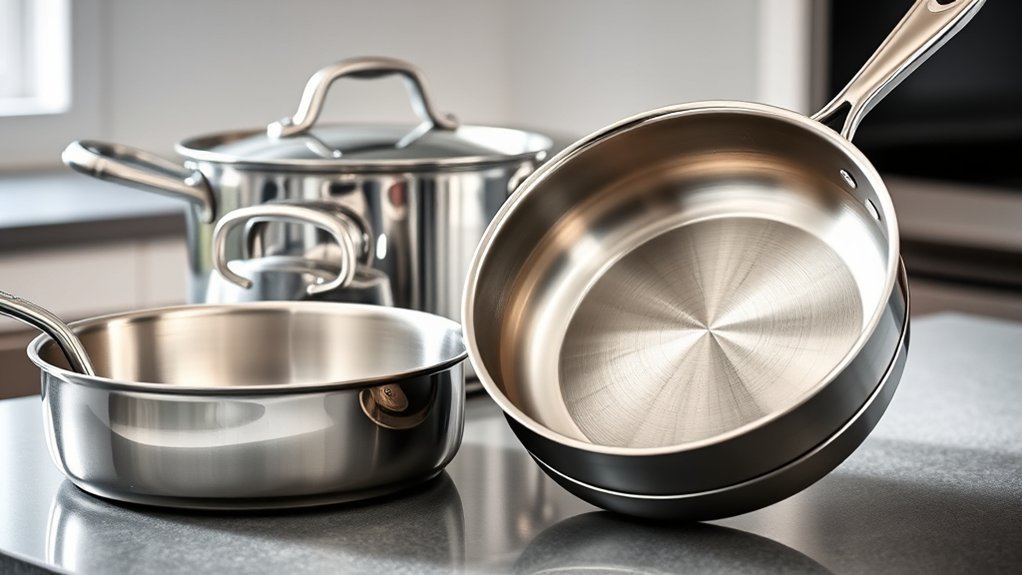
All-Clad pans are not all made from the same material. The brand’s fully bonded stainless cookware combines stainless steel with highly conductive core materials such as aluminum, copper, or graphite, while other All-Clad lines use hard-anodized aluminum with PTFE or ceramic nonstick surfaces, or enameled cast iron. D3, D5, Copper Core, G5, and the nonstick collections therefore differ significantly in construction, heat response, oven limits, and manufacturing origin.
Quick Answer
Most classic All-Clad stainless pans use stainless-steel cooking and exterior surfaces around a conductive core. D3 uses aluminum, D5 combines aluminum with a stainless-steel core, Copper Core adds copper, and G5 uses graphite with aluminum. All-Clad also sells hard-anodized aluminum nonstick, ceramic nonstick, and enameled cast-iron cookware.
Key Takeaways
- D3 uses three bonded layers: an 18/10 stainless-steel cooking surface, aluminum core, and stainless-steel exterior.
- D5 uses five bonded layers with aluminum on both sides of an internal stainless-steel core.
- Copper Core uses five bonded layers with copper at the center for faster temperature response.
- G5 Graphite Core combines graphite, aluminum, and stainless steel for rapid heating at a lower weight.
- PTFE-coated All-Clad cookware contains PFAS according to All-Clad’s current chemical disclosure.
- Not every All-Clad pan is made in Pennsylvania: fully bonded cookware is produced there, while several nonstick and cast-iron collections are manufactured overseas.
What Are All-Clad Pans Made Of?
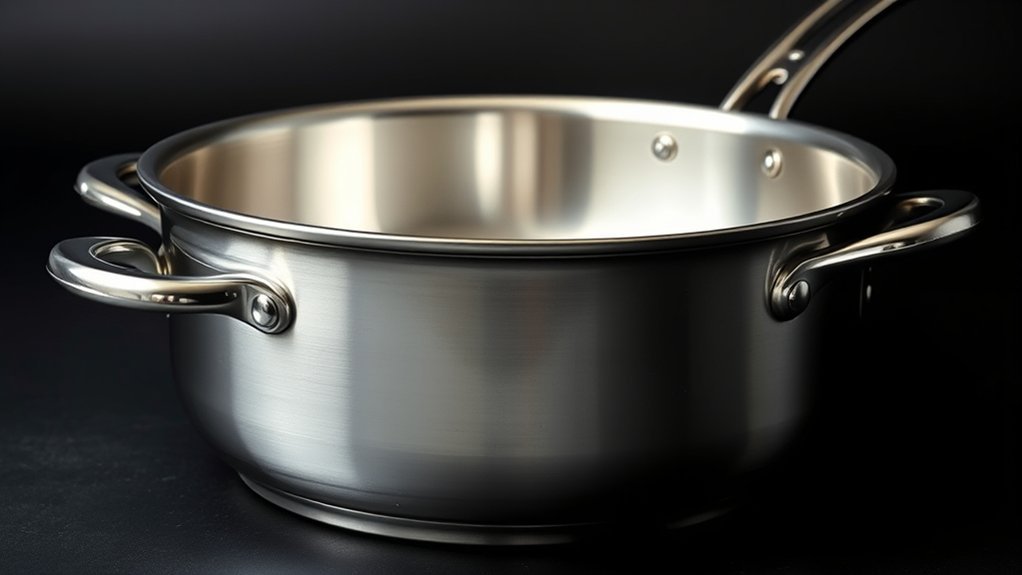
The materials depend on the collection. All-Clad’s best-known stainless cookware uses fully bonded construction, meaning multiple layers extend across the cooking surface rather than using only a separate disc on the bottom.
In D3 cookware, an aluminum layer sits between stainless-steel surfaces. D5 adds an internal stainless-steel core between two aluminum layers. Copper Core substitutes a highly conductive copper center within its five-layer stack, while G5 combines graphite and aluminum between stainless-steel surfaces.
“All-Clad” describes a brand, not one universal pan material. The exact metal stack depends on the cookware collection.
All-Clad also sells cookware that is not built like D3 or D5. HA1 Expert and NS Pro nonstick pans primarily use aluminum bodies with coated cooking surfaces, while newer ceramic collections use hard-anodized aluminum with ceramic nonstick interiors. Enameled cast iron is another separate material category.
| Collection | Main Construction | Typical Strength |
|---|---|---|
| D3 Stainless | Stainless steel / aluminum / stainless steel | Fast, even everyday heating |
| D5 Stainless | Stainless / aluminum / stainless core / aluminum / stainless | Steadier, more controlled heating |
| Copper Core | Stainless steel, aluminum, copper center, aluminum, stainless steel | Rapid temperature response |
| G5 Graphite Core | Stainless steel, aluminum and graphite core construction | Very fast heating with lower weight |
| HA1 / NS Pro PTFE | Aluminum body with PTFE nonstick coating; many pieces use a stainless induction base | Easy release and cleanup |
| Ceramic Nonstick | Hard-anodized aluminum with ceramic nonstick cooking surface | Coated cooking without traditional PTFE nonstick |
| Enameled Cast Iron | Cast iron with enamel coating | High heat retention for braising and roasting |
All-Clad’s current stainless-steel material guide confirms the different layer arrangements used in D3, D5, G5, and Copper Core. All-Clad’s stainless cookware comparison is the most direct manufacturer reference for the current lineup.
How All-Clad Bonded Construction Works
Bonded cookware combines metals with different strengths into one continuous structure. Stainless steel gives the pan a durable, corrosion-resistant cooking surface and exterior, while more conductive materials inside the pan move heat across the cooking surface.
| Layer or Component | Function | Result |
|---|---|---|
| Stainless-steel cooking surface | Durable food-contact surface | Good browning and deglazing |
| Aluminum | Conducts and spreads heat | Faster, more even heating |
| Internal stainless steel, where used | Adds structure and moderates heat response | Steadier heating |
| Copper, where used | Highly responsive heat conductor | Faster temperature adjustment |
| Graphite, where used | Rapid lateral heat transfer at low weight | Quick heat-up and maneuverability |
| Magnetic stainless exterior | Provides durable outer surface and induction compatibility | Works across major cooktop types |
In D3, three layers create a relatively simple and responsive structure. D5 uses five layers and an internal stainless-steel core to produce steadier heat. Copper Core and G5 use different core materials when rapid responsiveness is a higher priority.
The handles are mechanically attached rather than forming part of the bonded heat-conducting stack. Current D3, D5, Copper Core, and G5 products use riveted stainless-steel handles.
Why the Stainless Steel Outer Layers Matter
Stainless steel performs two different jobs in All-Clad’s bonded cookware. The interior provides a durable food-contact surface suitable for browning, searing, simmering, and deglazing, while the magnetic stainless-steel exterior allows the pan to work on induction cooktops.
- Induction compatibility: A magnetic exterior allows compatible cookware to work with induction elements.
- Durable cooking surface: Stainless steel tolerates metal utensils and high-heat browning better than coated nonstick surfaces.
- Corrosion resistance: Stainless steel protects the more conductive core materials inside the pan.
- Food-contact stability: Stainless steel is widely used for cookware because it is durable and comparatively resistant to chemical reaction with food.
All-Clad identifies the cooking surface of its bonded stainless cookware as high-quality 18/10 stainless steel. The manufacturer separately describes the exterior as magnetic stainless steel for induction compatibility rather than saying that every stainless layer has the same alloy composition.
Note: Stainless steel is not literally inert under every possible cooking condition. Research has found measurable nickel and chromium migration during some long or acidic cooking tests, with the amount affected by cookware age, alloy, acidity, and cooking time. This is most relevant to people with significant nickel sensitivity.
What the Aluminum Core Does Inside
Aluminum is the primary heat-spreading material in D3 and also appears within D5, Copper Core, and G5. It conducts heat much more readily than stainless steel, which helps the cooking surface warm quickly and reduces large temperature differences between the center and edges.
| Function | Practical Effect |
|---|---|
| Fast heat transfer | Shorter response time when burner output changes |
| Heat spreading | More uniform cooking across the pan |
| Relatively low weight | Less mass than an equivalent all-steel or cast-iron pan |
| Bonded construction | Keeps the aluminum protected between outer layers |
Because the aluminum is enclosed within the bonded structure on stainless lines, food normally contacts stainless steel rather than the aluminum core itself. The material is used primarily for thermal performance rather than as the exposed cooking surface.
Where Copper Core Cookware Fits In
All-Clad Copper Core uses a five-layer bonded structure centered on copper. The copper layer is surrounded by aluminum and finished with stainless-steel interior and exterior surfaces.
Copper has high thermal conductivity, so the pan reacts quickly when burner output changes. That responsiveness is particularly useful for sauces, reductions, eggs, fish, and other foods where a small temperature change can affect the result.
- Five-ply bonded construction extending to the rim
- Copper center for rapid temperature response
- Aluminum layers that help spread heat
- Stainless-steel cooking surface for durability
- Magnetic stainless exterior for induction compatibility
Current Copper Core cookware is compatible with induction and is rated by All-Clad for oven and broiler use up to 600°F. The manufacturer recommends handwashing. See the current Copper Core collection specifications.
How D3, D5, and Copper Core Compare
D3, D5, and Copper Core all use bonded stainless-steel construction, but the material stacks change how quickly and steadily they respond to heat.
| Line | Layers | Heat Character | Oven / Broiler |
|---|---|---|---|
| D3 | 3 | Fast, responsive everyday heating | Up to 600°F |
| D5 | 5 | Steadier and more moderated response | Up to 600°F |
| Copper Core | 5 | Very rapid temperature response | Up to 600°F |
D3 Tri-Ply Basics
D3 uses three bonded layers: an 18/10 stainless-steel cooking surface, an aluminum core, and a stainless-steel exterior that supports induction cooking.
- Stainless-steel cooking surface for browning and deglazing
- Aluminum core for fast and even heat transfer
- Stainless exterior for durability and induction compatibility
- Oven and broiler use up to 600°F on current stainless pieces
D3 is the most straightforward of these three designs. Its relatively simple stack keeps weight and thermal lag lower than heavier multi-layer constructions while still providing the durability of stainless steel.
D5 And Copper Core
D5 also uses five bonded layers, but its stack is different from Copper Core. Current All-Clad information describes D5 as a stainless-steel cooking surface followed by aluminum, a stainless-steel core, another aluminum layer, and a stainless-steel exterior.
The extra internal stainless layer moderates heat movement and contributes to the line’s steadier temperature behavior. Copper Core instead prioritizes responsiveness by putting copper at the center of its five-layer construction.
Both remain induction compatible and oven/broiler safe to 600°F according to current All-Clad specifications.
What About G5 Graphite Core?
G5 Graphite Core is another current All-Clad bonded stainless collection and deserves mention in a complete materials comparison. Its five-ply construction uses a graphite core surrounded by aluminum layers, with stainless steel on the cooking surface and magnetic stainless steel on the exterior.
Graphite transfers heat rapidly while weighing much less than many metals, allowing G5 cookware to heat quickly without becoming as heavy as some other multi-ply designs. All-Clad rates current G5 cookware for oven and broiler use up to 600°F and for use on induction cooktops.
See All-Clad’s G5 Graphite Core specifications for the current construction.
What All-Clad Nonstick Pans Are Made Of
All-Clad’s nonstick cookware should not be treated as one single construction. Current collections include traditional PTFE nonstick pans and separate ceramic nonstick lines.
HA1 Expert, for example, uses a hard-anodized aluminum body, a PTFE nonstick cooking surface, and a stainless-steel base that enables induction use. Current NS Pro cookware also uses heavy-gauge aluminum with PTFE nonstick and, on many pieces, an induction-compatible stainless base.
These aluminum nonstick lines are not constructed in the same way as fully bonded D3 or D5 stainless cookware.
Nonstick Coating Basics
Traditional All-Clad nonstick lines use PTFE to create a low-friction cooking surface. PTFE makes eggs, fish, pancakes, and other delicate foods easier to release and usually reduces the amount of fat needed to prevent sticking.
All-Clad currently describes NS Pro as using high-quality PTFE reinforced with a ceramic-plasma layer for greater scratch resistance. HA1 Expert also uses PTFE over a hard-anodized aluminum body.
- PTFE cooking surface for easy release
- Aluminum body for rapid heat transfer
- Stainless-steel base on induction-compatible models
- Riveted stainless-steel handles
Warning: Do not treat coated nonstick like bare stainless steel. Avoid unnecessary high heat, broiler use unless the specific product explicitly permits it, prolonged empty preheating, and metal utensils when the manufacturer recommends silicone, nylon, or wood. Current HA1 and NS Pro PTFE cookware is generally rated to 500°F, while current ceramic lines are generally rated to 450°F.
Hard-Anodized Aluminum Core
Hard anodizing creates a harder, more wear-resistant oxide layer on aluminum. In cookware such as HA1, this gives the aluminum body a tougher exterior while preserving aluminum’s useful thermal properties.
The material remains much lighter than cast iron and responds quickly to burner adjustments. On induction-compatible models, a stainless-steel base provides the magnetic layer required by an induction cooktop.
Hard anodizing improves the durability of aluminum, but it does not make a coated pan immune to scratching or overheating. The nonstick cooking surface still determines which utensils and temperatures are appropriate.
PFOA, PTFE, and PFAS: What the Terms Mean
PFOA, PTFE, and PFAS are not interchangeable terms. PTFE is the fluoropolymer widely used to create traditional nonstick cookware surfaces. PFAS is a broader chemical category.
All-Clad’s current chemical-disclosure page states that its PTFE-coated products contain PFAS chemicals, including PTFE and related fluoropolymers. Therefore, describing a product as PFOA-free does not automatically mean that it is PFAS-free.
Note: The FDA distinguishes polymerized fluoropolymer coatings used on nonstick cookware from PFAS uses that readily migrate into food. Its current guidance says approved nonstick coatings are tightly polymerized and contain negligible amounts of PFAS capable of migrating to food under their authorized use.
For product-specific disclosure, check All-Clad’s current nonstick chemical information.
Ceramic Nonstick Options
All-Clad also currently sells HA1 Ceramic and NS Pro Ceramic cookware. These pans use hard-anodized aluminum bodies with ceramic nonstick cooking surfaces rather than the traditional PTFE surface described above.
Current NS Pro Ceramic and HA1 Ceramic pans are rated to 450°F, with glass lids typically limited to 350°F. All-Clad advises low-to-medium stovetop heat, no broiler use, and avoiding prolonged empty preheating to preserve the ceramic coating.
This makes ceramic nonstick another material option for readers who specifically want an alternative to a traditional PTFE-coated cooking surface.
How Enameled Cast Iron Fits The Lineup
Enameled cast iron is fundamentally different from All-Clad’s bonded stainless and aluminum nonstick cookware. Its thick cast-iron body stores a large amount of heat, making it well suited to braising, roasting, stewing, baking, and other methods where temperature stability matters more than rapid response.
The enamel coating covers the cast-iron surface, so the cookware does not require the seasoning routine associated with bare cast iron. The smooth exterior also makes the cookware suitable for stove-to-table serving.
Current All-Clad enameled cast iron is compatible with induction and other common cooktops and is rated to 650°F. The manufacturer recommends handwashing and non-metal utensils to protect the enamel.
Although enamel is durable, it is not indestructible. Strong impacts, thermal shock, or rough metal tools can damage or chip the coating.
Which All-Clad Pans Are Made in Pennsylvania?
All-Clad’s fully bonded cookware is bonded, engineered, and assembled at the company’s Canonsburg, Pennsylvania facility using U.S. and imported materials. Current D3, D5, Copper Core, and G5 product pages identify these bonded cookware lines as U.S.-made or bonded and assembled in Pennsylvania.
That does not mean every item carrying the All-Clad name is manufactured there.
- Bonded stainless cookware: Manufactured in Canonsburg, Pennsylvania, with product-specific exceptions such as some inserts.
- HA1 Expert nonstick: Designed in Canonsburg and currently listed as made in China.
- NS Pro nonstick: Designed in Canonsburg and currently listed as made in China.
- Current ceramic nonstick: Designed in Canonsburg and currently listed as made in China.
- Current enameled cast iron: Product pages identify pieces as designed in Canonsburg and made in Vietnam.
All-Clad explains this distinction in its manufacturing FAQ, which specifically says its fully bonded cookware and bakeware are bonded, engineered, and assembled in the United States while several other categories come from global factories.
Which All-Clad Pan Material Should You Choose?
The best material depends on what you cook most often and how much heat responsiveness, food release, weight, and maintenance matter to you.
| Priority | Good Fit | Why |
|---|---|---|
| General-purpose stainless cooking | D3 | Simple, responsive tri-ply construction |
| Steadier multi-ply heat | D5 | Five layers with internal stainless core |
| Maximum responsiveness for sauces and delicate work | Copper Core | Copper responds rapidly to burner changes |
| Fast heating with lower weight | G5 Graphite Core | Graphite core transfers heat rapidly while remaining light |
| Eggs and easy-release cooking | PTFE nonstick | Lowest-friction cooking surface |
| Non-PTFE coated cooking | Ceramic nonstick | Ceramic-coated hard-anodized aluminum surface |
| Braising and long oven cooking | Enameled cast iron | High thermal mass and strong heat retention |
Stainless Steel Strength
All-Clad’s bonded stainless cookware is the most versatile option for cooks who routinely sear meat, brown vegetables, deglaze pans, reduce sauces, or move cookware between stovetop and oven.
- Durability: No fragile nonstick coating covers the stainless cooking surface.
- Corrosion resistance: Stainless steel protects the conductive core.
- Induction compatibility: Current bonded stainless lines use magnetic exteriors.
- High-temperature capability: Current D3, D5, G5, and Copper Core stainless cookware is rated to 600°F.
D3 gives the simplest balance of conductivity and weight. D5 adds a more complex five-layer structure. Copper Core emphasizes fast response, and G5 emphasizes rapid heating with reduced weight.
Nonstick Ease
Nonstick pans are most useful when easy food release matters more than extremely high-temperature cooking. Eggs, pancakes, fish, reheating, and other delicate foods are typical examples.
| Feature | Benefit | Trade-Off |
|---|---|---|
| PTFE coating | Very easy food release | Coating requires gentler heat and utensil care |
| Hard-anodized aluminum | Fast, even heating | Not the same construction as bonded stainless |
| Stainless induction base | Works on induction on compatible models | Some specialty shapes may not be induction compatible |
Current HA1 Expert cookware is oven safe to 500°F, with glass lids generally limited to 350°F. NS Pro PTFE cookware is also generally rated to 500°F. Product-specific instructions should always take priority because individual pieces and lids can differ.
Pro Tip: Keep one stainless skillet for hard searing and pan sauces and one coated nonstick skillet for eggs and delicate foods. Each surface then handles the jobs it does best instead of forcing one pan to do everything.
Enameled Cast Iron
Enameled cast iron favors heat retention over speed. Once hot, its heavy body changes temperature slowly, which is useful for braises, stews, roasting, and oven-to-table dishes.
- Heat retention: Maintains steady cooking temperatures.
- Versatility: Works on induction and other major cooktop types.
- Oven use: Current All-Clad cast iron is rated up to 650°F.
- No seasoning required: The enamel covers the cast-iron cooking surface.
The trade-off is weight and slower response. It is not a replacement for a quick-reacting copper or aluminum-core skillet when rapid temperature adjustments are important.
Frequently Asked Questions
Is All-Clad cookware non-toxic?
There is no single scientific category called “non-toxic cookware.” All-Clad uses materials commonly approved for food-contact cookware, including stainless steel, aluminum, cast iron, enamel, ceramic coatings, and PTFE coatings. The FDA states that authorized polymerized PFAS coatings used for nonstick cookware have negligible amounts capable of migrating to food. People with significant nickel sensitivity may prefer to discuss stainless-steel exposure with a medical professional because some studies have measured nickel and chromium migration during acidic cooking.
What is the lawsuit against All-Clad?
The best-known recent All-Clad cookware litigation concerned D3, D5, and LTD cookware that had been marketed as dishwasher safe. Plaintiffs alleged repeated dishwasher washing could corrode exposed aluminum between bonded stainless layers and leave sharp edges. The consolidated federal cases were resolved through a class-action settlement, and the U.S. District Court for the Western District of Pennsylvania granted final approval on February 17, 2023. All-Clad also removed the disputed dishwasher-safe representations covered by the settlement.
What is the least toxic cookware?
There is no universally agreed “least toxic” cookware material. Uncoated stainless steel, glass, and enameled cast iron avoid traditional fluoropolymer nonstick coatings, but each material has different trade-offs. Stainless steel can release small amounts of nickel and chromium under some acidic cooking conditions, which may matter to people with strong nickel sensitivity. The more useful approach is to choose a well-made material appropriate for the food and use it according to the manufacturer’s instructions.
Do All-Clad pans contain PFAS?
Some do. All-Clad’s current chemical disclosure states that its PTFE-coated cookware contains PFAS chemicals used for nonstick properties. That includes several HA1, NS Pro, D3 Nonstick, D5 Nonstick, and Copper Core Nonstick products. Uncoated stainless cookware does not use a PTFE cooking coating. Check the exact product and current chemical disclosure when PFAS content is an important buying factor.
Are All-Clad pans made entirely from stainless steel?
No. Even the classic stainless collections usually combine stainless steel with more conductive materials inside the pan. D3 contains aluminum, D5 contains aluminum plus a stainless core, Copper Core adds copper, and G5 incorporates graphite and aluminum. Other All-Clad collections use hard-anodized aluminum or cast iron.
Are all All-Clad pans made in the USA?
No. All-Clad’s fully bonded cookware is manufactured at its Canonsburg, Pennsylvania facility, but several other products are made overseas. Current HA1, NS Pro, and ceramic nonstick product pages list China as the country of manufacture, while current enameled cast-iron product pages identify Vietnam.
Conclusion
All-Clad pans are built from several different material systems rather than one universal metal recipe. D3 uses stainless steel around aluminum, D5 adds a stainless-steel core within a five-layer structure, Copper Core centers its construction on responsive copper, and G5 combines graphite with aluminum. The brand’s other cookware includes PTFE-coated hard-anodized aluminum, ceramic nonstick, and enameled cast iron.
The key is to compare the specific collection rather than relying on the All-Clad name alone. Construction determines how quickly the pan heats, how much heat it retains, whether it contains a nonstick coating, which temperatures it can tolerate, and where it is manufactured.
Sources
- All-Clad Stainless Steel Cookware Guide — D3, D5, G5, and Copper Core construction.
- All-Clad Customer Service & Cookware FAQ — manufacturing, induction compatibility, materials, and oven limits.
- All-Clad Nonstick Chemical Disclosure — PTFE and PFAS disclosure information.
- U.S. Food and Drug Administration: PFAS in Food — food-contact use of polymerized PFAS in nonstick cookware coatings.
- PubMed: Release of Nickel and Chromium During Cooking in 18/10 Stainless Steel Pots — research on metal migration during cooking.
- U.S. District Court opinion in All-Clad cookware litigation — February 17, 2023 settlement approval and case background.

4 thoughts on “What Are All-Clad Pans Made of? Materials & Construction Explained”