
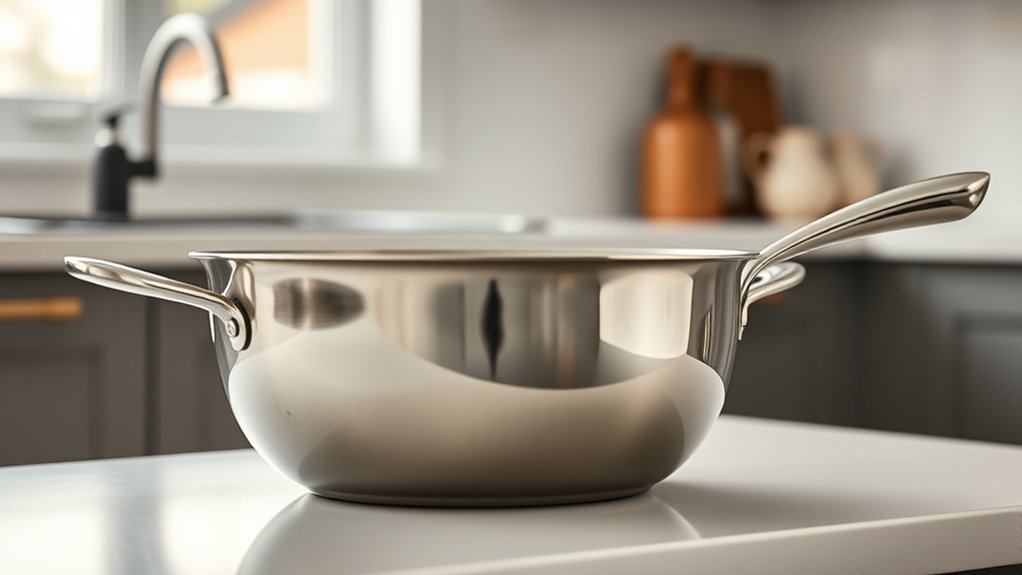
A large saucepan gives you more room than a standard everyday saucepan for soups, grains, sauces, vegetables, smaller pasta batches, and one-pot meals. There is no universal industry size that officially makes a saucepan “large,” but cookware around 4 quarts and above is commonly treated as the larger end of the saucepan category. Capacity, construction, handle design, lid fit, weight, and cooktop compatibility matter more than the label alone.
Quick Answer
A large saucepan is generally a deep, straight-sided pan of about 4 to 6 quarts, although cookware brands do not use one universal sizing standard. A 4-quart model suits sauces, grains, soups, and smaller batches, while a 5- or 6-quart vessel provides more headroom for boiling and larger meals.
Key Takeaways
- About 4 to 6 quarts is a useful rule of thumb for a large saucepan, but manufacturer naming varies.
- A 4-quart saucepan works well for sauces, grains, soups, reheating, and smaller pasta portions.
- A 5- or 6-quart vessel provides more boiling headspace and is easier to use for larger batches.
- Tall sides contain liquid and splashes; the pan’s material and construction determine how evenly and quickly heat moves through the cookware.
- Check handle comfort, lid fit, weight, cooktop compatibility, oven limits, and care instructions before buying.
What Is a Large Saucepan?
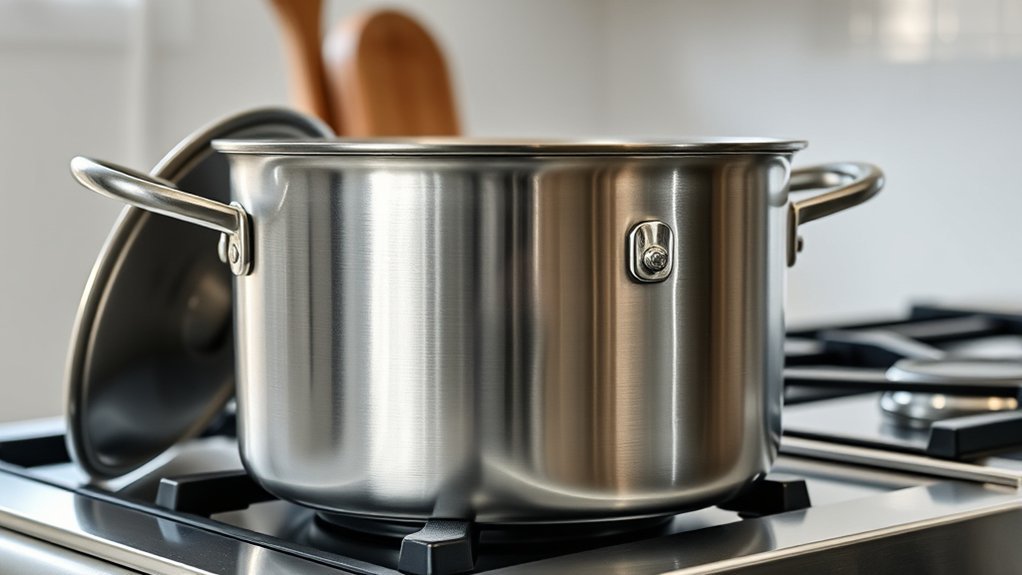
A large saucepan is a deep cooking vessel with relatively tall sides, a flat base, a long handle, and usually a fitted lid. Around 4 quarts is commonly the large end of a traditional saucepan line, while some brands offer 5- or 6-quart vessels under names such as saucepan, saucepot, or covered pot.
The capacity makes this cookware useful for soups, stews, grains, sauces, vegetables, reheating, and moderate batch cooking. Tall walls help contain liquid and reduce splashing, but they do not create even heating by themselves. Heat performance depends much more on the pan’s metal and construction.
For example, Made In’s 4-quart Stainless Clad Saucepan uses multilayer construction with an aluminum core to distribute heat through the pan.
Capacity is a better way to compare large saucepans than diameter alone because two pans with the same quart rating can have noticeably different widths and heights.
Large Saucepan Sizes and Capacity
There is no official industry rule that separates a medium saucepan from a large one. In practical home-kitchen terms, 4 to 6 quarts is a useful range to consider when you need more room than a typical 2- or 3-quart pan.
| Capacity | Practical role | Good for |
|---|---|---|
| 3 quarts | Medium to medium-large | Sauces, grains, vegetables, reheating |
| 4 quarts | Common large saucepan size | Soups, sauces, rice, smaller pasta batches |
| 5 to 6 quarts | Extra-large saucepan or saucepot territory | Larger soups, stews, boiling, meal prep |
Do not assume that every 4-quart saucepan has the same diameter. Shape varies by brand. A taller, narrower pan and a shorter, wider pan can hold the same volume but behave differently during stirring, reducing, and boiling.
4-Quart vs. 6-Quart Saucepan
A 4-quart saucepan is easier to maneuver and usually takes less storage space. It is a strong choice for everyday soups, sauces, grains, vegetables, custards, and modest batches.
A 6-quart vessel gives you more headroom. That extra space matters when food foams, expands, or needs vigorous stirring. It is particularly useful for larger soup batches, potatoes, blanching vegetables, and boiling pasta.
Note: A pan’s stated quart capacity is its total volume, not necessarily the amount you should fill it with during active boiling. Leave enough empty space above the food or liquid to stir safely and control foam and boil-over.
Common Uses for a Large Saucepan
A large saucepan is most useful when a smaller pan feels crowded but a stockpot would be unnecessarily bulky. Common jobs include soups, grains, sauces, vegetables, potatoes, reheating, poaching, and moderate pasta batches.
Boiling Pasta
A large saucepan can boil pasta, but the appropriate pan size depends on how much water and pasta you use. Barilla, for example, specifies four quarts of water in one of its pasta recipes. A nominal 4-quart saucepan would be too small to hold four quarts of water plus pasta with safe boiling headspace.
For that amount of water, use a larger vessel such as a 6-quart or larger pot. A 4-quart saucepan is more practical for smaller pasta portions or recipes that intentionally use less water.
- Leave enough headroom to control foaming and boil-over.
- Stir soon after adding pasta so pieces do not clump together.
- A lid can help bring water to a boil more efficiently, but remove or partially uncover it as needed after adding pasta to prevent boil-over.
- Choose a pot that is comfortable to drain when full of hot water.
Warning: Several quarts of boiling water are heavy and can cause serious burns if spilled. Do not fill a saucepan to the rim, and use a helper handle or a larger two-handled pot when the filled pan feels awkward to lift safely.
Batch Soup Making
Batch soup making is one of the strongest uses for a 4- to 6-quart saucepan. Tall walls help contain splashes, while a lid reduces evaporation when you want to retain moisture.
| Feature | Benefit |
|---|---|
| Tall walls | Help contain liquid and stirring splashes |
| Heavy or clad base | Helps reduce hot spots during simmering |
| Fitted lid | Reduces evaporation when covered |
| Helper handle | Makes a heavy, full pan easier to control |
Big-Batch Sauces
Large saucepans are also useful for marinara, curry sauces, gravy, cheese sauce, and other recipes that would crowd a smaller pan. Extra capacity gives you room to whisk and stir without sending food over the rim.
For sauces that need reduction, pan shape matters. A wider exposed surface generally allows moisture to evaporate more quickly than a narrow vessel with the same capacity. For sauces that need moisture retained, use a fitted lid and lower heat as appropriate for the recipe.
- Family dinners
- Meal-prep portions
- Potlucks and gatherings
- Freezer-friendly sauces
Large Saucepan vs. Stockpot
A large saucepan and a stockpot can perform some of the same jobs, but their shapes and handling are different. A saucepan normally uses one long handle and has moderate capacity. A stockpot normally has two short side handles and is designed for larger volumes of liquid.
Stockpots are not limited to 12 quarts. Current home and commercial cookware lines extend substantially higher; Tramontina describes stockpots as deep, tall-sided vessels intended for larger liquid volumes.
| Feature | Large saucepan | Stockpot |
|---|---|---|
| Typical handling | One long handle; sometimes a helper handle | Two side handles |
| Capacity | Often around 4–6 qt at the large end | Commonly larger; many home models are 6–12 qt, with much larger sizes available |
| Best suited to | Sauces, grains, soups, vegetables, moderate batches | Stock, broth, large pasta batches, seafood boils, big soups |
| Main advantage | Fine control and easy stirring | High liquid capacity and two-handed lifting |
Size and Capacity Differences
A 4-quart saucepan is compact enough for regular stovetop work while holding considerably more than a 1- or 2-quart sauce pan. A stockpot is usually deeper and designed around high liquid capacity rather than one-handed maneuverability.
Do not compare cookware only by diameter. Capacity, depth, base width, handle arrangement, and total filled weight all affect how the vessel behaves in real use.
Best Uses for Each
Choose the large saucepan when you want easy stirring, pouring, whisking, or sauce control. Choose the stockpot when the main requirement is more volume, especially for broth, stock, full pasta batches, blanching, or cooking for a crowd.
Saucepan vs. Saucepot vs. Saucier
Cookware names can overlap, but the shapes usually provide clues:
- Saucepan: straight or nearly straight sides with one long handle and usually a lid.
- Saucepot: similar cooking purpose but often larger and equipped with two short side handles.
- Saucier: rounded interior walls that make whisking and stirring easier because there is no sharp corner between the base and sidewall.
- Stockpot: deeper, higher-capacity vessel with two side handles, intended primarily for substantial liquid volume.
Manufacturers do not use these labels identically, so compare the actual dimensions and design instead of relying only on the product name.
Key Features to Look for in a Large Saucepan
A well-chosen large saucepan should balance capacity, heating performance, handling, and durability. Consider these features before buying:
- Useful capacity: choose enough volume to leave stirring and boiling headroom.
- Good heat-conducting construction: clad stainless steel commonly uses an aluminum core to spread heat more evenly than thin stainless steel alone.
- Secure handle: the main handle should feel stable when the pan is loaded.
- Helper handle: particularly valuable on heavier 5- or 6-quart cookware.
- Fitted lid: reduces evaporation for covered simmering and can help water heat efficiently.
- Pouring rim: a rolled or flared edge can make transferring soups and sauces cleaner.
- Manageable weight: remember that several quarts of food or water add substantial weight.
- Cooktop compatibility: verify induction compatibility when needed.
- Oven limits: check the temperature ratings for the pan, handle, lid, and knob rather than assuming they match.
Pro Tip: Before choosing a 5- or 6-quart saucepan with one long handle, imagine lifting it when full. If that sounds awkward, look for a helper handle or consider a two-handled saucepot instead.
Best Materials for Large Saucepans
The best material depends on whether you prioritize responsiveness, heat retention, easy cleanup, or low weight.
| Material | Strengths | Tradeoffs |
|---|---|---|
| Clad stainless steel | Durable, versatile, suitable for browning and acidic foods; aluminum-core versions distribute heat effectively | Food can stick without proper heat and fat control; heavier than thin aluminum |
| Nonstick aluminum | Lightweight, easy food release, convenient cleanup | Coating requires gentler utensils and cleaning; heat limits vary |
| Enameled cast iron | Excellent heat retention, non-reactive enamel surface, good for slow simmering | Heavy, slower to respond to heat changes, enamel can be damaged by impact or thermal shock |
| Lined copper | Very responsive to heat changes | Usually expensive and may require more specialized care |
Le Creuset’s current enameled cast-iron guidance emphasizes gradual heating and cooling and low-to-medium heat for normal cooking, illustrating why care advice should match the cookware material.
Cooktop and Oven Compatibility
Do not assume every large saucepan works on every heat source. Gas and conventional electric cooktops accept most cookware, but induction requires a magnetically compatible base. Many clad stainless pans are induction compatible, while some aluminum cookware needs a bonded magnetic plate.
Oven compatibility also varies. A metal pan body may tolerate more heat than its nonstick coating, glass lid, silicone grip, or lid knob. Always use the manufacturer’s temperature limit for the complete cookware setup you are putting in the oven.
If you use a glass-ceramic cooktop, lift rather than drag heavy cookware to reduce the chance of scratching the cooking surface.
How to Choose the Best Large Saucepan for You
Start with the foods you cook most often rather than automatically choosing the biggest pan.
- Choose around 4 quarts for sauces, grains, vegetables, soups, reheating, and smaller households.
- Choose around 5 to 6 quarts when you regularly make larger soups, stews, potatoes, or dishes that need more stirring and boiling headroom.
- Choose a stockpot or saucepot instead when you frequently boil large volumes of water or need two handles for safer lifting.
- Choose clad stainless steel for an all-purpose pan that tolerates a wide range of foods and cooking methods.
- Choose nonstick when easy release and cleanup matter most, while following the coating manufacturer’s heat and utensil limits.
- Choose enameled cast iron when heat retention and slow simmering matter more than low weight.
Finally, check whether the pan fits your largest burner, cabinet, dishwasher if applicable, and storage arrangement. A saucepan that is technically large enough is not useful if it is too heavy or awkward for you to handle comfortably.
Large Saucepan Care and Maintenance
Care instructions depend on the material, so always follow the manufacturer’s directions for your exact pan. A few general habits are broadly useful:
- Let hot cookware cool before exposing it to much colder water.
- Use warm water, dish soap, and a non-abrasive sponge unless the manufacturer specifies otherwise.
- Avoid harsh abrasives on polished surfaces, enamel, and nonstick coatings.
- Dry cookware before storage.
- Use pan protectors or soft layers between nested cookware when scratching is a concern.
- Match the burner reasonably closely to the pan base for more efficient heating.
All-Clad’s use-and-care guidance advises allowing cookware to cool before washing to reduce thermal-shock risk and recommends material-specific cleaning methods. That is more reliable than using one cleaning rule for every saucepan.
| Material | Care priority |
|---|---|
| Stainless steel | Cool before washing; use non-abrasive cleaning for routine care |
| Nonstick | Avoid damaging heat levels, abrasive pads, and utensils not approved for the coating |
| Enameled cast iron | Avoid severe thermal shock and hard impacts that can damage enamel |
Best Large Saucepans to Consider
There is no single best large saucepan for every kitchen. The better approach is to match the pan to the job.
- Best all-purpose style: clad stainless steel around 4 quarts for sauces, soups, grains, vegetables, and reheating.
- Best for easy food release: a quality nonstick saucepan used within the coating manufacturer’s heat limits.
- Best for slow simmering and heat retention: enameled cast iron, provided the extra weight is comfortable.
- Best for larger liquid batches: a 5- to 6-quart saucepan or, when two-handed lifting is preferable, a saucepot or stockpot.
The Made In 4-Quart Stainless Clad Saucepan mentioned earlier is one current example of the all-purpose stainless-clad category. Its manufacturer lists 5-ply construction, a rolled rim, a stay-cool handle, and compatibility with gas, electric, and induction cooktops. Those are useful features to compare with competing pans rather than reasons to assume one model is automatically best for every cook.
Sources
- Made In — 4-Quart Stainless Clad Saucepan — current size, construction, dimensions, handle, heat-source compatibility, and care details.
- All-Clad — Use & Care Guide — cooling, thermal-shock, cleaning, and material-specific cookware guidance.
- Le Creuset — Care and Use — enameled cast-iron heating, cooling, cleaning, and handling guidance.
- Barilla — Linguine Cooking Method — example of pasta preparation using four quarts of boiling water.
- Tramontina — Stock Pots and Sauce Pots — stockpot design, capacity, and common uses.
Frequently Asked Questions
What Size Is Considered a Large Saucepan?
There is no universal cookware standard, but about 4 to 6 quarts is a useful practical range for a large saucepan. Four quarts is a common large saucepan size, while 5- and 6-quart cookware may also be labeled as saucepots or covered pots depending on the manufacturer.
What Does a Large Saucepan Look Like?
A large saucepan usually has a flat base, relatively tall sides, one long handle, and a lid. Larger models may also have a helper handle opposite the main handle. The exact width and height vary even when two pans have the same quart capacity.
Is a 3-Quart Pan Medium or Large?
A 3-quart saucepan is usually better described as medium or medium-large rather than large, although cookware sizing labels are not standardized. It is a versatile size for sauces, grains, vegetables, reheating, and smaller soup batches.
What’s the Difference Between a Saucepan and a Regular Pan?
If “regular pan” means a frying pan or skillet, the main difference is shape. A saucepan has tall sides and usually a lid, making it better for liquids, boiling, simmering, grains, and sauces. A frying pan has lower, more open sides that make turning, searing, frying, and evaporation easier.
Can You Cook a Full Box of Pasta in a 4-Quart Saucepan?
It depends on the pasta, recipe, and water volume, but a 4-quart saucepan is too small if the cooking method itself calls for about four quarts of water because there would be no safe room for the pasta or boiling action. A 6-quart or larger vessel is more practical for that amount of water.
Is a 4-Quart or 6-Quart Saucepan Better?
Choose 4 quarts when you want easier handling and mainly cook sauces, grains, vegetables, soups, and moderate batches. Choose 5 to 6 quarts when you regularly need more boiling headroom or make larger soups, stews, potatoes, and meal-prep portions.
Conclusion
A large saucepan is one of the most flexible pieces of cookware for anyone who regularly needs more room than a 2- or 3-quart pan provides. A 4-quart model works well for many everyday jobs, while a 5- or 6-quart vessel adds valuable headroom for larger batches and active boiling. Rather than choosing by capacity alone, compare the pan’s construction, weight, handles, lid, cooktop compatibility, oven limits, and care requirements. The right combination makes soups, sauces, grains, vegetables, and other everyday meals easier to cook and safer to handle.

1 thought on “What Is a Large Saucepan? Meaning, Uses & Key Facts”