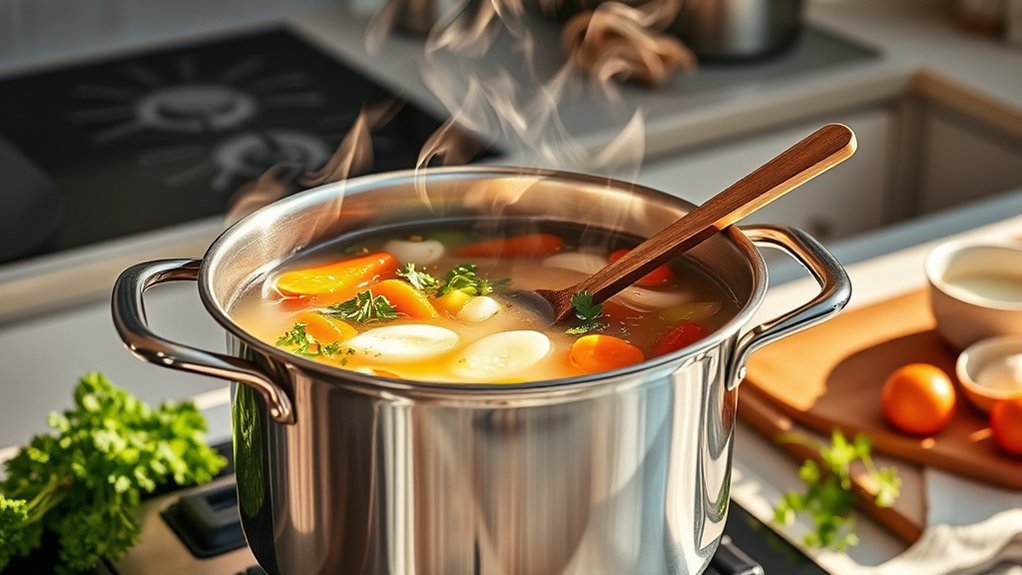
A stock pot is a tall, deep cooking pot built for large volumes of liquid. It works especially well for stock, broth, soup, chili, pasta, beans, seafood boils, steaming, and blanching. Its capacity makes batch cooking easier, but the right size, construction, burner setup, and cooking method matter. Stock pots can also be used for some water-bath canning jobs when properly equipped, but they cannot replace a pressure canner for low-acid foods.
Quick Answer
A stock pot is best for cooking large volumes of liquid, including stock, soup, pasta, beans, seafood, and blanching water. Choose a size your burner can support, use moderate heat for long simmering, and remember that a normal stock pot is not a substitute for a pressure canner when preserving low-acid foods.
Key Takeaways
- Stock pots are best for large-volume boiling, simmering, steaming, and batch cooking.
- A 6- to 8-quart pot is manageable for many everyday jobs, while 8- to 12-quart and larger pots suit bigger batches.
- Heating performance depends on construction; a thick or clad base usually gives better control than a very thin base.
- Check the manufacturer’s instructions before using any stock pot in an oven or on an induction cooktop.
- For home canning, a stock pot can serve as a boiling-water canner only when properly equipped and used for appropriate acid foods; low-acid foods require a pressure canner.
What Is a Stock Pot?
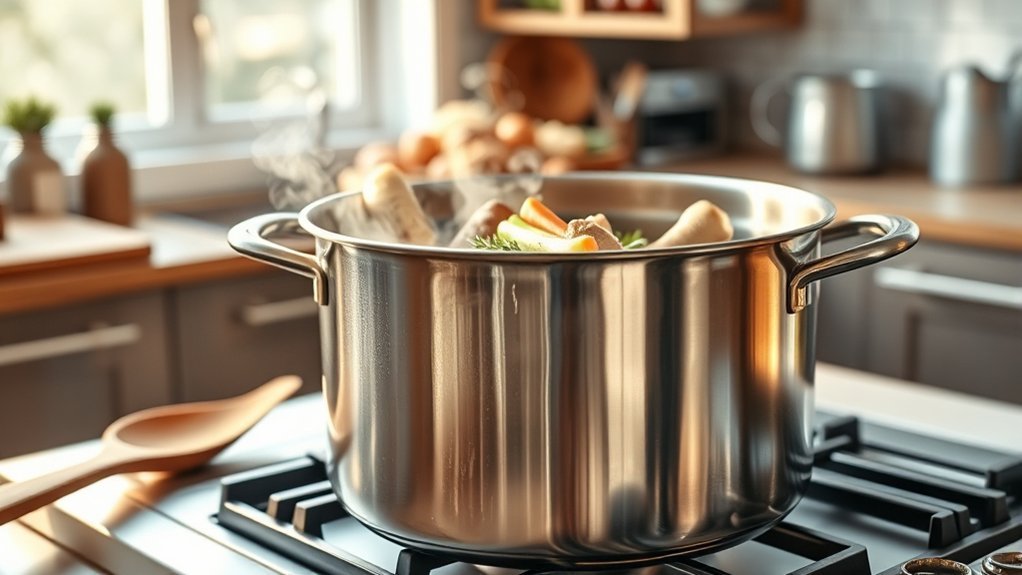
A stock pot is a tall, usually cylindrical cooking vessel with a relatively large capacity, straight sides, two side handles, and a lid. Home-kitchen sizes vary widely, so capacity is more useful than assuming every stock pot falls within one fixed range.
The tall shape provides room for large amounts of water, broth, vegetables, pasta, meat, or shellfish without needing an extremely wide cooking surface. That makes it well suited to boiling and long simmering.
Stock pots are commonly made from stainless steel, aluminum, or layered combinations of metals. Heating performance depends on the construction. A stock pot with an aluminum core or a thick encapsulated base generally spreads heat more evenly than a very thin single-layer pot.
Two loop handles make a large pot easier to control, but a filled stock pot can become extremely heavy. Make sure the handles are secure and avoid filling the vessel so high that boiling liquid can spill over.
Some stock pots can move from stovetop to oven, but that is not a universal feature. Oven safety depends on the material, handles, lid, coating, and manufacturer’s temperature rating. Check the cookware instructions before putting the pot in an oven.
What Size Stock Pot Do You Need?
The right stock pot size depends on how much you normally cook, how large your burner is, how much storage space you have, and how heavy the pot will become when full. Buying the largest pot available is not always the most practical choice.
| Capacity | Best For | Practical Consideration |
|---|---|---|
| 6–8 quarts | Everyday soup, pasta, beans, blanching, smaller stock batches | Easy to store and handle in many home kitchens |
| 8–12 quarts | Larger stock batches, meal prep, family-size soup, pasta for a crowd | Check burner size and lifting weight when full |
| 16 quarts and larger | Seafood boils, very large batches, suitable boiling-water canning setups | Needs substantial storage space and a burner that can safely support it |
Leave enough empty space at the top for stirring and active boiling. A pot filled to its rim is harder to move and much more likely to boil over.
Stock Pot Materials and Cooktop Compatibility
Stainless steel is durable, easy to maintain, and suitable for acidic foods. Because stainless steel itself is not a particularly fast heat conductor, many better-performing stock pots pair it with an aluminum core or an encapsulated conductive base.
Aluminum cookware is comparatively light and responds to heat quickly. Construction and surface treatment vary, so follow the manufacturer’s instructions for acidic foods, cleaning, and maximum heat.
For an induction cooktop, the bottom of the stock pot must contain magnetic material. If the product is not clearly labeled induction-compatible, a simple magnet test on the outside bottom can indicate whether the base is magnetic.
Note: Large stock pots can extend far beyond a burner. For very large vessels or home-canning use, check the stove manufacturer’s limits for cookware diameter and weight, especially on glass or smooth-top electric ranges.
Best Dishes for a Stock Pot
Soups, stocks, and broths are natural uses for a stock pot because the vessel provides room for meat, bones, vegetables, aromatics, and plenty of liquid.
A stock pot also handles soups and stews in large batches, especially recipes that spend most of their cooking time simmering rather than browning.
It is useful for cooking pasta because a large volume of water gives pasta room to move once the water returns to a boil.
For homemade stock, the tall vessel can hold bones, carcasses, vegetables, and water while leaving headroom for gentle simmering.
Chili, beans, lentils, rice, corn on the cob, seafood boils, and other large-batch dishes can also work well, depending on the recipe and the pot’s base construction.
The same generous volume makes an appropriately equipped stock pot useful as a boiling-water canner for suitable acid foods, provided it has a rack, lid, enough depth, and the correct processing procedure.
How to Make Stock in a Stock Pot
To make stock in a stock pot, place bones or a poultry carcass in the pot with aromatic vegetables such as onions, carrots, and celery. Add herbs if desired, then add enough cold water to cover the ingredients without filling the pot to the rim.
Combine bones or a poultry carcass with aromatic vegetables and herbs, cover with water, and bring the pot up to temperature gradually.
Bring the mixture toward a boil, then lower the heat to a gentle simmer. A hard, continuous boil can break ingredients apart and make the finished liquid cloudier.
Skim foam or excess fat from the surface when useful. Stock cooking time should match the ingredients rather than a single universal rule. Poultry carcass stock may need much less time than a dense batch made from beef bones.
When the flavor is where you want it, remove large solids and strain the liquid through a fine-mesh sieve. For an extra-clear stock, strain again through a finer filter.
Pro Tip: Keep the simmer gentle and taste as the stock cooks instead of relying only on the clock. Different bones, vegetables, batch sizes, and desired concentrations require different cooking times.
Cool Homemade Stock Safely
A large pot of hot stock can stay warm for a long time if left to cool as one deep mass. For faster cooling, divide the stock into smaller, shallow containers. An ice-water bath around the container can also speed cooling if the stock is stirred carefully.
Do not leave a large batch sitting at room temperature for hours. Once cooled, refrigerate or freeze it promptly in suitable containers. If freezing, leave appropriate expansion space in rigid containers.
How to Cook Pasta, Rice, and Beans
For pasta, a stock pot provides enough room for a generous amount of water and a full boil. Stir after adding the pasta and again during the first few minutes to reduce sticking.
Do not fill the pot so high that starchy water can foam over the rim. If the pot is very large for the amount of pasta being cooked, using less water than the pot’s maximum capacity also makes draining safer.
Rice can be cooked in a stock pot when preparing a large batch. A stable, reasonably heavy base helps reduce scorching, and the heat should be lowered once the liquid reaches the appropriate stage for the recipe.
For dried beans, allow substantial room for expansion and enough cooking liquid to keep the beans covered as they soften. Soaking may shorten cooking time for many beans, but the exact method depends on the variety and recipe.
The same vessel is useful for batch cooking, allowing soup, beans, grains, or pasta to be prepared for larger households, gatherings, or later meals.
How to Make Soups and Stews
A stock pot is well suited to soups and stews that require plenty of liquid and extended simmering.
Keep enough headroom for stirring, especially with recipes containing beans, pasta, dumplings, or other ingredients that can cause foaming or thickening.
If a recipe benefits from browned meat or vegetables, a stock pot with a thick or clad base may handle the initial browning adequately. Lightweight stock pots can lose heat quickly or develop hot spots, so browning in a skillet or Dutch oven first may give better results.
For better flavor, brown meat and aromatic vegetables only when the stock pot’s base can hold enough heat to sear rather than steam them.
- Use a pot large enough to leave safe headroom above the food.
- Bring the mixture to temperature, then reduce it to the simmer the recipe calls for.
- Stir thicker soups and stews regularly so food does not settle and scorch.
- Add more liquid when necessary to keep ingredients at the intended consistency.
A stock pot is particularly convenient for recipes where volume matters more than rapid evaporation or intense browning.
How to Use a Stock Pot for Canning
A stock pot can sometimes be used as a boiling-water canner, but only when the setup meets safe canning requirements. The pot needs a secure lid, a rack that keeps jars off the bottom, and enough depth for the required amount of boiling water above the jar tops.
Warning: A normal stock pot used as a boiling-water bath is appropriate only for foods that have a tested boiling-water canning process, such as certain fruits, jams, pickles, and properly acidified products. Meat, poultry, seafood, broth, stock, and most vegetables are low-acid foods and require a tested pressure-canning process. Do not water-bath can homemade meat or poultry stock.
For boiling-water canning, jars must sit on a rack rather than directly on the bottom of the pot. The water must remain at least 1 inch above the jar tops during processing, and longer processing times may require additional water depth.
Once the water reaches a full boil, follow the tested recipe’s processing time exactly. Processing time can change with jar size and elevation, so do not improvise.
A fitted lid reduces heat loss and evaporation. Add more boiling water if necessary to keep the required water level above the jars.
After processing, follow the tested recipe’s cooling and jar-handling directions. A lid appearing to seal does not correct an unsafe processing method.
A stock pot can function as a boiling-water canner, but it cannot create the pressure and higher processing temperature required for low-acid foods.
How to Steam and Blanch in a Stock Pot
A stock pot handles steaming well when fitted with a basket or insert that keeps food above the boiling water. This setup works for vegetables, shellfish, dumplings, and similar foods when enough steam can circulate around them.
For blanching, a stock pot holds enough boiling water to cook vegetables briefly without the water temperature dropping excessively when the food is added. The vegetables can then be transferred immediately to ice water to stop the cooking process.
Its capacity also makes it useful for batch cooking, although very large loads should be divided if crowding prevents steam or boiling water from circulating properly.
Steaming Vegetables and Shellfish
When fitted with a steaming insert, a stock pot can cook vegetables and shellfish without submerging them. Keep the steaming water below the food and use enough water that the pot will not boil dry during cooking.
- Add water to the stock pot without letting it reach the bottom of the food basket.
- Arrange vegetables or shellfish in the steamer basket without packing them too tightly.
- Cover the pot so steam remains inside.
- Cook until the food reaches the desired doneness or safe internal temperature for the specific food.
Open the lid away from your face and hands because escaping steam can cause severe burns.
Blanching for Color Retention
Blanching gives vegetables a brief boil before rapid cooling in an ice bath. It is commonly used before freezing or as a preparation step when a recipe calls for partially cooked vegetables.
Use enough water for the vegetables to remain submerged and for the pot to return to a boil quickly after they are added. Timing varies by the vegetable and the size of the pieces, so follow a reliable recipe rather than using one universal blanching time.
Move the vegetables promptly into ice water when the blanching time ends. Once cool, drain them well.
If the blanching water is clean and mild-tasting, it can sometimes be reused the same day for soup or another cooking task. Discard it if it has become bitter, strongly flavored, excessively starchy, or otherwise unsuitable.
Stock Pot Safety Tips
Handling a stock pot safely becomes increasingly important as its size and weight increase. Hot liquid, steam, unstable handles, and an overloaded burner can all create hazards.
- Place the pot on a stable burner that can safely support its diameter and filled weight.
- Use dry oven mitts or pot holders when the handles become hot.
- Check that both side handles are firmly attached before filling the pot.
- Leave headroom instead of filling the vessel to the rim.
- When draining a heavy pot, consider removing food with a spider, basket, or ladle instead of lifting the entire vessel.
- Open lids away from your face so steam escapes in the opposite direction.
- Keep pot handles positioned so they cannot be bumped or pulled from the stove.
Deep-Frying in a Stock Pot
A sturdy stock pot with stable handles and adequate depth can sometimes be used for deep-frying, but hot oil requires much more caution than boiling water.
Warning: Never overfill a pot with frying oil, never leave heating oil unattended, and make sure food is free of excess water or ice before it enters hot oil. Monitor the oil temperature. If the oil begins smoking, turn off the heat. Never pour water onto a grease or oil fire.
For frequent deep-frying, a dedicated fryer or heavy vessel designed for the task may provide easier temperature control and safer handling.
What Not to Cook in a Stock Pot?
A stock pot is usually a poor choice for foods that need rapid evaporation, easy utensil access, intense surface browning, or constant fine temperature adjustments.
Delicate sauces, caramel, small amounts of curry, pan-fried foods, and quick stir-fries are usually easier to manage in lower, wider cookware.
A stock pot can still cook many of these foods in a pinch, but the shape may work against the technique.
Dishes That Burn Easily
Dishes with little free liquid require more attention in a tall pot, particularly when the base is lightweight.
- Thick curries: a wide sauté pan or Dutch oven usually makes stirring and reducing easier.
- Sautéed or fried foods: a skillet provides easier access and more open surface area for browning.
- High-sugar sauces and caramel: a smaller saucepan gives better visibility and faster control.
- Delicate fish or eggs: shallow cookware makes turning, checking, and removing the food easier.
If you do use a stock pot for a thick preparation, reduce the heat and stir the bottom frequently to prevent scorching.
High-Heat Stir-Fry Limits
High-heat stir-frying is a poor match for most stock pots because the tall sides restrict access and a crowded load traps steam. A wok or wide skillet provides more exposed cooking surface and makes tossing or stirring much easier.
| Issue | Stock Pot Effect | Likely Result |
|---|---|---|
| Tall sides | Harder utensil access and less convenient tossing | Slower, less even stir-frying |
| Crowded ingredients | Steam collects around the food | Less browning |
| Lightweight base | Temperature may drop quickly when food is added | Food may steam instead of sear |
| Small quick-cooking batch | Oversized vessel makes control awkward | Greater risk of overcooking |
Use wider cookware when a recipe depends on rapid browning, quick evaporation, and continuous movement.
Better Pan Alternatives
Several common dishes perform better in a skillet, sauté pan, Dutch oven, or saucepan than in a stock pot.
- Curry dishes: a sauté pan or Dutch oven gives easier access for stirring, frying spices, and reducing sauce.
- Sautéed foods: a skillet provides a wide cooking surface for browning.
- Thin sauces: a wide saucepan or sauté pan promotes faster evaporation.
- Quick stir-fries: a wok or broad skillet makes rapid tossing and high-heat cooking easier.
- Delicate foods: shallow pans make it easier to turn and remove eggs, fish, pancakes, and similar foods.
Stock Pot vs. Dutch Oven
A stock pot and a Dutch oven can both simmer soup or broth, but they emphasize different strengths.
A stock pot is generally taller and lighter for its capacity, making it convenient when you need to boil or simmer a large amount of liquid. A Dutch oven is generally heavier, often made from cast iron or another heat-retentive construction, and is better suited to browning, braising, and oven cooking.
| Feature | Stock Pot | Dutch Oven |
|---|---|---|
| Typical strength | Large-volume boiling and simmering | Browning, braising, roasting, and simmering |
| Shape | Usually tall with straight sides | Usually shorter and wider |
| Weight | Often lighter for the same capacity | Often much heavier |
| Best choice when | You need lots of water or broth | You need strong browning and heat retention |
Frequently Asked Questions
Can You Cook Anything in a Stock Pot?
Not anything. A stock pot excels at stocks, broth, soup, chili, pasta, beans, seafood boils, steaming, blanching, and other large-volume cooking. It is less convenient for fast sautéing, searing, caramel, delicate sauces, or stir-frying, where a wider and shallower pan gives better access and heat control.
What Is the Difference Between a Stock Pot and a Regular Pot?
A stock pot is generally taller and available in larger capacities than a typical everyday saucepan or cooking pot. Its shape is designed around large-volume boiling and simmering. A smaller regular pot is easier to handle when cooking modest portions, reheating food, or preparing sauces.
What Is the Difference Between a Stew Pot and a Stock Pot?
A pot intended mainly for stews is often shorter and wider, making it easier to brown meat, stir thick mixtures, and reduce liquid. A stock pot is usually taller and emphasizes capacity for broth, soup, boiling water, and other liquid-heavy cooking. Product names vary by manufacturer, so the actual shape and construction matter more than the label.
Is a Stock Pot Worth It?
A stock pot is worth having if you regularly make soup, broth, pasta, beans, seafood boils, or other large batches that overwhelm a saucepan or Dutch oven. If you normally cook one or two small portions and rarely boil large volumes, a large stock pot may spend more time in storage than on the stove.
What Size Stock Pot Is Best for Home Use?
For many households, a 6- to 8-quart stock pot is manageable for everyday soup, pasta, beans, and smaller stock batches. An 8- to 12-quart pot provides more room for meal prep and entertaining. Choose based on your batch size, burner capacity, storage space, and how much weight you can safely lift when the pot is full.
Can a Stock Pot Go in the Oven?
Some can, but oven safety is model-specific. Check the manufacturer’s maximum temperature for the pot, handles, lid, knobs, and any nonstick coating. Do not assume a stainless steel body means every attached component is safe at the same oven temperature.
Conclusion
A stock pot is most useful when capacity matters. It handles broth, soup, pasta, beans, steaming, blanching, seafood, and batch cooking without crowding smaller cookware. A well-built pot with a stable base and secure handles can serve for years, but the best size and construction depend on your stove and cooking habits.
Use moderate heat for long simmering, leave enough headroom to prevent boil-overs, cool large batches rapidly, and verify oven and induction compatibility instead of assuming it. For preservation, remember the most important distinction: a properly equipped stock pot may serve as a boiling-water canner for suitable acid foods, but low-acid foods such as meat, vegetables, broth, and stock require an appropriate pressure-canning process.
Sources
- National Center for Home Food Preservation — Recommended Canners and boiling-water/pressure-canning requirements.
- National Center for Home Food Preservation — Ensuring Safe Canned Foods and acidity requirements.
- National Center for Home Food Preservation — Meat Stock preparation and pressure-canning guidance.
- USDA Food Safety and Inspection Service — safe rapid cooling of large batches and leftovers.
- U.S. Food and Drug Administration — two-stage cooling guidance for cooked time/temperature-control foods.
- U.S. Fire Administration — cooking-oil, stove, and home cooking fire-safety guidance.