
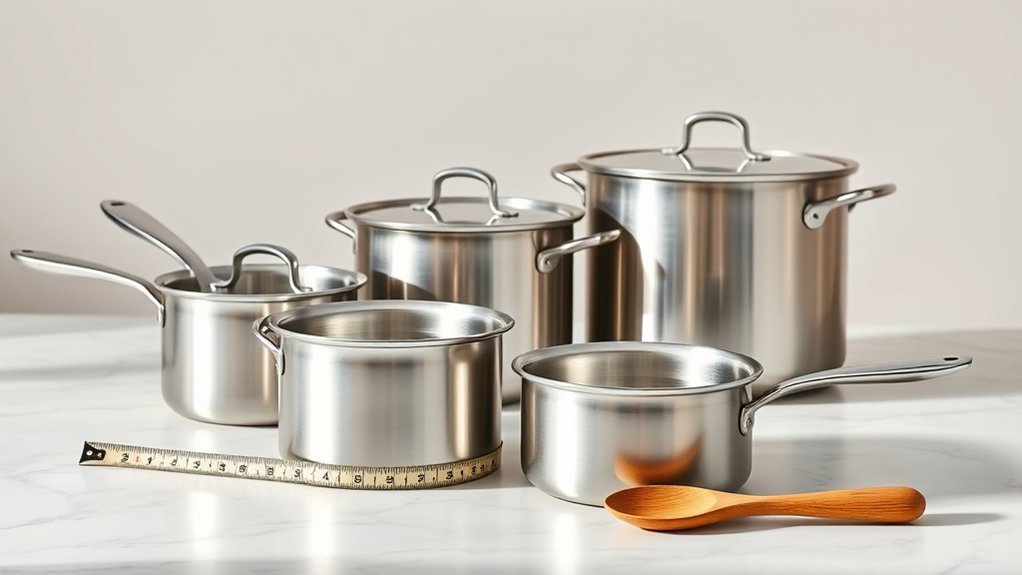
A saucepan is a deep, usually straight-sided cooking vessel with a long handle, commonly used for sauces, grains, oatmeal, vegetables, reheating, simmering, and boiling. Capacity matters more than exterior measurements because pans with the same quart rating can have different diameters and depths. For many home kitchens, 1- to 4-quart saucepans cover most everyday jobs, while larger vessels increasingly overlap with stockpots and other cookware.
Quick Answer
For most home cooks, a 2- or 3-quart saucepan is the most useful everyday size. A 1-quart pan suits butter, sauces, and small portions, while a 4-quart saucepan gives more room for pasta, grains, soup, and larger batches. Exact diameter and height vary by manufacturer.
Key Takeaways
- 1 quart: best for butter, small sauces, reheating, and single portions.
- 2 quarts: a compact everyday size for grains, oatmeal, sauces, vegetables, and smaller meals.
- 3 quarts: one of the most versatile sizes for households that regularly cook several portions.
- 4 quarts: useful when you want more headspace for pasta, soup, risotto, vegetables, or batch cooking.
- Dimensions are not standardized: two saucepans with the same quart capacity can have different diameters and depths.
What Is a Saucepan?
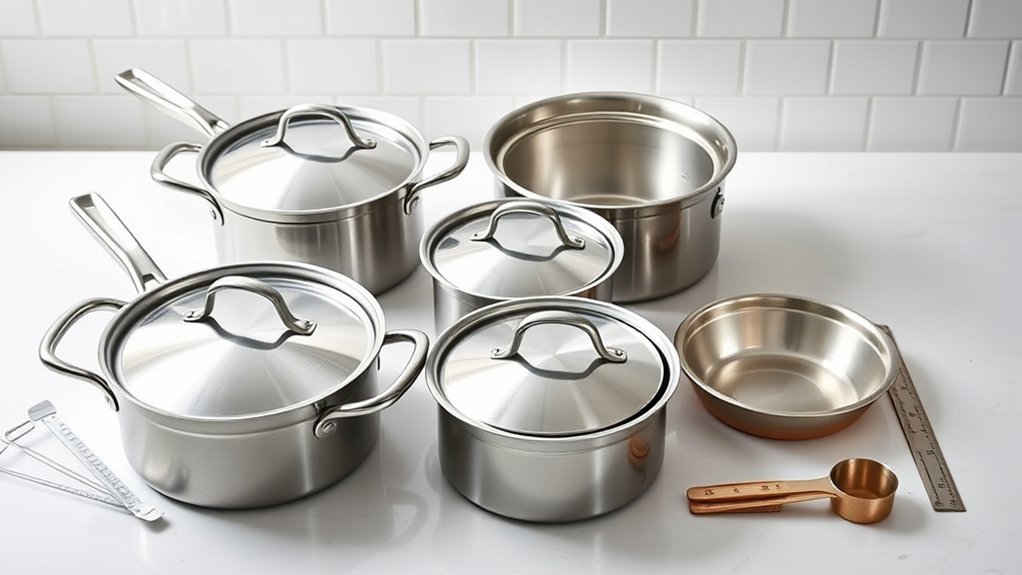
A saucepan is a relatively deep cooking vessel with a long handle and, in most cases, a lid. Traditional saucepans have straight or nearly straight sides and a smaller cooking surface than a frying or sauté pan of similar overall volume.
The shape works especially well for heating liquids, simmering sauces, cooking grains, boiling vegetables, reheating soup, and making reductions. Tall sides provide useful capacity while limiting splashes compared with a shallow skillet.
Saucepan size is normally sold by liquid capacity, such as 1, 2, 3, or 4 quarts. Capacity tells you how much the vessel can hold; it does not establish one standard diameter or height.
Note: Compare saucepan capacity first, then check the manufacturer’s actual diameter, depth, total length, lid design, weight, and burner compatibility. Exterior dimensions can differ substantially between pans with the same quart rating.
Saucepan Sizes by Quart
Many mainstream saucepan collections center on capacities from about 1 to 4 quarts. For example, ZWILLING currently offers 1-, 2-, 3-, and 4-quart versions within its Spirit saucepan line. Larger saucepan-style vessels are also sold, but once capacities move well beyond this range, manufacturers often use names such as stockpot, soup pot, multipot, Dutch oven, or casserole.
| Capacity | Best suited to | General role |
|---|---|---|
| 1 qt | Butter, small sauces, reheating, oatmeal, single portions | Small |
| 2 qt | Rice, grains, vegetables, sauces, soup for a small meal | Small to medium |
| 3 qt | Sauces, grains, vegetables, soup, pasta, several portions | Medium / versatile |
| 4 qt | Risotto, pasta, larger soup or sauce batches, family cooking | Large everyday saucepan |
| 5+ qt | Large-volume cooking | Often overlaps with pots and stockpots |
Quart capacity is the better comparison number. Diameter and height depend on the individual cookware design.
Small Saucepan Sizes and Uses
Small saucepans usually fall around 1 to 2 quarts. They heat modest quantities efficiently, are easy to lift and pour from, and take up little cabinet or stovetop space.
A 1-quart saucepan is well suited to melting butter, warming soup, heating milk, cooking a small amount of oatmeal, or preparing a sauce. A 2-quart model provides noticeably more flexibility for grains, potatoes, lentils, vegetables, and everyday sauces.
Common Small Capacities
- 1 quart: useful for small amounts of liquid, butter, sauces, leftovers, or single portions.
- 1.5 quarts: adds some headspace while staying compact.
- 2 quarts: useful for grains, oatmeal, vegetables, sauces, potatoes, lentils, and small soup batches.
- Overall: small saucepans are easy to store and easier to handle when the recipe does not require a large vessel.
As a real-world example, ZWILLING lists its 1-quart Spirit saucepan with a 5.51-inch upper diameter and its 2-quart version with a 7.09-inch upper diameter. These are useful examples, not universal standards.
Best Uses For Small
A compact saucepan is particularly useful when a larger pot would leave a shallow layer of food spread over too much surface area.
Good jobs for a 1- to 2-quart saucepan include:
- melting butter or chocolate gently;
- making gravy, custard, glaze, or a small reduction;
- cooking oatmeal or other hot cereal;
- preparing rice, quinoa, lentils, or similar grains and pulses;
- reheating soup or leftovers;
- boiling eggs or a modest quantity of vegetables; and
- warming milk, broth, or sauce.
A very small butter warmer of roughly ¾ to 1 quart can be convenient for melting, warming, or finishing sauces, but it is less versatile than a conventional 1- or 2-quart saucepan.
Size, Shape, And Handling
Small saucepans usually feel easier to control because there is less cookware and food weight to lift. A long handle gives leverage for pouring, while a well-designed rim can help reduce drips.
Do not choose by diameter alone. A narrow, deeper saucepan and a wider, shallower saucepan can hold the same number of quarts while behaving differently on the stove. A wider base exposes more food to the heated surface, while a narrower vessel may reduce evaporation for the same volume.
Medium Saucepan Sizes and Uses
A 2- to 3-quart saucepan is the everyday range many home cooks find most useful. It is large enough for sauces, grains, vegetables, soup, and several portions without becoming unnecessarily heavy or bulky.
Physical dimensions vary by manufacturer, so the numbers below are examples rather than standards.
| Example | Capacity | Published Upper Diameter | Typical Jobs |
|---|---|---|---|
| ZWILLING Spirit | 2 qt | 7.09 in | Rice, potatoes, lentils, sauces |
| ZWILLING Spirit | 3 qt | 7.87 in | Soup, grains, reductions, vegetables |
| Demeyere Industry | 3 qt | 9.61 in | General saucepan cooking |
The difference between the two 3-quart examples shows why saucepan dimensions should always be checked on the specific product page rather than inferred from capacity.
Pro Tip: If you are deciding between a 2- and 3-quart saucepan and have enough storage space, the 3-quart size usually gives more headroom for stirring and simmering while still remaining manageable for everyday cooking.
Large Saucepan Sizes and Uses
A 4-quart saucepan is a large but still conventional everyday saucepan. It provides additional headspace for recipes that feel crowded in a 2- or 3-quart pan.
Cookware above roughly 4 quarts certainly exists in saucepan-like shapes, but terminology becomes less consistent. Manufacturers may sell larger vessels as soup pots, stockpots, multipots, casseroles, or Dutch ovens.
Choose a larger vessel when the food and liquid volume require extra room rather than assuming bigger cookware automatically cooks better.
Large Capacity Range
A 4-quart saucepan can handle larger amounts of sauce, risotto, vegetables, soup, or pasta while remaining more compact than a typical stockpot.
For example, ZWILLING describes its 4-quart Spirit saucepan as suitable for boiling pasta, preparing risotto, and making larger batches of sauce. Its published upper diameter is 7.87 inches, the same listed upper diameter as the collection’s 3-quart model, illustrating how manufacturers can increase capacity by changing depth and overall geometry rather than simply widening the pan.
When you move to substantially larger capacities, consider whether a stockpot or Dutch oven would better suit the task, especially if you need two short handles instead of one long handle.
Best Cooking Uses
A larger saucepan is helpful for:
- larger batches of soup or sauce;
- risotto and other dishes that need stirring room;
- pasta when enough water and headspace are available;
- vegetables or grains for several people;
- batch cooking and meal preparation; and
- recipes that foam or expand during cooking.
Warning: Leave adequate headspace when boiling foods that foam or expand. If cooking with a substantial amount of hot oil, use cookware designed and sized appropriately for frying, never fill it close to the rim, and keep water away from hot oil.
Choosing The Right Size
Select the size according to the amount and type of food you actually cook:
- 1–2 quarts: small portions, sauces, grains, oatmeal, reheating, and quick jobs.
- 3 quarts: flexible everyday cooking when you want more stirring and simmering room.
- 4 quarts: larger batches, pasta, risotto, vegetables, and family cooking.
- Above 4 quarts: compare saucepan-style cookware with stockpots and other large vessels before deciding.
Also consider weight. A large pan becomes considerably heavier once filled with water or food. At higher capacities, a helper handle can make lifting and draining easier.
Common Saucepan Dimensions
Saucepan dimensions are not standardized by quart capacity. Two pans that both hold 3 quarts can have different diameters, depths, handle lengths, lid heights, and overall footprints.
Representative manufacturer specifications demonstrate the variation:
- A ZWILLING Spirit 1-quart saucepan lists a 5.51-inch upper diameter.
- The Spirit 2-quart model lists a 7.09-inch upper diameter.
- The Spirit 3-quart model lists a 7.87-inch upper diameter.
- The Spirit 4-quart model also lists a 7.87-inch upper diameter.
- A Demeyere Industry 3-quart saucepan lists a 9.61-inch upper diameter, showing how two 3-quart designs can differ substantially.
Overall product dimensions can also include the handle and lid, so do not confuse a manufacturer’s listed overall width or height with the interior cooking diameter or pan-body depth.
If cabinet, drawer, dishwasher, or stovetop clearance matters, use the exact manufacturer’s measurements for the model you intend to buy.
How to Pick the Right Saucepan Size
Start with the foods you cook most often rather than choosing solely by household size.
- Choose the capacity. Think about your normal quantity of sauce, grains, soup, vegetables, or pasta.
- Allow headspace. Food that bubbles, foams, or expands needs room above the ingredients.
- Check the diameter. Make sure the base is a reasonable match for your most-used burner.
- Check weight and handles. Remember that a pan filled with water weighs much more than the empty cookware.
- Check storage dimensions. Long handles can matter as much as pan diameter in a drawer or cabinet.
- Consider construction. Stainless-clad, aluminum, nonstick, and other designs respond differently because of their materials, thickness, cores, and coatings.
A small saucepan is convenient for small jobs, but using one that is too small increases the chance of boil-over. A pan that is unnecessarily large can be awkward and may increase evaporation because of greater exposed surface area.
Best Saucepan Size for Your Cooking
If you only want one general-purpose saucepan, a 2.5- to 3-quart model is a strong starting point for many home kitchens. It offers enough room for everyday sauces, grains, vegetables, soup, and reheating without the bulk of larger cookware.
Choose a 1- to 2-quart saucepan if you mainly cook one or two portions, make small sauces, or already own larger pots.
Choose a 3-quart saucepan if you want one pan to cover a wider range of everyday cooking.
Choose a 4-quart saucepan if you regularly want extra room for stirring, pasta, soup, risotto, vegetables, or larger batches.
Capacity should come first, but the final decision should also include the actual diameter, depth, weight, handle arrangement, lid, stovetop compatibility, and storage footprint of the specific model.
Saucepan vs. Saucier, Sauté Pan, and Stockpot
The names can look similar, but the shapes are designed for different jobs.
| Cookware | Typical Shape | Best For |
|---|---|---|
| Saucepan | Deep, usually straight sides, long handle | Sauces, grains, liquids, vegetables, reheating |
| Saucier | Rounded transition between base and sides | Whisking, custards, reductions, smooth sauces |
| Sauté pan | Wide base, relatively shallow straight sides | Browning, sautéing, braising, one-pan meals |
| Stockpot | Tall body, usually two short handles | Stock, soup, pasta, boiling, large-volume cooking |
A saucepan is therefore not defined only by capacity. Shape and handle layout are important parts of the design.
Frequently Asked Questions
How Big Is a Standard Saucepan?
There is no single standardized saucepan size. In home cookware lines, 2- and 3-quart saucepans are very common everyday capacities. Physical diameter and height vary by brand and design, so check the specifications of the exact model rather than relying on a universal measurement.
What Is the Difference Between a Pan and a Saucepan?
“Pan” is a broad cookware term. A saucepan is a specific type with relatively tall sides and a long handle, designed primarily for sauces, liquids, grains, vegetables, simmering, and boiling. Frying pans are shallower, while sauté pans usually have a wider cooking surface.
Is a 2 Quart Saucepan Big?
A 2-quart saucepan is relatively compact rather than large. It works well for grains, oatmeal, vegetables, sauces, potatoes, lentils, soup, and reheating smaller quantities. It is often a good choice when a 3- or 4-quart pan would be unnecessarily bulky.
Is 2.5 Qt a Medium Saucepan?
Yes. A 2.5-quart saucepan is reasonably described as a medium everyday size, although manufacturers do not follow one universal small-medium-large classification. It sits between compact 1- to 2-quart pans and roomier 3- to 4-quart models.
What Size Saucepan Should I Buy First?
For a first general-purpose saucepan, about 2.5 to 3 quarts is a useful starting point for many kitchens. Choose 2 quarts if you regularly cook small quantities, or 4 quarts if you prefer extra headroom for soup, pasta, vegetables, and larger batches.
Do All 3 Quart Saucepans Have the Same Diameter?
No. Capacity measures volume, not shape. One 3-quart saucepan may be narrow and deep while another is wider and shallower. Current manufacturer specifications show 3-quart saucepan designs with substantially different upper diameters.
Sources
- ZWILLING Spirit 1-Quart Saucepan — manufacturer capacity, dimensions, and suggested uses.
- ZWILLING Spirit 2-Quart Saucepan — manufacturer dimensions and cooking uses.
- ZWILLING Spirit 3-Quart Saucepan — manufacturer capacity, upper diameter, and recommended uses.
- ZWILLING Spirit 4-Quart Saucepan — manufacturer specifications and large-saucepan use examples.
- All-Clad D3 Everyday 3-Quart Sauce Pan — manufacturer example of a 3-quart saucepan and its intended uses.
Conclusion
The best saucepan size is determined primarily by capacity and what you cook most often. A 1-quart pan handles small jobs, a 2-quart pan is compact and practical, a 3-quart saucepan offers broad everyday versatility, and a 4-quart model gives extra room for larger recipes.
Do not assume that a particular quart capacity has one standard diameter or height. Manufacturer designs vary, sometimes substantially. Compare the exact dimensions, weight, handle layout, lid, stovetop compatibility, and storage footprint before buying. For many kitchens, a 2.5- to 3-quart saucepan is the most flexible single-size starting point.

3 thoughts on “How Big Is a Saucepan? Size, Dimensions & Capacity Guide”