
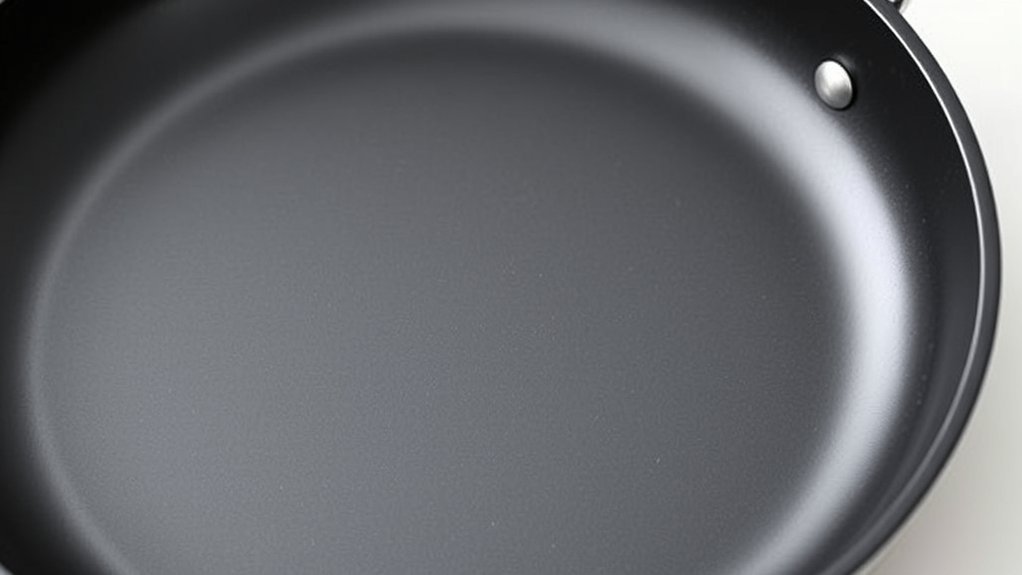
A nonstick pan usually has a smooth, continuous cooking surface designed to reduce food adhesion, but there is no single color or finish that proves a pan is nonstick. Traditional PTFE coatings are often dark gray or black, while ceramic nonstick can be light, dark, matte, satin, glossy, or speckled. The most reliable identification comes from the manufacturer’s label, model number, packaging, or product page. Visual clues and food-release tests can then help judge whether the surface is still performing properly.
Quick Answer
A nonstick pan usually has a smooth, uniform cooking surface rather than exposed bare metal. PTFE coatings are commonly dark, while ceramic coatings come in many colors. Color alone is not proof, however. Check the manufacturer’s label or model number first, then inspect the surface for an intact coating and consistent food release.
Key Takeaways
- Most factory nonstick pans have a smooth, continuous applied surface, but they are not always black.
- The pan’s body material and its cooking-surface coating are separate things; an aluminum pan can also be PTFE- or ceramic-coated.
- Manufacturer markings and the exact model number are more reliable than color, texture, a water test, or an egg test.
- Water beading can be a clue, but research shows wettability does not reliably measure every ceramic coating’s nonstick performance.
- Deep wear, peeling, exposed substrate, persistent sticking, or serious warping are reasons to check the manufacturer’s replacement guidance.
What a Nonstick Pan Looks Like
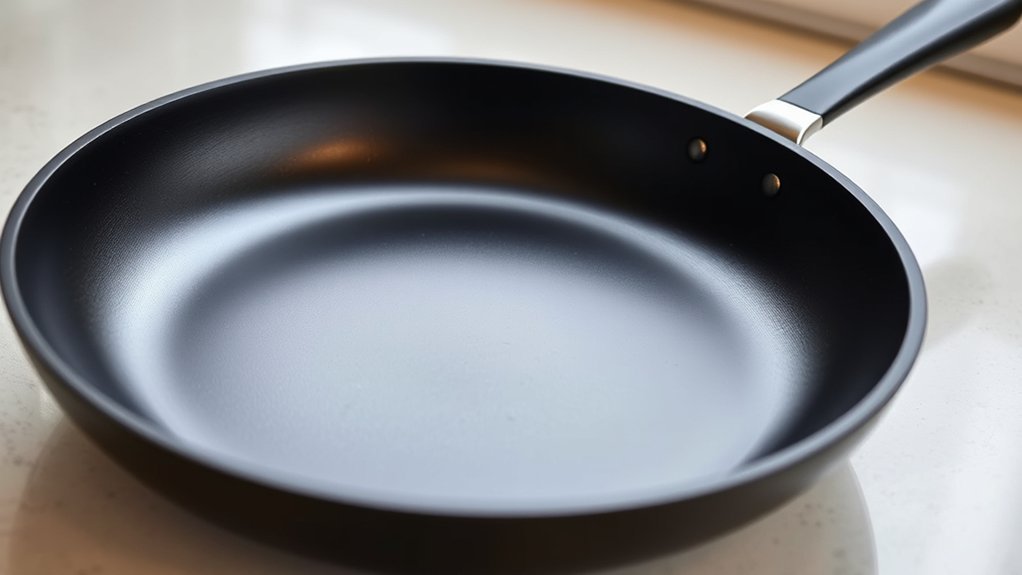
A nonstick pan generally has a continuous cooking surface that looks and feels different from exposed bare metal. The coating may be dark gray, black, cream, white, colored, or speckled depending on the formulation and design.
PTFE-coated cookware often has a dark, smooth surface. The German Federal Institute for Risk Assessment describes PTFE cookware as having a slightly waxy surface with water- and fat-resistant properties. Ceramic nonstick coatings can look matte, satin, glossy, or lightly textured, so appearance varies considerably between manufacturers.
What matters most is uniformity. A healthy factory-applied coating should not show obvious peeling, loose flakes, exposed substrate, deep gouges, or large areas where the finish has disappeared.
The body underneath the coating may be aluminum, hard-anodized aluminum, stainless-clad aluminum, or another construction. That means a pan can accurately be described as both an aluminum pan and a nonstick pan.
The strongest visual clue is a continuous applied cooking surface, but the manufacturer’s identification is more reliable than color alone.
How to Tell If a Pan Is Nonstick
The safest way to identify an unknown pan is to begin with its markings, then use appearance and performance as supporting evidence. This avoids assuming that every black pan is PTFE or every light-colored pan is ceramic.
At a Glance
| Time Required | About 2–5 minutes for a basic inspection |
| Difficulty | Easy |
| Tools Needed | Bright light, clean soft cloth, manufacturer/model information, and optionally a small amount of food or water for a performance check |
| Cost | Usually $0 |
Check the Label or Model First
Look at the pan’s underside, handle, packaging, receipt, or manufacturer’s product page for words such as nonstick, PTFE, ceramic nonstick, or a branded coating name. A model number is especially useful because it can reveal the coating type, oven limit, broiler compatibility, cleaning instructions, and recommended utensils.
Pro Tip: If the coating type is unclear, search the exact manufacturer and model number rather than trying to identify PTFE or ceramic from color. Two pans with similar-looking interiors may use completely different coatings and heat limits.
Visual Surface Cues
A factory nonstick surface normally looks continuous and deliberately finished. Traditional PTFE surfaces are commonly dark gray or black, but ceramic nonstick can be dark or light and may be matte, satin, glossy, or speckled.
Inspect a cool, clean pan under bright light. Look for:
- An even finish across the cooking area
- No obvious exposed base metal where a coating used to be
- No raised flakes or peeling edges
- No deep gouges through the coating
- No major blistering or delamination
Minor discoloration does not automatically mean the pan is unsafe or no longer nonstick. Baked-on oil and residue can also change the appearance, so clean the pan according to its manufacturer instructions before judging the coating.
Simple Slide Tests
Water or oil may bead or move readily across some nonstick surfaces, but this is only a supporting clue. It does not identify the coating chemistry and should not override the manufacturer information.
A 2025 study comparing ceramic sol-gel coatings with PTFE found that wettability was not an appropriate indicator of nonstick ability for every ceramic coating. A 2024 study likewise found that the relationship between water behavior and food release depended strongly on the coating type.
Note: A water-bead test can show how liquid interacts with the surface, but it cannot definitively tell you whether an unknown pan is PTFE, ceramic, seasoned metal, or another low-adhesion surface.
A low-heat cooking test with a delicate food such as an egg can show whether the pan currently releases food well. It still measures performance, not coating identity. A well-seasoned cast-iron or carbon-steel pan can also release an egg without being factory nonstick-coated.
Are Dark or Black Pans Nonstick?
No. Dark or black color alone does not prove that a pan has a nonstick coating.
Many PTFE-coated pans are black or dark gray, but seasoned cast iron, carbon steel, hard-anodized aluminum, black enamel, and some ceramic nonstick products can also have dark interiors. The finish, construction, and manufacturer information matter more than color.
Dark Coatings and Texture
A dark pan is more likely to be factory nonstick-coated when the interior has a continuous applied finish and the manufacturer identifies it as PTFE, ceramic, or another nonstick system.
- Smooth dark coating: may be PTFE, ceramic, or another coated system.
- Rough or pebbled black iron: may be cast iron rather than an applied nonstick coating.
- Dark seasoned steel: may be carbon steel with polymerized seasoning.
- Dark anodized metal: may be hard-anodized aluminum, with or without an additional nonstick coating.
- Black enamel: is a glass-like coating and should not automatically be treated as PTFE nonstick.
Black Pans That Can Be Mistaken for Nonstick
Cast iron is a common source of confusion. A seasoned cast-iron skillet is dark and can develop excellent food release, but its surface is seasoned iron rather than a factory PTFE or ceramic nonstick coating.
Carbon steel can behave similarly after seasoning. Hard-anodized aluminum may also be dark gray or black. Some hard-anodized pans additionally receive a PTFE or ceramic layer, while others rely primarily on the anodized surface.
For that reason, visual appearance is best used to identify obvious damage, not to determine exact coating chemistry.
How to Verify Nonstick
For the most reliable answer, use this order:
- Look for the manufacturer name and model number.
- Check the product specifications or use-and-care instructions.
- Confirm whether the cooking surface is listed as PTFE, ceramic, another coating, anodized aluminum, bare stainless steel, cast iron, or carbon steel.
- Inspect the cool, clean surface for damage.
- Use a low-heat food-release test only if you still need to judge current performance.
A manufacturer specification is stronger evidence than color, water movement, or how slick the surface feels.
What Ceramic Nonstick Looks Like
Ceramic nonstick does not have one standard appearance. Some coatings are white, cream, or beige, while others are gray, black, blue, green, or speckled. The finish may be glossy, matte, or satin.
Modern cookware marketed as ceramic nonstick commonly uses a sol-gel coating based on silica/siloxane chemistry rather than a thick piece of fired ceramic. Formulations vary by manufacturer. For example, GreenPan states that the precursor materials for its Thermolon coating are derived from silicon dioxide.
It is therefore inaccurate to assume that every ceramic nonstick coating contains titanium or that appearance alone identifies its composition.
Many ceramic nonstick products are marketed as PFAS-free, but that claim should be verified for the exact product. “Ceramic” by itself should not replace checking the manufacturer’s material disclosure.
Oven limits also vary substantially. One current All-Clad ceramic nonstick line specifies an oven limit of 450°F, while different GreenPan models list limits ranging from about 350°F to 600°F. The pan’s handle, lid, and other components may have lower limits than the pan body.
Warning: Do not assume that ceramic or PTFE cookware is safe for a particular oven temperature or for broiling based only on the coating type. Follow the exact product’s maximum temperature and broiler instructions.
How to Test a Nonstick Pan
If the label is missing and you mainly want to know whether an older pan still releases food properly, use a low-risk inspection rather than deliberately overheating it.
- Let the pan cool completely. Wash it according to the manufacturer’s instructions and dry it.
- Inspect under bright light. Look for peeling, exposed substrate, deep scratches, blisters, or heavy residue.
- Check the model information. Search any number or brand marking before trying to identify the coating by sight.
- Use liquid only as a clue. A few drops of water on a cool pan may bead or move, but this does not prove the coating type.
- Test food release on low heat. If the manufacturer permits it, cook an egg or another delicate food using the recommended amount of butter or oil and the heat setting specified for that cookware.
- Compare performance over time. Persistent sticking after proper cleaning and correct heat use can indicate coating wear.
Do not intentionally heat an empty pan to extreme temperatures as a “test.” Health Canada advises against empty preheating of nonstick cookware and recommends avoiding high heat, giving temperatures over 260°C/500°F as an example. The German Federal Institute for Risk Assessment likewise warns against strong empty-pan overheating of PTFE cookware.
How to Spot Worn Nonstick Coating
Worn nonstick coating can show both visual changes and declining food release. Not every stain or fine mark means immediate failure, but damage becomes more important when the coating is visibly separating or the underlying material is exposed.
| Indicator | What to Observe | Practical Response |
|---|---|---|
| Light surface marks | Fine marks with no obvious peeling or exposed substrate | Check manufacturer guidance and monitor performance |
| Persistent sticking | Food sticks despite correct heat, cleaning, and normal fat use | Clean as directed; if performance does not return, replacement may be reasonable |
| Exposed substrate | Bright metal or base material visible through a formerly coated area | Stop treating the pan as an intact nonstick surface and consult replacement guidance |
| Peeling or flaking | Raised or loose pieces of coating | Replace the pan rather than attempting to repair the cooking surface |
| Warped base | Pan rocks, spins, or no longer sits evenly on a flat cooktop | Consider replacement because heating can become uneven |
Residue can sometimes imitate coating damage. Before discarding a pan for dullness or reduced release alone, use the manufacturer’s approved cleaning method and reassess it after the surface is clean.
Is a Worn Nonstick Pan Safe?
“Worn” can mean anything from minor cosmetic marks to a visibly peeling coating, so the answer depends on the type and severity of damage.
For PTFE specifically, the German Federal Institute for Risk Assessment states that accidentally swallowed tiny PTFE particles from a scratched coating are not expected to cause adverse health effects because PTFE is inert and the particles are excreted unchanged. That finding should not be generalized to every unidentified coating material.
Performance is a separate issue. A badly worn pan may stick, heat unevenly, or continue losing pieces of its finish even when a specific scratch is not considered a toxicological emergency.
- Follow the manufacturer’s damage and replacement instructions.
- Do not intentionally overheat damaged cookware.
- Replace cookware with significant peeling, delamination, or exposed substrate if the manufacturer recommends retirement.
- Do not attempt to sand, grind, or apply a home coating to restore a factory nonstick surface.
PTFE heat safety also depends heavily on use conditions. BfR reports that PTFE can begin decomposing at around 360°C/680°F and above and specifically warns against strong heating of empty PTFE cookware. Health Canada advises avoiding empty preheating and high heat for nonstick cookware.
PTFE vs Ceramic Nonstick Finishes
PTFE and ceramic nonstick coatings can both provide low-stick cooking surfaces, but appearance alone may not reliably distinguish them.
| Feature | PTFE Nonstick | Ceramic Nonstick |
|---|---|---|
| Common appearance | Often dark gray or black and smooth | Can be light or dark; matte, satin, glossy, or speckled |
| Basic chemistry | Fluoropolymer coating using polytetrafluoroethylene | Typically a sol-gel/silica- or siloxane-based coating; formulations vary |
| PFAS terminology | PTFE falls within broad PFAS definitions | Many products are marketed PFAS-free, but verify the exact model |
| Heat guidance | Avoid empty high-heat preheating and follow the manufacturer’s maximum temperature | Maximum oven and broiler temperatures vary widely by product |
| Best identification method | Manufacturer/model specification | Manufacturer/model specification |
PTFE is a fluoropolymer and falls within broad definitions of PFAS. PFOA is a different PFAS that was formerly used in production processes and has been phased out in many markets. Therefore, a label saying “PFOA-free” does not automatically mean “PFAS-free.”
The U.S. Food and Drug Administration states that certain polymerized PFAS are authorized for nonstick cookware applications and that studies show negligible amounts of PFAS capable of migrating to food from those tightly bound polymer coatings.
For ceramic nonstick, newer research has found that PTFE can maintain stronger nonstick performance than some tested sol-gel ceramic coatings over repeated cooking cycles, although results depend on the exact formulation. This is another reason not to assume one coating type is universally more durable based only on its marketing category.
How to Check the Manufacturer Details
The manufacturer information is the best place to settle questions that visual inspection cannot answer.
Check for:
- Exact coating type: PTFE, ceramic nonstick, another fluoropolymer, anodized surface, or another named system.
- Maximum oven temperature: include separate limits for the pan and lid if provided.
- Broiler compatibility: never assume oven-safe also means broiler-safe.
- Recommended heat: many manufacturers recommend low to medium stovetop heat for coated cookware.
- Utensil restrictions: silicone, nylon, wood, metal, or other tools depending on the product.
- Cleaning instructions: dishwasher compatibility does not always mean dishwashing is preferred for coating longevity.
- Material claims: check the exact meaning of PTFE-free, PFOA-free, or PFAS-free.
- Warranty coverage: determine whether coating wear is included or treated as normal use.
For example, current All-Clad instructions for one PTFE nonstick line specify low-to-medium cooking heat, avoidance of empty-pan overheating, an oven limit up to 500°F for the cookware, and avoidance of the broiler. Its current ceramic nonstick line has different limits, including a 450°F oven rating for one model and no broiler use.
That variation shows why a general article cannot safely assign one heat limit to every PTFE or ceramic pan.
Frequently Asked Questions
How Do You Know if a Pan Is a Nonstick Pan?
Check the manufacturer’s label, model number, packaging, or product page first. A nonstick pan usually has a continuous applied cooking surface, but color is not proof. PTFE is often dark, while ceramic coatings can be light or dark. Water movement and food-release tests can show performance but cannot reliably identify the exact coating.
How Can You Tell the Difference Between an Aluminum Pan and a Nonstick Pan?
You often cannot treat them as separate categories because many nonstick pans have aluminum bodies. Bare aluminum normally exposes a silvery metallic cooking surface, while an aluminum pan may also have a PTFE or ceramic coating over that metal. Aluminum is generally lightweight and conducts heat well. Check the manufacturer specifications to learn both the body material and the cooking-surface type.
What Pans Are Actually Non-Stick?
Factory nonstick cookware commonly uses PTFE or ceramic-style sol-gel coatings, along with other proprietary coating systems. Seasoned cast iron and carbon steel can become low-stick with correct use, but they are not the same as factory nonstick-coated cookware. The product specification is the most reliable way to identify the surface.
When Should You Not Use a Non-Stick Pan?
Do not use a nonstick pan above the manufacturer’s stated temperature, under a broiler unless the product is specifically approved for it, or with utensils and cleaning methods the manufacturer prohibits. Avoid strong empty-pan heating. Significant peeling, exposed substrate, or other serious coating damage should be evaluated using the manufacturer’s replacement guidance.
Are All Black Pans Nonstick?
No. PTFE cookware is often black or dark gray, but cast iron, seasoned carbon steel, hard-anodized aluminum, black enamel, and dark ceramic coatings can look similar. Color is only a clue. Check how the manufacturer identifies the cooking surface.
Can You Tell PTFE From Ceramic Nonstick Just by Looking?
Not reliably. PTFE is frequently dark and ceramic coatings are sometimes light-colored, but modern ceramic cookware is also sold in dark colors and many finishes. Manufacturer documentation or the exact model specification is a much stronger identifier than appearance.
Conclusion
A nonstick pan usually has a smooth, continuous cooking surface, but there is no universal color, gloss level, or home test that identifies every nonstick coating. PTFE is commonly dark, ceramic nonstick comes in many finishes, and aluminum may be the underlying pan body for either type.
Start with the manufacturer name and model number. Then check the surface for peeling, exposed substrate, deep damage, or declining food release. Water and egg tests can provide supporting information about performance, but they should not replace the product specifications. For heat limits, broiler use, cleaning, utensils, and replacement decisions, follow the instructions for the exact pan.
Sources
- U.S. Food and Drug Administration — Questions and Answers on PFAS in Food — current FDA information on polymerized PFAS used in nonstick cookware and migration into food.
- German Federal Institute for Risk Assessment — PTFE Non-Stick Cookware FAQ — PTFE overheating, intended-use safety, and scratched-coating particle guidance.
- Health Canada — The Safe Use of Cookware and Bakeware — aluminum properties, nonstick heat guidance, PTFE/PFOA information, and cookware-use precautions.
- All-Clad — Cookware Care and Use — manufacturer examples for nonstick heat, utensil, cleaning, and broiler recommendations.
- GreenPan — Ceramic Nonstick FAQ — manufacturer description of silicon-dioxide-derived ceramic nonstick technology.
- Research in Engineering — 2025 Study of Sol-Gel Ceramic and PTFE Nonstick Coatings — evidence that water wettability is not a reliable nonstick indicator for all ceramic coatings and comparison of coating durability.

2 thoughts on “What Does a Nonstick Pan Look Like? What It Should Look Like”