
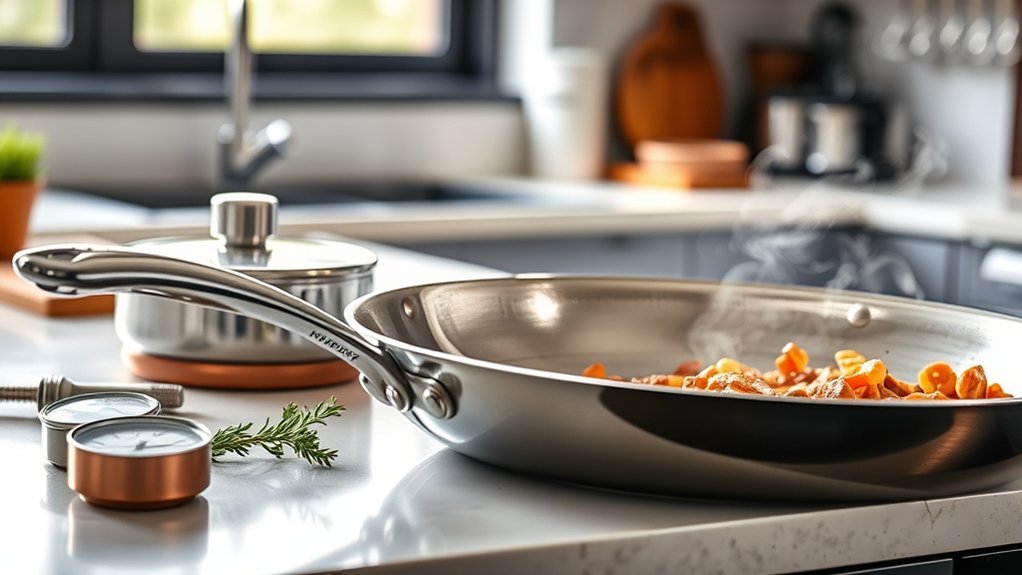
When buying a stainless steel pan, focus first on construction, usable cooking area, handle comfort, cooktop compatibility, and heat control. A well-made tri-ply or multi-ply pan usually combines a durable stainless cooking surface with a conductive aluminum or copper layer. Fully clad construction can improve heating up the sides, while a stable base, comfortable handle, and practical 10- to 12-inch size make everyday cooking easier.
Quick Answer
Look for a stainless steel pan with a conductive aluminum or copper core, sturdy construction, a flat base, comfortable handle, and a size that matches how you cook. Fully clad tri-ply is an excellent all-purpose starting point. For induction, confirm the manufacturer’s compatibility rating rather than relying only on appearance or stainless-steel grade.
Key Takeaways
- Construction matters more than ply count alone. Look at the core material, thickness, and whether the pan is fully clad.
- 10- and 12-inch skillets suit most kitchens. Choose based on burner size, usable cooking area, storage, and how much food you normally cook.
- Check induction compatibility on the product specification. A magnet test is useful, but the manufacturer’s rating is more reliable.
- Balance matters as much as total weight. Lift the pan by the handle and consider how it will feel when full of food.
- 18/10 is not automatically “healthier” than 18/0. Stainless grade affects corrosion resistance and nickel content, while heating performance depends largely on the conductive core.
Key Features to Look for in a Stainless Steel Pan
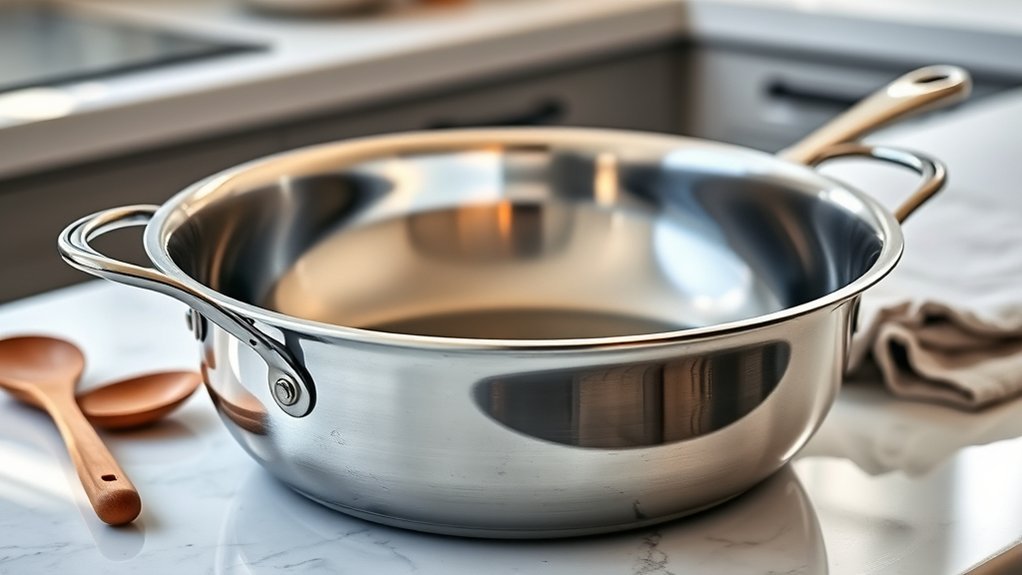
When evaluating a stainless steel pan, start with its construction. Stainless steel is durable and corrosion-resistant, but it is not an especially fast heat conductor by itself. Better cookware therefore bonds the stainless to aluminum, copper, or another conductive material that spreads heat more effectively.
A common example is fully clad tri-ply construction: a stainless cooking surface, a conductive aluminum core, and an exterior layer that adds strength and, when magnetic, induction compatibility. Current fully bonded tri-ply cookware is designed to spread heat through both the base and sides rather than concentrating the conductive layer only under the bottom. All-Clad’s D3 construction, for example, uses an aluminum core between stainless layers for fast, even heating.
The cooking surface should also be smooth, durable, corrosion-resistant, and easy to clean. Those characteristics align with the general food-contact-material principles described in the FDA Food Code.
| Feature | What to Look For | Why It Matters |
|---|---|---|
| Construction | Tri-ply or well-designed multi-ply with aluminum or copper | Improves heat distribution and temperature control |
| Cladding | Fully clad for maximum versatility; disc-bottom can still work well for many tasks | Determines where conductive material extends through the pan |
| Base | Flat and stable, with induction rating if needed | Improves burner contact and cooktop compatibility |
| Handle | Securely attached, comfortable, and easy to grip | Improves control when lifting, pouring, and transferring the pan |
| Size | Usually 10 or 12 inches for general use | Balances cooking area, burner fit, storage, and maneuverability |
| Oven rating | Manufacturer-stated temperature appropriate for your recipes | Allows stovetop-to-oven cooking without exceeding handle or lid limits |
Pro Tip: Do not judge a pan only by how heavy it feels in the store. Hold it by the handle, tip it as though you were pouring, and imagine it filled with food. Good balance is often more useful than maximum weight.
Choose the Right Stainless Steel Pan Construction
Tri-ply construction is a practical starting point for most home cooks because it usually combines stainless steel for the interior and exterior with a conductive aluminum core. That arrangement gives stainless cookware better heat distribution without making the pan unnecessarily complex.
Premium pans may use additional aluminum layers, copper, graphite, or other configurations. These can change responsiveness, heat stability, weight, and price, but more layers do not automatically mean better cooking performance. Layer thickness and material matter just as much as the number printed on the box.
For example, a thick aluminum core in a three-ply pan can perform extremely well, while a five-ply pan built with thin or poorly chosen layers may offer little practical advantage. Compare actual construction, warranty, weight, and manufacturer specifications rather than buying by ply count alone.
Fully Clad vs. Disc-Bottom Construction
A fully clad pan carries its bonded conductive layers from the base up the sides. This is useful for skillet work, sauces, shallow braises, and recipes where food touches more than the flat center of the pan.
A disc-bottom pan concentrates aluminum or another conductive material in a bonded plate beneath the base. A well-made disc-bottom design can work very well for boiling, simmering, and other tasks centered on the bottom surface, and it may cost less.
Neither design is automatically bad. For a general-purpose skillet, however, fully clad construction is usually the more versatile choice because heat is distributed across a larger portion of the pan.
Why Stainless Steel Pan Heat Responsiveness Matters
Heat responsiveness describes how quickly a pan reacts when burner output changes. It matters during searing, sautéing, sauce making, and any recipe where you need to reduce or increase heat quickly.
Stainless steel itself is durable but relatively slow at moving heat compared with aluminum or copper. That is why clad cookware uses a conductive core. Aluminum offers a strong balance of cost, weight, and conductivity, while copper can respond particularly quickly to burner adjustments.
Do not rely on an arbitrary surface-temperature number when comparing pans. Real heat evenness depends on the conductive layer’s material and thickness, pan diameter, burner size, preheating method, and measurement conditions.
A pan’s core material, thickness, and construction tell you more about heat behavior than the number of plies by itself.
For everyday use, look for a pan that heats evenly enough to avoid obvious hot zones while still responding when you turn the burner down. That balance makes browning easier to control and reduces the chance of scorching delicate sauces.
Pick the Best Stainless Steel Pan Size and Shape
Pan size should match the amount of food you normally cook and the diameter of your burners. 10-inch and 12-inch skillets are popular because they cover most everyday jobs without becoming specialty cookware.
Do not look only at the advertised rim diameter. Two 12-inch pans can have noticeably different usable flat cooking surfaces depending on how sharply the sides slope upward.
Pan Size Basics
An 8-inch skillet works well for small portions, eggs, reheating, or cooking for one. A 10-inch model is easier to store and maneuver while still handling many everyday meals. A 12-inch skillet gives more room for browning several pieces of food without crowding.
Larger is not automatically better. An oversized pan on a small burner may heat less evenly, take up more storage space, and become tiring when loaded. Measure your cooktop, cabinet space, and existing lids before choosing.
If searing is a priority, pay attention to the diameter of the flat cooking area. More flat surface lets you leave space between pieces of meat or vegetables so moisture can evaporate instead of steaming the food.
Shape And Sides
Sloped or flared sides make a skillet easier to toss, turn, and slide food from. They also help moisture escape during browning. A flared rim can make pouring sauces or pan juices cleaner.
Straighter, taller sides hold more liquid and reduce splatter, which is why sauté pans are often better for shallow frying, braising, or finishing dishes with sauce.
For an all-purpose skillet, look for enough side height to contain food without sacrificing too much flat cooking area.
Choose a Comfortable Handle and Balanced Weight
A stainless steel pan should have an ergonomic handle that feels secure when the pan is empty and when it is loaded. Riveted stainless handles are common on premium cookware because they provide a strong mechanical attachment, although welded designs can also be durable when properly made.
There is no universal ideal weight. Diameter, core thickness, lid, handle design, and construction all affect the final number. What matters most is whether the pan feels stable without becoming difficult for you to lift or pour from.
Ergonomic Handle Design
A comfortable handle should give your fingers enough room, resist twisting in the hand, and provide leverage without creating a sharp pressure point. Handle shape is personal, so holding the pan before buying can be more informative than reading a specification sheet.
Long stainless handles are often designed to limit heat transfer from the pan, but they are not guaranteed to stay cool in every situation. Gas flames, long cooking times, and oven use can make metal handles hot.
Warning: Treat any stainless steel handle as potentially hot after oven use or prolonged stovetop cooking. Use a dry oven mitt or handle cover when necessary.
On a large or heavy 12-inch pan, a helper handle can make it much easier to lift the cookware with two hands when it contains food or liquid.
Balanced Pan Weight
A balanced pan should not feel as though the body is constantly pulling your wrist downward. Moderate heft can improve stability, but excessively heavy cookware may be uncomfortable during tossing, pouring, washing, or transferring from stove to oven.
| Feature | Practical Benefit |
|---|---|
| Stable base | Helps the pan sit securely on the burner |
| Comfortable long handle | Improves leverage and pouring control |
| Helper handle on larger pans | Makes two-handed lifting safer and easier |
| Appropriate total weight | Reduces fatigue during routine handling |
| Good conductive core | Improves heating performance independently of handle balance |
When possible, test the pan’s balance with one hand and then imagine the additional weight of food. The best choice is heavy enough to feel stable but manageable enough for the person who will actually use it.
Compare Tri-Ply, 5-Ply, and Clad Construction
Tri-ply, 5-ply, and other clad pans describe how multiple materials are bonded together. The terms are useful, but they do not tell the full performance story.
A typical tri-ply pan uses stainless steel around an aluminum core. This can provide fast heat-up, good heat distribution, and moderate weight. Current examples such as All-Clad D3 use fully bonded aluminum and stainless steel throughout the pan.
A five-ply design adds two more bonded layers. Some 5-ply cookware alternates stainless and aluminum to change heat diffusion, stability, and resistance to warping. All-Clad’s current stainless comparison, for example, shows different layer arrangements across its D3 and D5 lines.
That does not mean every 5-ply skillet will beat every tri-ply skillet. A high-quality three-layer pan with a thick conductive core may outperform a poorly engineered pan with more layers.
Fully clad is also different from “multi-ply.” Fully clad tells you that bonded conductive material extends through the pan body rather than being limited to a separate base disc.
Note: When comparing two pans, look beyond “3-ply” versus “5-ply.” Core material, layer thickness, usable cooking surface, balance, warranty, and real-world handling can matter more.
Understand Stainless Steel Grades
Cookware descriptions often mention 18/0, 18/8, 18/10, 304, or 316 stainless steel. These labels describe alloy composition, not the number of conductive layers in the pan.
In common stainless labeling, the first number in 18/10 or 18/8 refers roughly to chromium content, while the second refers to nickel. The Nickel Institute notes that Type 304 is commonly used in food and beverage applications and is often referred to as 18/8 or 18/10.
18/0 stainless contains little or no nickel and is commonly used where magnetic behavior is useful, including some induction-compatible exterior layers. 18/10 or 18/8 stainless contains nickel, which generally improves corrosion resistance and formability.
Type 316 stainless includes molybdenum and generally provides greater corrosion resistance than Type 304 in demanding environments. That advantage is valuable in industrial, marine, and aggressive chloride conditions, but it does not automatically make a 316 cookware pan a better thermal performer. Heating still depends largely on the aluminum, copper, or other conductive core.
Match Your Stainless Steel Pan to Your Cooktop
Cooktop compatibility should be confirmed before purchase. Gas and conventional electric burners work with most stainless cookware, while induction requires a magnetically responsive base or exterior.
The easiest buying method is to look for an induction symbol or an explicit manufacturer statement. A strong magnet sticking firmly to the base is a useful home check, but it should not replace the manufacturer’s specification when you are buying new cookware.
Current tri-ply products can combine an 18/10 stainless cooking surface with a magnetic exterior specifically so the cookware works on induction. That is why judging induction compatibility from the cooking-surface grade alone can be misleading.
For glass, ceramic, and electric cooktops, a flat base is especially important because good physical contact helps transfer heat efficiently. Avoid pans that rock or arrive visibly warped.
Also check the manufacturer’s oven-safe temperature. Handles, lids, coatings, and other components can have lower temperature limits than the stainless pan body itself.
Learn How Stainless Steel Pans Cook
Stainless steel cookware excels at browning, searing, sautéing, deglazing, and building pan sauces. Unlike traditional nonstick surfaces, stainless encourages browned food residue called fond to develop on the pan, which can later be dissolved with stock, water, wine, or another cooking liquid.
A properly designed aluminum- or copper-core pan spreads burner heat more effectively than a thin single layer of stainless steel. This gives the cook more control over browning and reduces extreme hot spots.
Stainless steel is also widely used for acidic foods because quality food-contact grades offer strong corrosion resistance. However, stainless cookware can release small quantities of metals under some conditions. Research has found that release can increase with acidity, long cooking times, and new cookware, although results vary by alloy, food, and use.
How to Preheat Stainless Steel With Less Sticking
Stainless steel is not inherently nonstick, so cooking technique matters. Start over medium or medium-low heat rather than automatically using the highest burner setting.
- Place the empty pan over moderate heat and let it warm gradually.
- Add cooking oil or another suitable fat once the pan is preheated.
- Allow the oil to spread across the cooking surface.
- Add food and give proteins time to brown before trying to move them.
- Reduce the burner if oil smokes heavily or food browns too quickly.
Manufacturer guidance from All-Clad likewise recommends preheating stainless cookware over moderate heat and adding oil or butter before food to improve searing and reduce sticking.
Pro Tip: If meat seems firmly stuck immediately after you place it in the pan, avoid forcing it. Once a good crust develops, it often releases more easily for turning.
Clean and Care for Your Stainless Steel Pan
Proper care keeps a stainless steel pan performing well and helps preserve its finish. First, let a hot pan cool before washing it. Sudden temperature changes can cause thermal shock and may warp cookware. All-Clad’s current care guidance specifically recommends cooling cookware before washing.
- Let the pan cool before adding wash water.
- Wash with warm, soapy water and a soft sponge or cloth.
- Soak stubborn residue before scrubbing aggressively.
- Use baking soda or a nonabrasive stainless cleaner for difficult deposits when appropriate.
- Avoid steel wool, harsh chlorine bleach, and cleaners the manufacturer warns against.
- Dry the pan after washing to reduce water spotting.
For stubborn cooked-on food, add water and let the residue soften before cleaning. Some manufacturers also recommend simmering water with baking soda to loosen burnt food.
Chalky white spots are often mineral deposits from water. Diluted vinegar can help dissolve these marks, followed by thorough rinsing and drying.
High heat can leave blue, gold, or brown discoloration on stainless steel. This is usually cosmetic rather than structural, but avoiding unnecessary overheating helps preserve the finish.
Note: To reduce the chance of salt-related pitting, avoid leaving undissolved salt sitting on an empty or barely wet stainless surface. Some cookware makers recommend adding salt after the liquid is already hot or boiling so it dissolves promptly.
Frequently Asked Questions
What to Look Out for When Buying a Stainless Steel Pan?
Look for durable construction, a conductive aluminum or copper core, a flat base, comfortable handle, useful cooking-surface size, and the correct cooktop and oven compatibility. Fully clad tri-ply is a strong general-purpose choice, but a well-made disc-bottom pan may also work well for many tasks. Avoid judging cookware only by ply count, weight, or appearance.
Which Is Healthier, 18/0 or 18/10 Stainless Steel?
Neither is universally healthier. 18/10 stainless contains nickel and generally offers strong corrosion resistance, while 18/0 contains little or no nickel and may be attractive to people trying to avoid nickel exposure. Research shows stainless cookware can release nickel and chromium under some cooking conditions, especially with acidic food, new cookware, or long cooking times. A 2017 study found amounts under common test conditions were below known allergy-triggering thresholds for most nickel- or chromium-allergic subjects studied, although highly sensitive people may still need individualized medical guidance.
How Can I Tell if My Stainless Steel Is 304 or 316?
You generally cannot confirm 304 versus 316 reliably by appearance, and a simple magnet test is not a dependable grade identifier. Check the manufacturer’s specification or mill certification. Professional positive-material-identification methods such as X-ray fluorescence can distinguish common grades by alloy composition; Type 316 contains molybdenum that Type 304 normally lacks.
Which Pans Should I Stay Away From?
Avoid pans with visibly warped bases, loose or uncomfortable handles, extremely thin construction that heats erratically, unclear food-contact specifications, poor warranty support, or unknown coatings. Do not reject cookware solely because it uses a particular stainless series; overall construction, corrosion resistance, food-contact suitability, and manufacturer quality control are more useful buying criteria.
Is 5-Ply Stainless Steel Better Than Tri-Ply?
Not automatically. Five-ply cookware can provide excellent heat diffusion and stability, but performance depends on the metals used and the thickness of each layer. A well-designed tri-ply pan with a substantial aluminum core can be an excellent performer and may be lighter and more responsive than some heavier multi-ply pans.
Is Fully Clad Stainless Steel Better Than a Disc-Bottom Pan?
Fully clad construction is usually more versatile in a skillet because conductive material extends from the base into the sides. A well-made disc-bottom pan can still perform very well when most cooking happens on the flat base, especially for boiling and simmering. Choose according to the cooking tasks you do most often.
Conclusion
When choosing a stainless steel pan, prioritize construction quality, conductive-core material, size, usable cooking area, handle comfort, cooktop compatibility, and balance. Fully clad tri-ply cookware is an excellent starting point for many kitchens because it combines durable stainless steel with a heat-conductive core without unnecessary complexity.
Do not assume that the heaviest pan, the highest ply count, or 18/10 labeling automatically makes one model superior. Compare how the pan is actually built and whether it fits your burner, cooking style, strength, and storage space. With moderate preheating, sensible heat control, and proper cleaning after the pan cools, a quality stainless steel skillet can provide dependable searing, sautéing, and sauce-making performance for many years.
Sources
- U.S. Food and Drug Administration — FDA Food Code — food-contact material durability, corrosion resistance, cleanability, and safety principles.
- All-Clad — D3 Stainless 12-Inch Fry Pan — fully bonded tri-ply construction, aluminum-core heating, induction compatibility, handle design, and thermal-shock warning.
- All-Clad — Cookware Care & Use — cooling cookware before washing, cleaning methods, and surface-care guidance.
- Nickel Institute — Food Contact Materials — 304, 18/8, 18/10, nickel-containing stainless steel, and 316L corrosion-resistance information.
- Guarneri et al., Contact Dermatitis, 2017 — nickel and chromium release from 18/10 stainless cookware under common cooking conditions.
- Thermo Fisher Scientific — Stainless Steel Analysis With XRF and LIBS — professional alloy identification and distinguishing common stainless grades.