
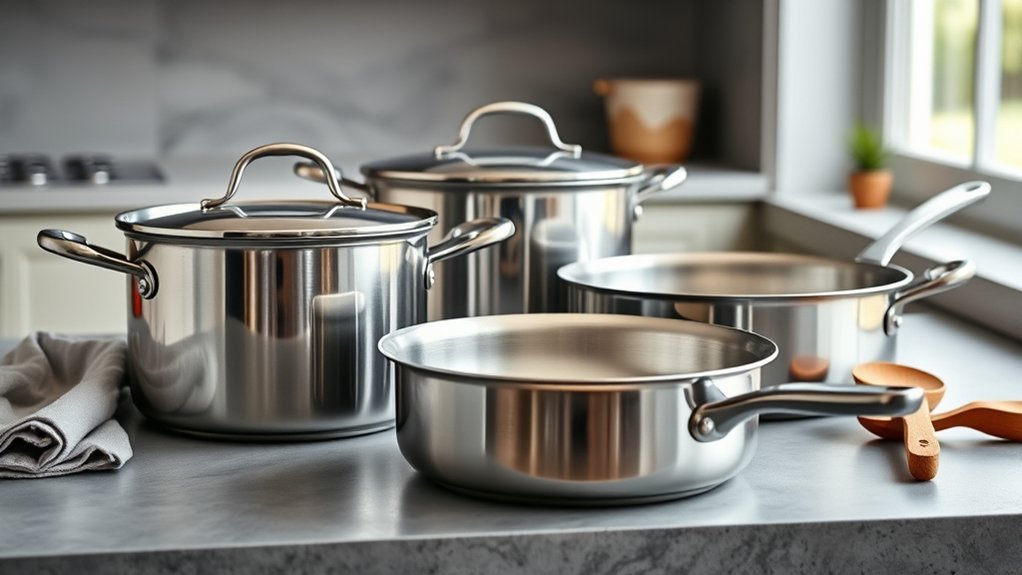
For most home cooks, the best stainless steel cookware combines a corrosion-resistant cooking surface with good pan construction. Type 304 is the most common stainless steel used for food-contact applications, while Type 316 adds molybdenum for extra resistance to localized corrosion. Just as important, aluminum or copper layers inside the pan provide the heat distribution that stainless steel alone cannot.
Quick Answer
For most cookware, Type 304 stainless steel is an excellent everyday choice. Type 316 offers additional corrosion resistance, especially against chloride-related attack, but it does not automatically cook better. For heating performance, prioritize a well-made fully clad pan with an aluminum or copper core over a higher-sounding steel grade or ply count.
Key Takeaways
- 304 stainless steel is the most common all-around choice for quality stainless cookware.
- 316 stainless steel contains molybdenum, which improves resistance to localized corrosion, particularly in chloride-rich conditions.
- 18/8 and 18/10 are common chromium/nickel composition labels associated with the 304 family; 18/10 is not a separate cookware grade.
- 430 stainless steel is ferritic and magnetic, so it is often useful in induction-compatible cookware.
- Cladding matters enormously: aluminum or copper cores spread heat far better than stainless steel alone.
- For safety and durability, favor cookware from a reputable manufacturer that identifies its materials and provides clear use and care instructions.
What Stainless Steel Grades Actually Mean
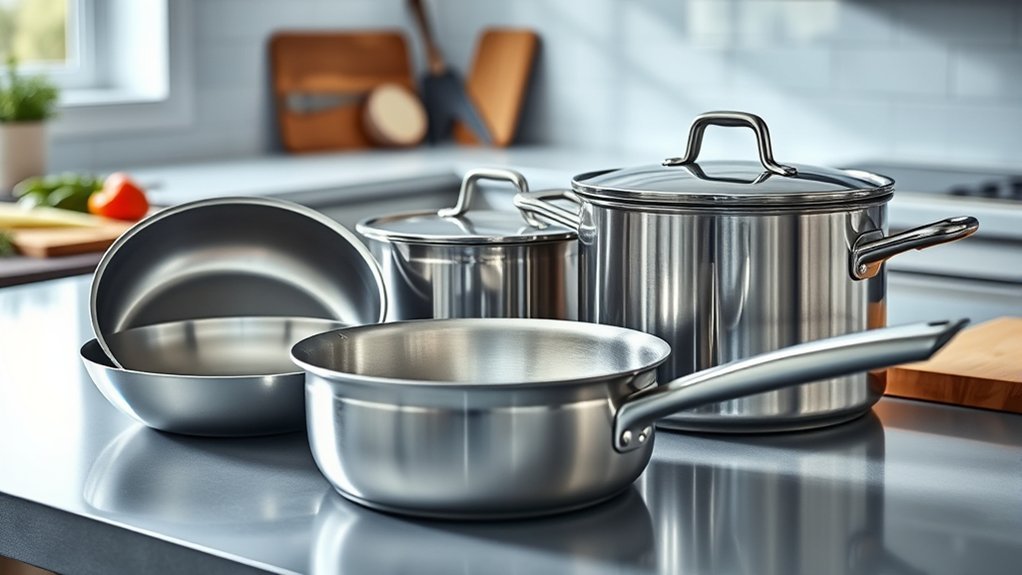
Stainless steel grades describe an alloy’s chemical composition and metallurgical structure. Chromium is essential because it helps form the thin passive surface layer that gives stainless steel its corrosion resistance. Nickel, molybdenum, manganese, and other alloying elements can further change corrosion resistance, formability, magnetism, and mechanical properties.
For cookware, the grade tells you about the stainless surface; the pan’s core, thickness, and bonding tell you much more about how evenly it will cook.
Type 304 is the most common nickel-containing stainless steel used in food and beverage applications. Commercial labels such as 18/8 and 18/10 are commonly associated with this family. The British Stainless Steel Association notes that 18/10 is often used as an alternative marketing designation rather than as proof of a distinctly higher-nickel grade.
Type 316 is another austenitic stainless steel. It contains molybdenum, which increases resistance to localized corrosion, particularly where chlorides can attack the protective passive layer.
Type 430 is a ferritic stainless steel. It contains little or no deliberately added nickel, is magnetic, and is commonly useful where induction compatibility is needed. Its corrosion resistance is generally lower than that of 304 or 316 in more demanding environments.
Type 201 is a lower-nickel austenitic stainless steel in which manganese replaces part of the nickel used in traditional 300-series alloys. It is used in kitchen utensils and other consumer products. Its exact corrosion performance depends on its composition and the conditions of use, so it should not automatically be treated as either unsafe or poor quality.
| Grade / Label | General Characteristics | Cookware Relevance |
|---|---|---|
| 304 / 18/8 / commonly 18/10 | Austenitic, corrosion resistant, nickel-containing | Common cooking surface for quality cookware |
| 316 | Austenitic, molybdenum-containing, greater localized-corrosion resistance | Premium cooking surface in some cookware |
| 430 / commonly 18/0 | Ferritic, magnetic, low nickel | Useful for magnetic outer layers and some cooking surfaces |
| 201 | Austenitic, lower nickel, higher manganese | Used in lower-cost kitchenware and utensils |
304 Stainless Steel for Everyday Cookware
304 stainless steel is a practical everyday cookware material because it combines good corrosion resistance, toughness, cleanability, and a stable food-contact surface. It is widely used in food and beverage applications and is commonly identified by 18/8 or 18/10 terminology.
Its strength is the cooking surface, not heat conduction. Stainless steel itself conducts heat much less effectively than aluminum or copper, which is why high-performance stainless cookware usually bonds the stainless layer to a more conductive core.
For most households, a well-built 304 stainless steel pan provides a strong balance of durability, availability, corrosion resistance, and cost.
Why 304 Works
Type 304 typically contains roughly 18% chromium and a significant amount of nickel within the grade’s permitted composition range. Chromium supports the protective passive film, while nickel helps maintain the austenitic structure and contributes to corrosion resistance and formability.
The surface is suitable for a wide range of foods, including everyday preparations involving tomatoes, wine, or citrus. However, describing any stainless surface as completely non-reactive is too absolute: measurable nickel and chromium migration can occur under some cooking conditions, particularly with new cookware, acidic food, and long cooking times.
| Property | Practical Benefit |
|---|---|
| Good corrosion resistance | Handles normal kitchen use well when properly maintained |
| Durable surface | Tolerates metal utensils and routine scrubbing better than coated cookware |
| Food-contact use | Widely used in cookware and commercial food equipment |
| Bonding compatibility | Works well as the durable surface over aluminum or copper cores |
Note: A pan labeled 304 or 18/10 is not automatically a high-performance pan. A thin single-layer 304 pan can heat less evenly than a well-built fully clad pan using the same stainless cooking surface.
304 Care And Use
Good care helps any stainless cookware retain its appearance and corrosion resistance.
- Follow the cookware manufacturer’s instructions for dishwasher use; the stainless alloy alone does not determine whether the complete product is dishwasher safe.
- Use the manufacturer’s stated oven-temperature limit because handles, lids, coatings, bonding, and other components can set a lower limit than the stainless steel itself.
- Avoid putting a very hot pan directly under cold water. Severe thermal shock can deform cookware.
- Avoid prolonged exposure to chlorine bleach and other harsh chloride-containing cleaners unless the manufacturer specifically approves them.
- Dry cookware after washing if water spotting is a concern.
- For burnt-on food, soak the pan and use a cleaner or scrubbing method approved by the manufacturer rather than aggressively gouging the surface.
Pro Tip: When comparing two stainless pans, check the full construction before focusing on whether the label says 18/8 or 18/10. Core material, total thickness, bonding quality, flatness, handles, and warranty are often more useful buying signals.
Why 316 Stainless Steel Is Worth Considering
316 stainless steel is worth considering when additional corrosion resistance is useful. Its distinguishing alloy addition is molybdenum, which improves resistance to localized corrosion such as pitting, particularly in chloride-rich environments. The British Stainless Steel Association’s corrosion guidance places 316 above 304 for resistance to localized attack because of this molybdenum addition.
This can be valuable in demanding food-processing environments or cookware that frequently encounters salty liquids and other aggressive conditions. It does not mean 304 suddenly becomes unsuitable for ordinary tomato sauce, vinegar, or citrus dishes; 304 remains widely used for food-contact applications.
316 also does not automatically heat more evenly, retain more heat, or resist warping better simply because it is 316. Those cooking characteristics depend mainly on the pan’s core materials, thickness, geometry, and construction.
Because 316 cookware is less common and can cost more, buyers should confirm that a manufacturer actually identifies the food-contact surface as 316 rather than assuming terms such as “premium,” “surgical,” or “professional” specify a recognized cookware grade.
Note: The main technical reason to choose 316 over 304 is its extra corrosion margin. It is not a substitute for good cladding, adequate thickness, or proper heat control.
How 18/10, 18/8, and 18/0 Differ
The labels 18/10, 18/8, and 18/0 refer broadly to chromium and nickel content, but they should not be treated as three precise performance grades.
18/8 stainless steel traditionally describes stainless containing about 18% chromium and about 8% nickel and is commonly associated with Type 304.
18/10 stainless steel is also widely associated with the 304 family. However, the label does not guarantee that a finished pan contains exactly 10% nickel or that it will outperform an 18/8 pan. The permitted composition ranges of standardized alloys and commercial labeling practices overlap.
18/0 stainless steel contains very little nickel and commonly refers to ferritic stainless such as Type 430. It is magnetic, which can make it useful in induction-ready cookware, although it generally provides less corrosion resistance than nickel-containing 304 in demanding conditions.
- Higher nickel content is not a simple measure of cookware quality.
- 18/8 and 18/10 commonly point to the 304 family rather than completely different grades.
- 18/0 is magnetic and much lower in nickel.
- The best choice depends on corrosion resistance, nickel sensitivity, construction, cooktop compatibility, and price.
430 and 201 Stainless Steel: Budget Options to Know
430 and 201 stainless steels often appear in more affordable kitchen products, but “budget” does not automatically mean unsafe or unusable.
430 stainless steel is ferritic and magnetic. It is frequently useful as the outside layer of induction-compatible multi-ply cookware because an induction cooktop needs a ferromagnetic base. It can also serve as a cooking surface in some products, although its resistance to localized corrosion is generally below 304 and 316 in harsher conditions.
201 stainless steel is an austenitic alloy that replaces part of the nickel found in conventional 300-series stainless with manganese and nitrogen. It is used in kitchen utensils and other household applications. Its corrosion resistance can be somewhat below common chromium-nickel grades depending on the exact alloy and environment, but it should not be assumed to have poor durability solely because the grade number is 201.
| Grade | Strengths | Trade-offs |
|---|---|---|
| 430 stainless steel | Magnetic, low nickel, affordable | Lower corrosion resistance than 304/316 in demanding environments |
| 201 stainless steel | Lower nickel content, strong, cost-efficient | Corrosion performance depends strongly on exact composition and use |
| 304 stainless steel | Widely used, strong all-around corrosion resistance | Normally nonmagnetic as a standalone austenitic sheet |
| 316 stainless steel | Greater localized-corrosion resistance | Usually more expensive and less common in home cookware |
With any lower-cost cookware, material traceability matters. A clearly identified alloy from a reputable manufacturer is easier to evaluate than a product marketed only as “stainless steel” with no information about its cooking surface, construction, or care requirements.
Why Clad Construction Matters More Than Steel Grade
For actual cooking performance, clad construction can matter more than whether the food-contact stainless is 304 or 316. Stainless steel is durable and corrosion resistant, but it is not an especially efficient heat conductor. Quality cookware solves this problem by bonding stainless steel to more conductive metals such as aluminum or copper.
A real-world example is All-Clad’s fully bonded tri-ply D3 construction, which uses an aluminum core to provide faster, more even heating while stainless steel forms the durable surface.
Heat Distribution Benefits
Fully clad cookware extends the bonded conductive material from the base into the sidewalls. This helps reduce sharp temperature differences between the center, edges, and walls of the vessel.
Disc-bottom cookware concentrates the conductive layer mainly at the base. A well-designed disc-bottom stockpot can perform perfectly well for boiling and other liquid-heavy tasks, but full cladding is often more useful in skillets and sauté pans where heat distribution up the sides can matter.
- Fewer severe hot spots
- Better control when searing and sautéing
- More even pan sauces and reductions
- More predictable response when burner power changes
Tri-ply typically means three bonded layers, often stainless/aluminum/stainless. Five-ply uses additional layers, but the extra count does not automatically make the pan better. Layer thickness, core material, bonding quality, total mass, and pan geometry determine how the construction behaves.
Grade Isn’t Everything
Two pans can use the same 304 stainless cooking surface yet perform very differently.
A thick, well-bonded pan with an effective aluminum or copper core can distribute heat more evenly and resist distortion better than a thin pan marketed with an impressive steel designation. Likewise, a carefully engineered tri-ply pan can outperform a poorly designed five-ply pan.
Look beyond the grade label and check:
- Whether the cookware is fully clad or disc-bottom
- The conductive core material
- Overall thickness and rigidity
- Whether the base sits flat
- Handle attachment and comfort
- Lid construction
- Induction compatibility
- Manufacturer warranty and care instructions
Which Stainless Steel Cookware Is Safest?
There is no meaningful universal ranking in which one stainless grade is always the “safest” or “least toxic.” Type 304 and Type 316 are widely used in food-contact applications because of their corrosion resistance, durability, cleanability, and stable passive surfaces.
Modern food-contact guidance evaluates the behavior of the finished material, including potential metal release, rather than relying only on a grade number. The European Directorate for the Quality of Medicines & HealthCare publishes guidance covering metals and alloys used in food-contact materials and specific release considerations.
Scientific testing has shown that stainless cookware can release measurable nickel and chromium under some conditions. A 2013 Journal of Agricultural and Food Chemistry study indexed by PubMed found that migration varied with stainless grade, cooking time, acidity, and cookware-use cycles, with newer cookware producing higher releases in its test conditions.
That finding should not be interpreted as evidence that ordinary stainless cookware is inherently unsafe. It means that “completely inert” is too strong a description and that individual circumstances matter.
Warning: People with a diagnosed or significant nickel sensitivity should not assume that 304, 316, or 18/10 cookware is nickel-free. Discuss medically important exposure concerns with a qualified clinician and consider cookware with a verified low-nickel cooking surface if advised.
For most buyers, the practical safety checklist is straightforward:
- Choose cookware from a reputable manufacturer that identifies the materials used.
- Avoid badly damaged, deeply pitted, or heavily corroded cooking surfaces.
- Follow the manufacturer’s cleaning and temperature instructions.
- Do not assume a marketing phrase such as “surgical steel” proves a particular alloy.
- Consider individual nickel sensitivity separately from general corrosion resistance.
How to Choose the Right Stainless Steel Cookware
Start with the cooking surface, but do not stop there. For general home use, 304 stainless steel is a proven and widely used choice. A verified 316 cooking surface offers additional corrosion resistance, but the upgrade is most meaningful when that extra corrosion margin matters to the user.
Next, evaluate construction. Fully clad aluminum-core cookware is a strong general-purpose choice because the conductive layer spreads heat through more of the pan. Copper-core designs can also perform very well but usually cost more.
For an induction cooktop, confirm that the base is magnetic. Austenitic 304 and 316 are normally weakly magnetic or nonmagnetic in their annealed form, so manufacturers commonly combine a 304 cooking surface with a magnetic outer layer such as ferritic stainless steel.
The easiest home check is the magnet test. Whirlpool’s induction cookware guidance recommends placing a magnet against the bottom of the pan: if it sticks firmly, the base is generally suitable for induction.
Note: A magnet test can help establish induction compatibility, but it cannot reliably tell you whether the food-contact surface is 304 or 316 stainless steel.
| Check | What to Look For |
|---|---|
| Cooking surface | Clearly identified stainless grade from a reputable manufacturer |
| Everyday grade | 304 / commonly labeled 18/8 or 18/10 |
| Extra corrosion resistance | Verified 316 surface where the added corrosion margin is useful |
| Construction | Well-bonded aluminum or copper core; fully clad where useful |
| Ply count | Judge materials and thickness, not layer count alone |
| Induction | Magnetic base or manufacturer-confirmed induction compatibility |
| Oven use | Follow the complete cookware item’s manufacturer rating |
| Care | Follow manufacturer dishwasher and cleaning instructions |
| Traceability | Avoid unknown-grade cookware with vague material claims when better-documented options are available |
For many kitchens, a well-built fully clad 304 pan offers a better balance of price and cooking performance than paying extra for a higher grade while accepting thinner or poorly engineered construction.
Frequently Asked Questions
What Is the Best Type of Stainless Steel for Cookware?
For most home cookware, Type 304 is an excellent all-around choice because it combines good corrosion resistance, durability, availability, and reasonable cost. Type 316 offers additional resistance to localized corrosion, but pan construction usually has a larger effect on everyday heating performance. A fully clad 304 pan can therefore be a better cooking tool than a poorly constructed pan carrying a more premium-sounding alloy label.
Which Is Healthier, 18/0 or 18/10 Stainless Steel?
Neither can be universally called healthier. 18/10 is normally associated with nickel-containing 304 stainless and generally offers stronger corrosion resistance than common 18/0 ferritic stainless. However, 18/0 contains far less nickel, which may be relevant to people with significant nickel sensitivity. Choose based on verified composition, product quality, condition, intended use, and individual sensitivity rather than a simple health ranking.
How Can I Tell if My Stainless Steel Is 304 or 316?
Check the manufacturer’s specifications, packaging, grade stamp, product documentation, or material certificate. A household magnet is not a reliable way to distinguish 304 from 316 because both are austenitic grades and their magnetic response can also change with fabrication. Positive alloy identification normally requires material-analysis equipment such as X-ray fluorescence or comparable testing.
What Grade of Stainless Steel Is the Least Toxic?
There is no authoritative universal “least toxic” stainless cookware grade. 304 and 316 are widely used for food-contact applications, while actual metal migration depends on factors such as alloy composition, surface condition, food chemistry, cooking time, and whether the cookware is new. People with significant nickel sensitivity may have different material priorities than the general population.
Is 316 Stainless Steel Better Than 304 for Cooking?
316 offers greater resistance to localized corrosion because it contains molybdenum, but that does not automatically make it cook better. Heating performance comes mainly from the pan’s aluminum or copper core, thickness, bonding, and geometry. For ordinary home cooking, a well-built 304 pan is usually a highly capable choice.
Conclusion
The stainless grade tells only part of the cookware story. Type 304 remains the common all-around choice for quality stainless cookware, while 316 provides additional resistance to localized corrosion. 430 is useful where magnetism and low nickel content matter, and 201 is a legitimate lower-nickel stainless whose performance depends on its exact formulation and construction.
For everyday cooking performance, pay just as much attention to what lies beneath the stainless surface. A properly bonded aluminum or copper core, adequate thickness, a flat base, good handles, and sound manufacturing can matter more at the stove than choosing between two similar stainless labels.
Finally, avoid treating terms such as “18/10,” “surgical steel,” “healthiest,” or “least toxic” as shortcuts for evaluating cookware. Confirm the actual materials, consider your cooktop and any nickel sensitivity, and follow the finished product’s temperature and care instructions.
Sources
- British Stainless Steel Association — Cutlery Stainless Steel Grades — explains 18/8, 18/10, 18/0, Type 304, and Type 430 terminology.
- British Stainless Steel Association — Corrosion Resistance of Stainless Steels — explains the corrosion-resistance progression from 430 to 304 to 316 and the role of molybdenum.
- European Directorate for the Quality of Medicines & HealthCare — Food Contact Materials — current guidance on metals, alloys, release limits, and food-contact safety.
- Journal of Agricultural and Food Chemistry / PubMed — Stainless Steel Leaching Study — examines nickel and chromium migration under different cooking conditions.
- Whirlpool — Induction Cookware Guide — supports the magnet test and ferromagnetic-base requirements for induction cookware.
- All-Clad — D3 Fully Bonded Tri-Ply Construction — illustrates how an aluminum core, rather than stainless steel alone, supplies fast and even heating.

5 thoughts on “What to Look for in Stainless Steel Cookware: Steel Types Explained”