
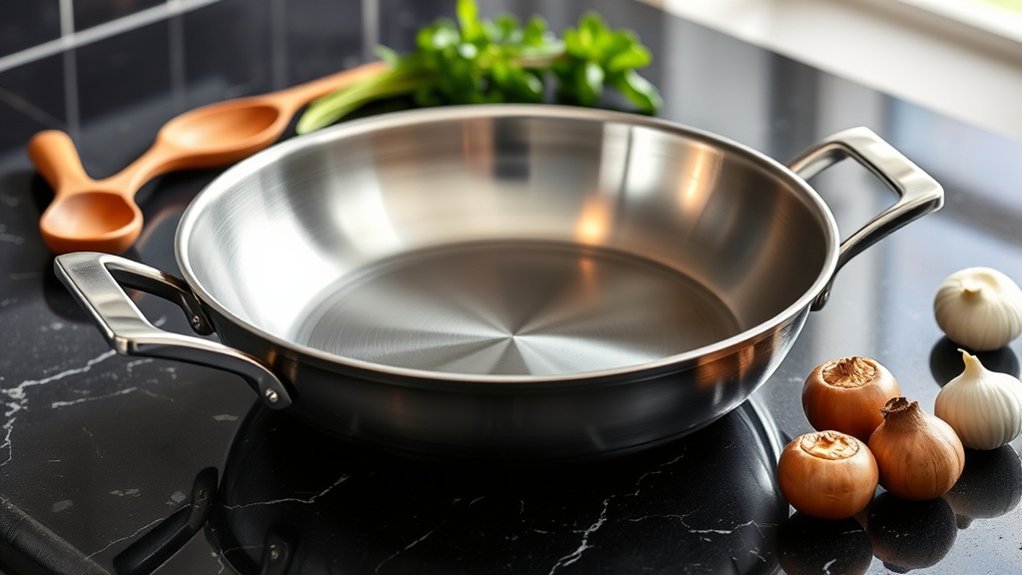
A sauteuse pan is a wide, moderately deep cooking vessel designed to handle jobs that fall between a skillet, sauté pan, saucepan, and Dutch oven. Many modern sauteuses have a broad cooking surface with curved or sloping sides, making them useful for browning, simmering sauces, risotto, shallow frying, braising, and one-pot meals. Exact shapes, handles, capacities, and materials vary by manufacturer, so the product specifications matter as much as the name.
Quick Answer
A sauteuse pan is a versatile, relatively deep pan with a broad base and usually curved or sloping sides. It can brown meat, reduce sauces, cook risotto, shallow-fry food, braise, and prepare one-pot meals. Because manufacturers use the name differently, compare the pan’s actual shape, material, handles, capacity, and oven rating before buying.
Key Takeaways
- A sauteuse commonly combines a wide cooking surface with enough depth for sauces, braises, and one-pan meals.
- Curved interior transitions make stirring, whisking, tossing, and scraping easier, but exact shapes vary by brand.
- Heat performance depends mainly on material and construction, not simply whether the walls are straight or sloped.
- Always check the specific pan’s cooktop compatibility and the oven limits of its body, lid, handles, knob, and coating.
What Is a Sauteuse Pan?
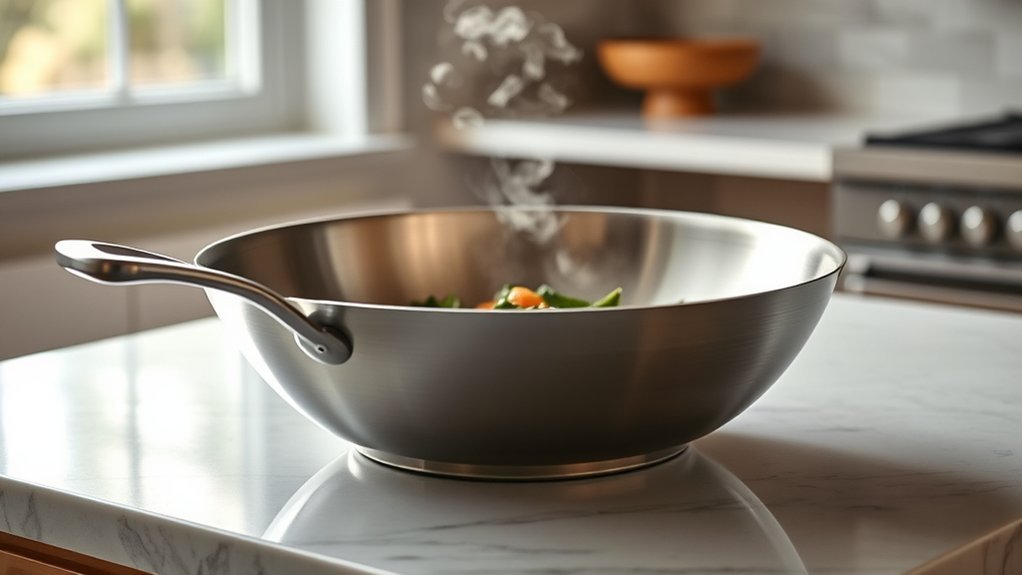
A sauteuse pan is a versatile cooking vessel that typically combines a broad base with curved or sloping sides and more depth than a standard frying pan. That shape makes it useful for tasks ranging from sautéing and searing to whisking sauces, cooking risotto, shallow frying, and finishing dishes in the oven.
The term is not completely standardized in English-language cookware. For example, Le Creuset describes its sauteuse as a cross between a deep sauté pan, fry pan, and Dutch oven, with a curved base and lower sides. Other manufacturers sell stainless-steel sauteuses with different capacities and handle arrangements.
Note: Do not rely on the word “sauteuse” alone when shopping. Check the actual diameter, cooking-surface size, wall height, handles, material, lid, weight, cooktop compatibility, and oven-temperature rating.
Some sauteuses use enameled cast iron and two loop handles. Others are made from clad stainless steel and may use a long handle, sometimes with a helper handle. Capacities also vary, so a sauteuse should be judged by its specifications rather than by one supposedly universal size or handle design.
A lid is especially useful when the pan is used for braising, covered simmering, casseroles, or dishes that need moisture retention. Without the lid, the same broad surface can encourage evaporation when reducing sauces.
Sauteuse Pan Shape, Size, and Handles
The most useful feature of many sauteuse pans is the transition between the bottom and sidewalls. Instead of a sharp corner, the interior is often curved or gently sloped. This allows a whisk, spoon, or spatula to sweep around the pan more easily.
That shape is particularly helpful for risotto, roux, gravy, pan sauces, polenta, and other foods that need frequent stirring. A broad base also creates enough contact area for browning meat or vegetables before liquid is added.
Handle design varies considerably:
- Two loop handles make a heavier cast-iron sauteuse easier to lift with both hands.
- A long handle improves leverage for lighter stainless-steel models.
- A helper handle can make a larger long-handled pan safer to lift when full.
- A fitted lid improves covered simmering and braising but may have a different oven-temperature limit than the pan itself.
Capacity is also model-specific. A 3- to 4-quart pan can be a practical everyday size for smaller households, while larger sauteuses provide more room for batch cooking. However, quart capacity alone does not tell the whole story. A broader pan provides more browning area than a narrower vessel of similar volume.
What Is a Sauteuse Pan Used For?
A sauteuse pan works best for recipes that need more depth than a skillet but more accessible stirring and browning space than a tall saucepan. Its strongest uses include sauces, risotto, one-pot meals, shallow frying, braising, casseroles, and stovetop-to-oven dishes.
Simmering Sauces
Curved interior sides are valuable when simmering or reducing sauces because a whisk or spoon can sweep the bottom without repeatedly catching in a sharp corner. A relatively broad surface also exposes more liquid to the air, which can speed reduction when the lid is off.
- Use gentle heat for delicate dairy, egg, or emulsified sauces.
- Leave the lid off when the goal is evaporation and concentration.
- Use the lid when you want to retain more moisture.
- Stir around the full bottom surface to reduce scorching.
This same geometry works well for gravy, béchamel, roux, risotto, polenta, and pan sauces.
One-Pot Meals
A sauteuse can move through several stages of a recipe without changing cookware. You can brown meat or vegetables first, cook aromatics, add rice, pasta, beans, stock, or sauce, and then simmer everything together.
Suitable dishes include:
- risotto and other rice dishes;
- one-pan pasta;
- chili and thick stews;
- braised chicken or vegetables;
- casseroles and baked pasta;
- curries and saucy skillet meals.
Oven-safe models can move directly from the burner to the oven, but only within the manufacturer’s temperature limits.
Pan-Frying Meats
A sauteuse with a sufficiently broad base can also brown or shallow-fry meat. For good browning, dry the surface of the food, preheat the pan according to its material, add an appropriate amount of fat, and avoid crowding.
Leaving space between pieces helps moisture escape rather than collecting as steam. Once a crust develops, the browned residue on the bottom can be deglazed with stock, water, wine, or another suitable liquid to form a pan sauce.
Warning: Browning does not prove that meat is safely cooked. According to the USDA, intact beef, pork, lamb, and veal steaks, chops, and roasts should reach at least 145°F (62.8°C) followed by a three-minute rest; ground meats should reach 160°F (71.1°C); and poultry should reach 165°F (73.9°C). Use a food thermometer.
Sauteuse Pan vs. Frying Pan
A sauteuse is generally deeper than a frying pan or skillet. A frying pan has lower, flared sides that make it easy to turn food, evaporate moisture quickly, and slide a spatula under ingredients. It is particularly convenient for eggs, pancakes, steaks, chops, fish, and quick vegetable cooking.
A sauteuse provides more vertical capacity, making it easier to add stock, sauce, grains, or other ingredients after browning. That makes it better suited to dishes that begin like a skillet recipe and finish like a braise, sauce, or one-pot meal.
A conventional sauté pan is another related shape. It normally has a broad flat base with relatively straight sides. Those walls preserve more usable bottom area for a given top diameter and contain liquids well. A sauteuse usually emphasizes a curved interior transition that makes whisking and stirring easier.
| Cookware | Typical shape | Best suited to |
| Sauteuse | Moderately deep with a broad base and often curved/sloping sides | Sauces, risotto, braises, one-pot meals, shallow frying |
| Frying pan/skillet | Shallow with flared sides | Fast browning, eggs, fish, steaks, pancakes, quick sautéing |
| Sauté pan | Wide flat bottom with straighter walls | Searing larger batches, shallow frying, sauces, dishes with liquid |
Sauteuse Pan vs. Saucepan
A saucepan is usually taller and narrower, with relatively straight walls and one long handle. That shape is efficient for boiling water, heating soup, cooking grains, preparing smaller quantities of sauce, and other liquid-heavy tasks.
A sauteuse is normally wider relative to its height. The larger exposed surface helps with browning and reduction, while a curved interior can make stirring easier.
Shape And Capacity
The important distinction is not simply which pan holds more. A saucepan concentrates volume vertically, while a sauteuse spreads more of that volume across a wider cooking surface.
As a result:
- A saucepan is convenient when you need depth for liquid.
- A sauteuse provides more accessible surface for browning and reduction.
- A curved sauteuse interior can be easier to whisk and scrape.
- A wider pan may require more burner and storage space even when capacity is similar.
When comparing two pans, look at both capacity and base diameter. The cooking-surface diameter often matters more than total quart capacity when searing meat or vegetables.
Cooking And Heat Retention
The shape of a sauteuse affects how easily you can stir and how much surface is available for evaporation, but it does not automatically give the pan better heat retention than a saucepan.
Heat retention and heat responsiveness depend mainly on material, thickness, mass, and construction. Enameled cast iron tends to hold heat well because of its mass. Clad stainless cookware can heat more evenly and respond faster when it contains conductive aluminum or copper layers.
For example, All-Clad’s D3 saucier uses an aluminum core between stainless-steel layers to improve heat distribution. The conductive core, rather than stainless steel alone, is responsible for much of that heating performance.
Sauteuse vs. Saucier, Braiser, and Dutch Oven
These cookware categories overlap, and brand terminology is not perfectly uniform. The proportions of the actual pan are therefore more useful than its name.
- Saucier: typically has a rounded bottom transition and sloping or contoured sides designed for whisking, stirring, and sauce work. In practice, some sauciers and sauteuses are very similar.
- Braiser: normally has a broad base, relatively shallow sides, two loop handles, and a fitted lid. Its large surface is particularly useful for searing food in one layer before adding liquid for a covered braise.
- Dutch oven: is generally deeper, making it better for larger soups, stews, bread, deep braises, and recipes needing more vertical capacity.
- Sauteuse: often sits between these forms, offering more depth than a skillet and easier stirring than a sharply cornered straight-sided pan.
Le Creuset describes a braiser as having a wide base and shallow sloped sides, while its sauteuse is deeper and more compact. That is a useful comparison, although dimensions differ among manufacturers.
What Can You Cook in a Sauteuse Pan?
A sauteuse is especially useful when a recipe combines two or more techniques. You can sear first, sauté aromatics next, add liquid, reduce, simmer, cover, or move an oven-safe model into the oven.
- Pan sauces: brown poultry, fish, meat, or vegetables, then deglaze and reduce.
- Risotto and polenta: curved interiors make constant stirring easier.
- One-pot pasta and rice: the pan provides both surface area and liquid capacity.
- Braises: brown food first, add a modest amount of liquid, cover, and cook gently.
- Shallow-fried foods: sufficient depth helps hold oil, although splatter can still occur.
- Soups and stews: practical for moderate batches where a full Dutch oven is unnecessary.
- Casseroles and baked dishes: suitable when the complete pan and lid are rated for the required oven temperature.
A sauteuse can also work as a serving vessel, particularly cast-iron models with two loop handles. Remember that handles and lids may remain dangerously hot long after the pan leaves the burner or oven.
How to Use a Sauteuse Pan
The correct method depends on the pan’s material. Clad stainless steel, enameled cast iron, and coated nonstick cookware should not automatically be heated in exactly the same way.
Preheat And Add Fat
For clad stainless steel, moderate preheating can improve browning and help proteins release after a crust forms. Manufacturer guidance from Le Creuset recommends preheating stainless cookware over medium heat, then adding fat once the pan is hot.
A few drops of water that gather into beads and glide over an appropriate stainless surface can indicate that the pan is hot enough for searing. Remove the test water completely before adding oil.
For enameled cast iron, heat the cookware gradually and follow its manufacturer’s care instructions. Le Creuset recommends low-to-medium heat for most cooking and warns against rapid overheating and excessive thermal shock.
For nonstick cookware, follow the specific manufacturer’s maximum heat and oven-temperature guidance. Avoid assuming that a technique intended for stainless steel is suitable for a coated pan.
Pro Tip: Match the burner to the base of the pan and use only as much heat as the cookware and recipe require. Excessive heat can burn oil and food, discolor stainless steel, damage some coatings, or stress enamel.
Cook In Single Layer
When browning meat or vegetables, arrange ingredients in a single layer with some space between pieces. Overcrowding traps moisture and encourages steaming instead of browning.
For the best result:
- Dry ingredients that need a strong sear.
- Cut similar ingredients to reasonably even sizes.
- Add only enough food to maintain contact with the hot base.
- Cook in batches if necessary.
- Allow proteins to develop a crust before repeatedly trying to move them.
The sauteuse’s curved or sloping sides make stirring and tossing easier once the initial browning stage is finished.
Finish, Deglaze, And Serve
After browning, reduce the heat if necessary and add aromatics or other ingredients. To deglaze, add an appropriate liquid and scrape the browned residue from the base with a suitable utensil.
- Add stock, water, wine, or another recipe-appropriate liquid.
- Scrape the flavorful browned residue into the liquid.
- Simmer uncovered when you want the sauce to reduce.
- Cover when the recipe calls for moisture retention or gentle braising.
- Move the pan to the oven only if every component is rated for the required temperature.
Use both handles when a filled pan is heavy enough to require them, and protect your hands with dry oven mitts or heat-resistant holders.
Cool and Clean the Pan Safely
Let hot cookware cool before washing it. Sudden temperature changes can damage some materials, particularly enamel, and can contribute to warping in other cookware.
For enameled cast iron, Le Creuset’s current care guidance advises allowing the product to cool and using warm soapy water with a non-abrasive sponge or brush. Stainless-steel and nonstick care varies by brand, so follow the instructions supplied with the pan.
How to Choose the Right Sauteuse Pan Size
Select a sauteuse pan size by considering what you cook rather than relying only on a serving-number claim.
A smaller 2- to 3.5-quart pan can be convenient for sauces, risotto, sides, and meals for one or two people. A 3.5- to 5-quart model offers more room for family meals and one-pot dishes. Larger pans can support batch cooking but become heavier and require more burner, oven, sink, and storage space.
Consider these factors:
- Cooking-surface diameter: more base area makes single-layer browning easier.
- Capacity: deeper or higher-volume pans accommodate soups, braises, and larger one-pot meals.
- Weight: cast iron becomes substantially heavier when full.
- Handles: two loop handles or a helper handle can improve control.
- Burner size: an oversized pan on a small burner may heat unevenly.
- Oven clearance: confirm that the pan and handles fit comfortably inside your oven.
The best sauteuse size is not simply the one with the highest quart capacity; it is the one whose cooking surface, depth, weight, and handles match the dishes you prepare most often.
Best Sauteuse Pan Materials and Oven Safety
The best material depends on whether you value heat retention, responsiveness, lighter weight, easy release, or low-maintenance cleanup.
- Enameled cast iron: holds heat well and works especially well for braising, steady simmering, casseroles, and stovetop-to-oven recipes. It is heavy and should be heated gradually.
- Clad stainless steel: durable and well suited to browning, deglazing, and sauce work. Quality clad cookware uses a conductive aluminum or copper layer to improve heating.
- Copper with a food-safe lining: highly responsive to heat changes but often more expensive and maintenance-intensive.
- Nonstick: convenient for foods prone to sticking and usually easy to clean, but maximum stovetop and oven temperatures depend on the coating and manufacturer.
Induction compatibility also depends on construction. Cast iron generally works on induction, while stainless cookware needs a magnetically compatible exterior or base. Copper and aluminum cookware require an induction-compatible layer unless an external interface system is used.
Never assume that “all metal” means unlimited oven use. Knobs, lids, coatings, detachable parts, and handle materials can impose a lower limit than the pan body. For example, Le Creuset lists different temperature limits for phenolic knobs, stainless-steel knobs, glass lids, and other components in its care documentation.
Warning: Use the lowest temperature limit specified for any component fitted to your pan. Handles, loop handles, lids, and knobs can become hot during stovetop or oven cooking even when they are marketed as stay-cool under some conditions.
Common Sauteuse Pan Mistakes
Most problems come from using too much heat or assuming every sauteuse behaves the same way.
- Overcrowding the base: too much food traps steam and weakens browning.
- Using maximum heat unnecessarily: this can scorch food and damage some cookware finishes.
- Using the same preheating method for every material: stainless steel, enameled cast iron, and nonstick cookware need different treatment.
- Ignoring the lid or knob temperature limit: the lid may have a lower oven rating than the pan body.
- Choosing by quarts alone: base diameter and usable browning area can matter more.
- Thermal shocking a hot pan: do not plunge very hot cookware into cold water.
- Using the wrong utensil: sharp or abrasive tools may damage enamel or nonstick coatings.
Do You Need a Sauteuse Pan?
A sauteuse is most useful for cooks who regularly make recipes that combine browning, stirring, simmering, reducing, and covered cooking. It can reduce the need to move food between a skillet and saucepan during a single recipe.
It may be a particularly good fit if you often cook risotto, pan sauces, braised chicken, one-pot pasta, curries, thick stews, casseroles, or meals that start on the stovetop and finish in the oven.
It is less essential if you already own cookware with similar dimensions. A wide saucier, shallow Dutch oven, braiser, or deep skillet may cover much of the same territory. Compare the cookware you already own before buying another overlapping piece.
The most useful sauteuse is therefore not defined by a particular material or handle style. It is a pan whose shape, capacity, cooking surface, construction, and heat compatibility fill a real gap in your kitchen.
Frequently Asked Questions
What Do You Use a Sauteuse Pan For?
A sauteuse pan can be used for sautéing, searing, simmering and reducing sauces, cooking risotto, shallow frying, braising, and preparing one-pot meals. Its broad base supports browning while its depth allows liquid to be added afterward.
What Are the Differences Between a Sauteuse Pan and a Braiser Pan?
A braiser is generally broad and relatively shallow, with a large cooking surface that makes single-layer searing easy before covered cooking. A sauteuse is often somewhat deeper and more compact, with a curved interior that works well for sauces, risotto, stirring, and one-pot meals. The categories overlap, so compare actual dimensions rather than relying only on the product name.
What Is the Difference Between a Saucier Pan and a Sauteuse Pan?
A saucier normally has a rounded bottom transition and sloping or contoured walls that make whisking and stirring easier. Many sauteuses use a very similar curved shape but may be wider, deeper, or equipped with different handles. Because manufacturers do not use these names identically, there can be substantial overlap between a saucier and a sauteuse.
What Do You Cook in a Sauté Pan?
A conventional straight-sided sauté pan is useful for browning chicken, steak, fish, and vegetables; shallow frying; reducing sauces; and cooking dishes that include both solids and liquid. Its broad flat base provides substantial usable searing area, while the higher sides contain more liquid than a frying pan.
Is a Sauteuse the Same as a Sauté Pan?
Not necessarily. A conventional sauté pan usually has a broad flat bottom and straighter vertical walls. A sauteuse commonly has a curved transition between the bottom and sides and may be deeper. Product terminology varies, however, so the dimensions and profile of the actual pan are more reliable than the label alone.
Can a Sauteuse Pan Go in the Oven?
Many sauteuse pans are oven-safe, but there is no universal temperature limit. Check the manufacturer’s instructions for the pan body, handles, lid, knob, and any nonstick coating. Use the lowest oven-temperature limit that applies to any component.
Sources
- Le Creuset — What Is a Sauteuse? — sauteuse shape, uses, capacity example, and comparison with other cookware.
- Le Creuset — Signature Stainless Steel Saucier Pan — rounded-bottom and sloping-side saucier design.
- All-Clad — D3 Stainless Saucier — curved saucier geometry and clad stainless-steel construction.
- Le Creuset — What Is a Braiser? — braiser proportions, sloped sides, broad base, and braising uses.
- Le Creuset — Care and Use — heat settings, cooling, handling, oven limits, and component-specific temperature guidance.
- USDA Food Safety and Inspection Service — Safe Minimum Internal Temperature Chart — minimum safe cooking temperatures for meat, poultry, fish, leftovers, and casseroles.
Conclusion
A sauteuse pan is useful because it combines a broad cooking surface with enough depth for techniques that a shallow skillet cannot handle as easily. It can brown meat, reduce sauces, cook risotto, shallow-fry, braise, and prepare complete one-pot meals. The name is used somewhat differently across cookware brands, so focus on the pan’s actual dimensions, material, handles, cooking surface, lid, cooktop compatibility, and oven rating. Choose those features well, and a sauteuse can become one of the most flexible pieces of cookware in the kitchen.