
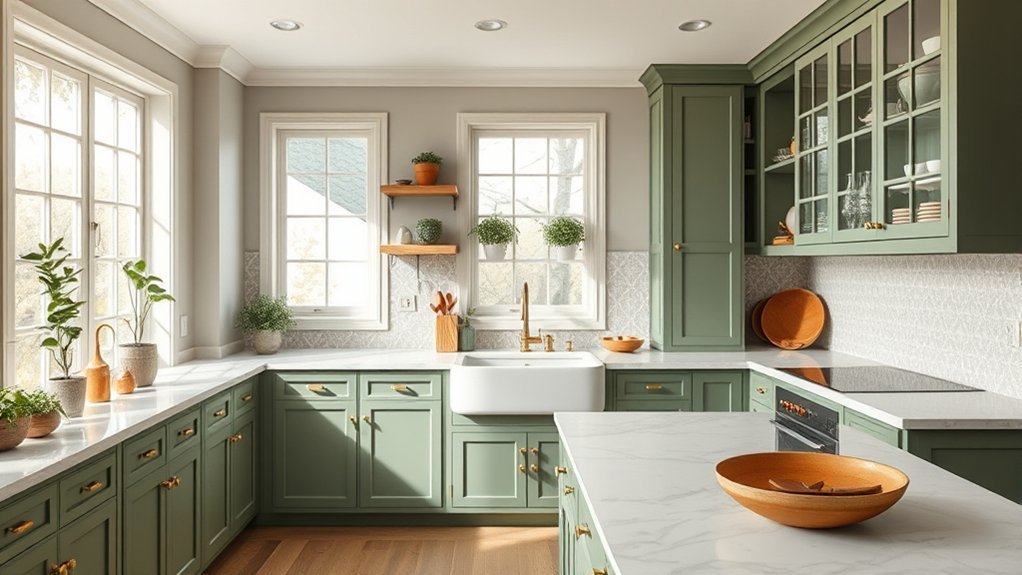
Green kitchen ideas can range from pale grey-greens that make a bright room feel softer to deep forest and sage tones that give cabinets strong architectural presence. The most successful schemes consider more than the paint color alone: daylight, undertone, cabinet finish, countertops, flooring, hardware, and the amount of green used all affect the finished room.
Quick Answer
For a balanced green kitchen, choose the shade according to the room’s light and existing materials, then test it in place before painting. Pale sage and grey-green work well for softer schemes, while forest and deep sage create more drama. Pair green with warm white, wood, stone, brass, black, or other restrained neutrals.
Key Takeaways
- Test green paint in the actual kitchen because daylight, bulbs, countertops, and flooring can change how the color reads.
- Use a washable kitchen wall paint on walls and a harder-wearing cabinet or trim coating on doors, drawer fronts, and woodwork.
- Light greens make an easy backdrop for white, cream, pale stone, and light wood; deeper greens work especially well with warm wood, brass, and high-contrast stone.
- Green remains relevant in 2026, but current manufacturer forecasts also emphasize khaki, brown, warm neutrals, natural wood, and other earthy tones.
- For a lower-risk update, use green on an island, lower cabinets, pantry, or feature wall rather than every surface.
Green Kitchen Paint Finishes
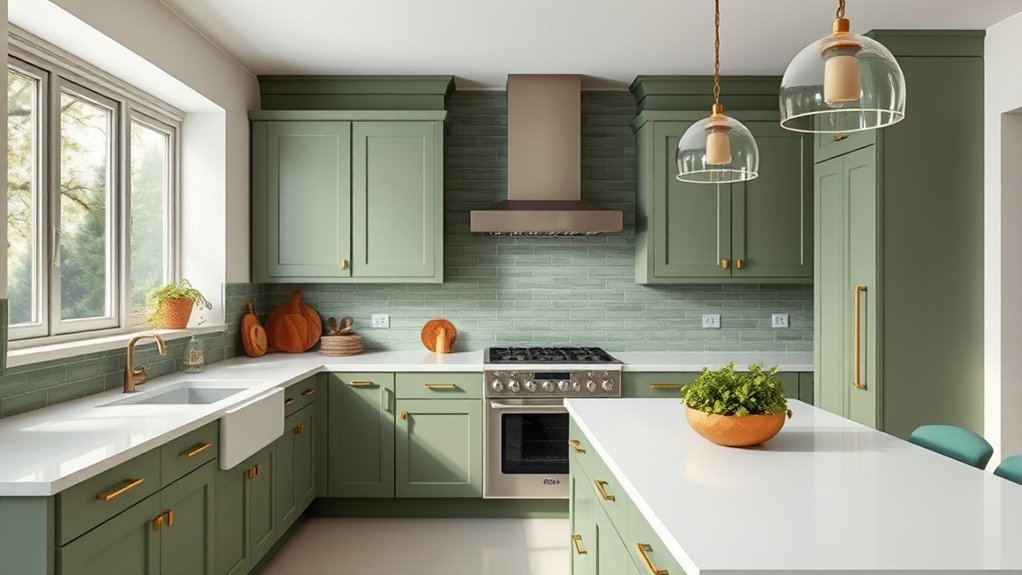
A well-chosen paint finish matters almost as much as the shade in a green kitchen. Kitchen walls face fingerprints, cooking residue, splashes, and humidity, so a washable finish is more practical than a fragile flat coating in hard-working areas.
For example, Farrow & Ball Modern Emulsion is designed for interior walls and ceilings and is described by the manufacturer as washable, wipeable, scuff-resistant, and protected against mould. Those qualities make that type of finish useful in moisture-prone kitchens.
Cabinets and trim need a different approach. Doors, drawer fronts, skirting boards, and other frequently touched surfaces benefit from coatings specifically designed for cabinetry, trim, or woodwork. Satin and semi-gloss finishes are popular because they combine a cleanable surface with enough sheen to highlight the cabinet shape without creating a mirror-like effect.
Sherwin-Williams’ cabinet-painting guidance recommends durable cabinet and trim enamels and identifies satin, semi-gloss, and gloss as suitable sheen options for kitchen cabinetry.
Note: A paint color and a paint finish are separate decisions. A shade you like may be available in several products, but the correct product depends on whether you are painting drywall, wood cabinets, MDF, metal, or another surface.
How to Choose Green Kitchen Colors
Start by deciding whether the kitchen needs more lightness, more contrast, or a stronger focal point. Then look at the green’s undertone. Some greens lean yellow or olive, some read grey and muted, and others contain noticeable blue.
- Warm greens tend to work naturally with cream, oak, walnut, brass, beige stone, and terracotta.
- Cool greens can feel crisp beside white, grey stone, nickel, black, and blue-based accents.
- Muted sage and grey-green sit between those extremes and are often easier to use across large areas.
Specific paint colors illustrate how wide the range can be. Benjamin Moore describes October Mist 1495 as a gently shaded sage. Farrow & Ball’s Cooking Apple Green is fresher and brighter in strong light, while Studio Green is so deep that it can appear almost black indoors unless the room is well lit.
The existing kitchen should guide the final choice. A green that looks balanced beside a warm oak floor may look much cooler next to blue-grey tile. Likewise, a bright white countertop will produce more contrast than cream, soapstone, or warm-veined quartz.
Choose Green for Your Kitchen’s Light
Natural light can change a green dramatically throughout the day. North-facing rooms often receive cooler, less direct light, which can emphasize grey or blue undertones. Strong southern or western light can make yellow-green and olive tones feel warmer and more saturated.
Dark greens need particular care. Farrow & Ball describes Studio Green as its darkest green and notes that it can appear almost black inside unless the room is very well lit. That can be a striking effect on an island or wall of cabinets, but it may feel heavy in a small kitchen with little daylight.
Test Green Paint Before Committing
Do not choose a kitchen color from a phone screen or a small chip alone. Paint a sample on a movable board or a generous test area and view it beside the actual countertop, backsplash, flooring, and cabinet hardware.
Check the sample in morning light, afternoon light, and after dark with the kitchen lights on. Benjamin Moore’s paint-sample guidance specifically recommends testing color in different light and spaces before committing.
Pro Tip: Move the same painted sample around the kitchen for several days. A green that works beside a window may look very different on cabinets under an overhang or across the room from warm wood flooring.
Light Green Kitchen Ideas
Light green kitchens can feel fresh without becoming stark. Pale sage, softened apple green, and grey-green work particularly well when you want color but still want cabinetry and walls to reflect plenty of light.
Farrow & Ball’s Cooking Apple Green can appear brighter in good light, while Green Ground is a lighter version of Cooking Apple Green. Old White is more nuanced: Farrow & Ball classifies it as a historic grey-green that may read greener in some cooler rooms and greyer in stronger light.
Airy Light Green Shades
Cooking Apple Green, Green Ground, pale sage, and similar muted greens work well on cabinet doors, walls, a pantry, or an island when the goal is an easygoing rather than highly dramatic kitchen.
- Pale yellow-greens feel warmer beside cream and natural oak.
- Grey-greens create a quieter backdrop for marble, quartz, stainless steel, and painted white trim.
- Blue-green shades bring a cooler, cleaner contrast to warm wood and brass.
In a compact kitchen, a lighter green on upper cabinets can reduce the visual weight of a full-height cabinet wall. Another option is to keep the uppers white or warm neutral and use green below the counter.
Pair With Whites
White and green are an easy combination, but the undertones still need to agree. A stark blue-white can make a yellow-based green look more olive, while a warm off-white creates a softer transition.
Soft white cabinetry with light green walls is useful when you want the architecture to stay bright. Green cabinets with white or cream walls place more attention on the millwork instead.
Natural wood helps prevent a pale green-and-white scheme from feeling too cool. Oak stools, wood flooring, butcher block, woven shades, and open shelving can add warmth without introducing another strong color.
Soft, Calm Finishes
Muted green works especially well with low- to mid-sheen surfaces. On walls, a durable matte or eggshell-like finish keeps glare down. On cabinets, satin offers a softer furniture-like appearance while remaining easier to clean than a flat wall paint.
Cromarty, subdued sage, grey-green, and related tones suit kitchens where the goal is a restrained backdrop rather than a strong statement. Pair them with simple hardware and repeat one or two materials, such as oak and warm white quartz, to keep the design cohesive.
Dark Green Kitchen Ideas
Dark green kitchen ideas work best when the color has enough surrounding contrast. Deep cabinetry can look rich and architectural beside pale countertops, warm wood, unlacquered brass, or light tile.
Calke Green is described by Farrow & Ball as a rich traditional sage, while Studio Green sits much darker. The two create very different effects even though both belong to the green family.
A dark green kitchen succeeds through contrast: the deeper the cabinetry, the more important the room’s light, countertop, backsplash, and flooring become.
White countertops create a crisp contrast. Cream or beige stone softens the jump between dark cabinets and the work surface. Wood brings additional warmth, while black hardware produces a more graphic result.
If an all-dark kitchen feels risky, use the deepest green only on the island, lower cabinets, pantry, or one cabinet wall. That keeps the focal color while preserving more visual lightness elsewhere.
Best Green Kitchen Cabinet Colors
There is no single best green for every kitchen. The strongest choice depends on the room’s light, size, countertop, flooring, and desired level of contrast.
- Sage and grey-green: versatile choices for calm kitchens and mixed natural materials.
- Olive and yellow-green: especially comfortable with cream, oak, walnut, beige stone, and aged brass.
- Forest and deep green: strong choices for islands, lower cabinets, large kitchens, and rooms with good daylight.
- Fresh apple and pale green: useful when the room needs more color without the weight of a dark cabinet wall.
Benjamin Moore October Mist, Guilford Green, and Peale Green illustrate different positions within the muted-to-deep spectrum. Farrow & Ball Cooking Apple Green, Green Ground, Calke Green, and Studio Green provide another range from light and fresh to extremely dark.
Custom cabinetry can make almost any green look intentional when the undertone is repeated elsewhere. For example, a warm sage can connect with oak flooring, while a blue-green cabinet can echo veining in stone or a glazed backsplash.
Green Kitchen Trends in 2026
Green remains part of the 2026 design conversation, but current color forecasts are more varied than a simple “green is the color of the year” message suggests.
Behr’s 2026 Color of the Year, Hidden Gem, is a smoky jade that blends blue and green. By contrast, Sherwin-Williams selected Universal Khaki, a warm mid-tone neutral, while Benjamin Moore selected Silhouette AF-655, a burnt-umber and charcoal-influenced brown.
For cabinetry specifically, Sherwin-Williams’ trend guidance includes green options such as Oyster Bay, Evergreen Fog, Green Sprout, and Olive Grove alongside warm neutrals, browns, natural wood, texture, and other finishes.
The useful takeaway is not that every 2026 kitchen should be green. Instead, green fits the broader preference for earthy color, natural materials, personalization, mixed finishes, and warmer schemes.
Countertops, Backsplashes, and Floors for Green Kitchens
Countertops for Green Cabinets
Pale quartz, marble-look surfaces, and light natural stone create strong separation from dark green cabinets. Warm cream, beige, or softly veined stone produces a lower-contrast look that works particularly well with sage and olive.
Dark soapstone-style or black countertops can also work, but the combination becomes visually heavier. Use that pairing where the kitchen has good natural light or where pale walls and backsplash tile can balance the darker surfaces.
Backsplash Ideas for Green Kitchens
White tile is the simplest partner for green cabinetry, but warm off-white, handmade-look cream, pale stone, and restrained patterned tile can add more character.
If the green cabinets are already bold, keep the backsplash quieter. If the cabinetry is a muted sage, a backsplash with texture or subtle color variation can supply the visual interest.
Flooring for Green Kitchens
Natural oak is one of the easiest materials to combine with green because its warmth offsets both grey-green and cooler forest tones. Walnut creates a richer, darker effect. Light stone or neutral tile can keep a saturated cabinet color from making the room feel too heavy.
Try to evaluate the flooring, countertop, cabinet sample, and backsplash together rather than choosing each material separately.
Green Kitchen Materials and Hardware
Green kitchens can incorporate solid wood, plywood, MDF, reclaimed wood, recycled-content surfaces, glass, stone, quartz, tile, and a wide range of painted finishes. Material choice should be based on durability, moisture exposure, maintenance, budget, appearance, and how the product is manufactured rather than color alone.
Low-VOC paint can be one consideration when comparing products. However, the U.S. Environmental Protection Agency notes that “low-VOC” or “zero-VOC” labels do not by themselves guarantee that a product is safer, because different volatile chemicals have different properties and toxicity.
Regardless of the coating selected, follow the manufacturer’s safety directions and provide good ventilation while painting.
Cabinet Materials And Finishes
Solid wood, plywood, and MDF can all be used successfully in kitchen cabinetry, but they behave differently. Wood shows natural grain and may move slightly with changes in humidity. Plywood is widely used for cabinet boxes because of its layered construction. MDF provides an exceptionally smooth painted surface but needs proper edge sealing and protection from prolonged moisture.
- Matte-looking finishes create a softer visual effect but should still come from a coating rated for cabinetry if used on doors.
- Satin finishes balance cleanability with a moderate sheen.
- Semi-gloss finishes reflect more light and are easy to wipe, although they can reveal surface imperfections more readily.
Prepare Cabinets Before Painting
Good preparation is essential when changing existing cabinets to green. Remove hardware, clean grease and residue thoroughly, repair defects, dull or sand glossy surfaces when required, and use a compatible primer before applying the selected cabinet coating.
Sherwin-Williams’ cabinet-painting guidance emphasizes cleaning, surface preparation, primer where required, and adequate drying time between coats. Skipping those steps can undermine even a high-quality topcoat.
Hardware, Fixtures, And Accents
Hardware can change how the same green reads. Warm metals make most greens feel richer, while black and cool metals create crisper contrast.
- Brass: warm and particularly effective with sage, olive, forest green, cream, and wood.
- Matte black: graphic and modern, especially against pale or mid-tone green.
- Nickel or stainless finishes: cooler and useful in kitchens with stainless appliances or grey stone.
- Bronze: softer than pure black and well suited to traditional or earthy schemes.
Soft-close hinges and quality drawer slides improve function without changing the visible design. Decorative pulls, knobs, lighting, and faucets can then supply the stronger stylistic accent.
Green Kitchen Ideas for Small Spaces
A small kitchen does not have to avoid green. The amount and depth of the color matter more than room size alone.
For a lighter result, use pale green on all cabinets, pair green lowers with warm white uppers, or keep the cabinetry neutral and use green on walls or a backsplash. If you prefer dark green, concentrate it on the island, base cabinets, or one feature wall rather than every vertical surface.
Consistent flooring, a simple backsplash, and fewer competing colors can make a compact kitchen feel calmer even when the cabinets are saturated.
Two-Tone Green Kitchen Ideas
Two-tone cabinetry is useful when you want green without committing the entire kitchen to one strong color. Common approaches include green lower cabinets with warm white uppers, a green island with neutral perimeter cabinetry, or pale green cabinets with a darker pantry wall.
Sherwin-Williams’ recent cabinetry trend reporting also highlights growing use of two-tone combinations to create contrast and emphasize focal areas.
The key is repetition. If the island is green, echo a small amount of that color or undertone in artwork, tile, upholstery, or adjacent decor so it does not look isolated.
Green Kitchen Decor Ideas
Green cabinetry already provides strong color, so decor does not need to compete with it. Use a few repeated textures and materials to make the room feel complete.
- Soft white or cream walls keep muted green cabinets bright.
- Wood cutting boards, stools, shelving, or flooring add warmth.
- Green marble or patterned tile can reinforce the palette when cabinetry is more restrained.
- Artwork can introduce rust, ochre, blue, pink, or burgundy without changing the permanent finishes.
- Woven baskets and ceramic vessels add texture without requiring another dominant color.
For a bolder kitchen, glossy green on an island or a bright green pantry alcove can provide a clear focal point. In a calmer scheme, repeat several nearby greens in plants, textiles, or small accessories instead.
Colors That Go With Green Kitchens
Warm white is one of the most flexible partners because it creates contrast without feeling as sharp as pure white. Beige and cream soften sage and olive. Natural wood adds warmth and texture, while black gives pale green more definition.
For additional color, muted blush, terracotta, dusty blue, ochre, and burgundy can work well when their undertones relate to the green and surrounding materials.
A simple rule is to choose one dominant green, one quiet neutral, and one material or accent color. Add more colors only when they repeat something already present in the stone, flooring, tile, or adjoining room.
Sources
- Farrow & Ball — Modern Emulsion — wall and ceiling finish, washability, scuff resistance, and mould protection.
- Farrow & Ball — Studio Green — description of the brand’s darkest green and how it responds to indoor light.
- Benjamin Moore — Color Trends 2026 — current 2026 palette and Silhouette AF-655.
- Sherwin-Williams — How to Paint Kitchen Cabinets — cabinet preparation, coating, sheen, and drying guidance.
- Magnolia — Jo’s Inspiring Butler’s Pantry — Cottage Grove Green and Joanna Gaines’s primary kitchen cabinet color reference.
- U.S. EPA — VOCs in Household Products — context and limitations of low-VOC and zero-VOC labeling.
Frequently Asked Questions
What Color of Green Is Best for Kitchen Cabinets?
There is no single best green for every kitchen, but muted sage and grey-green are flexible starting points because they work with many whites, woods, stones, and metal finishes. Choose a warmer olive for cream and warm wood, or a cooler blue-green for crisp white, grey stone, and cooler metals. Always test the color in the room first.
What Are the Trendy Colors for Kitchen Cabinets in 2026?
Green is still relevant in 2026, especially smoky jade, sage, olive, and other nature-inspired tones, but it is only part of the picture. Current manufacturer forecasts also emphasize khaki, brown, warm neutrals, natural wood, and layered earthy colors. Behr selected smoky jade Hidden Gem for 2026, while Sherwin-Williams chose Universal Khaki and Benjamin Moore chose the brown-charcoal Silhouette AF-655.
What Two Colors Look Good With Green?
Warm white and beige are two easy colors to combine with green. White adds contrast and brightness, while beige softens the palette and connects naturally with wood, stone, and brass. For a cooler scheme, green can also pair well with crisp white and restrained blue-grey.
What Color Green Did Joanna Gaines Paint Her Kitchen Cabinets?
Magnolia identifies Cottage Grove Green as the color used on Joanna Gaines’s primary kitchen cabinets. Her other kitchen projects use different greens; for example, recent Colorado Mountain House cottage kitchens include Wellington Green and Mosswood. The correct answer therefore depends on which Joanna Gaines kitchen you mean, but Briarwood is not the documented color for her primary kitchen cabinets.
Should Green Kitchen Cabinets Be Satin or Semi-Gloss?
Both can work. Satin has a softer sheen and tends to give cabinets a furniture-like appearance, while semi-gloss reflects more light and is easy to wipe clean. Whichever sheen you choose, use a coating formulated for cabinets, trim, or other hard-wearing woodwork rather than ordinary wall paint.
Do Green Cabinets Make a Small Kitchen Look Dark?
Not necessarily. Pale sage and grey-green can work well in small kitchens, and even dark green can be successful when it is limited to lower cabinets or an island and balanced with light walls, counters, and backsplash materials. Natural light and the amount of dark color matter more than room size alone.
Conclusion
Green kitchens can be light and subtle, dark and architectural, or somewhere between the two. The best result comes from choosing the shade in context: test it with the room’s light, countertop, backsplash, flooring, and hardware, then use a finish designed for the surface being painted. Pale sage and grey-green remain flexible choices, while olive, forest, and deep sage provide stronger contrast. With those decisions made carefully, green can feel distinctive without making the kitchen difficult to coordinate or maintain.

4 thoughts on “Green Kitchen Ideas: Colors, Cabinets & Design Inspiration”