
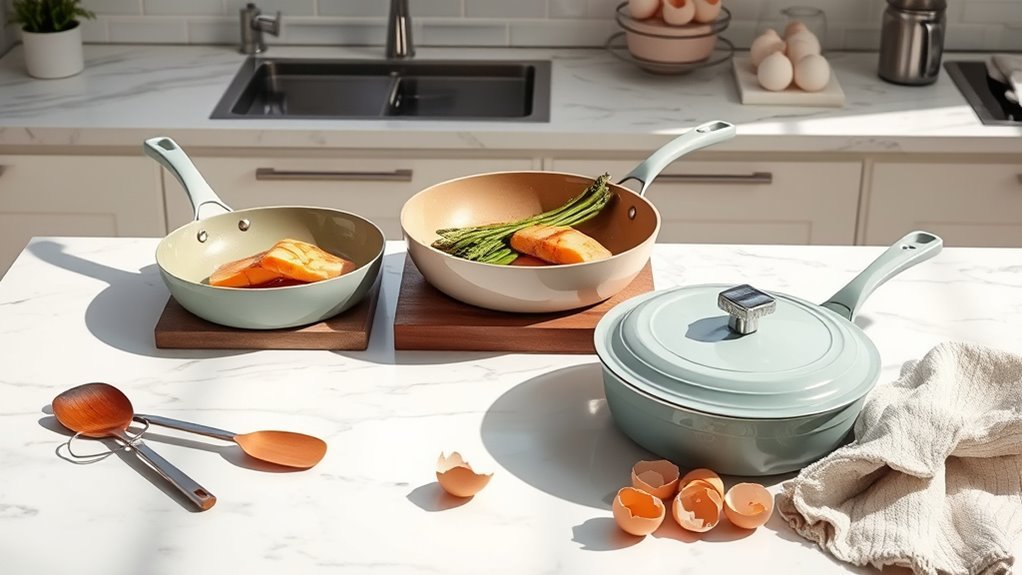
Are Caraway pans worth it if you want PFAS-free ceramic nonstick cookware? Their colorful design and easy-clean surface are appealing, but price and coating life deserve a closer look. Here is what the materials, independent testing, cooking results, and care requirements actually mean for your kitchen.
Quick Answer
Caraway pans are worth considering if you value PFAS-free ceramic coating, attractive storage, and everyday low-to-medium-heat cooking. The 12-piece set contains four cooking vessels, three lids, and five organizers, not 12 pans. Its main drawbacks are a premium price, hand-washing, and a nonstick surface that may lose its slickness with use.
Last checked: November 14, 2026. Dates and figures were verified against official sources.
Key Takeaways
- Caraway’s coating is applied to an aluminum body with stainless steel handles and an induction-compatible base. It is not solid ceramic cookware.
- Published laboratory results show tested PFAS were not detected at the laboratory’s reporting limits. That is not a promise of zero exposure to every substance.
- The cookware is oven-safe up to 550°F, but the manufacturer recommends low to medium heat on the stovetop.
- Caraway’s one-year limited US warranty excludes normal wear and various forms of coating deterioration. A high set price does not ensure lasting nonstick performance.
Quick Verdict: Are Caraway Pans Worth It?
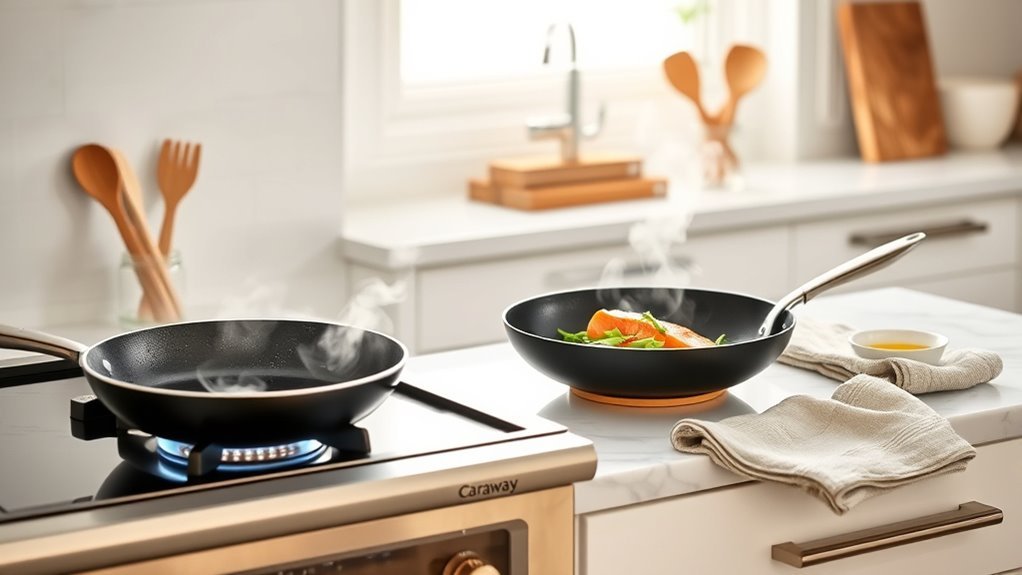
Caraway pans make sense for careful home cooks who want a coordinated ceramic nonstick set. They are less compelling if you routinely sear over very high heat or expect one nonstick coating to last for decades.
The official 12-piece ceramic cookware set has a $675 list price. Caraway advertised a holiday promotional price of $356 when checked, but discounts and checkout prices can change.
You receive a 10.5-inch fry pan, a 3-quart saucepan, a 4.5-quart sauté pan, a 6.5-quart Dutch oven, three lids, four magnetic pan organizers, and a canvas lid holder. Those storage pieces account for five of the 12 items.
The set’s strongest selling points are its coordinated storage, modern appearance, and comfortable everyday cooking, not a promise of permanent nonstick performance.
It is a reasonable premium choice for eggs, vegetables, sauces, soups, and one-pan dinners. If you already own durable pots, buying a single ceramic fry pan may be the more economical way to try the cooking surface.
Caraway’s Claims vs. What’s Inside
Caraway’s ceramic cookware is metal cookware with a mineral-based nonstick coating. The body is aluminum, while the handles and induction-compatible base plate are stainless steel. The aluminum spreads heat; the coating makes food easier to release.
Caraway markets its ceramic surface as made without PTFE, PFOA, PFAS, lead, and cadmium. Unlike a raw cast-iron pan, however, this is still coated cookware, and its release performance depends on the condition of that layer.
The precise proprietary coating formula is not fully itemized for shoppers. That limits your ability to examine every ingredient independently, although published testing offers more useful evidence than marketing wording alone.
Also distinguish this ceramic line from Caraway’s stainless steel and enameled cast-iron products. Their cooking surfaces, upkeep, and durability are different, so the same advice does not apply to every pan carrying the Caraway name.
Health & Safety: PFAS, Coatings, and Certifications Explained
Caraway provides meaningful evidence for its PFAS-free claims, but PFAS-free does not mean risk-free. The clearest way to assess the cookware is to separate chemical testing, regulatory standards, and comparative health claims.
PFAS and Health Risks
PFAS are a large group of chemicals used in many products. The US Environmental Protection Agency’s health overview links exposure to certain PFAS, at certain levels, with possible immune, hormonal, reproductive, and cancer-related effects.
That does not establish that every PFAS has the same risks or that ordinary use of PTFE-coated cookware causes those illnesses. The FDA’s guidance on PFAS in food contact materials says approved polymerized nonstick coatings show negligible migration of PFAS into food under their intended use.
If avoiding PFAS-containing nonstick finishes is your personal preference, Caraway offers that choice. It is not accurate to describe all traditional nonstick pans as automatically dangerous.
Ceramic Coating Composition
Caraway describes its coating as mineral-based and made without PTFE or PFOA. Its published Light Labs report for ceramic cookware lists PTFE and PFOA as not detected in tests dated January 26, 2026, with broader PFAS and heavy-metal screening also reported.
Caraway says its testing covers more than 600 PFAS and over 20 heavy metals. A laboratory result of not detected means the tested substance was below the method’s reporting limit, not necessarily absent at every possible concentration.
| Feature | Claim | Practical impact |
|---|---|---|
| Composition | Mineral-based coating on aluminum | A coated nonstick surface, not solid ceramic |
| Testing | Published PFAS and metal screening | Results can be checked against detection limits |
| Nonstick | Made without PTFE and PFOA | Easy initial food release; coating care still matters |
Third-Party Certifications Explained
Caraway refers to SGS testing, California Proposition 65, and FDA food-contact standards. These are not interchangeable with a blanket government guarantee that a finished pan can never present a risk.
In August 2025, the National Advertising Division of BBB National Programs found support for Caraway’s PFAS-free and non-toxic claims. It also recommended changing certain comparisons that implied conventional nonstick cookware was harmful and Caraway was proven safer.
The important distinction is that independent testing supports specific material claims. It does not establish that Caraway performs better, lasts longer, or produces better health outcomes than every other cookware option.
Note: A cookware test report cannot assess your personal chemical exposure or health. If you have a specific exposure-related health concern, discuss it with a qualified healthcare professional.
Performance: Heat, Nonstick Results, and Handle Design
Caraway’s aluminum body helps distribute heat and makes the pans responsive to burner adjustments. Their ceramic finish can release delicate foods well, but results vary by technique and how long you have used the pan.
Heat Distribution Evenness
These pans work well for controlled sautéing, simmering, and gently frying food. They are compatible with gas, electric, and induction cooktops, but low to medium heat remains the recommended stovetop setting.
A well-matched burner and a little preheating help food cook evenly. The pan can still develop hotter areas, so even heating should not be taken to mean perfect temperature uniformity at every point.
| Feature | Effect |
|---|---|
| Aluminum body | Spreads and responds to heat |
| Ceramic surface | Can release delicate food with modest oil |
| Low-to-medium heat | Helps protect the coating |
| Stainless steel handles | Secure grip, but can become hot |
| Hand-washing | Reduces wear from harsh cleaning |
Nonstick Performance Longevity
New Caraway pans can be very slick, especially for eggs and other delicate foods. Over time, though, ceramic nonstick surfaces often lose some of that easy-release feel, even without obvious scratches.
In Good Housekeeping’s cookware testing, heat distribution was mostly even, but eggs began sticking during repeated ungreased cooking. Other testers have reported easier releases, so there is no guarantee that every dish will slide out without oil.
Overheating, metal utensils, abrasive cleaning, and baked-on oil can hasten a decline in performance. If a pan becomes less slick, clean away residue gently before deciding that the coating itself has worn out.
Handle Comfort and Safety
Caraway’s stainless steel handles have a shaped grip and a small bump underneath. The bump is a guide to where you should stop holding the handle, not a heat indicator that changes when the pan gets hot.
Handle ends may stay relatively cool during short stovetop sessions, but lids and metal grips can still become hot. Always use an oven mitt or pot holder when moving a hot pan or lifting its lid, especially after oven use.
Everyday Use: Recipes, Heat Settings, and Utensil Tips
Caraway pans are a good fit for eggs, pancakes, vegetables, rice dishes, and sauces. The saucepan handles grains and gentle simmering, while the sauté pan and Dutch oven offer room for saucy meals and oven-finished recipes.
For easy weeknight cooking, use a modest amount of oil, a gentle burner setting, and utensils that will not scrape the ceramic finish.
You can also prepare baked pasta, enchiladas, or a casserole in the appropriate oven-safe vessel. Caraway rates its ceramic cookware for oven use up to 550°F, but that does not make high-heat stovetop searing a good everyday practice.
A little oil or butter helps prevent sticking and improve browning. Avoid aerosol cooking sprays, which can leave stubborn deposits, and choose silicone, wood, or other non-scratching utensils instead of metal.
For recipes that rely on a deeply browned crust and flavorful stuck-on bits, such as a hard-seared steak with pan sauce, stainless steel or cast iron may work better. Caraway’s pieces are manageable to move but are not necessarily lighter than every competing nonstick pan.
Care & Storage: Hand-Wash Rules, Racks, and Longevity
Caraway’s official ceramic cookware care guide recommends gentle heat, nonmetal utensils, and washing by hand. These habits cannot stop all aging, but they reduce avoidable coating damage.
- Before cooking: Preheat over low to medium heat for no more than about 90 seconds, then add a little oil or butter.
- While cooking: Use silicone or wooden utensils, avoid aerosol sprays, and adjust heat gently.
- After cooking: Let the cookware cool fully before washing with mild dish soap and a soft sponge.
- Before storing: Dry the pieces and keep coated surfaces from rubbing against other cookware.
Warning: Do not rinse a hot pan with cold water or leave an empty pan over high heat. Sudden temperature changes and overheating can damage the cookware and its coating.
The included magnetic organizers hold pans upright and apart; the canvas holder keeps lids accessible. If you store pieces stacked, put a soft protective layer between them to reduce scratches.
Caraway’s one-year limited US warranty covers qualifying defects in materials and workmanship. It excludes normal wear, cosmetic damage, and specified coating deterioration, including damage caused by overheating or improper cleaning.
That distinction matters when judging long-term value: a pan may remain usable after its nonstick release has declined, but the warranty does not promise years of like-new slickness.
Caraway vs. Alternatives: Cast Iron, GreenPan, and Price Tradeoffs
The best alternative depends on whether you care most about easy release, heat tolerance, low cost, or long service life. None of these choices wins in every category.
| Option | Best reason to choose it | Main tradeoff |
|---|---|---|
| Caraway ceramic | Coordinated design, storage, PFAS-free coating | Premium price and delicate nonstick surface |
| GreenPan ceramic | PFAS-free choices across different lines and budgets | Also needs careful treatment to protect nonstick performance |
| Bare cast iron | High-heat searing and long-lasting uncoated metal | Heavier; seasoning and drying matter |
| HexClad hybrid | Metal-utensil-tolerant hybrid surface | Different texture and cleaning needs; still coated |
| Gotham Steel or budget ceramic | Lower upfront-cost options | Performance and coating life vary by model |
GreenPan’s Thermolon information confirms its ceramic nonstick lines are also made without PFAS. It may be a better value if you find a suitable pan or set on sale, though neither ceramic brand promises permanent nonstick release.
Cast iron is especially appealing if you want a pan that can withstand high heat and be maintained for decades. It is not maintenance-free: unenameled cast iron needs seasoning, thorough drying, and care against rust.
HexClad offers a different approach: a raised stainless-steel hybrid cooking surface with a ceramic nonstick component. Unlike Caraway, it permits ordinary metal utensils, but sharp tools can still scratch it. Compare the actual cookware pieces and total prices rather than treating every 12-piece set as equivalent.
Frequently Asked Questions
Why Is Caraway Cookware Being Sued?
Groupe SEB USA and Meyer Corporation filed a federal advertising lawsuit against Caraway on February 13, 2026, challenging claims about competing nonstick cookware. This is a lawsuit brought by rival manufacturers, not the consumer class action described in some summaries. Allegations are not proof that Caraway pans are unsafe. The public case docket identifies the parties and filing.
What’s Better, HexClad or Caraway?
Choose HexClad if you want a hybrid stainless cooking surface that tolerates regular metal utensils; choose Caraway for a smoother ceramic finish and coordinated storage. HexClad’s current TerraBond ceramic nonstick is also described by its manufacturer as PFAS-free, so PFAS avoidance alone is no longer a clear difference. Both benefit from sensible heat control.
How Long Will Caraway Pans Last?
Caraway pans can remain usable for years, but there is no verified guarantee that their original nonstick performance will last three to five years. Some independent tests report noticeable sticking much sooner. Gentle heat, soft utensils, hand-washing, and protected storage help, but normal coating wear is different from a covered manufacturing defect.
Which Is Better, GreenPan or Caraway?
GreenPan is worth comparing if you want PFAS-free ceramic nonstick cookware across more price points. Caraway may suit you better if color coordination and the included storage system matter most. Neither brand is automatically more durable in every model, so compare the exact collection, coating care instructions, price, and warranty.
Can Caraway Pans Go in the Oven and Work on Induction?
Yes. The ceramic cookware line works on induction, gas, and electric cooktops, and Caraway rates it for oven temperatures up to 550°F. Use oven mitts when handling hot pans and lids. The higher oven rating does not change the manufacturer’s recommendation to use low to medium heat on the stovetop.
Conclusion
Caraway pans are worth the premium if you prioritize a PFAS-free ceramic surface, matching cookware, and tidy storage, and you are comfortable with gentle care. If high-heat cooking or decades of service matter more, choose cast iron or stainless steel instead. Before buying a set, compare its actual cooking pieces, promotional price, and warranty exclusions with what you already own.
Sources
- Caraway, Ceramic Cookware Set: set contents, pricing, oven rating, and cooktop compatibility.
- US EPA, PFAS Health Risks: health evidence for exposure to certain PFAS.
- US FDA, PFAS in Food: migration from approved polymerized nonstick coatings.
- Light Labs, Caraway Ceramic Cookware Testing: PFAS and heavy-metal laboratory results.
- BBB National Programs, Caraway Advertising Review: determination on supported and comparative claims.
- Good Housekeeping, Caraway Cookware Review: independent heat and nonstick testing.
- Caraway, Care & Cleaning: recommended cooking, cleaning, and handling.
- Caraway, Limited Warranty: coverage period and exclusions.
- GreenPan, Cookware FAQs: Thermolon ceramic coating and PFAS claims.
- US District Court Case Docket via Justia: lawsuit parties and filing date.
- HexClad, Frequently Asked Questions: hybrid coating and utensil guidance.
