
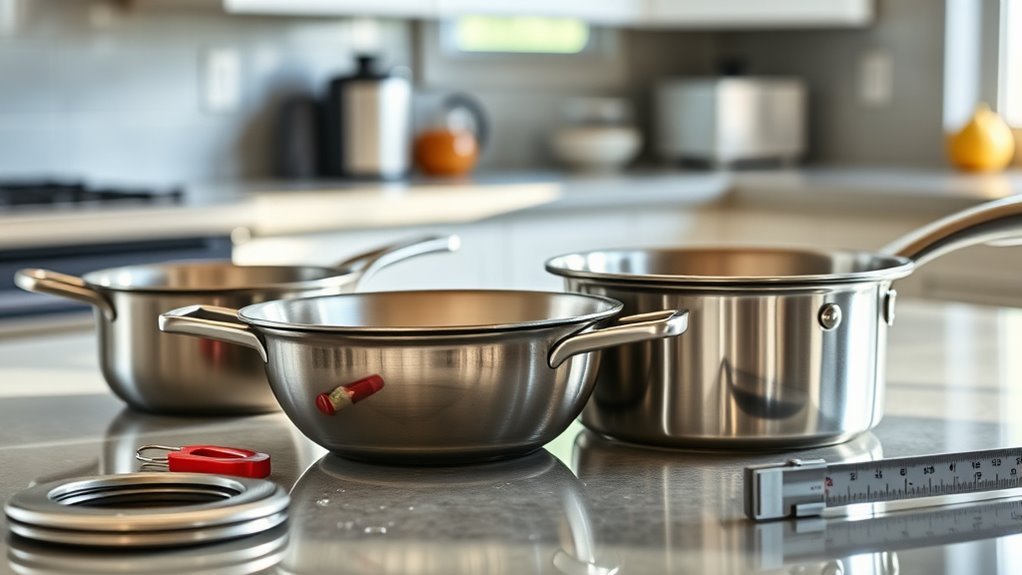
Choosing the right stainless steel cookware starts with understanding what makes a pan cook evenly, last longer, and feel comfortable in your hands. Steel grade matters, but construction, thickness, handles, and stovetop compatibility often matter more. This guide explains what to look for before buying individual pots, pans, or a complete cookware set.
Quick Answer
For most home kitchens, choose stainless steel cookware with a 304-grade cooking surface, fully clad tri-ply construction, sturdy handles, and a flat base. Look for an aluminum or copper core that spreads heat evenly. Confirm induction compatibility, oven-temperature limits, lid quality, and cleaning instructions before deciding between individual pieces and a complete set.
Key Takeaways
- 18/8 and 18/10 usually belong to the same 304 stainless steel family. The label alone does not determine cookware quality.
- Five-ply cookware is not automatically better than three-ply. Core thickness and overall construction matter more.
- Induction cookware needs a magnetic base. A magnet provides a simple first compatibility check.
- Glass lids, coated handles, and other components may have lower oven-temperature limits than the pan itself.
- Hand washing and drying help preserve the finish. Avoid thermal shock, prolonged overheating, and salt sitting on the cooking surface.
Choosing the Right Stainless Steel Cookware for Your Needs
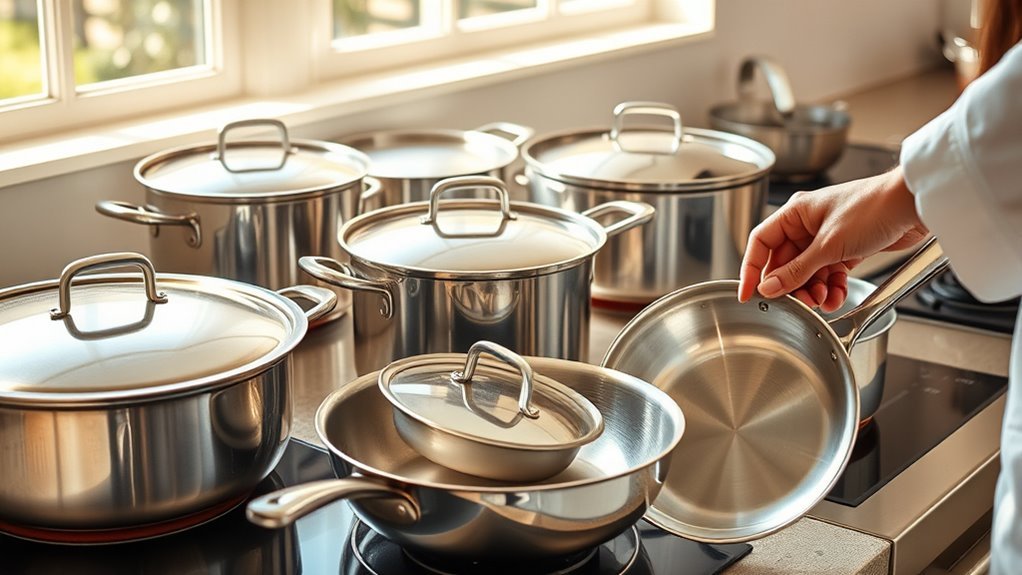
The best stainless steel cookware for your kitchen depends on what you cook, how often you cook, and which stovetop you use. Start by evaluating the steel grade and construction rather than choosing based on appearance alone.
High-quality stainless steel resists corrosion and maintains its finish with proper care. However, stainless steel conducts heat less effectively than aluminum or copper, so the materials inside the pan make a significant difference.
Which Stainless Steel Grade Should You Choose?
For everyday cooking, 304 stainless steel is an excellent starting point. It offers good corrosion resistance and is widely used for food preparation.
The numbers in 18/8 and 18/10 refer to nominal chromium and nickel percentages. According to the British Stainless Steel Association’s explanation of stainless steel grades, both labels generally refer to the same 304-grade family.
Here is how the common grades compare.
| Steel Grade | Main Characteristics | Best Use |
|---|---|---|
| 18/8 (304) | Common food-grade stainless steel with good corrosion resistance. | Everyday pots, pans, and kitchen utensils. |
| 18/10 (304 family) | Similar corrosion resistance to 18/8. Often used as a premium cookware label. | Everyday cookware and polished kitchenware. |
| 316 | Contains molybdenum for improved resistance to certain corrosive conditions. | Specialized applications requiring extra corrosion resistance. |
| 316Ti | Titanium-stabilized 316 steel designed to resist certain forms of corrosion after elevated-temperature exposure. | Specialized cookware and industrial applications. |
The BSSA’s food-processing steel guidance confirms that both 304 and 316 are suitable for food-contact applications when selected appropriately.
Grade 316 offers additional resistance to some salty and corrosive environments. However, it is not automatically necessary or superior for everyday home cooking.
Likewise, 316Ti stainless steel contains titanium to improve resistance to a specific corrosion process associated with prolonged heating. That feature does not guarantee better cooking performance in a household kitchen.
Note: Stainless steel is suitable for ordinary food preparation, but small amounts of nickel and chromium can migrate into food. Published research on metal release from cookware found that release varies with acidity, cooking conditions, and cookware use. If you have a severe nickel allergy, ask your healthcare professional about suitable cookware materials.
Essential Features of High-Quality Stainless Steel Cookware
High-quality stainless steel cookware combines durable materials with a design that makes cooking and cleaning easier. Look beyond the steel grade and examine the pan’s construction, base, handles, lids, and heat limits.
These features deserve the most attention:
- Conductive core: An aluminum or copper core improves heat transfer and helps reduce uneven heating.
- Sturdy construction: The base should feel stable and sit flat on your cooking surface without rocking.
- Comfortable handles: Look for handles that provide a secure grip and support the weight of a full pan.
- Secure handle attachments: Riveted or well-made welded handles should feel firm, without movement or loose connections.
- Tight-fitting lids: Properly fitting lids help retain moisture and support simmering, steaming, and braising.
- Useful pouring design: Flared rims and practical pan shapes make transferring liquids easier.
- Suitable oven rating: Verify the maximum safe temperature for the pan, lid, and handle materials.
- Easy maintenance: Choose cookware with clear cleaning instructions and a finish you can maintain comfortably.
How Can You Tell Whether Cookware Works With Induction?
Induction cooktops require cookware with a magnetic base. Stainless steel cooking surfaces are not always magnetic, so an attractive stainless finish does not guarantee induction compatibility.
To check a pan, place a magnet against its underside. If it sticks firmly, the base likely contains the magnetic material needed for induction cooking.
Also look for an induction-compatible symbol or manufacturer confirmation. A flat base with a size suitable for your burner helps the cooktop operate properly.
How Hot Should Stainless Steel Cookware Be Oven-Safe?
Choose a pan with an oven-temperature rating that matches the cooking methods you use. A rating of 500°F is useful for many recipes, but stainless cookware does not have one universal temperature limit.
For example, some fully bonded stainless steel collections are rated up to 600°F, while matching glass lids may be limited to 350°F. These differences appear in manufacturer oven-safety specifications.
Do not assume a lid, silicone grip, or coated component can withstand the same temperature as the metal pan. Check whether the cookware is also approved for broiler use.
Why Multi-Ply Cookware Ensures Even Cooking
Multi-ply cookware uses bonded layers of different metals to improve heating performance. Stainless steel provides a durable cooking surface, while aluminum or copper spreads heat more efficiently.
This combination helps minimize hot spots, supports controlled browning, and makes temperature adjustments more predictable.
What Is the Difference Between Tri-Ply and Five-Ply Cookware?
Tri-ply cookware generally combines three bonded layers, often stainless steel surrounding an aluminum core. Five-ply cookware contains additional layers, but more layers do not automatically mean better performance.
The thickness, type, and arrangement of the metals determine how a pan heats. The manufacturer’s explanation of three-ply and five-ply construction also emphasizes that layer count alone is not a reliable measure of quality.
| Construction | Advantages | Considerations |
|---|---|---|
| Fully clad tri-ply | Effective heat distribution and responsive cooking. | A strong general-purpose choice for most kitchens. |
| Fully clad five-ply | Additional layers may change heat retention and temperature response. | Can be heavier or more expensive without necessarily cooking better. |
| Encapsulated or disc-bottom | Conductive metal improves heating across the base. | Sidewalls usually lack the conductive core, which can matter during sautéing and sauce preparation. |
Fully Clad vs. Disc-Bottom: Which Should You Buy?
Fully clad cookware extends its bonded metal layers from the bottom up the sides. Disc-bottom cookware concentrates its conductive layers beneath the cooking surface.
Fully clad construction is especially useful for frying pans, sauté pans, and saucepans because heat spreads through more of the cookware body.
A well-built disc-bottom stockpot can still be suitable for boiling pasta, preparing soup, and cooking foods surrounded by liquid.
For everyday versatility, fully clad tri-ply cookware is a practical starting point. It offers a balance of heat distribution, weight, and temperature control without requiring extra layers.
Pro Tip: Examine the outer wall near the bottom of a pan. A visible ridge or seam may indicate an attached disc base. Fully clad cookware typically has continuous bonded construction extending toward the rim. Confirm the construction in the product specifications before buying.
How Handle Design Enhances Comfort and Usability
Handle design affects how safely and comfortably you can lift, tilt, and move cookware. A pan that heats evenly may still feel awkward if its handle is slippery, narrow, or poorly balanced.
Broad, rounded handles can reduce pressure on your hand. Contoured handles may also improve grip when lifting heavier cookware.
However, handle comfort is personal. If possible, hold the cookware before buying and test how it feels when you tilt it.
What Makes a Cookware Handle Comfortable?
- Secure grip: The handle should feel comfortable without sharp edges or pressure points.
- Balanced weight: A well-balanced pan is easier to lift, rotate, and pour from.
- Strong attachment: Rivets or welded joints should hold the handle firmly.
- Helper handles: Larger stockpots and sauté pans benefit from a second grip point.
- Practical handle length: A suitable length helps keep your hand away from the hot cooking surface.
Flared rims are another useful feature. They help guide liquids when pouring sauces, soups, or cooking water into another container.
Do Stainless Steel Handles Stay Cool?
Some stainless steel handles are designed to heat more slowly during stovetop cooking. However, no ordinary metal handle should be assumed to remain cool in every situation.
Gas flames, long cooking times, and high temperatures can make handles hot. Lid handles and short side handles may heat faster because they sit closer to the cookware body.
Warning: Always use dry oven mitts or suitable heat-resistant protection when removing cookware from an oven. Treat metal handles and lids as hot, even when the manufacturer describes them as stay-cool during stovetop use.
Should You Buy a Stainless Steel Cookware Set or Individual Pieces?
Buying individual pieces is often sensible if you already own useful cookware. A complete set can be convenient when you need several matching pots and pans, but only if you will use the included pieces.
Instead of judging a set by its advertised piece count, consider the cooking vessels you actually need. Lids are commonly included in the total count.
Which Stainless Steel Pots and Pans Are Most Useful?
- Frying pan or skillet: Useful for browning meat, sautéing vegetables, and preparing everyday meals.
- Saucepan with lid: Suitable for sauces, grains, reheating, and simmering small portions.
- Sauté pan: Its wide cooking surface and taller sides help with larger meals and dishes containing sauces.
- Stockpot: Useful for soups, broth, pasta, and boiling larger amounts of water.
Start with the cookware that matches your regular meals. Then consider the size of your burners, storage space, and how much weight you can lift comfortably.
A smaller collection of well-constructed pieces can be more useful than a larger set containing pans you rarely use.
Best Cleaning Practices for Stainless Steel Cookware
Stainless steel cookware is relatively easy to maintain, but proper cleaning helps preserve its appearance and performance. Most everyday residue comes off with warm water, dish soap, and a soft sponge.
Follow these steps after cooking:
- Let the pan cool: Remove it from the heat and allow it to cool naturally before washing.
- Wash with warm, soapy water: Use a soft sponge or non-abrasive cleaning cloth to remove grease and food residue.
- Soak stubborn food: Add warm, soapy water and allow stuck-on food to soften before gently scrubbing.
- Rinse thoroughly: Remove all detergent and loosened residue.
- Dry immediately: Use a clean towel to reduce water spots and mineral deposits.
For additional guidance, see the manufacturer’s stainless steel cookware care instructions.
How Do You Remove Stubborn Stains and Discoloration?
Different marks need different cleaning methods. Rainbow discoloration, white mineral deposits, and burned food are not the same problem.
- Rainbow or blue discoloration: Wipe the surface with a little white vinegar and a soft cloth, then rinse and dry.
- White mineral deposits: Use diluted white vinegar to help dissolve deposits left by hard water.
- Burned-on food: Soak in warm, soapy water. For tougher residue, gently loosen it with baking soda and water.
- Stubborn stains: Use a suitable stainless steel cookware cleaner, following the product instructions.
Bar Keepers Friend can help remove difficult residue from suitable stainless steel surfaces. Its official cleanser instructions recommend applying the product to a wet surface, rubbing gently, rinsing within one minute, and drying afterward.
Test cleaners on a small area first when appropriate. Avoid steel wool, chlorine bleach, and harsh oven cleaners that may damage the finish.
How Can You Prevent Sticking While Cooking?
Stainless steel does not have a permanent nonstick coating. However, correct heat control and cooking technique can reduce food sticking.
- Preheat the clean pan over low to medium heat.
- Add enough oil or fat to lightly coat the cooking surface.
- Allow the oil to heat before adding food.
- Place the food in the pan and let it brown before attempting to turn it.
- Reduce the heat if food begins burning or the oil starts smoking.
Meat often releases more easily after a browned crust forms. Trying to move it immediately can cause tearing and sticking.
What Common Mistakes Damage Stainless Steel Cookware?
Good stainless steel cookware can last for many years, but improper use may cause discoloration, warping, or surface damage.
- Thermal shock: Never place a very hot pan under cold running water. A sudden temperature change can contribute to warping.
- Excessive heat: Avoid leaving empty cookware over high heat for extended periods.
- Salt pitting: When salting water, wait until it boils and stir so salt does not remain concentrated against the metal.
- Dragging cookware: Lift pans when moving them across glass or ceramic cooktops to reduce scratches.
- Improper dishwasher use: Follow the specific product’s instructions. Some collections permit dishwashing, while others recommend or require hand washing.
Small surface scratches and heat-related discoloration often affect appearance more than cooking performance. However, severe warping, loose handles, or damaged construction may require repair or replacement.
Frequently Asked Questions
Which Is Better, 18/8 or 18/10 Stainless Steel?
Neither is automatically better. Both labels commonly refer to the 304 stainless steel family and offer similar corrosion resistance. The higher nickel number on an 18/10 label does not necessarily prove superior durability or cooking performance. Compare construction, thickness, handles, and overall build quality instead.
Is 304 or 316 Stainless Steel Safer?
Both 304 and 316 stainless steel are suitable for ordinary food preparation. Grade 316 offers better resistance to certain corrosive environments, but it is not automatically safer for typical home cooking. Both can release trace metals under some conditions, so proper cookware selection and use matter.
Which Is Better, 18/10 Stainless Steel or 316 Stainless Steel?
For most household cookware, well-constructed 18/10 stainless steel is a practical choice. Grade 316 provides additional resistance to certain corrosive conditions, especially those involving chlorides. However, 316 does not automatically distribute heat better. The pan’s conductive core, thickness, and design have a greater effect on cooking performance.
Is 304 or 18/8 Stainless Steel Better?
304 and 18/8 generally describe the same stainless steel grade, so neither label is inherently better. Both provide good corrosion resistance and are widely used in food-contact products. Differences in cookware durability usually depend more on manufacturing quality, metal thickness, construction, and maintenance than on these two labels.
Conclusion
Choosing quality stainless steel cookware means looking beyond the steel grade. Focus on dependable construction, even heat distribution, comfortable handles, and compatibility with your stovetop.
For most home cooks, fully clad tri-ply cookware with a 304-grade cooking surface offers a sensible balance of performance and durability. Choose the pieces you will use regularly, confirm their oven and cleaning requirements, and maintain them properly for long-term use.
Sources
- British Stainless Steel Association: Cutlery Stainless Steel Grades: Explains 18/8, 18/10, and their relationship to grade 304.
- British Stainless Steel Association: Food Processing Steel Selection: Supports the food-contact applications and corrosion resistance of 304 and 316 steel.
- British Stainless Steel Association: 316 and 316Ti Comparison: Explains titanium stabilization and corrosion-related properties.
- PubMed: Nickel and Chromium Release From Stainless Steel Cookware: Research on metal migration during common cooking conditions.
- All-Clad: Understanding Stainless Steel Cookware Layers: Explains multi-ply construction and why more layers do not always mean better performance.
- All-Clad: Product Support and FAQ: Manufacturer specifications for induction compatibility, handles, lids, and oven-temperature limits.
- All-Clad: Cookware Care and Use: Guidance on preheating, cleaning, discoloration, and avoiding cookware damage.
- Bar Keepers Friend: Cleanser Instructions: Official cleaning and rinsing guidance for suitable stainless steel surfaces.
