
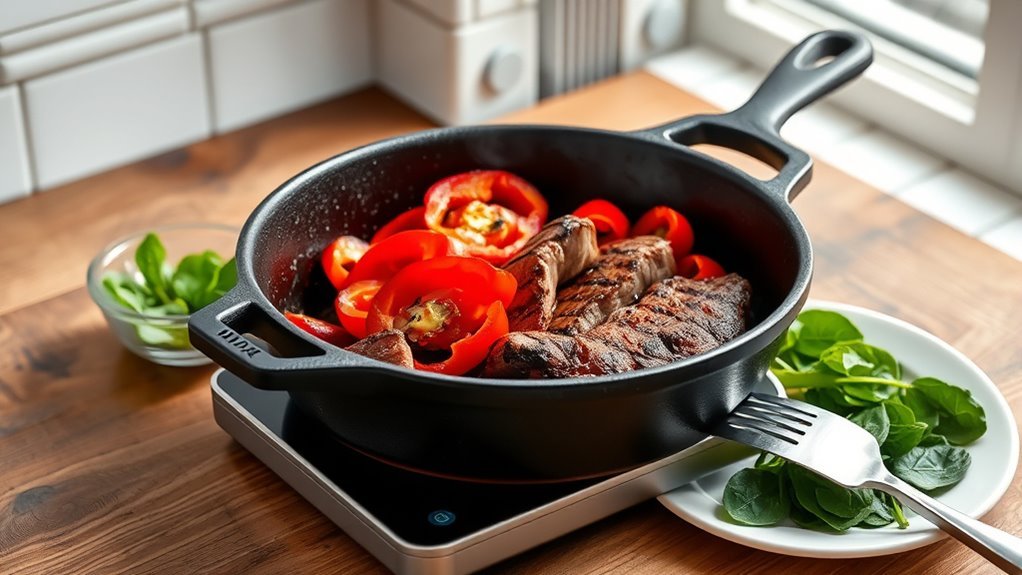
You’re probably wondering how much a cast iron skillet actually weighs and what that means for cooking, iron intake, and safety. Skillets usually run 4–6 pounds, with heavier pieces holding heat better but being harder to lift. You’ll learn how thickness, casting, and handle design affect performance and iron transfer, plus practical tips for lifting and care—so you can pick the right pan and use it safely.
How Much Do Cast Iron Skillets Weigh? (Quick Table)
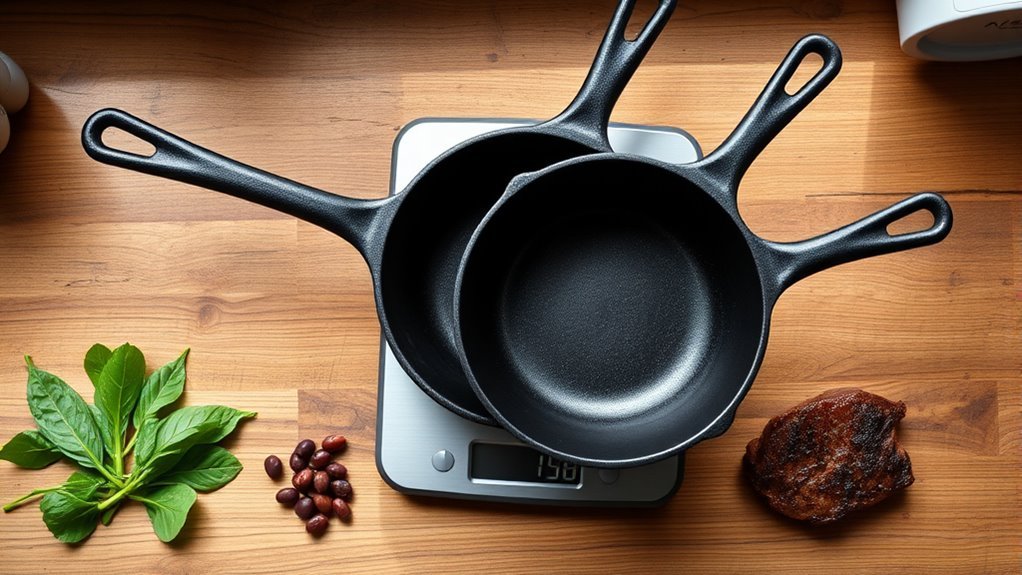
A 10.5-inch cast iron skillet typically weighs about 4 pounds, while common larger sizes—like a 12-inch—often run around 6 pounds or more. You’ll use that baseline to gauge what fits your kitchen and strength.
Vintage pieces often tip the scale differently: some older #8 Griswold skillets can weigh over 4 pounds, whereas modern Lodge variants—like a #8 chicken fryer—can weigh roughly 5 pounds 6 ounces, illustrating how casting choices change mass.
Vintage skillets vary noticeably: some old #8 Griswolds exceed 4 lb, while modern #8 Lodges can be about 5 lb 6 oz.
Thickness drives much of that variance; bases around 0.125 inches hit a practical balance for cooking performance. Heavier skillets hold heat longer but need more energy and time to reach temperature; lighter, thinner pans heat faster but can show hot spots and be more prone to thermal shock.
When you choose a cast iron skillet, match weight to your workflow and capacity—pick a tool that liberates your cooking, not one that limits your movement or patience.
How Thickness and Casting Method Affect Weight
Consider both wall and base thickness when judging skillet weight: a 0.125-inch base hits a practical balance of performance and weight, while thicker bases (~0.164 in.) add pounds and improve heat retention.
Know that sand-cast or lower-quality castings can make a pan heavier without improving durability, whereas machine or higher-quality castings tend to yield more consistent thickness and performance.
You’ll also see variability from hand casting—thicker side walls increase weight and toughness, but only up to the point where added mass meaningfully benefits cooking.
Wall And Base Thickness
Thickness directly shapes how a cast iron skillet performs and how much it weighs: walls and bases around 0.125 inches hit the sweet spot for cooking, while thinner vintage pieces (down to about 0.069 inches in spots on some Griswold pans) cut weight at the cost of fragility.
Thicker modern pans (Lodge examples at ~0.164 inches) add weight for better heat retention and durability. You’ll choose thickness based on how you cook and how liberated you want to feel in the kitchen: lighter pans move and heat faster but risk warping and hot spots; heavier pans hold temperature and are forgiving with technique.
Variability from hand casting can make weight uneven, so inspect feel and balance when selecting cast iron cookware.
Sand Vs. Machine Casting
Sand casting usually yields noticeably heavier skillets because the mold and pouring process favors thicker walls and bases, while machine casting lets manufacturers produce lighter, more uniformly thin pans.
You’ll notice weight differences primarily from thickness: skillets near 0.125 inches hit a sweet spot for cooking performance, and sand-cast pieces often exceed that, adding mass and thermal inertia.
That extra weight slows heating and cooling, so you’ll adapt cook times and handling. Poor casting raises weight further—excess material or surface imperfections add grams without benefit.
Choosing between sand and machine casting is practical: pick sand-cast if you value mass and heat retention, pick machine-cast if you want lighter, more consistent pans that free you to move quickly in the kitchen.
Weight Versus Durability
Having compared sand and machine casting, you’ll next want to weigh how thickness ties into durability and overall performance. You’ll find weight correlates with heat retention and structural resilience: a typical #8 runs about 4 lb 4 oz, while some skillets exceed 6 lb, reflecting thicker walls and bases. Thinner pans save weight but sacrifice durability and resist thermal shock less effectively.
- Aim for ~0.125 inch thickness to balance weight and durability for reliable heat distribution.
- Expect sand casting quality to affect final weight; poor casts can be heavier and more fragile.
- Heavier, well-cast pans store heat longer, improving searing and consistency.
- Avoid ultra-thin skillets if you want longevity and resistance to cracking under stress.
How Weight Changes Heat-Up, Retention, and Hotspots
When you compare skillets by weight, you’ll notice heavier pans take longer to heat up but hold temperature much better, which stabilizes cooking.
A base thickness near 0.125 inches (and heavier examples like 0.164-inch castings) minimizes hotspots and evens surface temperature, whereas thinner, lighter pans (around 0.105 inches) cool and develop uneven hot spots more readily.
That trade-off — slower response versus superior heat retention and fewer hotspots — is what guides which weight fits your cooking style.
Heat-Up Time
Anyone cooking with cast iron will notice that weight directly affects how a pan heats and holds temperature. Heavier skillets need more time to come up to cooking temperature, but their mass improves heat retention so you get steadier results once they’re hot.
Lighter pans heat faster, which frees you to move quickly, yet they lose temperature sooner and can produce uneven cooking.
- Heavy (≈5.6 lb) pans heat slowly, then stabilize for consistent searing.
- Thin bases (<0.125 in) respond fast but struggle with heat retention.
- Ideal base (~0.125 in) balances warm-up speed and steady heat.
- Choose weight based on your workflow: slow-and-steady or fast-and-flexible.
You’ll gain control by matching skillet mass to how you cook.
Heat Retention & Hotspots
Because mass and thickness determine how cast iron absorbs and spreads heat, heavier, thicker skillets hold temperature longer and resist hot spots better than thin, lightweight pans.
You’ll notice a 0.125-inch base or heavy Lodge-style 5.63-pound pan maintains even heat across the cooking surface, so food cooks uniformly and you don’t chase hot spots.
Thinner pans heat faster but can’t distribute heat, producing localized hot zones and uneven results. Heavier skillets take longer to change temperature, so you gain thermal stability at the cost of responsiveness.
For practical liberation in the kitchen, choose a skillet with sufficient mass and thickness to balance steady heat retention and manageable heating time—this gives you control and predictable outcomes without extra effort.
Heavy vs. Thin Pans: What You Gain and What You Lose
Curious which skillet suits your kitchen needs? You’ll weigh freedom against function when choosing between heavy and thin pans. Heavier cast iron (often over 6 pounds) gives you superior heat retention and fewer hot spots because modern bases sit around 0.164 inches thick.
Thinner pans (near 4 pounds, ~0.105 inches) heat faster and are easier to lift, but they respond poorly to temperature swings and damage.
- durability vs mobility: heavy resists warping; thin risks cracking under shock
- heat consistency: heavy holds steady heat; thin creates hot spots faster
- handling: thin offers agility for quick flips; heavy demands more strength
- longevity: heavy tolerates abuse; thin may need replacement sooner
Choose according to your cooking rhythm and body autonomy. If you want predictable searing and less maintenance, opt for heavy. If you prize nimbleness and lighter lifting, accept the trade-offs of thin pans.
Handle Design and Weight Balance
Although cast iron skillets are prized for heft and heat retention, their handles often determine how usable they feel day-to-day. You’ll notice most handles run about 4.75 inches, which limits leverage when you lift a loaded skillet; modern designs lengthen handles to improve comfort and control.
Consider handle material and shape: lighter tab handles save metal but can be hard to grip, while loop handles give you secure purchase for lifting and pouring. Balance matters as much as durability — a well-designed handle positions mass so the skillet feels stable in your hand rather than cantilevered forward.
Some makers add a helper handle to share load; the Stargazer’s 0.38-pound helper handle improves convenience without a big weight penalty. If you want freedom in the kitchen, prioritize a skillet whose handle geometry and material let you move confidently, not one that forces awkward grips or strains your wrist.
Iron Transfer to Food: Safety and Who Should Care
How much iron your skillet adds to a meal depends on what you cook and how you cook it: longer cooking times, acidic ingredients (like tomatoes or citrus), and less-developed seasoning all increase iron transfer.
You can lean into this benefit or minimize it, depending on your needs. Regular cast iron use can boost dietary iron and help prevent deficiency; it’s simple, reliable, and low-cost.
Lean into or limit it: regular cast-iron cooking can boost dietary iron—simple, reliable, and low-cost.
- If you’re iron-deficient or anemic, cooking stews or tomato sauces in cast iron can add measurable iron.
- If you have hemochromatosis or high iron, monitor intake and avoid prolonged cooking of acidic dishes in cast iron.
- Well-seasoned pans transfer less iron; newer or stripped pans transfer more.
- Routine use offers cumulative dietary support but isn’t a substitute for medical advice.
Act with evidence: consult a clinician if you have a medical condition affecting iron.
Use the skillet as a tool for empowerment, aligning cooking choices with your health goals.
Lifting, Serving, and Storage Tips for Heavy Skillets
Knowing how your skillet affects the iron content of meals is helpful, but handling the pan safely matters just as much—especially once it’s heavy with food. When lifting a heavy cast iron skillet, use both hands to distribute weight and reduce strain; that’s vital if it’s over six pounds.
Use the helper handle on larger pans (10–12 lb) to stabilize and pivot, and keep your core engaged to protect your back.
For serving, choose silicone or wooden utensils to protect seasoning and maintain a firm grip on dense foods. Transfer portions deliberately—avoid sudden moves that force you to adjust grip mid-serve.
Store skillets with a protective barrier, like a paper towel, between them to prevent scratching and preserve seasoning. Stack heavy pans on the bottom for stability and to protect lighter ones.
These practical steps reduce injury risk, preserve cookware integrity, and let you cook and move freely without being limited by unnecessary friction or damage.
Choose the Right Skillet Weight for Your Stove and Cooking
Pick a skillet weight that matches both your stove’s support and the way you cook: lighter pans (around 3–4 lb) heat and respond faster and are easier to maneuver for single servings, while heavier skillets (5–12+ lb with ~0.125 in thickness) give superior heat retention and evenness for searing and larger batches but demand a stable cooktop and stronger handling.
You’ll choose freedom in the kitchen by matching capacity to your goals: speed and agility or steadiness and thermal mass.
- 3–4 lb skillet: best for solo cooks, quick heat response, easier to lift and flip.
- 5–8 lb skillet (~10–12 in): balances maneuverability with enough mass for even sears.
- 9–12+ lb skillet: ideal for family meals, long holds, and deep searing on robust stoves.
Consider stove grate strength and your comfort lifting heavy cookware before committing.
Select the skillet that liberates your cooking style while respecting your stove’s limits.
Maintenance That Preserves Performance (Regardless of Weight)
Although cast iron is tough, you’ll preserve its performance by washing gently, drying thoroughly, and oiling lightly after each use; this maintenance routine prevents rust and keeps the seasoning intact. You’ll hand-wash with warm water and a soft brush, avoid harsh detergents and steel wool, and immediately dry—heat briefly on the stove if needed. Rub a thin layer of neutral oil while the pan’s warm to reinforce the nonstick surface. Periodically re-season by applying oil and baking; that restores protection and heat retention.
| Task | Why it matters | Frequency |
|---|---|---|
| Hand wash w/ brush | Protects seasoning | Each use |
| Thorough drying | Prevents corrosion | Each use |
| Light oiling | Maintains nonstick | Each use |
| Avoid harsh cleaners | Prevents stripping | Always |
| Re-season treatment | Restores durability | Monthly or as needed |
Follow this evidence-based maintenance plan and you’ll keep freedom in the kitchen—a reliable skillet that performs regardless of its weight.
Frequently Asked Questions
How Much Does a 15 Inch Lodge Cast Iron Skillet Weigh?
A 15-inch Lodge cast iron skillet typically weighs about 10–12 pounds. You’ll appreciate that weight for Cooking Techniques like searing and slow roasting, since it gives excellent heat retention and even cooking.
It’s durable and can last generations, but you’ll want to lift with both hands to stay safe. Embrace its solidity: it empowers you to cook boldly, rely on consistent results, and practice liberating, confident kitchen skills.
How Much Does a 12 Inch Lodge Cast Iron Skillet Weigh?
A 12-inch Lodge cast iron skillet weighs about 8.5 pounds.
You’ll get superior cooking efficiency thanks to its thicker 0.164-inch base, which boosts heat retention and even distribution.
You’ll need longer preheat times because it responds slowly to temperature changes, but that mass delivers durable, high-heat performance and longevity.
That heft supports liberation in the kitchen—you’ll rely on steady, predictable results across searing, frying, and baking.
How Much Does a 20 Inch Cast Iron Skillet Weigh?
A 20-inch cast iron skillet typically weighs 12 to 15 pounds; you’ll often need two hands.
You’ll appreciate that heft for superior heat retention during varied cooking techniques, yielding even sears and steadier temperatures.
Handle it deliberately: use a firm grip, mitts, and lifters to protect joints and food.
That weight frees you from flimsy pans, letting you cook boldly, confidently, and sustainably for large groups or long braises.
How Much Is a Large Cast Iron Skillet Worth?
A large cast iron skillet is typically worth $30 to $100+, depending on brand, condition, and rarity — that’s your Skillet Value.
You’ll favor heavier, well-seasoned pieces for performance; vintage or boutique brands fetch premiums.
Check weight, maker’s marks, and heat retention to gauge resale or replacement worth.
If you want liberation in the kitchen, invest in quality: it delivers longevity, consistent results, and better long-term value.
Conclusion
Choose a skillet weight that fits your strength and cooking goals: lighter pans heat faster and’re easier to lift, while heavier ones hold heat and steady like a seasoned anchor. Consider stovetop type, handle balance, and how often you’ll move the pan. Remember iron transfer can boost dietary iron but may matter only for deficient individuals. With proper seasoning, lifting technique, and storage, you’ll get reliable performance and safety from any well-cared-for cast iron.
