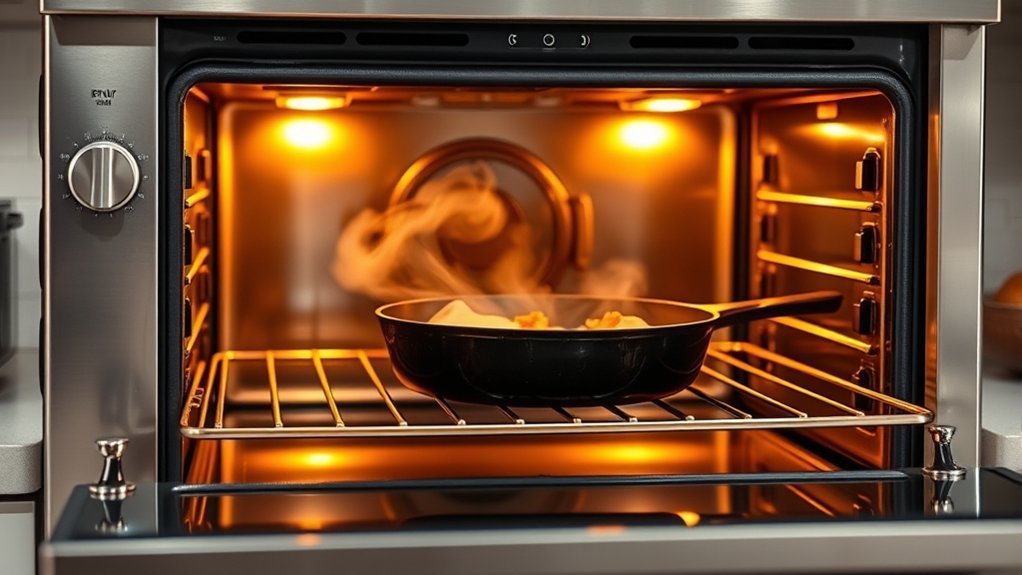
Low broil is a gentler version of an oven’s broil mode, using direct heat from above at a lower temperature or reduced heating-element intensity than High Broil. On many ovens, Low Broil is around 400°F to 450°F, but there is no universal setting. The exact temperature, element power, rack position, preheating method, and oven-door position depend on the appliance, so the owner’s manual should always take priority.
Quick Answer
Low Broil commonly uses about 400°F to 450°F or reduces the broiler element’s power. GE lists Lo Broil at 450°F on certain models, while some KitchenAid ovens use 400°F for Low. Because broilers differ, use the Low setting or temperature specified in your oven’s manual.
Key Takeaways
- Low Broil is model-specific: roughly 400°F to 450°F is common, but some ovens control broiler power rather than assigning a fixed temperature.
- Check the owner’s manual: rack position, preheating, and whether the oven door stays open or closed vary by appliance.
- Use broiler-safe cookware: sturdy metal cookware is generally appropriate when approved by its manufacturer; ordinary glass bakeware should not be placed under a broiler.
- Stay nearby: direct radiant heat can brown or burn food quickly.
- Use a food thermometer: surface color does not prove that meat or poultry has reached a safe internal temperature.
At a Glance
| Time Required | A few minutes of setup or preheating, plus food-specific cooking time |
| Difficulty | Easy, but requires close monitoring |
| Tools Needed | Broiler-safe pan, oven mitts, tongs or spatula, and a food thermometer for meat, poultry, or fish |
| Cost | Usually no added cost if suitable cookware and a thermometer are already available |
What Is Low Broil on an Oven?
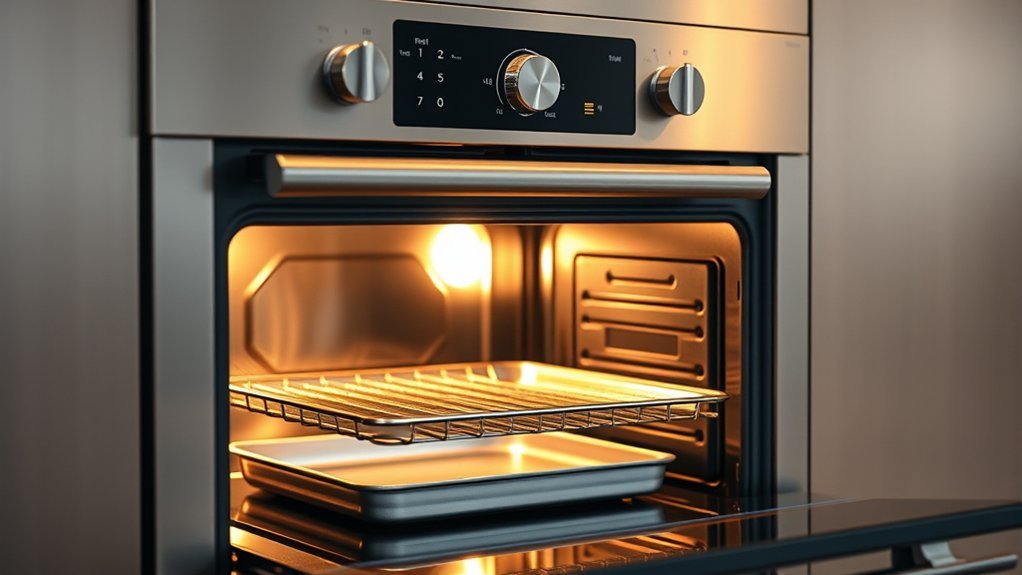
Low Broil is a broiling mode that applies less intense top heat than High Broil. Broiling differs from ordinary baking because most of the useful cooking energy comes from the upper broil element or flame as direct radiant heat.
There is no single Low Broil temperature shared by every oven. GE states that Low Broil commonly falls around 400°F to 450°F and lists 450°F for Lo Broil on many Hi/Lo models. A KitchenAid owner’s manual, by comparison, defines Low Broil as 400°F, Medium as 450°F, and High as 500°F.
Other appliances may change which broil elements operate or how long an element cycles instead of assigning Low Broil a simple temperature. For that reason, the oven’s own control panel and manual are more reliable than a universal temperature chart.
Note: Setting an oven to 425°F or 450°F on Bake does not automatically duplicate Low Broil. Baking and broiling use different heat patterns, so use the Broil mode when a recipe specifically calls for broiling.
Low Broil vs. High Broil
The main difference between Low Broil and High Broil is the intensity of direct heat reaching the food. Low Broil slows surface browning, while High Broil produces a faster sear, char, toast, or browned topping.
| Setting | Typical behavior | Useful for |
|---|---|---|
| Low Broil | Lower temperature, reduced element power, or more frequent cycling | Thicker foods, controlled browning, delicate toppings, or foods that need more time before the surface becomes dark |
| High Broil | Stronger direct radiant heat; many ovens reach roughly 500°F to 550°F | Fast browning, thin cuts, crisp toppings, toast, blistering, and finishing already-cooked dishes |
Low Broil is not simply “a slightly cooler oven.” It is a gentler form of direct top heat, and its exact operation depends on the appliance.
GE, for example, lists Hi Broil at 550°F and Lo Broil at 450°F on many models, while other manufacturers use different temperatures or element-power levels. Check the appliance instructions before treating those numbers as universal.
Best Foods for Low Broil
Low Broil is useful when food needs direct top heat but would brown too quickly under full broiler power. It can work well for thicker pieces of meat or poultry, especially when the surface begins browning before the center reaches the desired temperature.
It is also useful for controlled finishing tasks such as melting cheese, browning casseroles, lightly blistering vegetables, warming an already-cooked topping, or caramelizing fruit without applying maximum broiler intensity.
Foods that need a very fast sear or char may perform better under High Broil. Thin vegetables, toast, breadcrumbs, and the surface of an already-cooked dish often need only a short burst of stronger heat.
Regardless of the setting, thickness, moisture, sugar content, rack position, and distance from the broiler can change cooking time dramatically.
How to Use Low Broil Safely
Safe broiling starts with the appliance instructions. The correct oven-door position, preheating method, rack level, and Low Broil control vary by model.
| Step | Safe practice |
|---|---|
| 1. Check the manual | Confirm the Low Broil setting, rack position, preheating instructions, and required door position |
| 2. Position the rack | Use the recommended rack level before heating the broiler |
| 3. Prepare cookware | Use cookware specifically suitable for broiler heat |
| 4. Preheat if required | Many ovens call for a short broiler preheat, but follow the model instructions |
| 5. Monitor continuously | Stay nearby because browning can accelerate quickly |
| 6. Check doneness | Use a food thermometer when cooking meat, poultry, or fish |
Warning: Do not automatically leave the oven door open while broiling. GE notes that most newer ovens are designed for closed-door broiling, while some older or specific electric models use a partially open broil-stop position. Gas models may require a closed door for safety. Follow the instructions for your exact oven.
The GE oven-door guidance illustrates why model-specific instructions matter: open-door broiling was historically common, but many modern appliances are designed differently.
Stay in the kitchen while broiling. Direct top heat can take food from pale to deeply browned or burned in a short period.
Which Pans Are Safe for Low Broil?
The best choice is cookware that its manufacturer specifically identifies as broiler-safe. Broiler pans, cast-iron skillets, and many heavy stainless-steel pans with all-metal construction tolerate intense top heat well when their makers approve that use.
Ordinary glass bakeware should not be assumed safe. Pyrex states that its glass bakeware must not be used under a broiler because broiling exposes it to a direct heat source. See the Pyrex usage guidance.
Handles and lids matter too. A metal pan may still be unsuitable if it has plastic, wood, silicone, or another component that is not rated for broiler temperatures.
Best Broiler-Safe Materials
Common choices include:
- Cast iron: handles intense heat well, but confirm that any handle cover or accessory has been removed.
- Stainless steel: a sturdy all-metal pan can work well when its manufacturer approves broiler use.
- Dedicated broiler pan and grid: designed to expose food to top heat while allowing fat and juices to drain below.
- Heavy metal sheet or roasting pan: suitable when rated for the required broiler temperature.
- Sturdy aluminum or foil cookware: use only when stable and appropriate for broiling; flimsy disposable pans can buckle or become difficult to handle when hot.
- Ceramic cookware: use only when the manufacturer specifically states that the piece is broiler-safe.
Pans To Avoid
Avoid glass bakeware unless its manufacturer explicitly approves broiler use. Pyrex, for example, specifically prohibits its glassware from being placed under a broiler.
Do not put ordinary nonstick cookware under a broiler unless the cookware manufacturer gives a broiler-safe temperature or explicitly approves that use. High direct heat can exceed the limits of handles, coatings, or bonded components even when the base metal itself could tolerate the temperature.
Also avoid cookware with plastic or wooden handles, fragile decorative pieces, and thin pans that can warp severely.
Safe Broiling Tips
- Use a dedicated broiler pan or another manufacturer-approved broiler-safe pan.
- Choose shallow cookware when strong surface browning is the goal.
- Keep food and cookware clear of the heating element or flame.
- Use dry oven mitts when handling hot pans.
- When lining a broiler pan with foil, follow the oven manufacturer’s instructions and do not block drainage openings intended to carry fat away from the food.
- Stay close enough to check browning frequently.
GE’s broiling guidance, for example, recommends a broiler pan and grid and explains how foil should be fitted so drainage openings remain functional.
How to Set Oven Racks for Low Broil
There is no single rack position that works for every oven or food. The safest starting point is the rack position listed in the appliance’s broiling chart or owner’s manual.
As a general cooking principle, moving food closer to the broiler increases the rate of surface browning, while moving it farther away gives the center more time to heat before the exterior becomes dark.
That makes a lower position useful for thicker or easily scorched foods, while a higher position can work for quick finishing tasks. The exact rack number varies because oven cavities and broiler designs are different.
Rack Placement Basics
- Position the rack before turning on the broiler whenever the manual recommends doing so.
- Start with the manufacturer’s broiling chart for the specific food.
- Use a lower rack when the surface is browning before the center cooks.
- Use a higher rack when browning is too slow and the manual permits a closer position.
- Keep the pan centered unless the appliance instructions state otherwise.
Some recipes describe food as being roughly 4 to 6 inches from the broiler, while thicker foods may be positioned farther away. Treat those measurements as starting points rather than universal rules.
Distance From Heat
Distance changes how aggressively radiant heat reaches the surface. A small movement toward the broiler can noticeably increase browning, particularly once the outside of the food becomes dry.
If the outside is becoming too dark while the center remains undercooked, lower the rack or switch to a gentler setting if your oven allows it. If the surface barely colors, confirm that the correct broil mode is active and move the rack closer only within the positions permitted by the appliance manufacturer.
Best Broil Positions
For Low Broil, thicker cuts generally benefit from more distance from the heating element than quick finishing jobs. Casseroles, fruit, vegetables, and cheese toppings can often be positioned according to how quickly their surfaces need to brown.
- Use the oven’s recommended rack position as the baseline.
- Lower thick foods if the exterior is darkening too quickly.
- Raise foods needing faster surface browning when the manual allows it.
- Check frequently instead of relying on a fixed number of minutes.
Low Broil Tips for Best Results
Good broiling depends on surface preparation as much as temperature. Pat meat or vegetables reasonably dry when a browned exterior is desired, arrange pieces in a single layer, and avoid overcrowding the pan.
Preheat the broiler if your oven’s instructions call for it. Five minutes is common on some appliances, but the correct procedure varies. Certain broiling modes require little or no preheating, so the manual should control.
For meat, poultry, or fish, use a food thermometer rather than judging safety from color. Insert it into the thickest part while avoiding bone where applicable.
Pro Tip: Sugary glazes and barbecue sauces can darken rapidly under direct broiler heat. Apply them late in cooking or watch them particularly closely so the sugar browns instead of burning.
If an oven browns unevenly, rotate the pan when safe to do so. Do not walk away simply because the broiler is set to Low.
Common Low Broil Mistakes
- Assuming Low Broil always means the same temperature: ovens vary, so check the manual instead of automatically selecting 450°F or 500°F.
- Using the wrong door position: do not leave the oven door open unless the manufacturer specifically instructs you to do so.
- Using incompatible cookware: glass, non-broiler-safe coatings, plastic handles, and fragile materials may fail under direct top heat.
- Using a universal rack distance: rack numbering and broiler geometry differ among ovens.
- Skipping required preheating: if the manufacturer’s broiling instructions call for a preheat, give the element time to reach operating conditions.
- Crowding the pan: tightly packed food can steam and brown unevenly.
- Walking away: broiling can change the surface quickly even on Low.
- Judging meat by color: use a food thermometer to determine safe internal temperature.
Warning: If a fire starts inside the oven, U.S. fire-safety guidance recommends turning off the oven and keeping the door closed. If the fire escapes the oven or cannot be controlled safely, leave the home and contact emergency services.
What If Your Oven Has No Low Broil Setting?
If a recipe says “Low Broil” but the oven has only a single Broil control, first check the manual to see whether broiling temperature can be adjusted through another control.
If the broiler has only one fixed intensity, moving the food farther from the element can reduce the rate of surface browning. Monitor it closely and use the rack positions approved by the appliance manufacturer.
Do not assume that selecting 450°F Bake is an exact substitute. Bake surrounds food with heated oven air and may use different elements, whereas Broil concentrates radiant heat from above.
If the recipe’s main purpose is merely melting cheese or browning an already-cooked topping, use the available broil setting for short intervals and watch continuously.
Safe Internal Temperatures for Broiled Food
A dark or well-browned surface does not prove that the center is safe to eat. The USDA safe minimum internal temperature chart recommends the following temperatures:
| Food | Minimum internal temperature |
|---|---|
| Beef, pork, veal, and lamb steaks, chops, and roasts | 145°F, followed by at least a 3-minute rest |
| Ground beef, pork, veal, and lamb | 160°F |
| Poultry, including chicken and turkey | 165°F |
| Fish and shellfish | 145°F |
| Casseroles | 165°F |
Check the thickest part with a food thermometer. For poultry pieces, avoid touching bone with the probe because it can distort the reading.
When to Broil Instead of Bake
Choose broiling when the goal is rapid surface browning from direct top heat. Choose baking when food needs steadier, more surrounding heat to cook through.
| Best use | Why broiling fits |
|---|---|
| Browning a finished dish | Direct top heat colors the surface quickly |
| Melting and browning cheese | The top can brown without reheating the entire dish for a long period |
| Thin foods | Strong radiant heat can cook or sear them quickly |
| Vegetables and fruit | Broiling can blister, char, or caramelize exposed surfaces |
| Toasting breadcrumbs or toppings | A short burst of top heat adds color and crispness |
For cakes, breads, large roasts, and dishes that need even heat throughout, baking is usually more appropriate. Broiling is better treated as a direct-heat cooking or finishing method rather than a hotter version of baking.
Frequently Asked Questions
Can You Cook on Low Broil?
Yes. Low Broil can cook food as well as finish or brown it, depending on the oven and recipe. It is especially useful when full broiler intensity would darken the outside before the center has enough time to cook. Stay nearby and use a food thermometer for meat, poultry, and fish.
What Temperature Do I Put for Broil at a Low Temperature?
On many ovens, Low Broil is around 400°F to 450°F. GE lists 450°F on many Lo Broil models, while some KitchenAid ovens use 400°F. If the oven has a dedicated Low Broil button, use it instead of assuming a temperature, and check the owner’s manual for the exact behavior.
Is Broil Hotter Than 425°F?
High Broil commonly operates above 425°F, often around 500°F to 550°F. Low Broil is different: some ovens use about 400°F to 450°F, so Low Broil is not always hotter than 425°F. Broiling is also defined by direct radiant heat from above, not only by the oven’s air temperature.
What Is High Broil Vs Low Broil?
High Broil delivers stronger top heat for fast searing, charring, toasting, and browning. Low Broil reduces the temperature, heating-element power, or duty cycle so food browns more slowly. The exact temperatures and heating pattern depend on the oven.
Should the Oven Door Be Open or Closed When Broiling?
Follow the owner’s manual. Many modern ovens are designed for closed-door broiling, while some electric models use a partially open broil-stop position. Do not leave the door ajar simply because an older recipe tells you to do so.
What Should I Do If My Oven Has No Low Broil Setting?
Check whether the broil temperature can be adjusted manually. If the appliance has only one broil intensity, use the rack positions recommended by the manufacturer and move the food farther from the element when slower browning is needed. Do not assume that 450°F Bake is identical to Low Broil.
Sources
- GE Appliances — Hi and Lo Broil Feature — supports manufacturer-specific High and Low Broil temperatures.
- GE Appliances — Oven Door Position During Broil — supports model-specific open-versus-closed-door guidance.
- KitchenAid Owner’s Manual — provides an example of Low Broil at 400°F, Medium at 450°F, and High at 500°F.
- USDA Food Safety and Inspection Service — Safe Minimum Internal Temperature Chart — supports food-safety temperatures for meat, poultry, fish, and casseroles.
- Pyrex — Frequently Asked Questions — confirms that Pyrex glass bakeware should not be used under a broiler.
- U.S. Fire Administration — Cooking Fire Safety — supports close monitoring and oven-fire precautions.
Conclusion
Low Broil provides gentler direct top heat than High Broil, making it useful when food needs more time to cook or brown without immediately scorching. A range of roughly 400°F to 450°F is common, but Low Broil is not standardized across ovens. The safest approach is to follow the appliance manual for the broil setting, rack position, preheating, and door position, use broiler-safe cookware, stay nearby, and verify meat, poultry, and fish with a food thermometer.

1 thought on “What Temp Is Low Broil on Oven? Ideas, Tips & Guide”