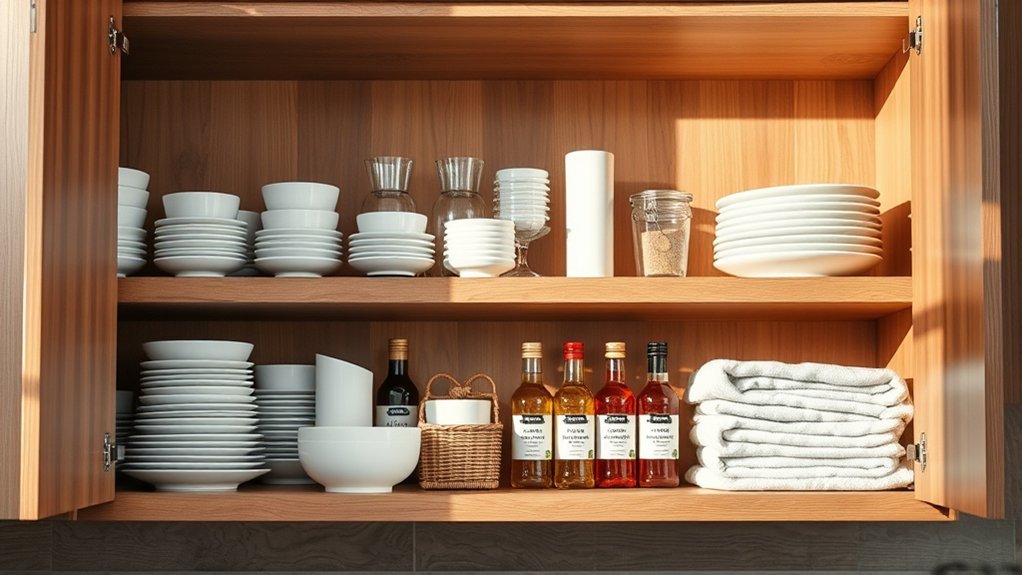
Kitchen cabinets work best when each item is stored close to where it is used. Everyday dishes and glasses usually belong near the dishwasher or sink, cooking tools and cookware near the range, food-storage containers near the prep area, and shelf-stable foods in a cool, dry pantry zone. Heavy items should stay low, while lighter and less-used pieces can use higher shelves.
Quick Answer
Kitchen cabinets should hold the items you use for eating, cooking, food storage, and cleanup. Keep everyday dishes and glasses near the dishwasher, utensils near prep areas, pots and pans in lower cabinets, and shelf-stable food in a cool, dry pantry zone. Store chemicals separately and secured from children.
Key Takeaways
- Store frequently used items in the easiest-to-reach cabinets and drawers.
- Keep heavy cookware and appliances in lower cabinets, deep drawers, or sturdy pull-outs.
- Place dishes, glasses, and silverware near the dishwasher or cleanup zone when possible.
- Keep shelf-stable foods cool and dry, away from the stove, sink leaks, and excess moisture.
- Store household chemicals separately from food and secure them where children cannot reach them.
What Belongs in Kitchen Cabinets First
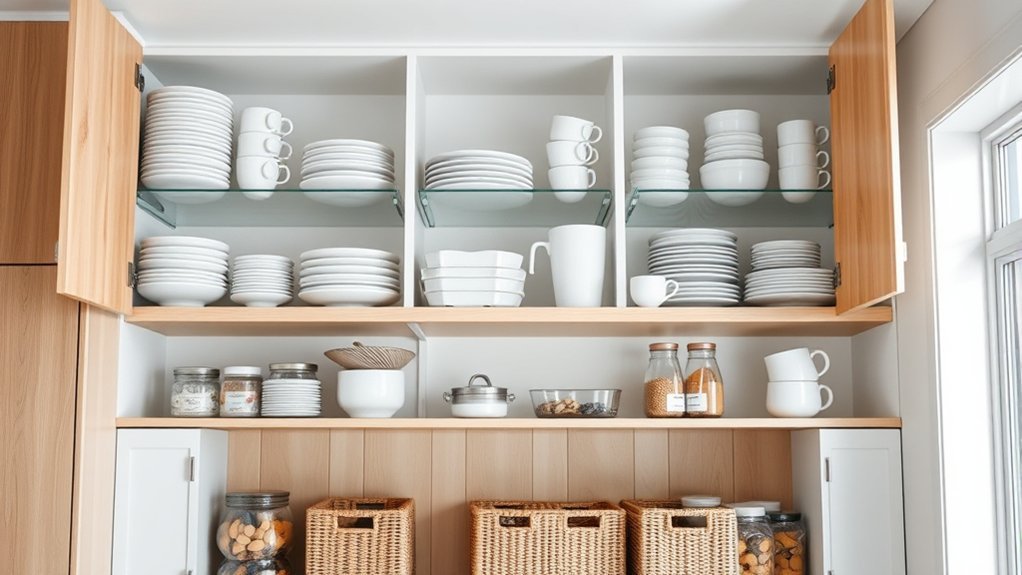
Start with the things used every day. Plates, bowls, mugs, drinking glasses, silverware, cooking utensils, frequently used cookware, food-storage containers, and common pantry staples deserve the most convenient cabinet space.
If the layout allows it, keep plates, bowls, cups, and glasses near the dishwasher. That shortens the unloading route and keeps the cleanup zone efficient. Silverware and everyday utensils usually work best in drawers near the sink or primary prep counter.
Lower cabinets and deep drawers are better for heavier pieces such as Dutch ovens, cast-iron pans, mixing bowls, slow cookers, stand mixers, and other bulky appliances. Higher shelves are better reserved for lighter items that are used less often, such as serving platters, holiday dishes, lightweight pitchers, and spare glassware.
| Item | Best Cabinet Zone | Why |
|---|---|---|
| Everyday plates and bowls | Easy-reach shelf near dishwasher | Faster unloading and serving |
| Glasses and mugs | Upper cabinet near sink or dishwasher | Keeps light daily items accessible |
| Silverware and utensils | Drawer near prep or cleanup area | Quick access during cooking and cleanup |
| Pots and pans | Lower cabinet or deep drawer near range | Safer lifting and shorter cooking workflow |
| Heavy appliances | Lower cabinet or sturdy pull-out | Avoids overhead lifting |
| Dry pantry food | Cool, dry cabinet or pantry | Protects food from heat and moisture |
| Rarely used lightweight items | Higher shelves | Preserves prime storage space |
How to Organize Kitchen Cabinets by Item Type
The easiest system is to organize by both function and frequency. Items that are used together should live near one another, and everyday pieces should take the most convenient positions.
- Empty one cabinet or zone at a time. Remove everything so you can see duplicates, broken pieces, expired food, and items that no longer belong in the kitchen.
- Group like items. Make separate groups for dishes, drinkware, cookware, baking supplies, food storage, pantry food, appliances, and cleaning products.
- Build activity zones. Keep cookware near the range, dishes near the dishwasher, food containers near the prep area or refrigerator, and baking equipment together.
- Prioritize by frequency. Daily items belong at the front and within easy reach. Occasional items can move higher or farther back.
- Keep heavy items low. Store cast iron, large pots, stand mixers, pressure cookers, and similar equipment in base cabinets or deep drawers.
- Add organizers only where they solve a problem. Shelf risers, dividers, pull-outs, turntables, and bins are useful when they improve visibility or access, not simply because they fit.
Pro Tip: Organize around movement rather than appearance. If you repeatedly walk across the kitchen for a pan, utensil, plate, or food container, that item probably belongs closer to the task where you use it.
Best Ways to Store Dishes, Glasses, and Silverware
Everyday dishes should be easy to reach without excessive stretching. In many kitchens, that means a lower shelf in an upper cabinet or a deep drawer designed for plates and bowls.
Glasses and mugs are light enough for upper cabinets and are especially convenient near the dishwasher, sink, coffee station, or refrigerator. Group similar pieces together so family members can return them to the same place.
Silverware belongs in a drawer with an insert or divider. Frequently used cooking utensils can use a neighboring drawer, while less-used specialty tools can move to a secondary drawer.
Shelf risers are useful when tall cabinets leave unused vertical space. They can separate plates, bowls, mugs, or glasses without forcing one large stack.
Fragile stemware and specialty glasses should be stored where they are unlikely to be knocked by everyday pieces. If they are rarely used, a dining-room hutch, buffet, or protected upper shelf may be a better use of space than a prime kitchen cabinet.
How to Store Pots, Pans, and Appliances
Pots, pans, lids, and heavy appliances are easier to handle in lower storage. Deep drawers are especially useful because the entire contents can be viewed from above instead of being hidden at the back of a cabinet.
Nest compatible pots and pans when necessary, but avoid stacks so tall that you have to remove several pieces to reach one pan. Protective pan separators can help prevent scratches on coated or polished cookware.
Store lids vertically in a divider, rack, or dedicated drawer when possible. This prevents loose lids from sliding behind cookware and makes the correct size easier to find.
Large or heavy small appliances such as stand mixers, pressure cookers, food processors, and slow cookers should stay in a lower cabinet, deep drawer, appliance lift, or sturdy pull-out. Lightweight appliances used only occasionally can be placed on higher shelves if they can be reached safely.
Warning: Do not place a heavy appliance on a high shelf simply because it is rarely used. Lifting a bulky mixer, cooker, or appliance base above shoulder height can make it harder to control.
Where to Store Food Containers, Bakeware, and Cutting Boards
Food-storage containers are easiest to manage when containers and lids have defined spaces. Nest containers by shape or size, and keep lids upright in a divider or shallow bin. Store the set near the refrigerator or main prep area if that is where leftovers are normally packed.
Baking sheets, muffin tins, cooling racks, cutting boards, and serving trays often work better stored vertically than stacked flat. A lower cabinet fitted with dividers can turn these flat pieces into easy-to-grab files.
Mixing bowls, measuring cups, measuring spoons, rolling pins, and baking tools can form a dedicated baking zone. If flour, sugar, and other baking staples are used frequently, keeping them in the same general area reduces unnecessary movement during prep.
Pantry and Spice Storage for Kitchen Cabinets
Pantry staples should be stored in a cool, clean, dry place. The USDA advises keeping shelf-stable foods away from extreme heat and moisture and specifically cautions against storage above the stove or under the sink. USDA FSIS food-storage guidance provides additional details.
Group pantry food into practical categories such as breakfast foods, canned goods, grains, pasta, snacks, baking supplies, oils, and spices. Clear food-safe containers can make dry goods easier to identify, but they are optional. Original packaging is perfectly workable when it closes securely and remains dry.
Store the most-used foods and seasonings toward the front. Reserve higher shelves or deeper positions for backup stock and items used only occasionally.
Spices are convenient near the cooking zone, but they should not sit directly over a hot range or in a damp area. A drawer, pull-out, or cabinet away from direct heat helps keep labels visible and the collection easier to manage.
Check pantry food periodically for damaged packaging, moisture, pests, and products that are no longer suitable to use. Rotate older items toward the front before opening newer packages.
What to Store Under the Kitchen Sink
The cabinet under the sink is useful for sponges, dishwashing supplies, trash bags, and some household-cleaning products, but it is not a good place for shelf-stable food because plumbing can leak and the area can become damp.
If household chemicals are kept in a kitchen cabinet, keep them in their original containers, away from food, and secured from children. The U.S. Consumer Product Safety Commission recommends locked storage for household cleaners and other potentially poisonous products when children could gain access. CPSC cleaner-storage guidance explains the precaution.
Note: Do not transfer cleaners, pesticides, or other household chemicals into beverage bottles, food jars, or unlabeled containers. Keep original labels intact so safety and first-aid information remains available.
Small Kitchens, Corner Cabinets, and Hard-to-Reach Storage
In a small kitchen, prime cabinet space should go to items used weekly or daily. Duplicate gadgets, seasonal serving pieces, bulk supplies, and rarely used appliances can move to a nearby pantry, dining-room cabinet, utility shelf, or other appropriate storage area.
Corner cabinets work better with a turntable, swing-out shelf, pull-out tray, or other device that brings the contents forward. Avoid using deep blind corners for tiny loose items that can disappear from view.
For users with limited reach or mobility, place everyday items in the most comfortable reach zone instead of automatically using the highest available shelf. Current NKBA planning guidance emphasizes activity zones and accessible design as part of kitchen planning. NKBA’s 2026 planning-guideline update describes that approach.
How to Keep Kitchen Cabinets Organized
A cabinet system only works if it is easy to maintain. Give every common item a clear home, avoid filling every shelf to maximum capacity, and leave enough room to remove one item without unloading an entire stack.
Once a month or whenever groceries are restocked, take a quick look for empty packages, expired or spoiled food, duplicate items, and anything that has migrated into the wrong zone. A deeper cabinet review once or twice a year is usually enough for items that change less often.
Labels can help in shared kitchens, especially on opaque bins or pantry categories. Keep labels broad enough that the system can adapt; “snacks,” “baking,” or “breakfast” is often easier to maintain than creating a label for every individual product.
Frequently Asked Questions
What should go in what kitchen cabinets?
Put everyday dishes and glasses near the dishwasher, silverware and utensils near the prep or cleanup area, pots and pans in lower storage near the range, food containers near the refrigerator or prep counter, and shelf-stable foods in a cool, dry pantry cabinet. Place rare lightweight items higher and heavy items lower.
What is the new trend in kitchen cabinets?
Current 2026 research emphasizes storage maximization, personalized layouts, seamless design, smart technology, and organized activity zones rather than one single cabinet style. NKBA’s 2026 Kitchen Trends Report lists storage maximization among its major themes, while the 2026 U.S. Houzz Kitchen Trends Study found pantry cabinets were the most common built-in feature among the options reported by renovating homeowners surveyed.
How can I update kitchen cabinets without replacing them?
You can refresh existing cabinets with new hardware, paint or refinishing where suitable, improved hinges or drawer slides, interior pull-outs, shelf risers, dividers, under-cabinet lighting, and better organization. Refacing is another option when the cabinet boxes are sound but the doors and visible surfaces need a larger cosmetic change.
What should not be stored in kitchen cabinets?
Do not keep perishable foods that require refrigeration in ordinary cabinets. Avoid storing shelf-stable food above the stove, under the sink, or in damp locations. Discard spoiled or unsafe food. Household chemicals should be kept away from food and secured from children, and very heavy appliances should not be placed on high shelves.
Can pet food be stored in a kitchen cabinet?
Yes, dry pet food can be kept in a cool, dry, secure cabinet or pantry when stored properly. The FDA recommends keeping dry pet food in its original bag or placing the entire bag inside a clean storage container. If food is transferred, use a clean, dry container with a tight-fitting lid and retain the product and lot information.
Should plates go in upper or lower cabinets?
Either can work. Plates are commonly kept on an easy-to-reach lower shelf of an upper cabinet, but deep drawers are also practical, especially for people who prefer not to lift dishes overhead. The best location is stable, comfortable to reach, and close to the dishwasher or dining area.
Conclusion
Well-organized kitchen cabinets make daily cooking and cleanup easier because the right items stay close to the tasks they support. Keep frequently used pieces within easy reach, place heavy cookware and appliances low, reserve high shelves for lighter occasional items, and protect food from heat and moisture. A simple zone-based system is easier to maintain than a cabinet filled simply according to what fits.
Sources
- USDA Food Safety and Inspection Service — Safe Food Storage Tips — supports cool, dry storage guidance for shelf-stable foods.
- U.S. Consumer Product Safety Commission — Medication & Cleaner Storage Safety — supports locking cleaners away from children.
- U.S. Food and Drug Administration — Proper Storage of Pet Food & Treats — supports dry pet-food storage guidance.
- National Kitchen & Bath Association — 2026 Planning Guidelines Update — supports activity-zone, accessibility, and storage-system planning.
- National Kitchen & Bath Association — 2026 Kitchen Trends Report — supports current storage-maximization and design-trend information.
- Houzz Research — 2026 U.S. Kitchen Trends Study — supports current homeowner renovation and pantry-storage trends.