
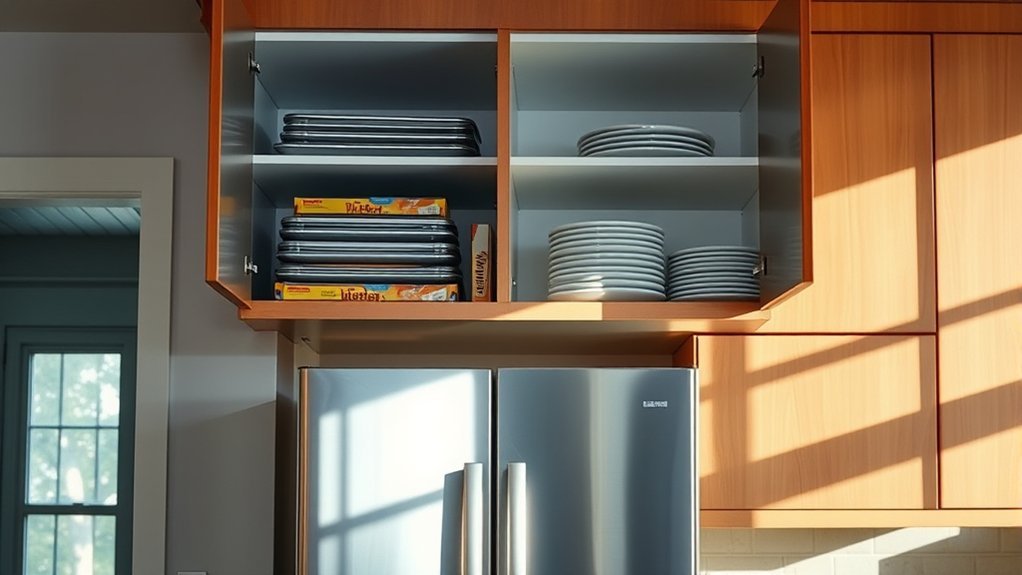
Cupboards above the refrigerator are best used for lightweight, infrequently needed items that can be stored safely at a higher level. Serving platters, baking trays, seasonal pieces, spare paper goods, and lightweight kitchen accessories are usually better choices than heavy appliances, fragile heirlooms, or foods that need controlled temperatures. The cabinet should also leave the refrigerator’s required ventilation space unobstructed.
Quick Answer
Cupboards above the refrigerator are mainly for lightweight items you use only occasionally, such as platters, baking trays, seasonal serveware, and spare paper goods. Avoid heavy appliances, fragile valuables, perishables, and heat-sensitive products. Before filling the cabinet, check your refrigerator manual so the cabinet and its contents do not interfere with required ventilation.
Key Takeaways
- Use the cabinet for light, low-use items rather than heavy cookware or appliances.
- Keep refrigerated perishables and temperature-sensitive products in locations that meet their storage instructions.
- Check the refrigerator’s installation manual before adding organizers or changing cabinetry because ventilation clearances vary by model.
- Tray dividers, handled bins, adjustable shelves, and pull-outs can make deep cabinets easier to use.
- If you cannot reach the cabinet safely, keep frequently used or heavy items somewhere lower.
What Are the Cupboards Above the Refrigerator For?
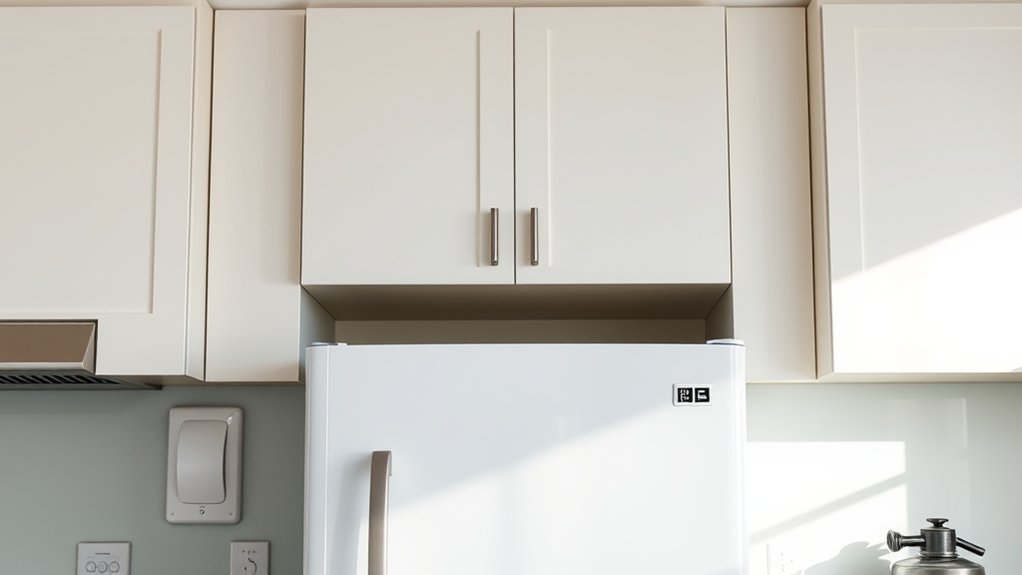
The cupboards above the refrigerator are typically used for lightweight, bulky, or occasional-use items that do not deserve prime space in lower cabinets. Common examples include serving platters, baking trays, holiday dishes, lightweight baskets, and extra paper products.
The best items for an above-fridge cabinet are light enough to handle safely, used infrequently, and not sensitive to warmth.
These upper cabinets make use of space that might otherwise be wasted. By moving occasional-use pieces upward, they can free easier-to-reach cabinets for plates, cookware, food-prep tools, and other everyday essentials.
The cabinet is different from the bare top surface of a refrigerator. Items should not be piled directly on the appliance if doing so blocks vents or violates the manufacturer’s clearance requirements. Refrigerator designs vary, so the installation instructions for the exact model should determine how much open space must remain around it.
Simple organizers such as tray dividers, handled bins, and adjustable shelves can improve order and visibility. The goal is not to fit as much as possible into the cabinet, but to make an awkward storage area useful without creating a lifting, falling-object, or ventilation problem.
Note: Refrigerator clearance is model-specific. Whirlpool and GE Appliances both advise following the installation instructions for the exact refrigerator rather than assuming one clearance works for every model.
Before Using the Cabinet Above the Refrigerator
Before reorganizing the cabinet, check four things: ventilation, weight, temperature sensitivity, and reach. These checks are more important than choosing a particular basket or divider.
- Check refrigerator clearance: Find the owner’s or installation manual for your model and confirm the required top, side, and rear ventilation spaces.
- Check cabinet condition: Make sure shelves, hinges, fasteners, and the cabinet frame are secure before adding weight.
- Check what you plan to store: Favor light, durable items that do not require controlled temperatures.
- Check safe access: If you need extra height, use a stable step stool appropriate for the task rather than standing on a chair or box.
Warning: Do not place very heavy appliances, large glass pieces, or frequently used items in a cabinet that requires awkward overhead lifting. If the cabinet cannot be reached comfortably, move those items lower and use a stable step stool when occasional access is necessary.
Best Things to Store Above the Refrigerator
The space above the refrigerator works best for light, rarely used items such as platters, serving dishes, baking trays, spare containers, seasonal pieces, and paper products.
Items stored there should be easy to grip and light enough to lower without losing balance. The cabinet can also hold lightweight kitchen accessories that are useful but not needed every day.
Tray dividers, bins with handles, and adjustable shelf heights help prevent items from disappearing into the back of a deep cabinet.
Light, Rarely Used Items
Because the space is high and usually less convenient to reach, it is well suited to infrequently used serveware, lightweight cake stands, seasonal platters, and oversized baking trays that do not need daily access.
Cookie sheets, cooling racks, cutting boards, and trays can be stored upright in dividers rather than stacked horizontally. Vertical storage makes it easier to remove one item without lifting an entire pile.
Extra paper towels, napkins, disposable serving supplies, or lightweight reusable containers can also work well. If you were considering storing a bread maker, juicer, mixer, or another appliance there, first consider its weight and how safely you can lower it. Heavy appliances are usually better stored at waist level or below.
This keeps the upper cabinet useful without turning it into a difficult-to-access collection of heavy objects.
Seasonal And Bulky Storage
The cabinet can also handle seasonal and bulky but lightweight items, such as holiday serving pieces, plastic trays, picnic accessories, reusable party supplies, and seasonal decorations.
A few seldom-used specialty tools or lightweight cookbooks may fit as well, provided the cabinet remains dry and the items are not packed so tightly that they become hard to remove.
Handled baskets can group related objects together. Instead of reaching deep into the cabinet for several loose items, you can pull down one lightweight bin and return it after use.
Bulk paper products such as napkins and spare paper towels are especially practical because they take up space but add relatively little weight.
Keep the number of categories limited. A cabinet containing two or three clearly defined groups is easier to maintain than one filled with unrelated items.
What Not to Store Above the Fridge?
A high cabinet above the refrigerator is a poor place for perishables, very heavy objects, fragile valuables, frequently used tools, or products with strict temperature requirements.
Foods that require refrigeration should be stored as directed on the package. The U.S. Food and Drug Administration recommends refrigerating or freezing perishable foods promptly and keeping the refrigerator at or below 40°F (4°C).
Shelf-stable food is different, but it still benefits from suitable conditions. The USDA Food Safety and Inspection Service recommends a cool, dry location for canned and other shelf-stable foods and notes that temperatures below 85°F are best for canned goods. If an above-fridge cabinet becomes noticeably warm, a cooler pantry is a better location for food backstock.
Wine, chocolate, some cooking oils, medicines, supplements, and other products may have their own temperature or storage instructions. Follow the label rather than assuming every closed kitchen cabinet provides the same environment.
Frequently used items should remain on lower shelves whenever possible. Repeatedly climbing or reaching above shoulder height for daily cookware or dishes adds inconvenience and increases the chance of a dropped object or fall.
Fragile glassware, antique pieces, heirloom china, and heavy containers are also better kept lower. Wrapping a fragile item does not remove the risk of dropping it while lowering it from a high cabinet.
How to Organize the Space Above the Refrigerator
Start by removing everything from the cabinet and sorting it by frequency of use, weight, size, and storage requirements. Return only items that make sense in a high, secondary storage zone.
Tray dividers, vertical racks, shallow baskets, handled bins, and pull-out organizers can make baking sheets, serving pieces, and small accessories easier to find.
Adjust shelf heights when the cabinet allows it. A tall unused cavity often becomes much more practical when divided into two usable levels.
Smart Storage Choices
The cabinet above the refrigerator works best when each category has a defined location. Low-use platters, lightweight seasonal dishes, and flat baking equipment are usually better candidates than miscellaneous objects.
In a deep cabinet, use organizers that help bring stored items toward you instead of forcing you to reach blindly into the back.
- Use tray dividers for baking sheets, boards, and platters.
- Group similar lightweight pieces together.
- Adjust shelf heights when the cabinet hardware allows it.
- Use handled bins or pull-out organizers for deep spaces.
- Keep the heaviest acceptable items on the lowest shelf of the cabinet.
Pull-out units improve visibility and reach; they do not replace the ventilation space required by the refrigerator. Appliance airflow should always be handled according to the refrigerator’s installation instructions.
Pro Tip: Use bins with handles rather than open boxes in a deep cabinet. A handled bin lets you bring a lightweight group of related items forward in one motion instead of reaching behind the front row.
Simple Organization Tricks
A few simple organization tricks can make an awkward cabinet much easier to use. The best system keeps occasional-use items accessible without turning the space into a catchall.
Tray dividers can hold baking sheets and platters upright. Adjustable shelves can create separate zones for short and tall items, while the most frequently used goods stay in lower, easier-to-reach cabinets.
Seasonal cookware and lightweight gadgets can occupy the upper zone if they can be handled safely. Pull-outs or handled baskets can help with deep cabinets where items otherwise disappear behind one another.
Labels are useful when bins are opaque or several similar categories share the cabinet. Keep labels simple, such as “holiday serveware,” “baking trays,” or “paper goods.”
Storage Ideas for Deep and Shallow Cabinets
Deep and shallow above-fridge cabinets solve different storage problems. A deep cabinet provides more capacity but can be harder to reach into, while a shallow cabinet makes contents easier to see but holds less.
- Deep cabinets: Use handled bins, pull-outs, or vertical dividers so items stored toward the back can be retrieved without unloading the whole shelf.
- Shallow cabinets: Use them for lightweight platters, trays, paper goods, or a small number of occasional-use accessories.
- Tray dividers: Use them in either cabinet style for cutting boards, baking sheets, serving boards, and similar flat items.
- Adjustable shelves: Set shelf heights around the actual items instead of leaving a large unused vertical gap.
- Lowest shelf: Put the slightly heavier acceptable items here so they require less lifting height.
Cabinet depth should not be chosen independently of the refrigerator. Any remodel or cabinet replacement should account for the refrigerator’s required airflow, hinge movement, door swing, and installation dimensions.
With clear zones and sensible weight limits, even an awkward overhead cabinet can provide useful secondary storage without crowding the main work area.
Creative Uses for the Space Above the Fridge
Once basic storage and safety are handled, the cabinet can take on a few more specialized roles. The best creative uses still follow the same rule: keep the contents lightweight, occasional-use, and easy to retrieve.
| Use | Benefit | Example |
|---|---|---|
| Seasonal storage | Frees lower cabinets | Holiday platters and lightweight decor |
| Display zone | Adds visual interest | Lightweight pottery or baskets |
| Coffee-accessory storage | Groups occasional supplies | Filters, spare mugs, or empty travel cups |
| Paper-goods storage | Uses bulky space efficiently | Napkins and spare paper towels |
A cabinet can hold occasional entertaining supplies, serving pieces, recipe cards, or a small number of cookbooks. If coffee beans, wine, chocolate, or other quality-sensitive products require a cooler environment, store the product elsewhere and keep only heat-tolerant accessories in the upper cabinet.
If the cabinet has glass doors or an open section, a small number of lightweight decorative objects can add visual interest. Avoid filling the space simply because it exists.
How Heat Affects Storage Above the Refrigerator
The area around a refrigerator may be warmer than other parts of the kitchen, but the amount and location of heat depend on the appliance design and installation. Some refrigerators discharge heat near the back, bottom, sides, or upper areas, which is why manufacturer clearance requirements matter.
Do not assume that a cabinet above the refrigerator is automatically suitable for temperature-sensitive food or household products. Follow the storage directions on the product label and the refrigerator’s installation instructions.
Good candidates for the cabinet generally include:
- Paper products
- Lightweight cookware or trays
- Heat-tolerant seasonal decorations
- Large but lightweight serving pieces
Shelf-stable food should still be kept in a cool, dry location. USDA guidance notes that high storage temperatures can reduce the quality and shelf life of canned goods, so a pantry may be preferable if the cabinet becomes warm.
Pull-out organizers can make the cabinet easier to empty and inspect, but they do not cool the cabinet or create appliance ventilation. Keep required refrigerator air spaces clear.
Smart Styling Tips for Above-Fridge Cabinets
Smart styling can keep the space above the refrigerator from becoming a visual catchall. The most successful arrangement balances appearance with safe, practical storage.
Decorative bins can hide lightweight accessories and paper goods. A few cookbooks can work when they are not excessively heavy and the cabinet remains cool and dry enough for paper storage.
Lightweight vases, baskets, or pottery can create a simple display when the cabinet is open or glass-fronted. Keep the number of decorative pieces limited so the area does not become difficult to dust or access.
Fragile china and irreplaceable glassware should generally stay on a lower, more secure shelf. If delicate pieces are already stored overhead, relocating them is safer than relying on towel wrapping as protection against a fall.
Oversized but lightweight items can be arranged deliberately instead of stacked randomly. The result should feel easy to access, not tightly packed.
When to Repair or Replace the Above-Fridge Cabinet
An above-fridge cabinet should be inspected when cracks, loose hinges, sagging shelves, damaged fasteners, warping, water staining, or other structural problems appear.
Loose hardware may need a straightforward repair, but moisture damage deserves prompt attention. The U.S. Environmental Protection Agency emphasizes that moisture control is central to mold prevention and that the source of unwanted moisture should be corrected.
- Repair when hinges, doors, or minor structural components can be restored securely.
- Investigate moisture when staining, swelling, odors, or mold appear, and correct the water source rather than covering the damage.
- Replace or redesign when the cabinet interferes with refrigerator ventilation, door operation, or required installation clearance.
- Consider a redesign when the cabinet is so deep or high that useful items cannot be accessed safely.
- Replace for appearance only when desired; cosmetic age alone does not make a sound cabinet unsafe.
A practical decision should consider structural condition, refrigerator clearance, storage usefulness, and how safely the cabinet can be reached.
When the cabinet remains secure and functional, repair may be sufficient. When it obstructs the refrigerator, suffers serious moisture damage, or creates unusable storage, replacement or redesign can be the better long-term solution.
Frequently Asked Questions
What Do People Put in the Cabinet Above the Fridge?
People commonly store lightweight platters, serving dishes, baking trays, seasonal serveware, paper towels, napkins, and other occasional-use kitchen supplies in the cabinet above the refrigerator. The best items are easy to lift, not fragile, and not sensitive to warmth. Heavy appliances and frequently used cookware are usually better kept lower.
What Is the Cabinet Above a Refrigerator Called?
It is commonly called an over-the-refrigerator cabinet, above-fridge cabinet, or simply a refrigerator cabinet. Cabinet manufacturers may use slightly different terms, but they generally describe the upper cabinet installed over the refrigerator opening.
How Do You Use a Cabinet Above a Refrigerator?
Use it as secondary storage for lightweight items you need only occasionally. Keep trays upright in dividers, group small items in handled bins, and adjust shelves when possible. Before adding storage, check the refrigerator manual so the cabinet and its contents do not interfere with required airflow. Keep heavy, fragile, and frequently used objects lower.
What Are the Best Cupboards to Put Above a Refrigerator?
The best cabinet is one that fits the refrigerator opening without violating the appliance’s required ventilation and door clearances. Adjustable shelves, strong mounting, usable depth, and organizers that bring contents forward are more important than choosing one universal cabinet depth. The refrigerator’s installation specifications should guide the final dimensions.
Can You Store Food in the Cabinet Above the Refrigerator?
Refrigerated perishables should not be stored there. Shelf-stable packaged food may be acceptable only when the cabinet provides the cool, dry conditions required by the product. If the cabinet becomes warm because of the refrigerator or surrounding kitchen conditions, store food in a cooler pantry instead.
Is It Safe to Store Heavy Appliances Above the Fridge?
Usually, a high cabinet is not the best location for a heavy appliance because lifting it down can be awkward and the cabinet shelf has a finite load capacity. Keep mixers, bread makers, juicers, and similar heavy items lower whenever possible. If an item is stored overhead, confirm the cabinet’s load capacity and make sure it can be handled safely.
Conclusion
Cupboards above the refrigerator are most useful as secondary storage for lightweight, rarely used items. Platters, baking trays, seasonal serveware, and paper goods are sensible choices, while heavy appliances, fragile valuables, refrigerated food, and temperature-sensitive products are usually better elsewhere.
The most important step is to treat the cabinet and refrigerator as one installation. Keep the appliance’s required ventilation space clear, use organizers for access rather than airflow, and avoid storing anything that is difficult to lift safely. With those limits in place, the cabinet can turn an awkward area into practical, organized storage.
Sources
- Whirlpool Product Help — Refrigerator Location and Environment — refrigerator ventilation, spacing, and installation guidance.
- GE Appliances — Refrigerator Minimum Air Clearance Requirements — general refrigerator clearance guidance and model-specific installation reminder.
- U.S. Food and Drug Administration — Are You Storing Food Safely? — refrigeration and perishable-food storage guidance.
- USDA Food Safety and Inspection Service — Shelf-Stable Food Safety — cool, dry storage and temperature guidance for shelf-stable foods.
- U.S. Environmental Protection Agency — A Brief Guide to Mold, Moisture and Your Home — moisture and mold-prevention guidance.
- National Institute on Aging — Preventing Falls at Home — safe step-stool and high-reach guidance.

1 thought on “What Are the Cupboards Above the Refrigerator Used For? Quick Guide”