
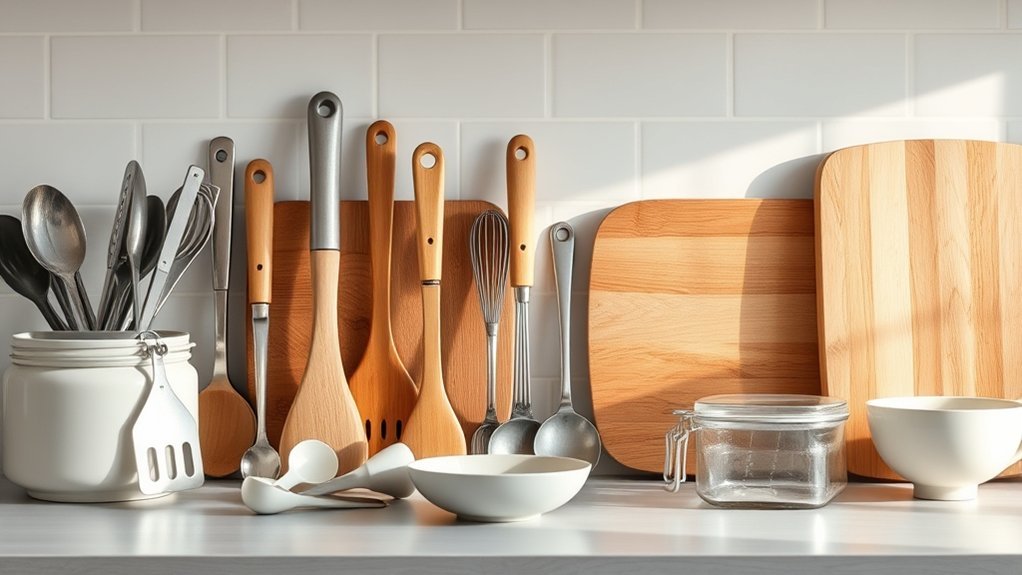
Kitchen utensils are hand-held tools used to prepare, cook, measure, mix, handle, and serve food. Common examples include knives, spatulas, whisks, measuring cups, peelers, ladles, and tongs. The best utensils match the task, cookware surface, and heat level while remaining comfortable to use and easy to clean. Materials such as stainless steel, wood, silicone, nylon, and glass each have different strengths, so choosing the right combination can make everyday cooking safer, faster, and more consistent.
Quick Answer
Kitchen utensils are small tools used for food preparation, cooking, measuring, mixing, draining, turning, and serving. Essential examples include a chef’s knife, spatula, wooden spoon, whisk, tongs, measuring cups and spoons, peeler, ladle, and can opener. Choose materials according to heat, cookware surface, cleaning needs, and the foods you prepare.
Key Takeaways
- Kitchen utensils cover tasks such as cutting, peeling, stirring, whisking, measuring, turning, draining, and serving.
- Stainless steel is durable; wood and silicone are gentle on coated cookware; nylon is lightweight but must stay within its stated heat limit.
- Pots and pans are technically cookware rather than hand-held utensils, although everyday speech often groups all kitchen equipment together.
- Keep utensils and cutting boards clean, and separate tools used with raw meat from ready-to-eat foods when practical.
- Buy versatile tools first and add specialized gadgets only when they solve a task you perform regularly.
What Are Kitchen Utensils?
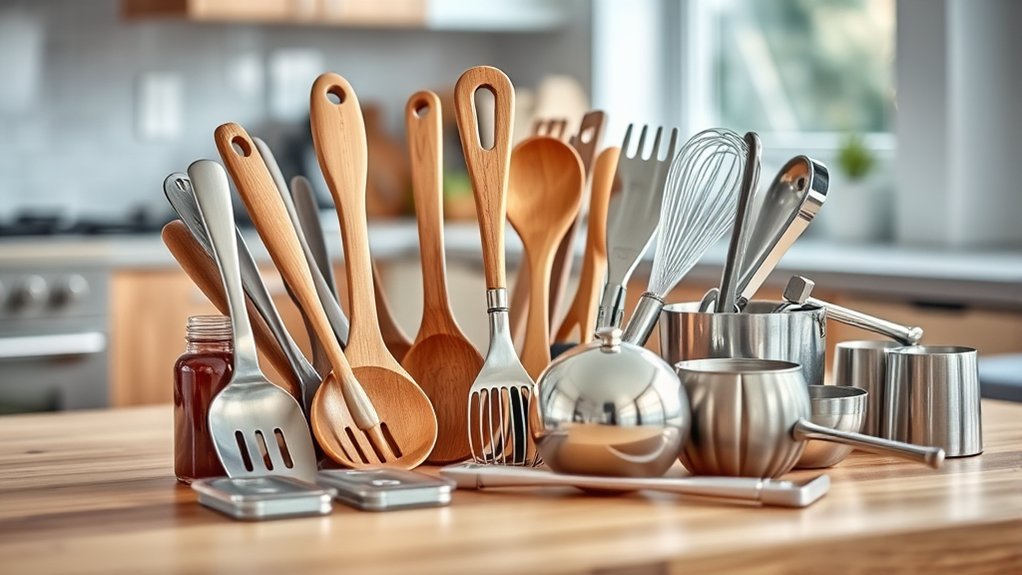
Kitchen utensils are small hand-held tools used during food preparation, cooking, and serving. They include general-purpose tools such as knives, spoons, spatulas, whisks, and tongs as well as specialized items designed for narrower jobs.
A chef’s knife, for example, can chop vegetables, slice meat, mince herbs, and handle many other preparation tasks. Specialized tools such as an egg separator, apple corer, citrus zester, pastry brush, or melon baller are useful when a specific task is performed often enough to justify the extra tool.
Kitchen utensils can be made from stainless steel, wood, silicone, nylon, plastic, glass, or combinations of materials. The most suitable material depends on heat exposure, cookware surface, food type, cleaning method, weight, grip, and durability.
It also helps to distinguish utensils from related kitchen equipment. In everyday conversation, people often call almost everything in a kitchen a utensil, but the categories are not identical.
| Category | What It Usually Means | Examples |
|---|---|---|
| Kitchen utensil | A hand-held tool used to prepare, cook, or serve food | Spatula, whisk, ladle, tongs |
| Kitchen tool | A broader term that includes utensils and other preparation equipment | Knife, cutting board, thermometer, can opener |
| Cookware | Vessels used to cook food | Frying pan, saucepan, stockpot |
| Eating utensils | Tools primarily used to eat food at the table | Dinner fork, table knife, soup spoon |
What Kitchen Utensils Are Used For
Kitchen utensils make food preparation more controlled and efficient. They are used to cut, peel, measure, stir, whisk, fold, turn, lift, drain, portion, and serve ingredients and finished dishes.
The easiest way to understand kitchen utensils is to group them by the job they perform.
| Task | Common Utensils and Tools | Typical Use |
|---|---|---|
| Cutting and preparation | Chef’s knife, paring knife, peeler, grater, kitchen shears | Chopping, trimming, peeling, shredding, slicing |
| Measuring | Measuring cups, measuring spoons, kitchen scale | Portioning dry and liquid ingredients accurately |
| Mixing | Whisk, spoon, silicone spatula, mixing bowl | Stirring, beating, folding, emulsifying |
| Cooking and turning | Turner, spatula, tongs, wooden spoon | Flipping, stirring, lifting, scraping |
| Draining | Colander, sieve, strainer, slotted spoon | Separating food from water, oil, or cooking liquid |
| Serving | Ladle, serving spoon, tongs, cake server | Portioning and transferring finished food |
Food Preparation Tasks
Essential kitchen utensils support food preparation tasks before ingredients reach the stove or oven. Chef’s knives and paring knives handle chopping, slicing, mincing, and trimming, while peelers, graters, zesters, and kitchen shears make specialized preparation faster.
Measuring cups and spoons help produce repeatable ingredient amounts. Accuracy is particularly important in baking, where the balance of flour, liquid, fat, leavening, and other ingredients can affect texture and structure.
Mixing bowls provide room for tossing salads, marinating foods, preparing batters, and combining ingredients. A practical collection does not need dozens of gadgets; versatile tools that are used regularly usually provide better value than highly specialized items that remain in a drawer.
Cooking And Baking Uses
During cooking, spatulas, spoons, ladles, and tongs help stir, turn, lift, scrape, and serve food while keeping hands away from hot cookware. A utensil should be long enough for the cooking vessel and made from a material suitable for the temperature and surface.
In baking, measuring cups, measuring spoons, kitchen scales, whisks, mixing bowls, scrapers, pastry brushes, and rolling pins support accurate measuring and controlled mixing. Silicone spatulas are especially useful for scraping bowls and gently folding ingredients.
The American Heart Association includes knives, measuring tools, spatulas, whisks, tongs, mixing bowls, a colander, and an instant-read thermometer among useful basic kitchen equipment. Its essential kitchen equipment guide also recommends choosing tools based on practical usefulness rather than buying a matching set simply for appearance.
Measuring And Mixing Tools
Measuring and mixing tools improve consistency by helping cooks control ingredient quantity and texture.
Dry measuring cups are generally designed to be filled and leveled, while liquid measuring cups usually have a spout and graduated markings that can be read at eye level. Measuring spoons handle small quantities, and a digital kitchen scale provides weight-based measurement when a recipe calls for grams or ounces.
Whisks combine ingredients and can incorporate air into eggs, cream, sauces, and batters. Silicone or flexible spatulas are useful for folding delicate mixtures and scraping bowls. Wooden or sturdy cooking spoons work well for stirring thicker foods.
Essential Kitchen Utensils for Everyday Cooking
A well-equipped kitchen does not need every gadget available. A compact group of versatile tools can handle most daily preparation and cooking.
A chef’s knife is one of the most useful cutting tools because it can chop vegetables, slice meat, mince herbs, and perform many general preparation tasks. Pair it with a stable cutting board that is large enough for the ingredients being prepared.
Measuring cups and spoons support portioning and recipe accuracy. A whisk handles sauces, dressings, eggs, and batters. Tongs provide controlled lifting and turning, while a wooden spoon or silicone spatula works well for stirring and scraping.
A useful kitchen is built around versatile tools that solve frequent tasks, not around the largest possible utensil collection.
A practical starter setup includes:
- Chef’s knife — general chopping and slicing
- Paring knife — trimming and smaller precision work
- Cutting board — stable preparation surface
- Measuring cups — portioning dry and liquid ingredients
- Measuring spoons — small-volume measurements
- Wooden spoon — stirring and scraping
- Silicone spatula — folding and bowl scraping
- Turner — flipping eggs, pancakes, burgers, and similar foods
- Tongs — lifting and turning food
- Whisk — beating and emulsifying
- Ladle — serving soups and sauces
- Colander or strainer — draining and rinsing
- Peeler — removing thin fruit and vegetable skins
- Can opener — opening canned foods
- Kitchen shears — trimming and snipping
Pro Tip: Buy the tools you will reach for every week before buying specialty gadgets. A good knife, cutting board, spoon, spatula, whisk, tongs, measuring tools, and strainer cover far more tasks than a drawer full of single-purpose accessories.
What’s the Difference Between Cooking and Eating Utensils?
Cooking utensils are designed to prepare, handle, cook, or serve food. Examples include spatulas, ladles, tongs, whisks, wooden spoons, and measuring cups.
Eating utensils are primarily designed for use at the table. Dinner forks, table knives, soup spoons, dessert spoons, and similar flatware are shaped for comfortable eating rather than for high heat or food preparation.
The main differences are purpose, size, construction, and material requirements. Cooking utensils often need heat resistance, longer handles, stronger joints, or shapes designed to scrape, turn, stir, or lift food. Eating utensils prioritize comfort, balance, portion size, and table presentation.
Cooking Tool Purposes
Cooking utensils support preparation and transformation of ingredients. A whisk blends and aerates, a spatula turns or scrapes, a ladle transfers liquids, and tongs grip food without requiring direct hand contact.
| Tool | Main Use | Useful Material Feature |
|---|---|---|
| Whisk | Mixing and aerating | Stiff wires and corrosion resistance |
| Spatula or turner | Turning and lifting food | Heat resistance and suitable edge flexibility |
| Tongs | Gripping and transferring | Strong hinge and comfortable grip |
| Colander | Draining | Durable perforated construction |
| Measuring cup | Portioning | Clearly marked capacity |
A frying pan is better classified as cookware, not a hand-held cooking utensil. The distinction matters because the pan’s surface determines which utensils should be used with it.
Eating Utensil Examples
Eating utensils include forks, knives, spoons, and other flatware used during meals. Dinner forks are used for main dishes, smaller forks may be used for salads or desserts, and table or dinner knives are shaped for cutting food on a plate.
Spoons also vary by purpose. Soup spoons hold liquids, teaspoons handle drinks and smaller portions, and dessert spoons are suited to foods such as pudding, custard, or ice cream.
Stainless steel is common because it is durable and easy to maintain, although wood, plastic, and other materials are also used in different settings and cultures.
Key Functional Differences
Cooking utensils must withstand the conditions of active food preparation. A spoon used in a hot saucepan may need a long handle and suitable heat resistance. A turner for a coated pan must avoid damaging the cooking surface. Tongs need enough strength to lift food securely.
Eating utensils, by comparison, emphasize comfort and ergonomics. Their shapes help users cut, spear, scoop, or transfer individual bites.
Utensil styles also differ among cuisines. Chopsticks, soup spoons, forks, knives, serving paddles, and other tools reflect the foods, preparation methods, and dining traditions in which they are used.
Common Kitchen Utensil Materials and Their Uses
Kitchen utensils are made from several materials, and no single material is ideal for every task. Consider heat exposure, cookware compatibility, stiffness, weight, cleaning requirements, and durability.
| Material | Advantages | Best Uses | Cautions |
|---|---|---|---|
| Stainless steel | Strong, corrosion-resistant, easy to clean | Whisks, ladles, tongs, strainers | Metal edges can scratch some coated cookware |
| Wood | Gentle on cookware, comfortable, does not readily scratch surfaces | Spoons, spatulas, rolling pins | Avoid long soaking; dry thoroughly |
| Silicone | Flexible and gentle on coated cookware | Scrapers, spatulas, pastry brushes | Heat ratings vary; follow the manufacturer’s limit |
| Nylon | Lightweight and inexpensive | Turners, spoons, pasta servers | Can soften or deform if used above its rated temperature |
| Glass | Nonporous and useful for measuring or mixing | Measuring cups and bowls designed for the intended use | Breakable; not all glass is designed for high heat or thermal shock |
Stainless steel is widely used because it combines strength, corrosion resistance, and easy cleaning. Metal utensils are excellent with durable uncoated cookware but may scratch some nonstick surfaces.
Wooden utensils are useful for stirring, mixing, and scraping because they are relatively gentle on cookware. Wash them promptly rather than leaving them soaking in water, and allow them to dry thoroughly.
Silicone utensils are flexible and popular for coated cookware. Silicone is a family of silicon-based polymers rather than simply another conventional plastic. Because formulations differ, use the temperature rating provided by the utensil manufacturer.
Nylon and other plastic utensils can be lightweight and convenient, but their heat tolerance is product-specific. Do not leave them resting against a hot burner, open flame, or cooking surface beyond their rated temperature.
Warning: Do not assume every silicone, nylon, plastic, or rubber-like utensil has the same heat limit. Check the manufacturer’s temperature rating, and replace tools that melt, warp, crack, peel, or shed material.
Copper, Iron, and Stainless Steel Utensils
Copper, iron, and stainless steel are more commonly discussed as cookware materials, although metal is also used in many hand-held kitchen tools.
Copper conducts heat very effectively, which is why it is valued in cookware. The important safety distinction is whether food contacts bare copper. The FDA Food Code restricts copper and copper-alloy food-contact surfaces with acidic foods below pH 6, including examples such as vinegar, fruit juice, and wine. Properly lined copper cookware separates food from the copper surface.
Iron and cast iron are durable cooking materials that retain heat well. Cast-iron cookware can develop a seasoned surface through repeated oiling and heating, but it should be kept dry to limit rust. Cast iron is primarily cookware rather than a common material for lightweight hand-held utensils.
Stainless steel is widely used for whisks, tongs, ladles, serving spoons, strainers, knives, and cookware because it is durable and resistant to corrosion. Its suitability for a specific cutting tool depends on the exact steel, blade geometry, heat treatment, and construction rather than on the words “stainless steel” alone.
Aluminum, Glass, and Plastic Utensils
Aluminum, glass, and plastic also appear across kitchenware, but their uses differ.
Aluminum is lightweight and conducts heat well, so it is particularly common in cookware and bakeware. It is less common for flexible hand-held utensils than stainless steel, silicone, nylon, or wood.
Glass is useful for measuring cups, mixing bowls, storage containers, and some bakeware. Only glass specifically designed for the intended heat exposure should be used in an oven or with hot liquids, and manufacturer instructions should be followed to reduce breakage from impact or thermal shock.
Plastic and nylon utensils are light and inexpensive and can be shaped into comfortable handles, spoons, turners, and serving tools. Their main limitation is heat. Product temperature ratings vary, so a tool suitable for stirring a warm mixture may not be appropriate for prolonged contact with a very hot skillet.
Silicone should be treated as a separate material category. It is commonly used in spatulas, pastry brushes, baking molds, and utensil tips because of its flexibility and compatibility with coated cookware.
| Material | Practical Note |
|---|---|
| Aluminum | Lightweight and thermally conductive; especially common in cookware and bakeware |
| Glass | Nonporous but breakable; use only as directed for heat exposure |
| Plastic or nylon | Lightweight; heat limits vary by product |
| Silicone | Flexible and cookware-friendly; follow the stated heat rating |
How to Match Utensils to Cookware
The utensil material should match the cookware surface. This reduces scratches, coating damage, melting, and unnecessary wear.
- Nonstick cookware: Use wood, silicone, or another utensil approved by the cookware manufacturer. Avoid sharp or abrasive metal edges unless the manufacturer specifically says they are safe.
- Stainless-steel cookware: Stainless-steel, wood, silicone, and many other utensils can generally be used without concern about scratching a delicate coating.
- Cast iron: Wood, silicone, and sturdy metal utensils are commonly used. Avoid tools that are damaged or poorly finished.
- Enameled cookware: Wood or silicone can reduce the chance of chipping or scratching the enamel.
- Copper cookware: Protect the lining or interior surface and follow the cookware maker’s utensil recommendations.
MedlinePlus guidance on cookware and cooking utensils recommends avoiding metal or hard plastic utensils on surfaces they can scratch and using materials such as wood, bamboo, or silicone where appropriate.
Note: “Safe for nonstick” is not determined by material name alone. Check both the cookware manufacturer’s instructions and the utensil’s heat rating.
How to Clean and Care for Kitchen Utensils
Good utensil care protects food, cookware, and the tools themselves. Wash food-contact utensils after use with appropriate dishwashing soap and water, then dry or air-dry them according to the material and manufacturer instructions.
The USDA Food Safety and Inspection Service advises washing cutting boards, dishes, and related surfaces after preparing food and recommends using separate boards for fresh produce and bread versus raw meat, poultry, and seafood when possible.
Prevent Cross-Contamination
Cross-contamination occurs when harmful microorganisms are transferred from one food or surface to another. Raw meat, poultry, and seafood deserve particular care because their juices can contaminate foods that may be eaten without further cooking.
- Start with clean utensils and cutting boards.
- When practical, use a separate cutting board for raw meat, poultry, and seafood.
- Use another board for produce, bread, and ready-to-eat foods.
- Wash knives, boards, countertops, and utensils after contact with raw animal foods.
- Do not place cooked food back on a dirty plate or surface that held raw food.
Care by Material
Stainless steel: Wash according to the product instructions and dry when needed to reduce spotting. Inspect hinges, handles, and joints for looseness.
Wood: Wash promptly and avoid prolonged soaking. Allow wooden spoons, boards, and similar tools to dry thoroughly before storage.
Silicone: Clean food residue from seams and handle joints. Replace a utensil if the silicone tears, separates from the handle, becomes sticky, or develops damage that prevents effective cleaning.
Nylon or plastic: Replace tools that melt, warp, crack, develop rough edges, or show other damage that can trap food.
Glass: Discard cracked, chipped, or badly damaged items rather than continuing to use them for food preparation.
When to Replace Kitchen Utensils
There is no single replacement schedule for every utensil. Condition matters more than age. Replace a tool when damage makes it difficult to clean, unsafe to handle, or unsuitable for its intended task.
Common replacement signs include:
- Deep cracks, splits, or splinters in wooden utensils
- Melted, rough, peeling, or warped plastic and nylon
- Torn or separating silicone
- Loose handles, broken hinges, or sharp damaged edges
- Severe rust or corrosion that cannot be properly removed
- Cracked or chipped glass
- Cutting boards with deep, hard-to-clean grooves
USDA specifically recommends replacing cutting boards that become excessively worn or develop grooves that are difficult to clean.
How Kitchen Utensils Have Evolved Over Time
Kitchen utensils developed from simple multipurpose tools into increasingly specialized devices as materials, manufacturing, and household technology changed.
Early kitchens relied heavily on knives, spoons, paddles, bowls, mortars, grinding tools, and other basic implements. Industrial manufacturing later made it easier to produce specialized tools with gears, cutting mechanisms, shaped blades, and standardized measurements.
Documented nineteenth-century examples show this trend clearly. The Smithsonian’s National Museum of American History preserves a can opener associated with an 1887 patent as well as later mechanical food-preparation devices. Mechanical egg beaters and mixers illustrate how kitchen tools became more specialized for repetitive jobs.
During the twentieth century and beyond, stainless steel, aluminum, engineered polymers, silicone, improved glass, and coated cookware expanded the available choices. Modern utensil design increasingly focuses on comfort, cleaning, heat resistance, cookware compatibility, storage, and specialized functions.
- Early tools were relatively simple and multipurpose.
- Mechanical inventions created tools for repetitive preparation jobs.
- Industrial materials increased durability and reduced maintenance.
- Modern designs emphasize ergonomics, cookware protection, cleaning, and convenience.
The result is not that every new gadget is necessary. Basic tools such as knives, spoons, tongs, whisks, and measuring utensils remain useful because they solve common tasks efficiently.
How to Choose Kitchen Utensils for Your Home
Choose kitchen utensils according to the foods you cook, the cookware you own, your available storage, and how much maintenance you are willing to do.
Start with versatile, multi-functional tools. A chef’s knife, cutting board, measuring tools, whisk, spoon, spatula, tongs, peeler, and strainer cover a large share of everyday preparation.
Then consider material. Stainless steel offers strength and corrosion resistance. Wood is comfortable and gentle on cookware. Silicone is flexible and useful with coated surfaces. Nylon is lightweight but must stay within its heat rating.
Your cooking style should guide specialty purchases. Someone who bakes frequently may benefit from a digital scale, pastry brush, bench scraper, rolling pin, and additional measuring tools. Someone who cooks soups and stews may use ladles, skimmers, and long-handled spoons more often.
Storage matters as well. Nesting bowls and measuring cups save cabinet space. Frequently used spoons, spatulas, and tongs can be stored in a utensil crock if they remain clean and protected from contamination. Sharp knives should be stored so their edges are protected and cannot accidentally cut someone reaching into a drawer.
Building the collection gradually is often more practical than buying a large set at once. Add a specialized utensil when you know the job it will perform and expect to use it regularly.
Frequently Asked Questions
What Are Kitchen Utensils and Examples?
Kitchen utensils are hand-held tools used to prepare, cook, handle, measure, or serve food. Examples include a chef’s knife, spatula, wooden spoon, whisk, tongs, measuring cups, measuring spoons, ladle, vegetable peeler, grater, strainer, and can opener. Cookware such as frying pans and saucepans is related kitchen equipment but is usually categorized separately.
What Are 50 Common Kitchen Utensils?
Fifty common kitchen utensils and tools include:
- Chef’s knife
- Paring knife
- Bread knife
- Carving knife
- Boning knife
- Kitchen shears
- Cutting board
- Vegetable peeler
- Box grater
- Microplane or fine zester
- Can opener
- Bottle opener
- Corkscrew
- Measuring cups
- Liquid measuring cup
- Measuring spoons
- Kitchen scale
- Mixing bowl
- Balloon whisk
- Wooden spoon
- Solid cooking spoon
- Slotted spoon
- Silicone spatula
- Turner
- Slotted turner
- Fish spatula
- Kitchen tongs
- Ladle
- Pasta server
- Skimmer
- Colander
- Fine-mesh strainer
- Sieve
- Funnel
- Rolling pin
- Pastry brush
- Bench scraper
- Pastry cutter
- Pizza cutter
- Garlic press
- Potato masher
- Mortar and pestle
- Citrus reamer
- Melon baller
- Apple corer
- Ice-cream scoop
- Food thermometer
- Meat tenderizer
- Serving spoon
- Cake or pie server
What Are 10 Essential Kitchen Tools?
Ten useful kitchen basics are a chef’s knife, cutting board, measuring cups, measuring spoons, wooden spoon, silicone spatula or turner, whisk, tongs, colander or strainer, and can opener. Depending on the foods you cook, a food thermometer, paring knife, ladle, and peeler are also valuable additions.
What Are 20 Kitchen Tools?
Twenty practical kitchen tools are:
- Chef’s knife
- Paring knife
- Cutting board
- Measuring cups
- Measuring spoons
- Mixing bowls
- Silicone spatula
- Whisk
- Tongs
- Ladle
- Vegetable peeler
- Box grater
- Colander
- Fine-mesh strainer
- Wooden spoon
- Can opener
- Corkscrew or bottle opener
- Food thermometer
- Rolling pin
- Microplane or zester
What Material Is Best for Kitchen Utensils?
There is no single best material. Stainless steel is strong and durable, wood is gentle on cookware, silicone is flexible and useful with coated pans, and nylon is lightweight. Choose according to the cooking temperature, cookware surface, cleaning method, and task.
Which Utensils Are Best for Nonstick Cookware?
Wooden and silicone utensils are commonly suitable for nonstick cookware because they are less likely to scratch the coating. Some nylon utensils may also be suitable if their heat rating is high enough. Always follow the cookware manufacturer’s instructions and avoid sharp or abrasive utensils that can damage the surface.
Conclusion
Kitchen utensils may be small, but they shape almost every stage of meal preparation. The most useful collection combines versatile tools, suitable materials, safe handling, and proper care. Start with dependable basics such as knives, measuring tools, spoons, spatulas, whisks, tongs, and strainers. Match each utensil to the cookware and temperature, keep food-contact surfaces clean, and replace damaged tools when they become difficult to use or clean safely.
Sources
- USDA Food Safety and Inspection Service — Cutting Boards — cross-contamination, cleaning, and replacement guidance.
- U.S. Food and Drug Administration — Food Code 2022 — food-contact material standards and copper-use limitations.
- MedlinePlus — Cooking Utensils and Nutrition — cookware materials, nonstick-surface care, copper, and cutting-board guidance.
- American Heart Association — Essential Kitchen Equipment and Utensils — practical starter kitchen tools and equipment.
- Smithsonian National Museum of American History — Can Opener — documented example of nineteenth-century kitchen-tool innovation.

1 thought on “What Are Kitchen Utensils? Meaning, Uses & Key Facts”