
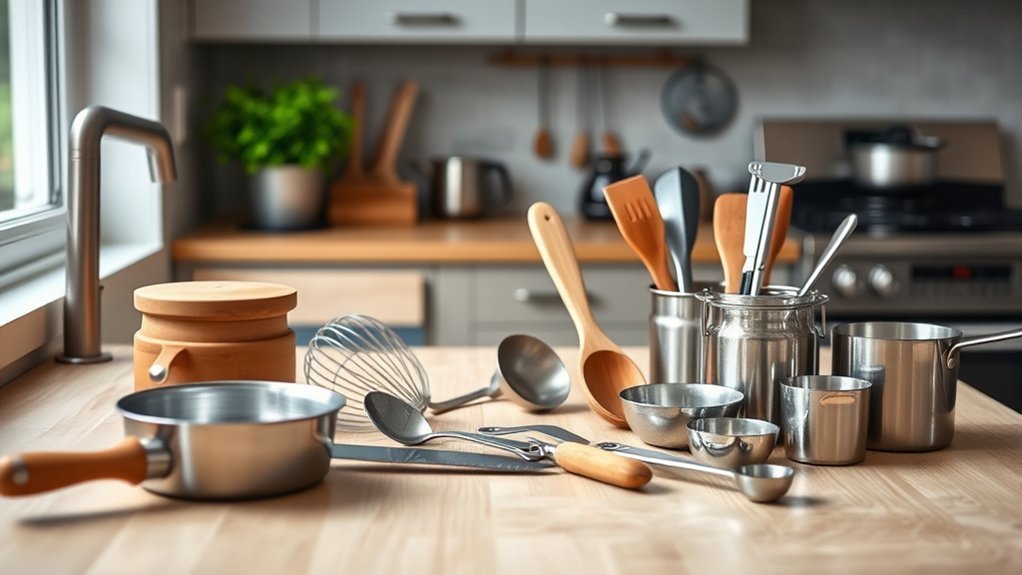
The essential cooking utensils for a first kitchen are a chef’s knife, cutting board, measuring cups and spoons, mixing bowls, wooden spoon, silicone spatula, tongs, vegetable peeler, whisk, and colander. An 8-inch chef’s knife, 9- to 12-inch tongs, and 10- to 12-inch spatula suit many everyday tasks. If you are outfitting the whole kitchen rather than buying utensils alone, add a versatile skillet and a few basic pots.
Quick Answer
Start with tools that handle several jobs: an 8-inch chef’s knife, sturdy cutting board, measuring cups and spoons, mixing bowls, wooden spoon, silicone spatula, 9- or 12-inch tongs, peeler, whisk, and colander. Add specialized tools only when your cooking habits show that you will use them regularly.
Key Takeaways
- An 8-inch chef’s knife and a stable cutting board form the core of a practical prep setup.
- Silicone and wood are gentle on coated cookware, while stainless-steel tools suit many high-heat jobs on durable, uncoated surfaces.
- Silicone heat limits vary by product, so follow the manufacturer’s temperature rating instead of assuming every utensil is safe to 600°F.
- Use separate cutting boards for raw meat, poultry, or seafood and ready-to-eat foods when possible, and replace boards with deep, hard-to-clean grooves.
- Buy a small group of versatile tools first, then add specialized utensils according to what you actually cook.
What Cooking Utensils Do You Need First?
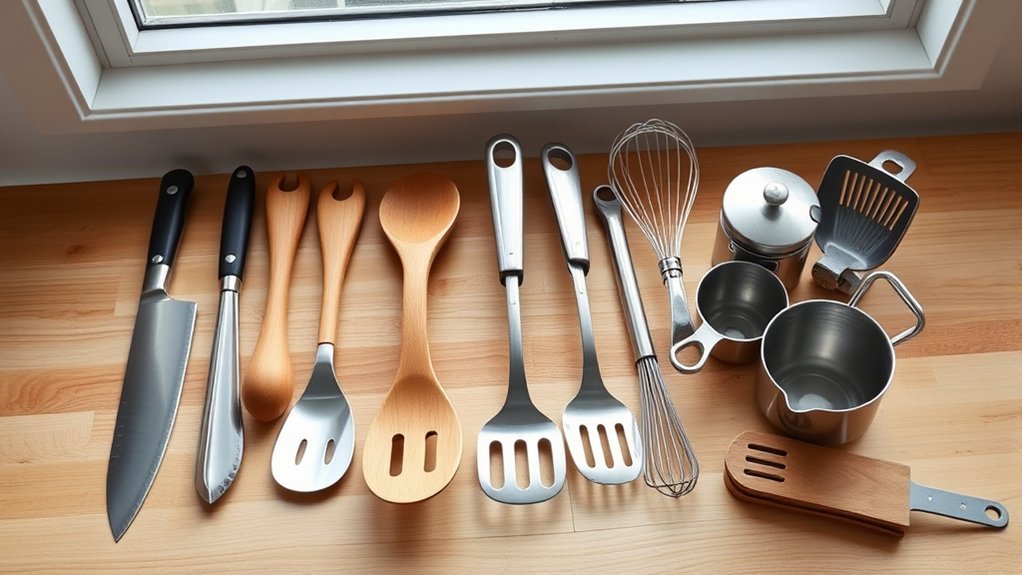
The first utensils to buy are the ones that cover several common jobs. A chef’s knife around 8 inches is a practical starting point for chopping vegetables, slicing meat, mincing herbs, and many other prep tasks. The American Heart Association includes an 8- or 10-inch chef’s knife among its recommended basic kitchen equipment.
A small group of versatile tools is usually more useful than a large utensil set filled with duplicates and rarely used gadgets.
Pair the knife with a sturdy cutting board. Plastic and wood can both work, but food safety depends heavily on keeping the board clean and preventing juices from raw meat, poultry, or seafood from reaching ready-to-eat foods.
Add dry measuring cups, measuring spoons, and a liquid measuring cup if you follow recipes regularly. Mixing bowls in several sizes make it easier to whisk, toss, marinate, and combine ingredients without needing a separate container for every task.
A wooden spoon, flexible silicone spatula, tongs, vegetable peeler, whisk, and colander complete a lean everyday kit.
Note: A frying pan is technically cookware rather than a utensil. If you are building an entire kitchen, however, an 8- to 12-inch skillet is a useful addition alongside the hand tools listed here.
Which Cooking Utensils Are Worth Buying First?
The best first purchases are tools that solve several everyday problems rather than performing only one narrow job. Spend first on a comfortable chef’s knife, a stable cutting board, dependable measuring tools, and utensils that match the surfaces of your cookware.
After those basics, a mixing-bowl set, silicone spatula, wooden spoon, tongs, peeler, whisk, and colander add flexibility for cooking, baking, draining, serving, and cleanup.
Must-Have Starter Tools
| Tool | Practical Size | Best For |
| Chef’s knife | About 8 inches | Chopping, slicing, dicing, mincing |
| Cutting board | Large enough to keep food on the board | Safe, stable food preparation |
| Measuring cups and spoons | Standard nested set | Cooking and baking measurements |
| Mixing bowls | Small, medium, and large | Mixing, whisking, marinating, serving |
| Wooden spoon | About 10–14 inches | Stirring sauces, soups, and thicker mixtures |
| Silicone spatula | About 10–12 inches | Scraping, folding, stirring, coated cookware |
| Tongs | 9 or 12 inches | Turning, tossing, serving |
| Vegetable peeler | Standard handheld size | Peeling vegetables and fruit |
| Whisk | About 9–12 inches | Eggs, sauces, dressings, batters |
| Colander | Medium size | Draining pasta, vegetables, and rinsed foods |
These ten tools cover most routine prep and stovetop tasks without filling a drawer with single-purpose gadgets.
Smart First Purchases
If the budget is limited, buy in stages. Start with the knife, cutting board, measuring tools, one mixing bowl, wooden spoon, and spatula. Add tongs, a peeler, whisk, and colander as soon as the recipes you cook call for them.
A paring knife around 3 to 4 inches is useful for trimming, coring, and small detailed cuts. A serrated bread knife is the next useful blade if you regularly slice bread, tomatoes, cakes, or foods with a firm exterior and soft interior.
Pro Tip: Avoid choosing a utensil set by piece count alone. A smaller set containing tools you use every week usually offers better value than a 20- or 30-piece bundle padded with duplicate spoons and specialized gadgets.
Essential Cooking Utensils for Prep
Prep work starts with a sharp chef’s knife and stable cutting surface. An 8-inch blade is a comfortable all-purpose size for many home cooks, while people with larger hands or larger cutting tasks may prefer a 9- or 10-inch knife.
A separate paring knife helps with peeling, trimming, coring, and other small jobs. A serrated knife becomes valuable for bread and foods that are difficult to slice cleanly with a straight edge.
For measurement, a starter kitchen benefits from a set of dry measuring cups, a set of measuring spoons, and a clear liquid measuring cup with a pouring spout. Dry and liquid measuring tools are shaped differently because they are used differently, even when the stated volume is the same.
Mixing bowls in roughly small, medium, and large sizes cover whisking eggs, tossing salads, marinating food, preparing batter, and serving. Stainless steel and glass are common choices; the best material depends on weight, break resistance, and how the bowls will be used.
A peeler, whisk, wooden spoon, silicone spatula, and kitchen tongs round out the main prep tools. A box grater, kitchen shears, citrus reamer, or bench scraper can be added later if they match your cooking habits.
Best Sizes for Spoons, Tongs, and Spatulas
There is no single mandatory utensil length, but a few size ranges work well in an average home kitchen.
For measuring, a U.S. tablespoon equals about 14.79 mL and a teaspoon about 4.93 mL according to NIST. Recipes commonly round those figures to 15 mL and 5 mL.
For cooking and serving spoons, roughly 10 to 14 inches gives enough reach for most saucepans and stockpots. A ladle with a roughly 2- to 4-ounce bowl is useful for soups and sauces, although the ideal capacity depends on the portion size you serve.
For tongs, 9-inch tongs give good control for smaller foods and serving, while 12-inch tongs provide more distance from heat when turning meat or vegetables in a hot pan.
A flexible silicone spatula around 10 to 12 inches is convenient for bowls, sauces, batters, and coated cookware. A wider slotted turner around 10 to 14 inches is more useful for lifting pancakes, burgers, eggs, fish, and other foods that need support underneath.
Which Utensil Materials Work Best?
The best utensil material depends on the cookware surface, heat level, cleaning method, and job. Stainless steel, silicone, and wood all have useful roles, but they are not interchangeable in every pan.
Stainless Steel Durability
Stainless-steel utensils are strong, rigid, and well suited to tasks such as lifting, whisking, serving, and turning food in durable uncoated cookware. They tolerate normal stovetop heat well and are often easy to clean.
The main limitation is surface compatibility. Metal tools can scratch or mark some nonstick, enamel, and other coated cooking surfaces, so the cookware manufacturer’s care instructions should take priority.
For stainless-steel pans, cast iron, and other robust uncoated cookware, a metal turner, ladle, or whisk can provide the firmness needed for scraping, flipping, or handling heavier foods.
Silicone And Wood
Silicone is flexible and non-abrasive, making it useful for scraping bowls and cooking in coated pans. However, heat resistance varies by product. For example, OXO specifies up to 600°F for one of its silicone spatulas, while Le Creuset specifies 482°F/250°C for its silicone utensils.
Warning: Do not assume every silicone or nylon utensil has the same heat limit. Check the manufacturer’s stated temperature rating, and do not leave utensils resting against a hot burner, pan edge, or heating element.
Wooden utensils are sturdy and gentle on many cookware surfaces. They work especially well for stirring sauces, soups, grains, and thicker mixtures. Wood should normally be washed promptly and dried well rather than left soaking; follow the manufacturer’s instructions for oiling or other maintenance.
Nylon utensils can also be gentle on coated cookware, but their heat limits vary and may be lower than those of high-temperature silicone. Use them only within the manufacturer’s stated temperature range.
How to Build a Starter Utensil Set
A practical starter utensil set begins with a versatile 8-inch chef’s knife and a small paring knife for detail work. Add a serrated knife later if you frequently cut bread or delicate foods with tough skins.
Next, buy a large cutting board, dry and liquid measuring tools, and two or three mixing bowls. These pieces handle the bulk of chopping, measuring, mixing, and marinating.
For stovetop work, add a wooden spoon, silicone spatula, and spring-loaded tongs. A whisk improves sauces, eggs, dressings, and baking tasks, while a colander handles draining.
A dependable can opener is useful if canned ingredients are part of your normal cooking. A ladle, box grater, kitchen shears, instant-read thermometer, and potato masher can be added according to the meals you prepare most often.
If you are also buying cookware, a medium saucepan and one versatile skillet are more useful starting points than a large matching cookware set. The American Heart Association’s basic-equipment guidance likewise includes common skillets, saucepans, mixing bowls, tongs, measuring equipment, and an instant-read thermometer.
How to Use and Care for Kitchen Utensils Safely
Kitchen utensils can transfer bacteria from raw foods to foods that are ready to eat. USDA FSIS recommends starting with a clean cutting board and, when possible, using one board for fresh produce and another for raw meat, poultry, and seafood.
FoodSafety.gov also advises washing cutting boards, dishes, and utensils that contact raw meat, poultry, seafood, eggs, or flour with hot, soapy water before they are reused.
Replace cutting boards that become excessively worn or develop deep grooves that are difficult to clean. Inspect other utensils for cracked handles, melted edges, loose parts, sharp burrs, splintering wood, or damage that prevents thorough cleaning.
Keep knives sharp enough to cut predictably and store their edges where they cannot strike other utensils or hands. A knife block, properly installed magnetic strip, sheath, or drawer insert protects both the blade and the person reaching into the drawer.
What Tools Should You Add After the Basics?
Once the starter set is working well, add tools according to the foods you actually prepare. Common second-stage additions include:
- Instant-read thermometer: useful for checking doneness and food-safe internal temperatures.
- Serrated knife: useful for bread, tomatoes, cakes, and foods with a firm exterior and soft interior.
- Kitchen shears: helpful for herbs, packaging, poultry prep, and other cutting jobs where scissors offer more control.
- Box grater or rasp: useful for cheese, vegetables, citrus zest, garlic, and spices.
- Ladle: useful for soup, stew, sauce, and portioning.
- Can opener: essential for kitchens that regularly use canned foods.
- Bench scraper: useful for moving chopped ingredients and working with dough.
- Pot holders or oven mitts: necessary for safely handling hot cookware and bakeware.
Single-purpose gadgets can still be worthwhile when they solve a frequent problem. The goal is not to avoid specialized tools entirely, but to buy them because they match your cooking routine rather than because they came in a large set.
Frequently Asked Questions
What Are the Most Essential Cooking Utensils?
The most essential cooking utensils are an 8-inch chef’s knife, cutting board, measuring cups and spoons, mixing bowls, wooden spoon, silicone spatula, tongs, vegetable peeler, whisk, and colander. These tools cover chopping, measuring, mixing, stirring, turning, peeling, whisking, and draining.
What Are 10 Essential Kitchen Utensils?
A practical list of 10 is a chef’s knife, cutting board, measuring cups and spoons, mixing bowls, wooden spoon, silicone spatula, kitchen tongs, vegetable peeler, whisk, and colander. A can opener, serrated knife, ladle, grater, kitchen shears, and thermometer are useful additions after the basics.
What 6 Kitchen Tools Should You Throw Away?
There is no universal six-item list, but six common categories deserve replacement when damaged: deeply grooved cutting boards, cracked or splintering utensils, tools with melted edges, utensils with loose handles or parts, broken measuring tools, and cookware or utensils whose damaged surfaces can no longer be cleaned or used as intended. Duplicate or unused tools can be donated if they remain safe and functional.
What Are Some Essential Basic Kitchen Utensils?
Basic kitchen utensils include a chef’s knife, cutting board, measuring spoons and cups, mixing bowls, silicone spatula, wooden spoon, whisk, peeler, tongs, and colander. Choose materials that suit your cookware and tools that feel comfortable and secure in your hand.
Is Silicone or Wood Better for Cooking Utensils?
Neither is universally better. Silicone is flexible, easy to scrape with, and gentle on coated cookware, while wood is rigid, comfortable for stirring, and also gentle on many surfaces. Silicone heat limits vary by product, and wooden tools require prompt washing and thorough drying.
How Many Cutting Boards Should a Kitchen Have?
Having at least two is practical when raw meat, poultry, or seafood is prepared regularly. USDA guidance recommends, when possible, one board for fresh produce and ready-to-eat foods and another for raw meat, poultry, and seafood to reduce cross-contamination.
Sources
- USDA Food Safety and Inspection Service — Cutting Board Cross-Contamination Guidance — supports separate-board, cleaning, and replacement guidance.
- FoodSafety.gov — Four Steps to Food Safety — supports cleaning and separating boards, plates, and utensils that touch raw foods.
- National Institute of Standards and Technology — U.S. Customary to Metric Conversions — supports tablespoon and teaspoon volume conversions.
- American Heart Association — Essential Kitchen Equipment and Utensils — supports common starter knife, mixing, measuring, tong, cookware, and thermometer recommendations.
- Le Creuset — Care and Use — supports silicone utensil temperature and care guidance.
- OXO — Silicone Spatula Specifications — demonstrates that some silicone utensils have manufacturer-specific ratings up to 600°F.
Conclusion
A good starter kitchen does not need a crowded utensil drawer. Begin with a versatile chef’s knife, cutting board, measuring tools, bowls, spoon, spatula, tongs, peeler, whisk, and colander, then add specialized tools only when your cooking routine calls for them.
Material matters as much as quantity. Match stainless steel, silicone, wood, or nylon to the cookware surface and heat level, follow each manufacturer’s care limits, and replace tools that become damaged or difficult to clean. A modest collection of well-chosen utensils is usually easier to use, store, and maintain than an oversized set.

1 thought on “What Cooking Utensils Do I Need: Essential Sizes & Buying Guide”