
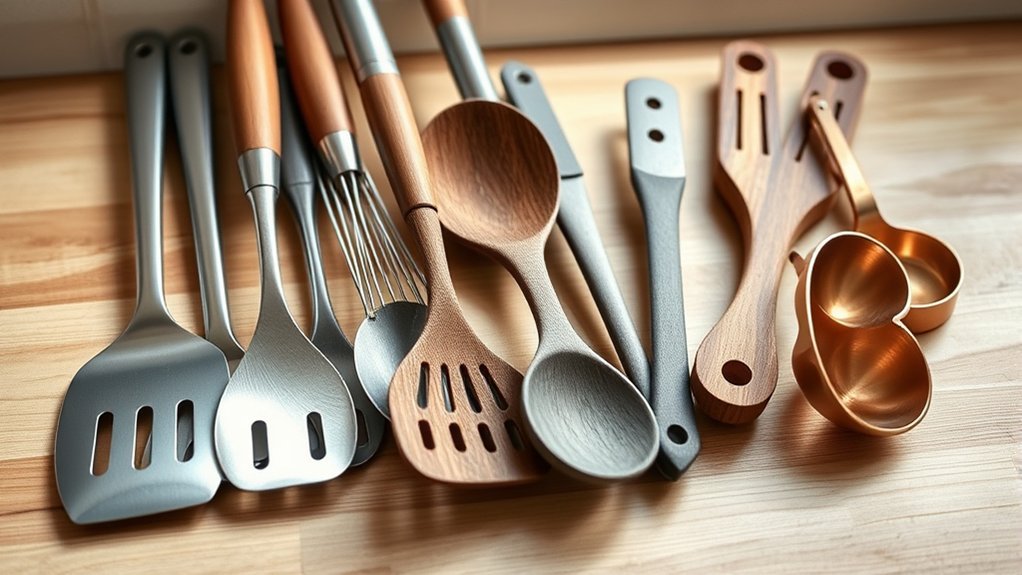
Kitchen utensils are commonly made from food-contact silicone, stainless steel, wood, bamboo, nylon, plastic, ceramic, and glass. The right material depends on the task, the cookware surface, heat exposure, cleaning method, and the tool’s construction. Stainless steel provides strength, silicone and nylon are gentle on coated pans, and wood or bamboo offers a rigid but cookware-friendly alternative. Ceramic, glass, copper, aluminum, and cast iron are more common in measuring tools, serving pieces, bakeware, and cookware than in everyday spatulas or spoons.
Quick Answer
Most cooks are best served by a mix of stainless steel, silicone, and wood. Use stainless steel when strength matters, silicone or nylon on delicate nonstick surfaces, and wood for stirring and scraping. Always follow the finished utensil’s stated heat limit because temperature ratings vary by formulation and product.
Key Takeaways
- There is no single best utensil material. The best choice depends on heat, cookware surface, rigidity, cleaning, and maintenance.
- Silicone heat ratings are product-specific. Some tools are rated very high, but the manufacturer’s limit should always control.
- Stainless steel is durable but can scratch PTFE, ceramic-coated, and enameled cooking surfaces.
- Wood and bamboo require drying and inspection for cracks, splitting, rough surfaces, or trapped food.
- Replace damaged utensils. Melting, deep gouges, peeling surfaces, loose heads, exposed cores, rust, splinters, and chipped glaze are signs a tool has reached the end of its useful life.
How to Choose Utensil Materials
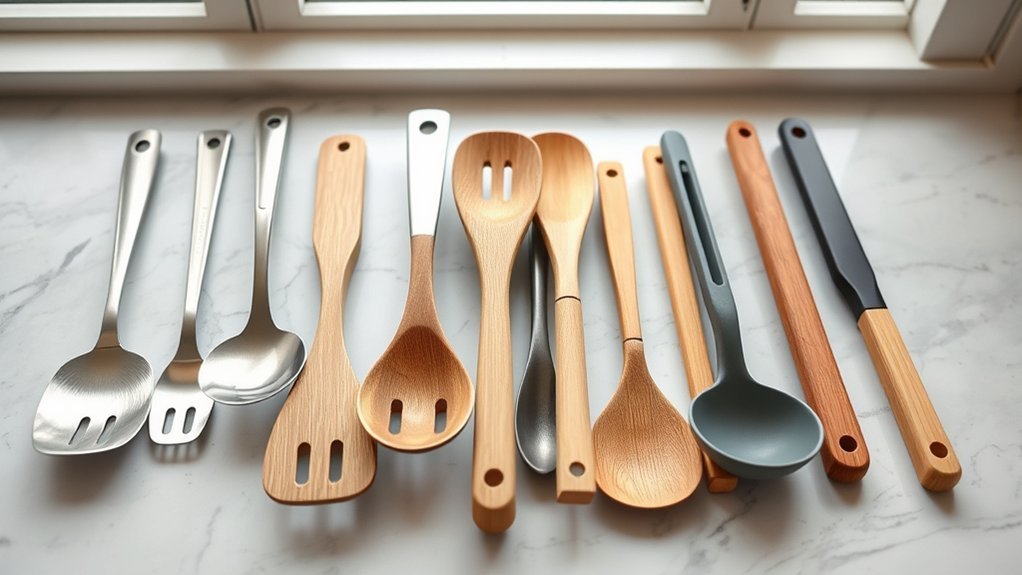
When selecting kitchen utensil materials, start with the job rather than choosing one material for an entire set. Food-contact silicone, stainless steel, and hardwood are useful choices because each solves a different problem.
Silicone is flexible and gentle on coated cookware. Stainless steel offers rigidity and long service life. Hardwood is useful for stirring, scraping, and handling foods without a metal edge contacting the pan.
Choose a utensil for the pan, heat level, and task rather than assuming one material is best for everything.
Heat resistance must be judged from the finished product’s rating. For example, some silicone spatulas are manufacturer-rated to 600°F, but this is not a universal limit for all silicone products. Health Canada advises using silicone products according to their intended use and stated limits.
Cleaning demands matter as well. Stainless steel and many silicone tools are dishwasher safe, while wood and bamboo generally benefit from prompt washing and thorough drying. Always follow the manufacturer’s care instructions because handles, adhesives, cores, coatings, and decorative finishes may have different limitations from the main utensil material.
Note: “Food-grade” does not mean that every product made from that material has the same heat limit. Check the manufacturer’s food-contact, temperature, dishwasher, and cookware-compatibility instructions for the finished utensil.
Safe Materials for Kitchen Utensils
Safe kitchen utensils are made from materials and finishes intended for food contact and used within the conditions specified by the manufacturer. Practical options include stainless steel, food-contact silicone, wood, bamboo, nylon, glass, and properly manufactured ceramic.
Food-contact silicone is useful where flexibility and a soft cooking edge are important. The U.S. FDA lists silicones and silicone elastomers within its food-contact regulatory framework, but authorization depends on the substance and its intended conditions of use. See the FDA food-contact substance inventory.
Stainless steel is strong, corrosion resistant, easy to clean, and well suited to rigid spoons, whisks, tongs, ladles, and turners. Wood and bamboo are also suitable when kept clean, dry, smooth, and free of cracks.
Ceramic and glass are non-reactive choices for measuring, mixing, baking, or serving, although they are more breakable than metal, wood, or silicone. With ceramic products, food-use labeling and the quality of the glaze matter more than vague claims such as “chemical-free.”
Warning: Do not use decorative ceramicware for food unless it is intended for food contact. Improperly manufactured or damaged glazes can release lead or other metals. The FDA specifically warns about certain traditional, antique, damaged, or poorly identified ceramic pieces.
Silicone, Nylon, and Plastic Utensils
Silicone, nylon, and other plastics are popular for coated cookware because they generally have softer contact surfaces than metal. Their performance, however, depends heavily on the exact polymer, formulation, construction, temperature rating, and condition of the tool.
Silicone is usually chosen for flexibility and heat resistance. Nylon is light, rigid, inexpensive, and useful for many everyday utensils. Other plastics can work well for cold or moderate-temperature tasks when they are specifically manufactured for that purpose.
Silicone Heat Resistance
Heat tolerance is an important consideration when choosing a silicone spatula, spoon, brush, or turner. Some high-quality products carry very high manufacturer ratings; for example, particular OXO silicone spatulas are rated to 600°F. That figure should not be applied to every silicone utensil.
The safer rule is simple: follow the temperature printed by the manufacturer. Different silicone formulations, fillers, internal cores, handles, and bonded parts can have different limitations.
Food-contact silicone is useful for sautéing, stirring, folding, scraping, and working with coated cookware because it is flexible and does not have the hard edge of a metal utensil.
Avoid placing silicone directly in a flame or leaving it resting against an extremely hot burner or pan surface unless the product is explicitly designed for that exposure.
Nylon For Everyday Use
Nylon utensils provide a practical middle ground for everyday cooking. They are lightweight, inexpensive, and generally gentle on nonstick cookware.
A rating around 200°C (392°F) appears on some nylon utensils, but it should not be treated as a universal material limit. Different nylon formulations and finished products have different ratings. Check the packaging or manufacturer’s instructions before using nylon around high heat.
Nylon is useful for turners, slotted spoons, ladles, pasta servers, and similar tools where moderate rigidity is more useful than the flexibility of silicone.
Many nylon products are dishwasher safe, but repeated high heat, rough use, or contact with a hot pan edge can eventually cause wear, discoloration, roughness, or deformation.
Plastic Safety And Limits
Plastic utensils vary widely, so safety cannot be determined from the word “plastic” alone. The relevant questions are whether the utensil is intended for food contact, whether it is being used within its stated temperature range, and whether its surface remains intact.
Health Canada recommends using plastic food-contact products only for their intended purpose and avoiding products that are visibly damaged, stained, or unpleasant smelling.
Research has also examined particles released from plastic and PTFE kitchenware during food preparation. A 2024 study found increased microplastic contamination in a food simulant after contact with plastic cookware, although the researchers emphasized that the human-health implications of ingesting microplastics remain unclear.
For a worn plastic utensil with deep scratches, melting, frayed edges, or a rough surface, replacement is a practical precaution.
Wood, Bamboo, and Hardwood Tools
Wood utensils provide a firm but relatively gentle cooking surface and do not have the sharp, rigid edge of metal. They work well for stirring sauces, mixing batters, scraping fond, and cooking in many types of cookware.
Bamboo is lightweight and absorbs relatively little moisture compared with many woods, but it can split or crack if repeatedly soaked or exposed to harsh dishwasher cycles.
Hardwoods such as acacia, maple, walnut, beech, and olive are common choices because a dense, smooth tool can remain useful for years when washed and dried correctly.
Wood Tools And Safety
Wood is suitable for food preparation when it is maintained properly. It is non-reactive with ordinary cooking ingredients and does not scratch cookware as readily as metal.
Food hygiene depends more on cleaning and condition than on assuming the wood itself will kill microorganisms. Wash wooden tools after use, remove food residue, and allow them to dry thoroughly before storage.
USDA guidance on wooden and bamboo cutting surfaces emphasizes washing after use and replacing surfaces that become excessively worn or develop hard-to-clean grooves. The same practical principle applies to wooden utensils with deep cracks or splits.
Do not use a wooden utensil that has splintered, developed persistent mold, become deeply cracked, or has a loose bonded section that cannot be cleaned properly.
Bamboo Durability And Care
Bamboo utensils combine low weight with a firm cooking edge. USDA notes that bamboo cutting boards absorb little moisture and resist knife scarring better than many woods; however, bamboo utensils still require appropriate care.
Repeated soaking, delayed drying, or dishwasher exposure can cause some bamboo products to warp, split, or crack. Hand-washing and prompt drying are usually the safest approach unless the manufacturer specifically says the utensil is dishwasher safe.
If the manufacturer recommends conditioning, use a finish specifically intended for food-contact wood or bamboo. Avoid using an unknown oil, varnish, or furniture finish on a utensil that contacts food.
Stainless Steel Kitchen Utensils
Stainless steel is one of the most durable materials for whisks, tongs, ladles, spoons, skimmers, serving utensils, and turners. Common stainless grades include 201, 304, and 316.
Type 304, often described as 18/8 or 18/10 stainless depending on composition and labeling convention, is widely used in food-contact applications. Type 316 contains molybdenum and provides greater resistance in more corrosive environments. Type 201 uses less nickel and more manganese than common 300-series grades and generally provides somewhat lower corrosion resistance, but it is still used for kitchen utensils and household products.
| Grade | Key Trait | Kitchen Context |
|---|---|---|
| 201 | Lower nickel; economical | Some utensils and household products |
| 304 | Strong general corrosion resistance | Common food-contact utensils |
| 316 | Higher resistance to aggressive environments | Specialty and demanding food applications |
Stainless-steel producer Outokumpu lists Type 201 among grades used for kitchen utensils, while its 316 family is intended for applications requiring greater corrosion resistance.
Do not rely on a single generic temperature figure such as 250°C (482°F) for all stainless utensils. The steel itself may tolerate substantial heat, but a finished tool can also contain plastic handles, silicone grips, adhesives, springs, welds, or other components with lower limits.
The main practical drawback is cookware compatibility: a stainless-steel edge can scratch or mark PTFE nonstick, ceramic-coated, or enameled surfaces.
Copper, Aluminum, and Cast Iron
Copper, aluminum, and cast iron are much more common as cookware materials than as everyday handheld cooking utensils. They are still relevant because material choice affects how cookware interacts with the utensil used on it.
Copper conducts heat rapidly and allows responsive temperature control, but copper cookware is normally lined where food contact would otherwise create unwanted reactions.
Aluminum is lightweight and conducts heat efficiently. Anodized or coated surfaces improve durability and reduce direct interaction between food and bare aluminum.
Cast iron is heavy, durable, and valued for heat retention. Proper cleaning, drying, and seasoning help prevent rust on traditional unenameled cast iron.
Copper Heat Conductivity
Copper is valued for rapid, even heat response, which is why it is widely used in premium cookware. This property matters more for the pan than for the spoon or spatula used with it.
When using lined copper cookware, choose utensil materials that will not damage the lining. Silicone, wood, and other manufacturer-approved non-abrasive tools are useful where a soft contact surface is desired.
Unlined copper can react with certain foods, so cookware intended for ordinary cooking is often lined with another food-contact metal.
Aluminum Safety Tradeoffs
Aluminum cookware provides low weight and good heat transfer, but surface condition and food type affect how it should be used.
Health Canada notes that worn or pitted aluminum cookware may transfer more aluminum to food and that acidic or salty foods can increase transfer. Anodized aluminum creates a harder surface and reduces transfer, particularly with acidic foods.
- Use anodized or appropriately coated aluminum according to manufacturer instructions.
- Avoid prolonged storage of acidic or salty foods in bare aluminum.
- Do not continue using badly pitted, damaged, or deteriorated cookware.
- Use a utensil that will not unnecessarily scratch a protected cooking surface.
Cast Iron Durability
Cast iron stands out for long service life and heat retention. With proper seasoning and drying, traditional cast-iron cookware can remain usable for decades.
Cooking in iron cookware can increase the iron content of some foods, particularly under certain acidic or longer cooking conditions. However, the amount varies substantially, and research on whether iron cookware reliably improves iron status in people has produced mixed results.
Cast-iron cookware therefore should be selected for cooking performance rather than treated as a substitute for medical evaluation or treatment of iron deficiency.
Metal utensils can be used on many traditional cast-iron surfaces, but wooden or silicone tools are useful when a gentler edge is preferred. For enameled cast iron, follow the cookware manufacturer’s recommendation because hard metal edges can mark or chip some finishes.
Glass, Ceramic, and Stoneware Tools
Glass, ceramic, and stoneware appear more often in measuring cups, mixing bowls, serving utensils, bakeware, and storage containers than in heavy-duty stirring tools.
Glass is non-reactive and useful where visibility, measurement, or food storage matters. Products designed for heating must be used within their manufacturer’s thermal limits because ordinary glass and heat-resistant glass are not interchangeable.
Ceramic products provide a hard, non-reactive food-contact surface when properly manufactured. The important safety issue is the glaze or decoration. Ceramicware should be intended for food use and should not have badly damaged food-contact glazing.
Stoneware is a dense ceramic material commonly used for baking and serving. It can retain heat effectively but remains vulnerable to impact and, depending on the product, rapid temperature changes.
- Choose glass according to its stated oven, microwave, freezer, or storage rating.
- Use ceramic specifically labeled or sold for food use.
- Inspect ceramic and stoneware for badly chipped food-contact surfaces.
- Avoid assuming that decorative pottery is suitable for serving or storing food.
Earthenware and Enamelware
Earthenware and enamelware serve different kitchen needs because their structures differ.
Earthenware is formed from clay and fired at comparatively low temperatures. The body may be porous, so food-contact pieces commonly rely on glaze to create a sealed surface.
The FDA warns that lead in improperly manufactured ceramic glazes or decorations can migrate into food. Antique, damaged, handmade, traditional, or poorly identified ceramicware deserves particular caution when its food-safety status is unknown.
Enamelware combines a metal base with a glass-like enamel coating. The coating creates a non-reactive cooking or serving surface but can chip after severe impact. A badly chipped food-contact surface should be evaluated according to the manufacturer’s guidance and replaced when continued use cannot be considered safe.
Best Utensil Materials by Use Case
The best utensil material depends on heat exposure, required rigidity, cookware surface, maintenance, and the type of food being prepared.
| Material | Best Uses | Coated-Pan Compatibility | Main Limitation |
|---|---|---|---|
| Silicone | Scraping, folding, stirring, flexible turners | Generally gentle | Heat rating varies by product |
| Stainless steel | Whisking, lifting, tongs, rigid turning, serving | Use cautiously | Can scratch softer coatings |
| Wood | Stirring, scraping, sauces, batters | Generally gentle | Requires drying and inspection |
| Bamboo | Stirring and serving | Generally gentle | Can split with moisture abuse |
| Nylon | Turners, ladles, pasta tools, serving | Generally gentle | Lower heat tolerance than many metal tools |
| Glass | Measuring, mixing, storage | Not usually used for pan contact | Breakable |
| Ceramic | Serving, baking, specialty tools | Depends on design | Can chip or break; glaze quality matters |
Pro Tip: A small mixed set is usually more useful than an all-silicone or all-metal set. Keep a stainless whisk and tongs for strength, a silicone spatula or turner for coated cookware, and a wooden spoon for stirring and scraping.
How Utensil Construction Changes Performance
The visible material is not always the whole utensil. Many kitchen tools use composite construction. A silicone spatula may have a stainless-steel or nylon core, while tongs may combine stainless arms with silicone tips and a polymer locking mechanism.
Construction can affect durability as much as the material itself. Check for:
- Loose heads or handles: movement at a joint can create hard-to-clean gaps.
- Deep seams: poorly designed seams can trap food and moisture.
- Exposed internal cores: replace a coated utensil when damage exposes material that was not intended for direct food contact.
- Weak bonding: glued or bonded sections should remain secure through normal washing and heating.
- One-piece construction: fewer joints can make a spatula or spoon easier to clean.
Match the Utensil to the Cookware Surface
Utensil safety is also about protecting the cooking surface. A durable utensil is not useful if it shortens the life of the pan.
- PTFE or other nonstick coatings: use silicone, wood, or manufacturer-approved nylon unless the cookware maker says otherwise.
- Ceramic-coated cookware: softer utensils help reduce scratching and surface wear.
- Enameled cookware: wood and silicone provide gentle contact; follow the manufacturer’s metal-utensil guidance.
- Stainless-steel cookware: stainless, wood, silicone, and nylon utensils can all be practical choices.
- Traditional cast iron: metal, wood, and heat-rated silicone are commonly used, depending on the task and seasoning condition.
Nonstick cookware should not be overheated. Health Canada advises against preheating empty nonstick cookware and recommends avoiding high heat above approximately 260°C (500°F), while the cookware manufacturer’s instructions remain the primary guide for the specific product.
When to Replace Kitchen Utensils
No utensil lasts forever. Replace a tool when wear makes it difficult to clean, changes its intended surface, or exposes an internal component.
- Silicone that is torn, deeply cut, separating from its core, or permanently tacky
- Nylon or plastic that is melted, deeply gouged, rough, or badly deformed
- Wood or bamboo with deep cracks, persistent mold, severe splintering, or loose joints
- Metal utensils with severe rust, sharp damaged edges, or failing welds
- Ceramic utensils with badly chipped food-contact glazing
- Composite utensils with loose heads, separated handles, or exposed internal cores
Ordinary staining does not always mean a utensil is unsafe, but structural damage or surfaces that can no longer be cleaned effectively are stronger reasons for replacement.
Choosing the Right Utensil Material
Choosing the right utensil material depends on how the tool will be used, how much heat it will encounter, what cookware it will touch, and how much maintenance you are willing to do.
For everyday cooking, food-contact silicone is useful for flexible scraping, folding, and working on nonstick surfaces. Check the actual product rating rather than assuming every silicone utensil tolerates the same temperature.
Stainless steel, especially common food-contact grades such as 304, suits demanding jobs where rigidity and durability matter. Type 316 offers increased corrosion resistance for more aggressive environments, while Type 201 is also used in kitchen products but generally provides somewhat less corrosion resistance than common 300-series grades.
Stainless steel is ideal when strength matters, while silicone, wood, and nylon are often better choices when protecting a coated pan is the priority.
Wooden utensils remain useful for sauces, batters, stirring, and scraping. Wash and dry them properly and replace pieces that become badly cracked or splintered.
Glass and ceramic offer non-reactive surfaces for many preparation, baking, measuring, and serving tasks, although both require more care against impact.
Plastic and nylon utensils should be used within their stated heat limits and replaced when damaged. For PTFE-coated cookware, avoid excessive heat and follow the pan manufacturer’s utensil instructions.
Frequently Asked Questions
What is the healthiest material for cooking utensils?
There is no single healthiest material for every task. Stainless steel is durable and stable for many food-contact uses, food-contact silicone is useful on coated pans, and properly maintained wood is another practical option. Choose a reputable food-contact product, use it within its temperature rating, and replace it when damaged.
How can you tell if utensils are plastic or silicone?
Check the product label, packaging, manufacturer’s specifications, or molded material markings. Silicone is often softer and more rubber-like than rigid plastic, but flexibility alone cannot reliably identify a material. Do not use a flame or burn test on a food-contact utensil.
What utensils can reduce contact with microplastics?
People who want to reduce contact with conventional plastic particles can rely more heavily on stainless steel, wood, bamboo, glass, and ceramic where those materials suit the task. Research shows that plastic kitchenware can release microplastic particles during use, but the health significance of typical dietary exposure is still being studied. Replace heavily worn plastic tools rather than continuing to use rough, melted, or deeply scratched surfaces.
What are some non-toxic kitchen utensil choices?
Practical food-contact choices include stainless steel, food-contact silicone, properly maintained hardwood or bamboo, suitable nylon, glass, and food-safe ceramic. Instead of relying on a broad “non-toxic” marketing claim, check the intended use, temperature rating, manufacturer instructions, condition, and cookware compatibility.
What utensil material is best for nonstick cookware?
Silicone, wood, and manufacturer-approved nylon are usually good choices because they do not have the hard metal edge that can scratch a coating. Check the pan manufacturer’s care instructions, especially for ceramic-coated, PTFE-coated, and enameled cookware.
Are nylon cooking utensils safe?
Nylon utensils intended for food contact can be used safely within the manufacturer’s stated conditions. Their heat tolerance is usually lower than that of bare stainless steel and varies by formulation, so do not rely on a single generic temperature limit. Replace nylon tools that melt, deform, become deeply scratched, or develop rough edges.
Conclusion
Kitchen utensils are best chosen as a mixed toolkit rather than a one-material set. Silicone and nylon are useful for gentle contact with coated cookware, wood and bamboo provide firm but non-metallic working surfaces, and stainless steel delivers strength and durability. Glass and ceramic work well for selected measuring, preparation, baking, and serving jobs.
The material name alone does not determine safety or longevity. Pay attention to the finished product’s temperature rating, food-contact use, construction, condition, cookware compatibility, and cleaning instructions. A well-selected utensil set should make cooking easier while protecting both the food and the cookware it touches.
Sources
- U.S. Food and Drug Administration — Food Contact Substance Inventory: Silicones — supports the regulatory context for silicone substances used in food-contact applications.
- Health Canada — The Safe Use of Cookware and Bakeware — supports silicone, plastic, aluminum, copper, stainless-steel, and nonstick-use guidance.
- USDA Food Safety and Inspection Service — Cutting Boards — supports wood and bamboo cleaning, condition, and replacement guidance.
- U.S. Food and Drug Administration — Lead-Glazed Traditional Pottery — supports ceramic and glaze safety guidance.
- PubMed — Microplastic and PTFE Contamination of Food From Cookware — supports the discussion of particle release from plastic and PTFE kitchenware and the uncertainty surrounding health implications.
- Outokumpu — Core Stainless Steel Range — supports stainless-steel grade characteristics and Type 201 use in kitchen utensils.