
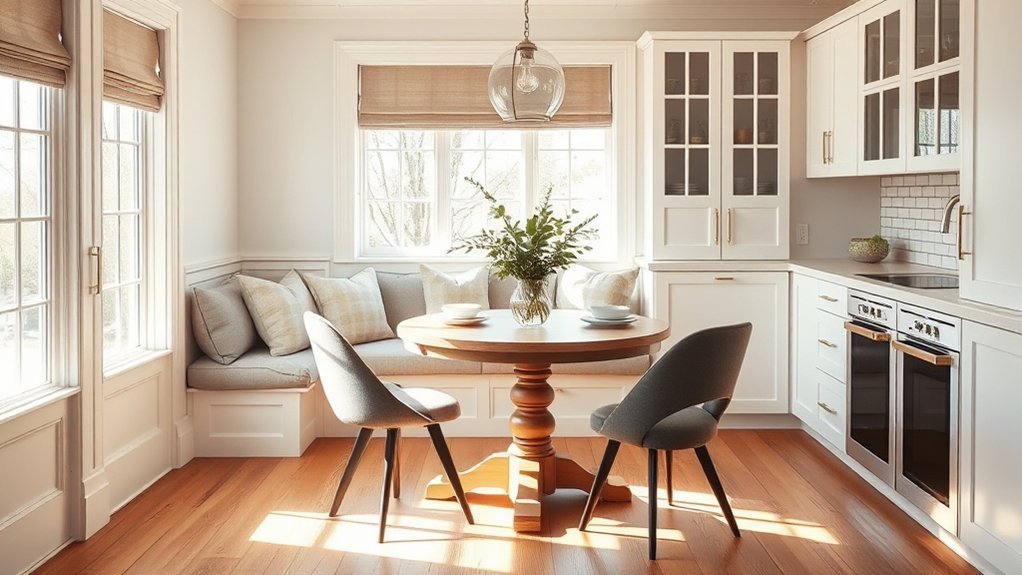
A kitchen nook is a compact, informal dining area within or beside the kitchen. It can turn a corner, bay window, alcove, or short wall into useful seating for breakfast, coffee, homework, and casual meals. The best nooks balance the table, seating, circulation, lighting, and storage instead of trying to fit the largest possible dining set into a small footprint.
Quick Answer
A kitchen nook is a small casual dining area placed in or next to a kitchen. It usually combines a compact table with chairs, a bench, or built-in banquette seating. Corner layouts, extendable tables, storage benches, and well-planned lighting can make a nook especially useful where a full dining set would take up too much room.
Key Takeaways
- Measure the complete dining zone, not just the tabletop, so chairs, benches, doors, cabinets, and appliances still work.
- Corner and L-shaped banquettes can save floor space because fixed seating does not need chair pull-out room along every wall.
- Round, oval, drop-leaf, and pedestal tables can work well in compact nooks, but seating capacity depends on the actual table dimensions.
- Center the main pendant or chandelier over the table rather than the room, and use a dimmer when possible.
- Test permanent built-ins with painter’s tape, boxes, or existing chairs before committing to cabinetry.
What Is a Kitchen Nook?
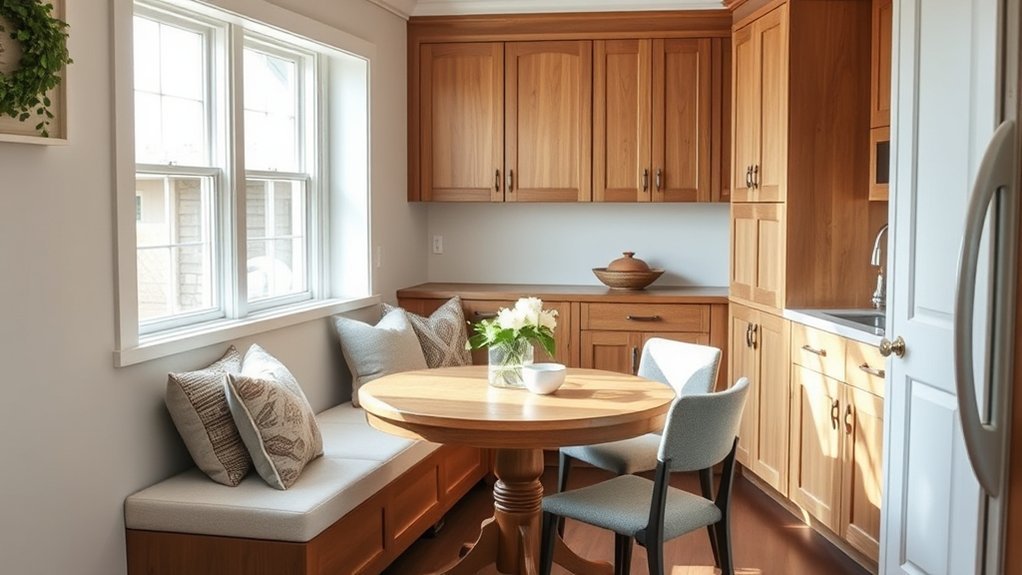
A kitchen nook is a small, informal dining zone positioned within or beside the kitchen. It provides a convenient alternative to a formal dining room for everyday meals, conversation, homework, or morning coffee.
It is often called a breakfast nook, dining nook, eating nook, or kitchen dining alcove. Breakfast nooks became a familiar feature of compact American home plans during the early and middle decades of the 20th century. Historical housing research shows that these informal dining spaces were not limited to one architectural style.
A National Park Service study of sampled 1950s ranch-house floor plans found that 59% included some type of dining area within the kitchen, including breakfast nooks, dining alcoves, or snack spaces.
The appeal comes from efficient use of space. A compact dining area can combine a small table with chairs, a straight bench, or an L-shaped banquette. Built-in versions may also include hidden storage beneath the seats.
There is no universal number of square feet or square meters that guarantees seating for a certain number of people. A useful nook must account for the table footprint, seating depth, chair movement, table legs or pedestal, walkways, nearby doors, and kitchen appliances.
Kitchen Nook Layout Ideas for Small Spaces
When space is limited, a well-planned kitchen nook should feel connected to the kitchen rather than squeezed into leftover floor space. Start with the location and circulation path, then choose the table and seating.
Corner nooks work especially well where two walls meet. An L-shaped banquette can place several seats against the walls while leaving the open side available for chairs or easier entry.
A straight bench against one wall is simpler when the room is narrow. It can be paired with two or three movable chairs so the nook remains flexible. A bay window or shallow alcove can also define the dining zone naturally.
Round and oval tables avoid sharp corners and can make movement easier in tight spaces. IKEA also notes that round tables can work well for socializing because diners face one another more directly. Drop-leaf and extendable tables are useful when the nook needs to stay compact most of the week but occasionally serve more people.
Placing the nook near a window can add natural light, but check window handles, curtains, radiators, vents, and sill height before installing permanent seating.
Pro Tip: Before ordering a banquette or table, mark the planned footprint on the floor with painter’s tape. Place boxes or existing chairs where the seating will go, then test sitting down, standing up, opening nearby cabinets, and walking through the space.
How to Measure and Plan a Kitchen Nook
A successful nook starts with measurements, not furniture shopping. Use this sequence before choosing a table or building a bench:
- Measure the available width and depth. Record wall lengths as well as baseboards, windows, vents, radiators, outlets, and trim.
- Mark anything that moves. Check refrigerator doors, dishwasher doors, cabinet doors, drawers, entry doors, and nearby chairs at their fully open positions.
- Protect the traffic path. Leave enough space for diners to enter and leave without blocking the main kitchen walkway.
- Choose the seating arrangement. Decide whether the nook needs chairs, one straight bench, an L-shaped banquette, or a combination.
- Choose the table after the seating. Confirm that the tabletop and its base allow adequate legroom and easy entry.
- Test the plan at full size. Use painter’s tape, cardboard, boxes, and existing chairs to simulate the final footprint.
IKEA’s dining-space planning guidance recommends roughly 60 cm, or about 24 inches, of table-edge space per diner. Its metric guide also suggests about 80 cm, or roughly 31.5 inches, between a dining table and a wall, with about 120 cm, or 47 inches, between a table and an active kitchen unit where someone may be cooking.
Those figures are useful starting points rather than guarantees. Your chairs, table base, room shape, household size, and mobility needs can require more space.
Note: If wheelchair accessibility is important, plan it from the beginning. The 2010 ADA Standards use a 30-by-48-inch minimum clear floor space for a forward approach to accessible dining surfaces and specify dining-surface heights of 28 to 34 inches in covered facilities. Private-home requirements vary, but these dimensions can be useful accessibility references.
Best Tables and Seating for a Kitchen Nook
The choice of table and seating determines whether a breakfast nook feels comfortable or cramped. Match the furniture to the actual room dimensions and confirm how many people the specific table is designed to seat.
| Table type | Best use in a kitchen nook |
|---|---|
| Round table | Useful in square or corner layouts because there are no sharp corners; choose the diameter from the available clearance and required seating. |
| Oval table | Offers a softer shape than a rectangle while providing more length for additional diners. |
| Rectangular table | Works well along a straight banquette or longer wall and provides predictable place-setting space. |
| Drop-leaf or extendable table | Keeps the everyday footprint smaller while providing more surface area when guests arrive. |
| Pedestal table | Can make banquette entry easier because corner table legs do not compete with knees and feet. |
Bench seating is useful because it can sit directly against a wall and may provide storage underneath. Upholstered benches or removable cushions can improve comfort, but cushion thickness and back padding reduce the usable seat dimensions.
Instead of relying on one universal bench depth, copy the proportions of a dining chair that feels comfortable to your household or create a temporary full-size mock-up. Check that diners can sit upright with back support, place their feet comfortably, and reach the tabletop without leaning forward.
For households that rent or do not want permanent construction, a freestanding bench paired with a small table can create the same visual effect without attaching cabinetry to the walls.
Kitchen Nook Lighting Tips and Storage Ideas
Lighting and storage can make a kitchen nook feel intentional rather than improvised.
A pendant light or small chandelier can establish the dining table as the focal point. Center the fixture over the table rather than automatically centering it in the room, especially when the table sits inside a bay window or corner.
Fixture proportions depend on the room, table, and individual light. Kichler’s dining-light guidance says that when table size is used to select a chandelier, about half the table width can serve as a starting point. Kichler also recommends keeping the bottom of the chandelier at least 30 inches above the tabletop.
Always check the fixture manufacturer’s installation instructions because ceiling height, fixture shape, sightlines, and local electrical requirements can affect the final position.
For smaller corners, wall sconces can provide extra illumination without taking up table or floor space. Dimmable fixtures are useful when the nook serves different jobs throughout the day, such as breakfast, homework, and evening meals.
Storage can stay almost invisible. Under-bench drawers, cabinets, or lift-up compartments can hold linens, serving pieces, games, or other items that would otherwise occupy kitchen cabinets.
When designing built-in storage, make sure cushions can remain in place or be removed easily enough to reach the compartment. Frequently used items are often easier to access from drawers than from a large hinged seat.
Kitchen Nook Design Styles to Try
Style gives a kitchen nook its personality after the layout, seating, lighting, and circulation have been solved. The nook does not have to match every kitchen finish exactly, but repeating one or two materials or colors helps it feel connected to the room.
Style works best after the practical decisions are settled: a beautiful breakfast nook still needs comfortable seats, an appropriately sized table, and an easy path in and out.
Rustic charm pairs solid or visibly grained wood with textured cushions and warm finishes for a cozy, grounded look. Modern design favors slim furniture, restrained colors, simple upholstery, and clean-lined lighting. Farmhouse style often combines a rectangular table with bench or banquette seating, painted millwork, and natural wood.
For smaller rooms, compact oval tables, lightweight chairs, drop-leaf tables, or three-piece dining sets can fit neatly into corners and window niches while keeping the layout flexible.
- Rustic: solid wood, warm textures, woven fabrics, and natural finishes
- Modern: simple lines, restrained colors, compact furniture, and streamlined lighting
- Farmhouse: banquette seating, painted woodwork, rectangular tables, and traditional details
- Small-space: extendable tables, freestanding benches, armless chairs, and furniture with compact footprints
How to Create a Kitchen Nook Step by Step
You do not need a complete kitchen remodel to create a useful nook. The same planning sequence works for permanent built-ins and freestanding furniture.
- Choose the location. Look for a corner, bay window, alcove, or short wall that does not interrupt the kitchen’s main work path.
- Measure the full usable zone. Include chair movement, cabinet openings, appliance doors, windows, and walkways.
- Decide how many people need seats every day. Plan around normal household use instead of occasional maximum capacity.
- Select the seating. Use chairs for maximum flexibility, a straight bench to save wall-side space, or an L-shaped banquette for a defined corner nook.
- Fit the table to the seating. Check both the tabletop and the location of its legs or pedestal.
- Test the arrangement. Mock it up before buying custom furniture or cabinetry.
- Add lighting. Position the main fixture over the table and use dimming or supplementary sconces if the nook serves several purposes.
- Add storage and washable finishes where useful. Keep frequently used items easy to reach and select surfaces that suit everyday meals.
- Finish with personal details. Cushions, artwork, window treatments, plants, or a small rug can give the nook character without changing its footprint.
Frequently Asked Questions
Are kitchen nooks worth it?
A kitchen nook can be worthwhile when you need casual seating without dedicating a separate room to dining. Built-in benches can make good use of corners and may add storage, while freestanding versions are easier to change later. Whether a nook is a good choice depends on your floor plan, circulation, and how often the household will use it.
What is another name for a kitchen nook?
A kitchen nook is commonly called a breakfast nook. Other terms include dining nook, eating nook, breakfast area, kitchen dining alcove, or kitchen corner. The names vary, but they generally describe a compact, informal place for sitting and eating close to the kitchen.
What is a nook in a home?
A nook is a small, partly enclosed or visually defined area within a larger room. Depending on its location, it may become a dining nook, reading nook, desk area, window seat, or quiet sitting space. In a kitchen, a nook usually serves as an informal dining and multipurpose area.
How do you create a kitchen nook?
Choose a corner, alcove, or window area; measure the available space and nearby openings; decide how many people need seats; then select a table and chairs, bench, or banquette that preserve comfortable circulation. Test the arrangement at full size before installing built-ins, then add lighting, storage, cushions, and other finishing details.
How much space do you need for a kitchen nook?
There is no single minimum size because the required footprint depends on the table, seating type, number of diners, and surrounding circulation. Measure the complete dining zone rather than the table alone. As a planning reference, IKEA recommends about 60 cm, or 24 inches, of table-edge space per diner and additional clearance around the table for movement.
What table shape works best in a small breakfast nook?
Round and oval tables are useful where sharp corners would interfere with circulation. Rectangular tables fit naturally along straight benches, while drop-leaf and extendable tables provide flexibility. For built-in banquettes, a pedestal base can also make it easier for diners to slide into the seats.
Conclusion
A well-planned kitchen nook can turn an overlooked corner into a comfortable, practical gathering place. The key is to measure the entire dining zone, protect circulation, choose seating and a table that work together, and test the arrangement before committing to permanent built-ins. With suitable lighting, storage, and finishes, even a modest space can handle casual meals, conversation, homework, and everyday routines without crowding the kitchen.
Sources
- National Park Service — Historical Residential Architecture in Des Moines — historical context for the breakfast nook in early residential design.
- National Park Service — Identifying the 1950s Ranch House Interior as a Cultural Resource — documents breakfast nooks, dining alcoves, and other in-kitchen dining areas in sampled ranch-house plans.
- IKEA — Dining Room Guide — dining-space measurement, per-person table space, and clearance planning guidance.
- Kichler Lighting — Lighting FAQs — dining chandelier sizing and hanging-height guidance.
- U.S. Department of Justice — 2010 ADA Standards for Accessible Design — accessible dining-surface height and clear-floor-space references.