
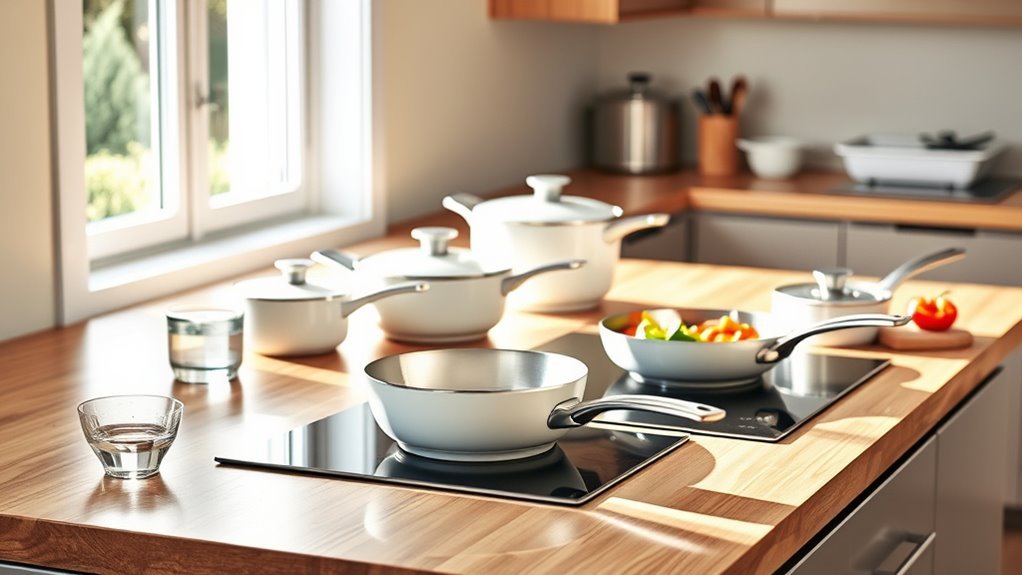
Is T-fal ceramic cookware safe? For normal home cooking, T-fal says its ceramic lines are made without lead or cadmium in the coating and that its cookware is PFOA-free. As with any coated pan, safety depends on staying within the heat limit, avoiding scratches and replacing the pan once the coating is damaged.
This page looks at T-fal’s ceramic range specifically. If you want the general explanation of what a ceramic coating is, start with what is ceramic coating cookware.
T-fal ceramic lines at a glance
| Line | Handles | Oven limit (no lid) | Induction |
|---|---|---|---|
| Refresh | Bakelite | 350°F | Not listed |
| Revive | Soft-touch Bakelite | 350°F | Not listed |
| Preserve | Stainless steel | 350°F | Not listed |
| Ultimate Hard Anodized Ceramic | Silicone | 400°F | Not listed |
| Inspire | Stainless steel | 500°F | Not listed |
| Excellence | Stainless steel | 500°F | Yes |
These details come from T-fal’s ceramic cookware page at the time of writing. Lines and ratings change, so confirm yours on the box or the T-fal website.
What is T-fal ceramic cookware made of?
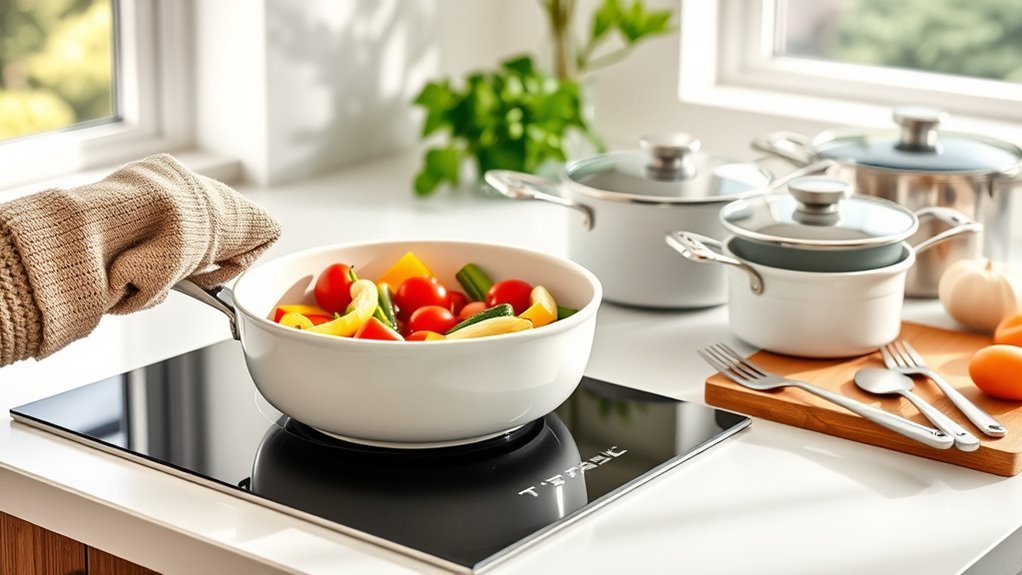
T-fal ceramic pans typically have a metal body, usually aluminum, with a ceramic-based nonstick coating on the cooking surface. The coating is a thin sol-gel layer, which is a silica-based finish applied and baked onto the metal. The pan is not made of solid ceramic.
Some T-fal sets state that the body is made from recycled aluminum. Check the product page for your own set, since claims differ between lines.
Are T-fal ceramic pans PTFE and PFOA free?
T-fal states that its non-stick cookware does not contain PFOA, and that its non-stick coatings and enamel contain no lead or cadmium. Ceramic nonstick coatings are generally sold as an alternative to PTFE (Teflon), but the T-fal pages checked for this article do not explicitly say “PTFE-free” for the ceramic range. If avoiding PTFE or PFAS is important to you, read the packaging or contact T-fal before buying.
For context, the FDA has authorized PFAS-based coatings in nonstick cookware for decades and says negligible amounts of PFAS in the cured coating migrate to food. Ceramic is a different chemistry, and neither choice is a guarantee of a risk-free pan.
Is the aluminum body a concern?
In coated cookware the aluminum sits behind the coating and does not normally touch your food. If the coating is scratched through or flaking, bare metal and the coating itself can contact food. That is one reason to replace a damaged pan rather than keep using it.
How to use T-fal ceramic cookware more safely
- Cook on low to medium heat. High heat is hard on ceramic coatings. One T-fal care guide notes the surface can reach about 570°F on a stovetop.
- Do not preheat an empty pan for long, and never leave a pan unattended.
- Use wood, silicone or plastic utensils. T-fal’s guide recommends them over metal.
- Avoid aerosol cooking sprays, which build up on nonstick surfaces.
- Do not add cold water to a hot pan.
- Keep pans out of the microwave unless the maker says otherwise.
Oven, induction and dishwasher: what to check
Oven: The limit depends on the line, and handle and lid materials can lower it. In one T-fal guide, tempered glass lids and phenolic (plastic) handle parts are rated much lower than all-metal pieces.
Induction: Only pans with a magnetic base work. Test with a magnet or look for the induction symbol. Read how to tell if cookware is induction ready.
Dishwasher: T-fal’s current ceramic page lists hand washing for its ceramic lines. See nonstick cookware and the dishwasher for a brand comparison.
When should you replace a T-fal ceramic pan?
- The coating is flaking, peeling or deeply scratched.
- Food sticks even with oil and clean technique.
- The base is warped or the handle is loose.
Manufacturers generally advise against continuing to use cookware with a damaged coating, so treat visible damage as the signal to replace it.
How does it compare with other healthy cookware options?
If you want to compare ceramic with stainless steel, cast iron and other materials, our guide to the healthiest cookware material lays out the trade-offs.
Frequently Asked Questions
Is T-fal ceramic cookware safe?
T-fal says its non-stick coatings and enamel contain no lead or cadmium and that its cookware is PFOA-free. Like any coated pan, it is safest when used within the stated heat limit and replaced once the coating is damaged. Follow the care guide for your specific line.
Is T-fal ceramic cookware PTFE free?
T-fal describes its ceramic lines as a ceramic nonstick coating, but the pages we reviewed do not explicitly say PTFE-free for the ceramic range. Check the packaging or ask T-fal if this matters to you. T-fal’s standard nonstick lines do use PTFE.
Can T-fal ceramic go in the oven?
Yes, within limits. T-fal’s ceramic page lists 350°F for Refresh, Revive and Preserve, 400°F for Ultimate Hard Anodized Ceramic, and 500°F for Inspire and Excellence, without lids. Lid ratings differ, so check your model.
Is T-fal ceramic cookware induction compatible?
Only some lines. T-fal’s ceramic page marks the Excellence line as induction compatible, while the Refresh set page says it works on all cooktops except induction. Look for the induction symbol on the base of your pan before using it on an induction cooktop.
Can T-fal ceramic cookware go in the dishwasher?
T-fal’s ceramic page marks all its ceramic lines as hand wash to protect the cookware. One older T-fal care guide listed ceramic pieces as dishwasher safe with hand washing preferred, so follow the instructions that came with your set, and use gentle detergent if you ever use a machine.
Conclusion
T-fal ceramic cookware is designed for ordinary home cooking, and the brand states its coatings contain no lead or cadmium. Use low to medium heat, follow your line’s oven and induction ratings, wash by hand, and replace the pan when the coating wears out.
