
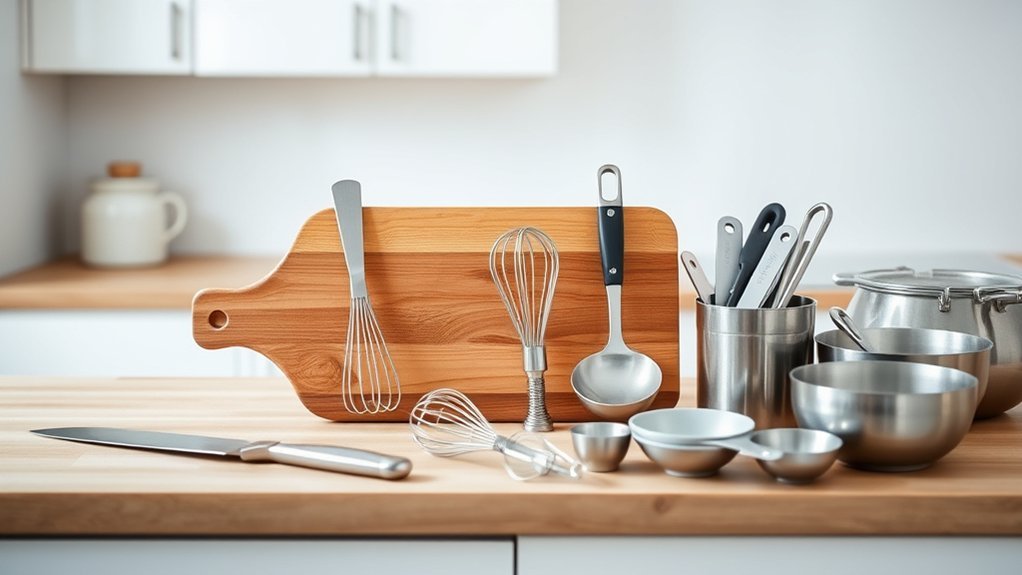
A practical must-have kitchen utensils checklist starts with tools that handle the jobs you do most: a chef’s knife, cutting board, measuring cups and spoons, mixing bowls, wooden or silicone stirring tools, a whisk, spatula, tongs, colander, can opener, and food thermometer. Add specialized tools such as a paring knife, serrated knife, peeler, grater, and kitchen scale as your cooking habits grow.
Quick Answer
The most useful kitchen utensils are a chef’s knife, cutting board, measuring cups and spoons, mixing bowls, wooden spoon, silicone spatula, whisk, tongs, colander, can opener, peeler, and food thermometer. Start with versatile tools you will use weekly, then add specialty utensils only when your recipes require them.
Key Takeaways
- A good chef’s knife, stable cutting board, mixing bowl, spoon, spatula, tongs, and measuring tools cover most everyday prep.
- Keep a food thermometer if you cook meat, poultry, seafood, eggs, casseroles, or reheated foods where internal temperature matters.
- Use separate cutting boards for raw meat, poultry, and seafood and for foods that will not be cooked to reduce cross-contamination.
- Choose utensil materials that suit your cookware, especially when using nonstick or other scratch-sensitive surfaces.
- Buy specialty gadgets only when they solve a task you actually perform often.
Essential Kitchen Utensils for Beginners
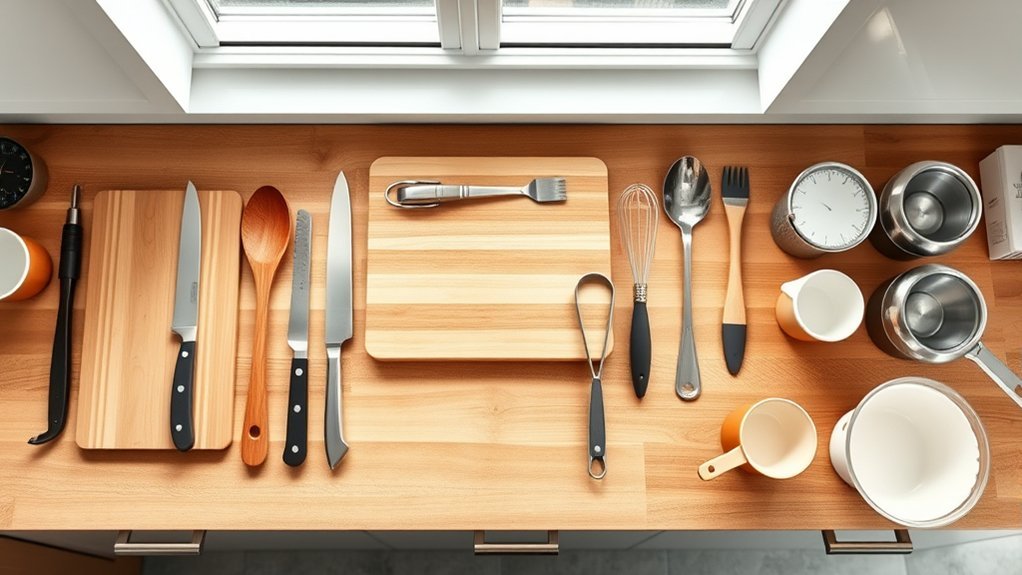
For beginners, a small group of core kitchen utensils makes everyday cooking easier without filling every drawer. A chef’s knife handles common chopping, slicing, and dicing jobs, while a sturdy cutting board provides a stable work surface.
Measuring cups and spoons help when following recipes, and mixing bowls give you room to combine, season, toss, and prepare ingredients. A wooden spoon or heat-rated silicone utensil works for stirring, while tongs make it easier to turn and lift hot foods.
A colander is useful for draining pasta and rinsing produce. A manual can opener is worth having if canned foods are part of your routine, and an instant-read food thermometer adds an important layer of safety when cooking temperature-sensitive foods.
| Buy First | Chef’s knife, cutting board, mixing bowls, measuring cups and spoons, wooden spoon or silicone spatula, tongs, colander, can opener, food thermometer |
| Add Next | Paring knife, serrated knife, whisk, vegetable peeler, box grater, ladle, kitchen scale |
| Buy When Needed | Fish turner, pastry brush, specialized slicers, garlic press, kitchen shears, specialty baking tools |
Together, these items form a focused kitchen essentials list that covers the most common prep and cooking jobs without requiring a large matching utensil set.
Must-Have Utensils for Daily Cooking
Daily cooking is easier when each utensil has a clear job. Your most-used tools should cover cutting, measuring, stirring, scraping, turning, gripping, draining, opening, and temperature checking.
Core Daily Utensils
A chef’s knife is the workhorse for many everyday prep jobs, including slicing vegetables, chopping herbs, and portioning ingredients. It does not need to be part of an expensive knife block; one comfortable, sharp knife is more useful than several dull blades.
Pair the knife with a sturdy cutting board, measuring cups and spoons, mixing bowls, a wooden spoon, a heat-rated silicone spatula, tongs, and a colander. If you prepare meat, poultry, seafood, egg dishes, casseroles, or reheated leftovers, keep an instant-read food thermometer within easy reach.
The CDC’s food-safety guidance recommends using a food thermometer rather than relying only on appearance or texture when confirming that foods have reached a safe internal temperature.
Pro Tip: Build your kitchen around tasks, not matching sets. If one knife, one spatula, and one pair of tongs already handle your regular recipes well, you do not need three versions of each.
Handy Prep Tools
Once the daily basics are covered, a few handy prep tools can reduce repetitive work. A vegetable peeler speeds up potatoes, carrots, apples, and similar produce. A box grater handles cheese and vegetables, while a can opener prevents improvised and potentially unsafe ways of opening cans.
A paring knife gives more control for trimming and small cuts. A serrated knife is useful for bread, ripe tomatoes, and other foods that compress easily under a straight blade.
Measuring cups and spoons remain useful when a recipe gives volume measurements, while a kitchen scale becomes especially helpful when baking recipes provide ingredient weights.
- A sharp, comfortable knife makes controlled cutting easier.
- A stable cutting board reduces slipping during prep.
- Accurate measuring improves consistency.
- A peeler and grater save time on repetitive prep.
- A thermometer replaces guesswork when food safety depends on internal temperature.
Kitchen Prep Tools for Cutting and Chopping
A high-quality chef’s knife and a stable cutting board form the core of most cutting and chopping tasks. A paring knife and serrated knife can then cover jobs that are awkward with a larger chef’s knife.
Knife Basics
An 8-inch chef’s knife is a common all-purpose size, although the best knife is one that feels balanced and controllable in your hand. Use it for chopping vegetables, slicing fruit, mincing herbs, and many general preparation jobs.
A paring knife, usually much smaller, works well for peeling, trimming, coring, and other detailed tasks. A serrated knife is useful for bread and foods with a firm exterior and soft interior.
- Keep one dependable chef’s knife readily available.
- Use a paring knife when a large blade feels awkward.
- Use a serrated knife for bread and other crush-prone foods.
Knife maintenance matters as much as knife type. Honing can realign the edge of an appropriate knife, while sharpening removes metal to restore a worn cutting edge. Follow the knife manufacturer’s care instructions because blade steels and edge designs differ.
Warning: A sliding cutting board can make knife work dangerous. Place the board on a stable, dry surface and use a board with nonslip feet or another manufacturer-approved nonslip method. Keep fingers clear of the blade path and never try to catch a falling knife.
Cutting Board Setup
A practical setup includes at least one sturdy cutting board large enough for comfortable prep. If you prepare raw meat, poultry, or seafood, using a separate board for those foods and another for produce, bread, and other foods that will not be cooked helps reduce cross-contamination.
The USDA cutting-board guidance says consumers may use wood or nonporous boards and recommends washing boards with hot, soapy water after each use. Nonporous acrylic, plastic, or glass boards and solid wood boards may be dishwasher-safe when the material and manufacturer permit it; laminated boards can crack or split.
For sanitizing food-contact surfaces, use a product labeled for that purpose and follow its directions. USDA also provides guidance for preparing a properly diluted unscented chlorine-bleach sanitizing solution. Do not assume that an improvised household mixture provides equivalent sanitation.
Replace a cutting board when it becomes excessively worn or develops deep grooves that are difficult to clean. This applies to both wooden and plastic boards.
Measuring Tools Every Home Cook Needs
Accurate measuring tools help home cooks follow recipes consistently, especially when baking. A basic set includes dry measuring cups, a liquid measuring cup or jug, measuring spoons, and, for recipes written by weight, a digital kitchen scale.
The University of Illinois Extension recommends filling dry measuring cups to the top and leveling the ingredient rather than packing it down unless a recipe specifically says to do so. Liquid measuring cups should sit on a flat surface and be read at eye level.
- Dry measuring cups: Use for flour, sugar, grains, and other dry ingredients measured by volume.
- Liquid measuring cup: Use the graduated markings and read the level on a flat surface.
- Measuring spoons: Use for small quantities of dry or liquid ingredients.
- Digital kitchen scale: Use when a recipe gives grams or ounces, particularly for flour and other baking ingredients.
When a baking recipe provides weight measurements, weighing ingredients can improve repeatability because flour and similar ingredients can settle differently when measured by volume.
Note: Do not convert a recipe’s cups to grams by assuming every ingredient has the same weight per cup. Ingredient density varies, so use the recipe author’s stated weights or a reliable ingredient-weight reference.
Stirring, Flipping, and Serving Tools
After cutting and measuring, a well-equipped kitchen needs a few utensils for stirring, scraping, flipping, gripping, and serving.
Silicone spatulas are useful for scraping bowls, folding batter, and working with cookware that should not be scratched. Heat resistance varies by product, so follow the manufacturer’s temperature rating rather than assuming every silicone utensil can withstand the same heat.
Wooden spoons are dependable for stirring sauces, soups, grains, and mixed ingredients. Their relatively gentle surface also makes them useful with many types of cookware.
Fish turners have a thin blade that can slide beneath delicate foods. Metal versions can scratch some nonstick surfaces, so check cookware-care instructions before using one.
Ladles make soups, stews, beans, and sauces easier to portion. Tongs add reach and control when turning, tossing, or serving hot foods.
A medium whisk rounds out the group for beating eggs, combining dressings, smoothing sauces, and incorporating ingredients into batters.
Baking Utensils You’ll Actually Use
Baking does not require a drawer full of specialty equipment. A silicone spatula, whisk, mixing bowls, measuring tools, and a digital kitchen scale cover many recipes.
A silicone spatula handles scraping and folding, while a whisk combines eggs, liquids, dry mixtures, and sauces. Stainless-steel mixing bowls are durable and easy to use for many baking jobs.
Measuring cups and spoons remain useful for recipes written by volume. When a recipe includes grams, a kitchen scale can make flour and other ingredient measurements more repeatable. King Arthur Baking, for example, recommends weighing flour for its recipes because the amount packed into a measuring cup can vary.
Baking sheets and trays are cookware rather than utensils, but they are useful additions if you bake cookies, roast vegetables, or prepare sheet-pan meals. A nonstick coating may help with release, but even heating depends on the pan’s overall construction and how it interacts with your oven.
- Silicone spatula for scraping and folding
- Whisk for combining and aerating
- Mixing bowls for prep
- Measuring cups and spoons for volume-based recipes
- Digital scale for recipes written by weight
Kitchen Gadgets Worth Buying
The best kitchen gadgets are tools that solve a frequent problem. A vegetable peeler, box grater, locking tongs, can opener, and instant-read thermometer usually earn their storage space because they perform recurring jobs efficiently.
A good knife remains more versatile than many single-purpose cutters. A paring knife can handle detailed trimming, while a serrated knife covers bread and other soft-centered foods.
A sturdy colander remains useful for draining pasta and rinsing produce, beans, or grains. If you regularly prepare smaller quantities, a fine-mesh strainer can supplement or sometimes replace a large colander.
A cast-iron skillet is cookware rather than a utensil, but it can be a durable optional purchase. Cast iron is valued for heat retention, although it does not spread stovetop heat as quickly or evenly as highly conductive materials such as aluminum. Gradual preheating on an appropriately sized burner can improve results.
Kitchen shears can also be useful for snipping herbs, opening food packaging, or other manufacturer-approved food-prep jobs. Choose a pair that can be cleaned thoroughly.
Kitchen Utensils to Skip for Now
Some kitchen utensils are convenient but unnecessary when another tool you already own performs the same job well.
A dedicated draining spoon may be low priority if a slotted spoon, spider, or suitable strainer already handles the foods you cook. A garlic press is also optional because a chef’s knife can mince garlic, although cooks who frequently prepare garlic may still find a press worthwhile.
A useful rule is simple: buy a specialty utensil when you repeatedly encounter the task it solves, not because it appears on someone else’s checklist.
A separate hand grater may be unnecessary if you already own a box grater or food processor that handles your usual ingredients. Likewise, a dedicated pastry brush can wait unless you regularly brush pastry, bread, meat, or vegetables.
If you do need a pastry brush, use one intended for food preparation rather than a general-purpose paintbrush. Avoid using your fingers with hot butter, oil, syrup, or cookware.
A pot stand or trivet is only optional if you already have another heat-safe surface protector. Do not place hot cookware directly on a countertop unless the countertop manufacturer specifically says the surface can tolerate the temperature involved.
- Skip duplicate draining tools when one suitable strainer already works.
- Delay single-purpose gadgets until you know you will use them regularly.
- Do not eliminate safety equipment merely to save drawer or counter space.
How to Choose the Right Kitchen Utensils
Choosing the right kitchen utensils starts with your cooking habits and cookware rather than the size of a packaged set. Stainless steel, wood, nylon, and silicone can all be useful, but no single material is best for every task.
Stainless steel is durable and rigid, making it useful for many whisks, ladles, tongs, and turners. However, metal edges can damage cookware that requires non-abrasive utensils.
Silicone is flexible and often suitable for scratch-sensitive cookware, but temperature limits vary. Check the manufacturer’s heat rating before using silicone near very high heat.
Wood is comfortable for stirring and generally gentle on cookware. Clean and dry wooden utensils according to their care instructions rather than leaving them soaking in water.
Comfort also matters. Handles should feel secure in your hand, and the tool should not be unnecessarily heavy for the job. If grip strength or hand fatigue is a concern, look for larger or cushioned handles and lighter designs.
Multifunctional utensils can reduce clutter, but versatility should not come at the expense of safety or control. A good starter kit contains tools that work efficiently, clean easily, suit the cookware you own, and match the meals you actually prepare.
Frequently Asked Questions
What Are the 10 Most Important Kitchen Utensils?
A practical top 10 is a chef’s knife, cutting board, measuring cups and spoons, mixing bowls, wooden spoon, silicone spatula, whisk, tongs, colander, and instant-read food thermometer. A can opener is also essential for kitchens that regularly use canned foods. The exact list should reflect what you cook most often.
What Are 20 Essential Kitchen Items?
Twenty useful starter items are a chef’s knife, paring knife, serrated knife, cutting board, measuring cups, measuring spoons, liquid measuring cup, mixing bowls, saucepan, skillet, baking sheet, wooden spoon, silicone spatula, tongs, peeler, colander, can opener, whisk, food thermometer, and oven mitts or potholders. Some are cookware or safety equipment rather than utensils, but together they form a practical starter kitchen.
What Are the Essential Cooking Utensils That Every Kitchen Needs?
Most kitchens benefit from a chef’s knife, cutting board, measuring cups and spoons, mixing bowls, stirring spoon, spatula, whisk, tongs, colander, can opener, and food thermometer. Choose materials that are compatible with your cookware and replace utensils that become cracked, badly worn, difficult to clean, or unsafe to use.
What Are 15 Essential Kitchen Tools?
A useful 15-tool starter set includes a chef’s knife, cutting board, measuring cups, measuring spoons, liquid measuring cup, colander, mixing bowls, silicone spatula, wooden spoon, tongs, peeler, whisk, can opener, food thermometer, and box grater. Add a ladle, serrated knife, kitchen scale, or other specialty tools when your cooking calls for them.
What Kitchen Utensil Should a Beginner Buy First?
If you are starting from an empty kitchen, begin with a comfortable chef’s knife and a stable cutting board because they support a large share of basic ingredient preparation. After that, add mixing bowls, measuring tools, a stirring utensil, spatula, tongs, colander, can opener, and food thermometer.
Conclusion
A useful kitchen does not need dozens of specialized utensils. Start with a sharp chef’s knife, stable cutting board, measuring tools, mixing bowls, spoon, spatula, whisk, tongs, colander, can opener, and food thermometer. Add a peeler, grater, extra knives, baking tools, and specialty gadgets only when your cooking habits justify them.
Quality matters most where comfort, control, durability, or safety is affected. Choose tools that suit your cookware, clean them correctly, replace damaged items, and keep the utensils you reach for most within easy reach. A smaller collection of dependable tools is usually more useful than a crowded drawer of gadgets that rarely leave it.
Sources
- USDA Food Safety and Inspection Service — Cutting Boards — cutting-board materials, cleaning, sanitizing, separation, and replacement guidance.
- CDC — Preventing Food Poisoning — food-safety practices, cross-contamination prevention, and food-thermometer guidance.
- U.S. Food and Drug Administration — Cleaning and Food Safety — cleaning food-contact surfaces, utensils, and cutting boards.
- University of Illinois Extension — Cooking Basics — correct use of dry measuring cups, liquid measuring cups, and measuring spoons.
- UCSB ScienceLine — Cast-Iron Heating — heat conductivity and heat-retention characteristics of cast-iron cookware.
