
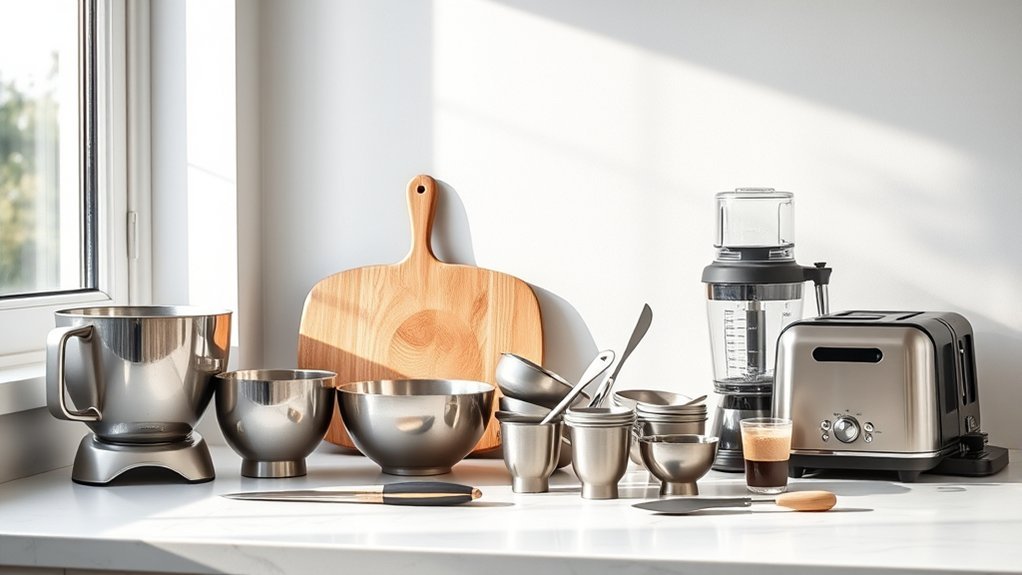
The best kitchen gadgets to start with are tools you will use almost every day: a sharp chef’s knife, a sturdy cutting board, measuring cups and spoons, a kitchen scale, a skillet, a saucepan, mixing bowls, and a few reliable utensils. Add specialized appliances only when they match the meals you actually cook. A smaller, well-chosen setup saves money, cabinet space, and prep time.
Quick Answer
Start with a chef’s knife, cutting board, skillet, saucepan, mixing bowls, measuring cups and spoons, kitchen scale, heat-safe spatula, tongs, and an instant-read food thermometer. These tools cover most everyday chopping, cooking, mixing, measuring, and food-safety needs. Add appliances such as a food processor or pressure cooker later.
Key Takeaways
- Buy versatile tools first instead of filling drawers with single-purpose gadgets.
- A sharp chef’s knife, stable cutting board, skillet, saucepan, and basic utensils handle a large share of everyday cooking.
- A food thermometer is a safety tool, not just an optional gadget.
- Check cookware compatibility, oven limits, handle materials, weight, and care instructions before buying.
- Food processors, mandolines, smart appliances, and other specialized tools can wait until you know you will use them.
What Kitchen Gadgets Do You Need First?
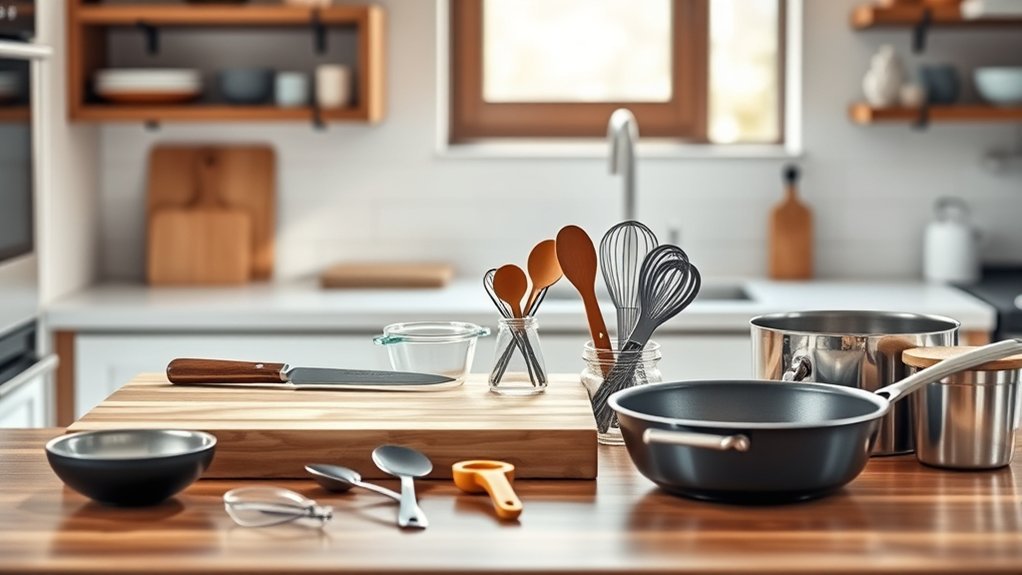
The first kitchen gadgets to buy are the ones that handle the widest range of everyday tasks. A dependable chef’s knife should be near the top of the list because it can chop vegetables, slice fruit, mince herbs, portion many foods, and handle most routine prep.
One practical example is the Mercer Culinary Millennia 8-Inch Chef’s Knife. Mercer specifies one-piece high-carbon Japanese steel, an ergonomic Santoprene and polypropylene handle, textured finger points, and a protective finger guard. Choose a knife that feels secure and balanced in your own hand rather than buying on brand alone.
Start with tools that solve several everyday jobs. One dependable knife, pan, pot, board, and set of utensils usually beats a drawer full of gadgets you rarely touch.
A sturdy cutting board comes next. The OXO Good Grips Utility Cutting Board, for example, has a nonporous surface, non-slip feet, a grooved side for catching liquid, a flat side for other prep, and dishwasher-safe construction.
Accurate measuring cups and spoons are useful for everyday recipes, while a digital kitchen scale such as the Escali Primo improves repeatability for baking and recipes written by weight. A scale with a tare function lets you zero out the bowl and weigh ingredients directly into it.
Add a manual can opener, wooden spoon or silicone spatula, tongs, and a whisk so common preparation and cooking jobs do not require improvising with the wrong tool. For cookware, start with a skillet and saucepan; a Dutch oven or stockpot becomes valuable for soups, stews, beans, pasta, braises, and larger batches.
A food processor, immersion blender, mandoline, salad spinner, and other specialized tools can wait if budget or storage space is tight. Mixing bowls, however, are inexpensive and useful for whisking, tossing salads, marinating, breading, and organizing ingredients during prep.
Pro Tip: Before buying a gadget, name at least two meals or tasks you expect to use it for every month. If you cannot, leave it on the wish list until your cooking habits show that you need it.
The First Kitchen Tools to Buy
A quality chef’s knife and a sturdy cutting board are practical first purchases because nearly every meal begins with some form of cutting or preparation.
From there, a reliable skillet adds flexibility for eggs, vegetables, pancakes, proteins, and quick one-pan meals. A medium saucepan covers rice, sauces, oatmeal, soups, reheating, and smaller portions.
Measuring cups and spoons, a liquid measuring cup, and a digital kitchen scale round out a useful measuring setup. Mixing bowls, a spatula, tongs, whisk, colander, and instant-read thermometer fill the most important gaps without creating much clutter.
| Priority | Tools | Why They Matter |
| Buy first | Chef’s knife, cutting board, skillet, saucepan | Cover chopping, slicing, sautéing, frying, simmering, boiling, and reheating. |
| Add next | Mixing bowls, spatula, tongs, whisk, colander, measuring tools | Make prep, mixing, draining, portioning, and cooking easier. |
| Safety | Food thermometer, oven mitts, stable knife storage | Help prevent undercooking, burns, and accidental blade contact. |
| Buy when needed | Food processor, immersion blender, mandoline, smart appliances | Useful for specific routines but unnecessary in every starter kitchen. |
Must-Have Starter Tools
For a new kitchen, a small core of essential tools covers most everyday cooking. Start with a sharp chef’s knife. A sharp blade generally requires less force than a dull one, although safe technique and a stable cutting surface still matter.
A sturdy cutting board gives reliable support for prep. Add a kitchen scale for recipes that use weight, especially baking, where small measurement differences can change the final result.
A skillet is useful for eggs, vegetables, pancakes, sautéing, browning, and quick meals. A medium saucepan handles grains, sauces, soups, pasta portions, and reheating. A mixing bowl set supports mixing, tossing, marinating, and organizing ingredients.
Round out the starter kit with tongs, a heat-safe spatula, wooden spoon, whisk, colander, can opener, vegetable peeler, rimmed baking sheet, oven mitts, and an instant-read food thermometer. These tools are compact, broadly useful, and easier to justify than highly specialized gadgets.
Smart First Buys
Smart first buys cover the widest range of tasks with the fewest purchases. A chef’s knife and cutting board handle most basic prep, while measuring tools improve repeatability in baking, sauces, dressings, and portioning.
A mixing bowl set gives flexible space for stirring, marinating, breading, and serving. A skillet, saucepan, and Dutch oven or stockpot can cover most stovetop cooking without requiring a large matching cookware set.
- Chef’s knife: choose one comfortable, controllable blade rather than a large knife block.
- Cutting board: look for a stable surface that is easy to clean.
- Kitchen scale: useful for baking and weight-based recipes.
- Skillet: choose a size that matches your household and stovetop.
- Saucepan: a medium size is one of the most versatile first pots.
- Utensils: start with tongs, spatula, spoon, and whisk.
Stainless steel cookware can provide long service and broad cooking flexibility, while cast iron offers strong heat retention. Nonstick cookware is convenient for delicate foods but requires more careful heat and utensil use. Buy individual pieces based on what you cook instead of assuming a large boxed set is automatically better value.
Best Kitchen Knives and Cutting Tools
Among the most useful kitchen essentials, a chef’s knife serves as the primary tool for chopping, slicing, mincing, and many other everyday tasks. The Mercer Culinary Millennia 8-inch chef’s knife is a practical example with documented high-carbon Japanese steel, a textured grip, and a protective finger guard.
A serrated or scalloped knife is useful for crusty bread, tomatoes, cakes, and foods that can be crushed by a straight blade. Dexter-Russell’s Basics line includes a 10-inch scalloped slicer that can handle many of these jobs.
A small paring knife supports trimming, coring, peeling, and detailed work. Current Victorinox Swiss Classic paring knives use blades around three inches, making them easier to control for small tasks than a full-size chef’s knife.
A vegetable peeler such as the Kuhn Rikon Original Swiss Peeler can speed potato, carrot, apple, and similar produce prep. If you use a carbon-steel peeler, follow its care directions so the blade does not remain wet and rust.
A mandoline slicer can create very even slices much faster than hand cutting, but it is not an essential first purchase.
Warning: Knife and mandoline blades can cause serious cuts. Keep the cutting surface stable, cut away from fingers, store exposed blades securely, and use the mandoline’s hand guard or another manufacturer-approved safety holder instead of pushing food toward the blade with bare fingertips.
Retail prices for knives and peelers change frequently by seller, country, and promotion, so compare current prices rather than relying on a fixed price range that may become outdated.
Must-Have Prep Tools for Cooking
Beyond knives and other cutting tools, a useful prep collection includes cutting boards, mixing bowls, a kitchen scale, vegetable peeler, colander, tongs, heat-safe spatula, grater, whisk, kitchen shears, and food thermometer.
These cooking tools support cleaner prep, better control, and less wasted movement. Choose pieces that are comfortable to hold, easy to wash, and durable enough for regular use.
- Chef’s knife: efficient for chopping, slicing, and mincing.
- Kitchen scale: precise for baking and weight-based recipes.
- Mixing bowls: useful for mixing, marinating, breading, and serving.
- Colander or strainer: drains pasta, beans, and washed produce.
- Tongs: turn, lift, toss, and serve hot food while keeping hands farther from heat.
- Heat-safe spatula: stirs, folds, scrapes bowls, and works with compatible cookware.
- Grater: handles cheese, citrus zest, garlic, ginger, and vegetables.
- Kitchen shears: useful for opening packages, trimming herbs, and selected food-prep tasks.
- Food thermometer: verifies safe internal temperatures instead of relying on color or appearance.
A versatile cutting board with a non-slip base or stable placement makes prep easier. A juice groove can help contain liquid when cutting juicy foods.
The USDA recommends using a separate cutting board for raw meat, poultry, and seafood when possible so their juices do not contaminate produce, bread, or other foods that may be eaten without further cooking. Wash boards after use and replace boards that become excessively worn or develop hard-to-clean grooves.
How to Choose Cookware and Bakeware
Choosing cookware starts with the food you cook, the type of stovetop you own, and how much maintenance you are willing to do. Stainless steel is durable and useful for browning, cast iron retains heat well, and nonstick surfaces make delicate foods and cleanup easier when used correctly.
Bakeware should also match the job. A rimmed sheet pan is one of the most versatile first purchases because it can roast vegetables, bake cookies, cook proteins, toast nuts, and catch drips under other dishes.
Do not assume that every glass, ceramic, silicone, stainless-steel, or coated pan has the same oven limit. Check the manufacturer’s maximum temperature, broiler guidance, lid and handle limits, and any thermal-shock precautions before use.
Cookware Material Matters
Material choice affects heating behavior, weight, care, and the cooking techniques a pan handles well. Common options include cast iron, stainless steel, nonstick cookware, enameled cast iron, ceramic-coated cookware, carbon steel, aluminum, and copper-containing constructions.
Cast iron is valued for heat retention. Stainless steel is durable and supports browning and pan sauces, particularly when it is built around a more conductive aluminum or copper layer. Nonstick cookware is convenient for eggs, pancakes, and delicate foods but generally needs gentler utensils and temperature control.
- Check whether cookware is compatible with gas, electric, glass-ceramic, or induction cooking.
- Check the oven-safe temperature of the pan, lid, knobs, and handles rather than assuming they share one rating.
- Consider weight before buying heavy cast-iron or large stainless-steel pieces.
- Follow the manufacturer’s cleaning and utensil instructions so coatings and finishes last longer.
For PTFE-based nonstick cookware, Health Canada advises against preheating the cookware empty and recommends avoiding high heat above about 260°C/500°F. Manufacturer instructions should take priority because individual cookware can have lower limits.
Note: Material labels alone do not guarantee that cookware is suitable. The FDA has warned consumers about certain imported aluminum, brass, and aluminum-alloy cookware that may leach significant lead into food. Check current FDA cookware safety information if you are unsure about an unfamiliar product.
For dependable performance, select cookware for specific jobs rather than chasing material trends. One good skillet, saucepan, and larger pot or Dutch oven can be more useful than a large set containing sizes you rarely use.
Bakeware For Your Needs
A practical bakeware setup should start with the pieces required by recipes you actually make. For many kitchens, a sturdy rimmed sheet pan does more work than a large specialized bakeware set.
Frequent bakers can add muffin tins, loaf pans, round cake pans, rectangular baking dishes, or cookie sheets as needed. Rolled or reinforced edges can help a metal sheet pan resist warping, while material thickness and construction affect how quickly a pan heats and cools.
Nonstick finishes and silicone baking mats can reduce sticking, but always follow the manufacturer’s temperature limit. Glass and ceramic bakeware also require product-specific care, especially around rapid temperature changes.
Good bakeware gives the cook the right size, heat tolerance, stability, and release characteristics for the recipe rather than simply offering the largest number of pieces.
Measuring and Mixing Tools to Own
Reliable measuring and mixing tools make recipes easier to repeat. A set of dry measuring cups works for ingredients that can be filled and leveled, while a clear liquid measuring cup with a spout is easier to use for water, milk, oil, stock, and other liquids.
Measuring spoons cover small quantities such as spices, extracts, baking powder, and baking soda. A digital kitchen scale adds another level of accuracy, especially for bread, pastry, coffee, and recipes written in grams.
- Stackable mixing bowls save cabinet space and work for mixing, marinating, breading, tossing, and serving.
- A sturdy whisk blends batters, eggs, dressings, sauces, and other mixtures.
- A silicone or heat-safe spatula scrapes bowls efficiently and can handle hot cooking when its temperature rating allows it.
Note: Dry measuring cups and liquid measuring cups are shaped differently for a reason. A liquid cup lets you read a level without filling it to the rim, while a dry cup can be filled and leveled across the top.
Choosing a few durable basics reduces guesswork without filling cabinets with duplicate measuring sets and mixing tools.
Kitchen Safety Tools You Should Not Skip
Some of the most useful kitchen tools are safety tools. An instant-read food thermometer is especially important because food can look cooked before it has reached a safe internal temperature.
According to the USDA safe minimum internal temperature chart, poultry should reach 165°F (73.9°C), ground beef, pork, lamb, and veal should reach 160°F (71.1°C), and whole beef, pork, lamb, and veal steaks, chops, and roasts should reach at least 145°F (62.8°C) followed by a three-minute rest.
Oven mitts or dry heat-resistant pot holders protect hands when moving hot cookware. Knife guards, a secure knife block, or another appropriate storage system can reduce accidental contact with exposed blades. A stable cutting board is safer and easier to control than one that slides across the counter.
Clean food-contact tools promptly, especially after raw meat, poultry, seafood, or eggs. Do not reuse a dirty utensil or board for ready-to-eat food without properly washing it first.
Time-Saving Kitchen Tools
When meal prep needs to move quickly, a few well-chosen appliances can reduce repetitive work. They are useful additions, but they do not all belong in every starter kitchen.
An Instant Pot or other electric pressure cooker can speed up many dishes that normally require longer simmering, including beans, grains, stews, soups, and some tougher cuts of meat.
A food processor can chop, shred, slice, mix, and puree larger quantities quickly. It becomes most worthwhile for cooks who repeatedly perform those jobs; otherwise, a knife, box grater, and mixing bowl may be enough.
For soups, sauces, and purees, an immersion blender works directly in a suitable pot or container and can be easier to clean than transferring food into a countertop blender.
A salad spinner washes and dries leafy greens efficiently so excess water does not dilute dressing. A colander and clean towels can perform a similar job if cabinet space is limited.
A mandoline slicer produces thin, consistent slices quickly, but its speed does not outweigh the need for careful blade safety.
Together, these tools can shorten prep, but buy them according to the meals you make repeatedly rather than because they appear on a universal gadget list.
What Kitchen Gadgets Can Wait Until Later?
Many specialized gadgets are convenient rather than essential. A first kitchen can usually operate without an avocado slicer, egg cooker, electric chopper, stand mixer, dedicated rice cooker, countertop ice maker, smart display, expensive knife block, or large matching cookware set.
A food processor is worth adding when you regularly chop or shred large quantities. A stand mixer makes more sense for frequent bread or baking projects. A rice cooker may earn permanent counter space in a household that cooks rice often, while another household may be satisfied with a saucepan or pressure cooker.
Smart appliances are similar: connectivity is useful only if remote monitoring, guided cooking, scheduling, or app integration solves a real problem for you. A simpler appliance may be cheaper, easier to maintain, and just as effective for the core cooking job.
Frequently Asked Questions
What Are the Top 10 Gadgets for a Kitchen?
Ten useful kitchen gadgets and tools are a chef’s knife, cutting board, instant-read food thermometer, digital kitchen scale, immersion blender, food processor, salad spinner, box grater, vegetable peeler, and can opener. Not every cook needs all ten immediately, so prioritize the tools that match the meals you make most often.
What Are 10 Essential Kitchen Tools?
Ten essential kitchen tools are a chef’s knife, cutting board, skillet, saucepan, mixing bowls, measuring cups and spoons, heat-safe spatula, tongs, colander, and instant-read food thermometer. Together, they cover cutting, cooking, mixing, measuring, draining, turning food, and checking safe cooking temperatures.
What Are 20 Essential Kitchen Items?
Twenty useful kitchen items are a chef’s knife, paring knife, cutting board, skillet, saucepan, Dutch oven or stockpot, rimmed sheet pan, mixing bowls, dry measuring cups, liquid measuring cup, measuring spoons, digital scale, tongs, spatula, whisk, vegetable peeler, colander, can opener, instant-read thermometer, and oven mitts. This collection covers most basic prep, stovetop cooking, baking, measuring, and food-safety tasks.
What Are the Top 10 Smart Kitchen Gadgets?
Ten common smart-kitchen categories are connected food thermometers, smart kitchen scales, voice-enabled displays or speakers, app-connected pressure cookers, smart coffee makers, connected countertop ovens, smart multicookers, connected blenders, wireless timers, and recipe-management displays or apps. Choose smart features only when they improve a task you already perform regularly.
Does a Beginner Cook Really Need a Food Thermometer?
Yes, especially if you cook meat, poultry, fish, casseroles, or leftovers. A thermometer verifies the internal temperature directly rather than relying on color, texture, or cooking time. It is a small tool that adds meaningful food-safety value to a starter kitchen.
Which Kitchen Gadgets Should a Beginner Avoid Buying First?
Delay highly specialized or bulky gadgets until you know you will use them. Examples can include single-purpose slicers, large knife blocks, stand mixers, countertop ice makers, smart appliances, specialty baking pans, and large cookware sets. Start with versatile tools and add specialized equipment as your cooking habits become clear.
Sources
- USDA Food Safety and Inspection Service — Cutting Boards — supports cutting-board cleaning, cross-contamination, and replacement guidance.
- USDA Food Safety and Inspection Service — Safe Minimum Internal Temperature Chart — supports food-thermometer and cooking-temperature guidance.
- Health Canada — The Safe Use of Cookware and Bakeware — supports nonstick heat precautions and product-specific cookware safety advice.
- U.S. Food and Drug Administration — Imported Cookware Lead Warning — supports the current cookware lead-safety note.
- Mercer Culinary — Millennia 8-Inch Chef’s Knife — supports the stated knife construction and handle features.
- OXO — Good Grips Utility Cutting Board — supports the cited cutting-board features.
Conclusion
A kitchen does not need every gadget to work well. Start with a sharp chef’s knife, stable cutting board, reliable cookware, measuring tools, basic utensils, mixing bowls, and a food thermometer. Those pieces cover most daily prep and cooking while keeping the kitchen easier to organize. Add food processors, smart appliances, specialty slicers, and other gadgets only when your recipes and routines give them a clear job.