
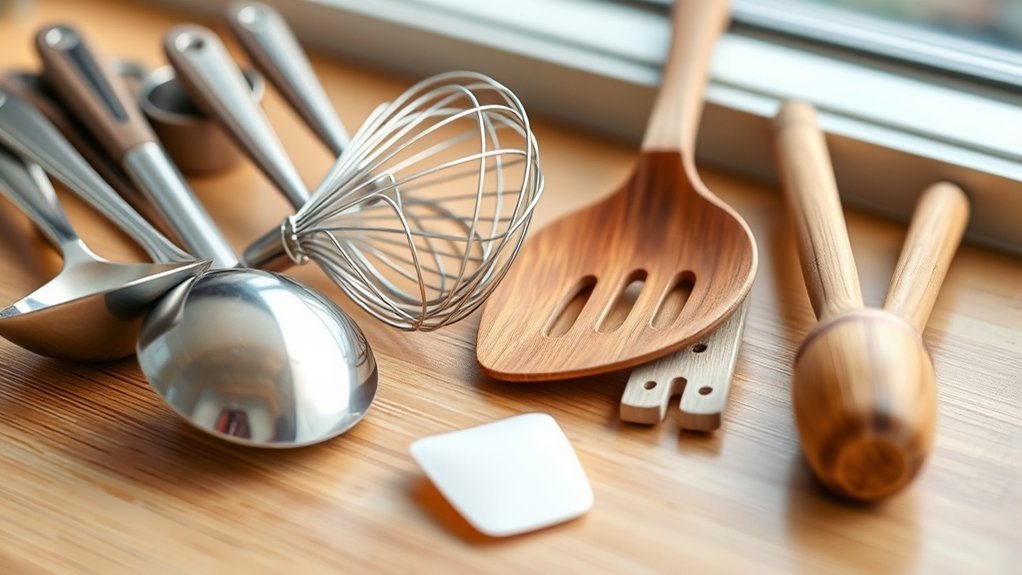
Kitchen utensils are commonly made from stainless steel, silicone, wood, bamboo, nylon, plastic, and combinations of those materials. Glass, ceramic, and enamel are also common in measuring, mixing, serving, and specialty kitchenware. The right material depends on the job, cookware surface, heat level, cleaning method, and how much maintenance you want. A good kitchen usually combines several materials rather than relying on one for every task.
Quick Answer
Most cooking utensils are made from stainless steel, silicone, wood, bamboo, nylon, or plastic. Stainless steel is strong and heat tolerant, silicone is gentle on nonstick cookware, and wood or bamboo works well for stirring without scratching pans. Always follow the utensil’s stated heat and care instructions.
Key Takeaways
- Stainless steel is rigid, durable, corrosion resistant, and useful for high-heat work, but it can scratch nonstick and enameled surfaces.
- Silicone is flexible and coating-friendly, but its heat limit varies by product, so check the manufacturer’s rating.
- Wood and bamboo are gentle on cookware and comfortable for stirring, but they need thorough drying and should be replaced if they crack or splinter.
- Nylon and plastic can be lightweight and inexpensive, but they should never be exposed to temperatures above their stated limits.
- No single material is best for every task. Match the utensil to the cookware, heat level, food, and cleaning method.
What Kitchen Utensils Are Made Of
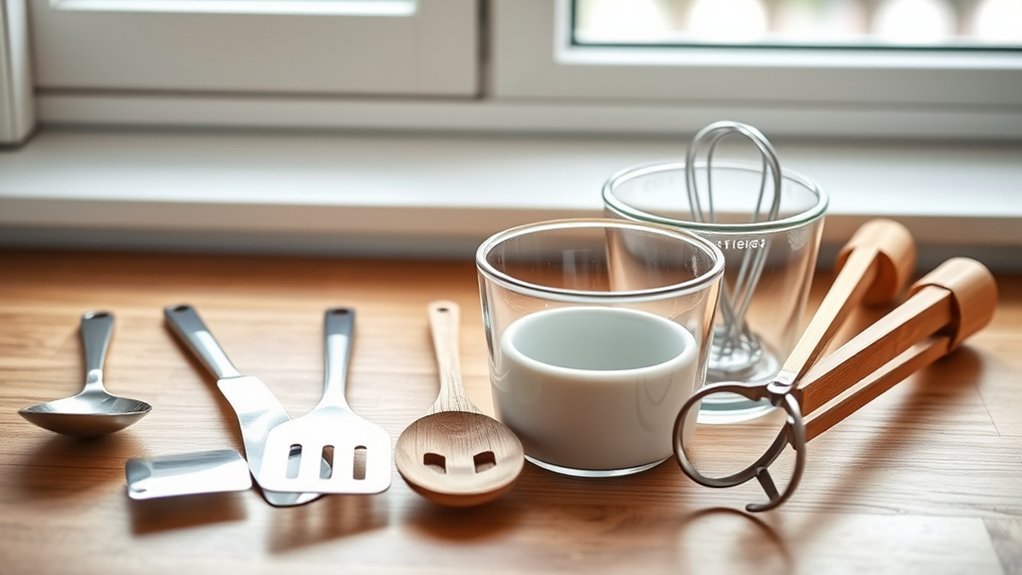
Kitchen utensils are made from several common materials, each suited to different cooking tasks. Handheld tools such as spoons, turners, ladles, tongs, whisks, and spatulas are most often made from stainless steel, silicone, wood, bamboo, nylon, plastic, or a combination of materials.
Stainless steel is common in whisks, ladles, tongs, serving spoons, and turners because it is rigid and durable. Silicone is widely used for spatulas, spoonulas, scrapers, and coated tongs because its softer surface is suitable for many nonstick pans.
Wood and bamboo are popular for spoons, spatulas, and turners. They do not have a sharp metal edge, so they are gentle on many cookware finishes. Nylon and other food-contact plastics are often used where low weight, flexibility, and lower cost matter.
Glass and ceramic are more common in measuring cups, bowls, baking dishes, crocks, and serving pieces than in handheld cooking utensils. Enamel is usually a coating over metal cookware or serving pieces rather than a stand-alone utensil material.
| Material | Best Uses | Main Strength | Watch For |
|---|---|---|---|
| Stainless steel | Tongs, whisks, ladles, rigid turners | Strength and durability | Can scratch coated cookware |
| Silicone | Scraping, stirring, folding, nonstick cookware | Flexible and coating-friendly | Heat rating varies by product |
| Wood | Stirring, sautéing, mixing | Comfortable and gentle on cookware | Cracking, splitting, moisture damage |
| Bamboo | Spoons, turners, serving tools | Lightweight and relatively hard | Splitting and glued joints |
| Nylon/plastic | Turning, serving, lower-temperature cooking | Light and often nonstick-friendly | Melting, warping, deep scratches |
| Glass/ceramic | Measuring, mixing, baking, serving | Nonreactive food-contact surface | Chipping, breakage, thermal shock |
Why Material Choice Affects Safety
Material choice affects kitchen safety because heat, abrasion, acidic foods, cleaning methods, and physical wear can affect different materials in different ways. The key is not to search for one supposedly perfect material, but to use a tool that is intended for food contact, suitable for the temperature, cleanable, and in good condition.
The U.S. Food and Drug Administration regulates substances used in food-contact applications according to their intended conditions of use. That is more meaningful than relying only on marketing words such as “food-grade,” “non-toxic,” or “BPA-free.”
| Material | Practical Safety Consideration | Best Use |
|---|---|---|
| Stainless steel | Durable and corrosion resistant; avoid on scratch-sensitive coatings | Stirring, lifting, whisking, serving |
| Silicone | Use within the manufacturer’s stated heat limit | Scraping, stirring, nonstick cookware |
| Wood/bamboo | Keep clean and dry; replace cracked or splintering pieces | Stirring and general cooking |
| Nylon/plastic | Avoid overheating, melting, and heavily damaged surfaces | Moderate-temperature tasks |
Practical selection reduces damage to cookware, keeps utensils easier to clean, and helps prevent avoidable problems caused by overheating or heavily worn tools.
Wood and Bamboo Utensils
Wood and bamboo utensils are popular because they are lightweight, comfortable to hold, and gentle on cookware. Neither material has a hard metal edge, making wooden and bamboo spoons useful with stainless steel, cast iron, enamel, and many coated pans.
Bamboo is a grass rather than a wood. USDA guidance for cutting boards notes that bamboo is harder and less porous than many hardwoods and absorbs relatively little moisture. Those properties can be useful, although the performance of a finished utensil also depends on its construction, finish, thickness, and glued joints.
Both materials benefit from prompt cleaning and thorough drying. They should be replaced when deep cracks, splinters, loose joints, or difficult-to-clean damage develops.
Wood Vs Bamboo
A wooden spoon may be made from maple, beech, cherry, walnut, olive wood, or other suitable species. Good wooden tools feel solid in the hand, do not become uncomfortably hot as quickly as metal handles, and work well for stirring sauces, soups, doughs, and sautéed foods.
Bamboo utensils are usually lighter and relatively hard. They can be a practical choice for spoons, turners, and serving tools, but laminated or glued bamboo products should not be treated as indestructible. Repeated soaking, very hot dishwasher cycles, or drying stress can weaken joints or cause splitting.
Neither material should be described as automatically antimicrobial or self-sanitizing. Good cleaning, drying, and replacement of damaged utensils still matter.
Benefits And Drawbacks
The main benefits of wood and bamboo are their cookware-friendly surfaces, comfortable grip, low heat transfer through the handle, and usefulness for stirring. They are also less likely than metal turners to mark delicate cookware surfaces.
The tradeoff is maintenance. Wood can absorb moisture and odors, while both wood and bamboo can eventually crack, split, or become rough. Decorative coatings, glued seams, and unknown finishes can also complicate cleaning, so simple, well-finished utensils are often easier to maintain.
Bamboo can resist moisture well when properly made and cared for, but it is not automatically longer-lasting than every hardwood utensil. Build quality matters at least as much as the material name.
Care And Maintenance
Wash wooden and bamboo utensils with warm water and dish soap after use, rinse them thoroughly, and allow them to dry completely. Avoid leaving them submerged in a sink for long periods because repeated soaking can promote swelling, warping, cracking, or joint failure.
The USDA recommends hot, soapy water as the basic cleaning method for wooden cutting surfaces. When sanitizing a food-contact item is necessary, use a method appropriate for that item and follow the sanitizer manufacturer’s directions rather than assuming a vinegar rinse is equivalent to a validated sanitizer. USDA cutting-board guidance also emphasizes replacing wood or plastic surfaces once wear creates grooves that are difficult to clean.
Food-safe mineral oil or a maintenance product specifically intended for wooden food-contact items can be used on unfinished wood when recommended by the manufacturer. Do not use cooking oils that can become rancid for long-term wood conditioning.
Store clean utensils only after they are dry. Good airflow is more important than whether the utensil sits in a crock or drawer.
Silicone Utensils for Nonstick Cookware
Silicone utensils are useful with nonstick and enameled cookware because their flexible edges are less likely than metal to scratch delicate surfaces. Silicone spatulas are particularly useful for scraping bowls, folding batters, stirring sauces, and reaching curved pan edges.
Silicone is used in food-contact applications under applicable regulatory requirements, but “FDA-approved silicone” should not be treated as a blanket certification for every consumer utensil. FDA rules address authorized materials and conditions of use, including repeated-use rubber articles containing silicone polymers. Choose products clearly intended for food contact and supplied with use and temperature instructions.
Heat limits vary by formulation and construction. For example, some current silicone utensils are manufacturer-rated substantially above 450°F, while others may have lower limits because of internal cores, handles, adhesives, or other components. The safest rule is simple: follow the temperature rating for the specific utensil.
Many silicone tools are dishwasher-safe, but that is also product-specific. One-piece designs can be easier to clean because they have fewer seams where food and moisture can collect.
Pro Tip: For nonstick cookware, start with silicone, wood, bamboo, or another utensil specifically described by the cookware manufacturer as safe for the coating. Save sharp-edged metal tools for uncoated stainless steel, cast iron, grills, and similar surfaces.
Stainless Steel Utensils for Daily Cooking
Stainless steel utensils are a durable everyday choice for whisking, stirring, lifting, turning, and serving. They resist corrosion, do not absorb odors, and can be made with thin, precise edges that work well for tasks such as flipping fish or scraping browned food from an uncoated pan.
Stainless steel is generally defined as steel containing at least about 10.5% chromium, which allows a protective chromium-rich surface layer to form. Common grades used around food include 304 and 316. Grade 304 is often called 18/8 stainless, while 316 contains molybdenum for additional resistance in more aggressive environments. World Stainless describes 304 and 316 as widely used grades in food production and storage.
Stainless steel is not an especially good heat conductor. That is not a disadvantage for a spoon, whisk, or turner; utensils are selected mainly for rigidity, durability, corrosion resistance, edge shape, and temperature tolerance rather than for distributing heat through food.
Many all-metal stainless utensils tolerate dishwashers well, but handles, coatings, adhesives, or decorative parts may change the care requirements. Follow the manufacturer’s instructions for mixed-material tools.
The main limitation is cookware compatibility. Metal utensils can scratch or score nonstick coatings and may mark some enamel surfaces.
Nylon and Plastic Heat Limits
Nylon and other plastic utensils can be lightweight, affordable, and gentle on many cookware surfaces. Their biggest limitation is temperature. There is no single heat limit that applies to every nylon or plastic utensil because the polymer, reinforcement, thickness, and construction vary.
Some branded nylon utensils are rated around 400°F (204°C), while other plastic tools have lower limits. A number printed on one manufacturer’s product should not be applied to a different utensil. Check the packaging, product page, or manufacturer’s instructions and stay within the stated limit.
Discard a utensil that has melted edges, bubbling, deep scoring, a sticky surface, severe discoloration, loose pieces, or other heat damage. “BPA-free” by itself does not tell you a utensil’s heat resistance or overall suitability for a particular cooking temperature.
Warning: Do not leave nylon or plastic utensils resting against a hot pan, burner, grill surface, or heating element. Local surface temperatures can exceed the temperature of the food and damage a tool even during a short cooking session.
Glass, Ceramic, and Enamel Utensils
Glass, ceramic, and enamel are common in kitchenware, although they are less common than silicone, wood, or steel in handheld cooking utensils. Glass appears in measuring cups, bowls, storage containers, and baking dishes. Ceramic is common in bakeware, serving pieces, crocks, and some knife blades. Enamel is a glass-like coating fused to a metal base.
These surfaces can be useful with acidic foods because they are generally nonreactive when intact and intended for food use. Their primary limitations are chipping, cracking, breakage, and thermal shock.
Dishwasher compatibility varies. Some products are dishwasher-safe, while decorated, handmade, damaged, or manufacturer-restricted pieces may need gentler washing. Always follow the product instructions.
Glass Cooking Benefits
Glass kitchenware provides a smooth, nonporous surface and allows food to be seen during measuring, mixing, storage, or baking. Heat-resistant glass products can be useful in ovens when used exactly as directed by the manufacturer.
Glass should not be assumed to tolerate every temperature change. Moving a vulnerable glass or ceramic item directly between very cold and very hot conditions can create thermal stress and cause breakage.
Ceramic vessels can retain heat well, which makes them useful for certain baking, slow-cooking, and serving applications. Performance depends on the ceramic body, glaze, wall thickness, shape, and intended use.
Recycling also needs qualification. Container glass can often be recycled, but heat-resistant cookware glass and ceramics may not belong in ordinary curbside glass recycling. The U.S. EPA recommends checking the rules of the local recycling program rather than assuming all glass products are accepted.
Ceramic And Enamel Care
Use non-abrasive cleaning tools when the manufacturer recommends them, especially on glazed ceramic and enamel surfaces. Abrasive pads and hard impacts can scratch, chip, or dull finishes.
Inspect ceramic and enamel kitchenware periodically. A cosmetic mark may not affect use, but significant chips, cracks, exposed base metal, or damage in a food-contact area deserve closer attention and may justify replacement.
Avoid sudden temperature changes unless the manufacturer specifically states that the product can tolerate them. Never assume that every ceramic bowl, serving dish, or glass container is oven-safe simply because another product made from a similar material is.
Match Utensil Material to Your Cookware
The cookware surface often determines which utensil material makes the most sense. The FDA Food Code specifically states that cookware with nonstick coatings should be used with nonscoring or nonscratching utensils and cleaning aids.
- Nonstick cookware: Silicone, wood, bamboo, and compatible nylon are generally safer choices than sharp metal edges.
- Enameled cookware: Silicone and wood reduce the chance of surface scratching or impact damage.
- Uncoated stainless steel: Stainless steel, wood, and silicone can all work; metal tools are useful when you need a thin or rigid edge.
- Cast iron and carbon steel: Metal, wood, and silicone can be appropriate depending on the task and the utensil’s temperature rating.
- Glass or ceramic cookware: Avoid forceful impacts with heavy metal utensils and follow the cookware maker’s instructions.
The most useful utensil set is usually a mix of materials: soft tools for delicate cookware and rigid tools for jobs that need strength or a thin edge.
How to Read Utensil Safety and Heat Claims
Marketing labels can be useful, but they should be interpreted carefully. “Food-grade,” “BPA-free,” “FDA compliant,” “dishwasher-safe,” and “heat-resistant” do not all mean the same thing.
- Food-contact suitability: Look for a product clearly sold for cooking or food preparation by a traceable manufacturer.
- Heat rating: Use the specific maximum temperature supplied for that product rather than a generic number for silicone, nylon, or plastic.
- Dishwasher-safe: Check the entire utensil, not only the head. Handles, adhesives, coatings, and decorative parts may have different care limits.
- One-piece vs. assembled construction: One-piece tools have fewer joints, while assembled utensils should be checked for loose heads, cracked seams, or trapped residue.
- “BPA-free”: This describes the absence of a particular chemical but does not establish the utensil’s heat rating, durability, or suitability for every cooking task.
When to Replace Kitchen Utensils
Utensils do not need to be replaced just because they are old. Replace them when wear makes them difficult to clean, unsafe to handle, or unsuitable for their intended job.
- Wood or bamboo: Replace pieces with deep cracks, splinters, severe warping, loose glued sections, or persistent damage that cannot be cleaned.
- Silicone: Replace tools that tear, split, become permanently tacky, expose an internal core, or have damaged seams.
- Nylon or plastic: Replace melted, bubbled, deeply scratched, brittle, warped, or shedding utensils.
- Stainless steel: Replace tools with broken welds, sharp unintended burrs, loose handles, or serious corrosion.
- Glass or ceramic: Retire pieces with structural cracks or damage that makes normal use unsafe.
- Enamel: Inspect chips and exposed underlying metal, especially on food-contact surfaces.
How to Choose the Best Utensil Material
Choosing the best utensil material means balancing cookware compatibility, temperature, rigidity, cleaning, and maintenance. There is no single material that is best for every kitchen.
Stainless steel works well when strength, a thin edge, or high-temperature durability matters. Silicone is useful for scraping and coated cookware. Wood and bamboo provide a comfortable, gentle stirring surface. Nylon can be practical when used within its specific heat rating.
For acidic foods or flavor-sensitive storage and serving, intact glass and ceramic kitchenware provide useful nonreactive surfaces. These items are better described as bowls, measuring tools, bakeware, or serving ware than as replacements for every handheld utensil.
Maintenance should guide the final choice. Dishwasher-safe tools reduce daily work, while wood and bamboo reward prompt washing and drying. A small mixed set is often more useful than a large set made entirely from one material.
Note: Research has found that plastic kitchen products can release microplastic particles under some conditions, particularly with wear, abrasion, or heat. However, the FDA currently states that available scientific evidence does not demonstrate that microplastic or nanoplastic levels detected in foods pose a proven human-health risk. Research is continuing, so reducing unnecessary wear of plastic tools is reasonable without presenting the health effects as settled science.
Frequently Asked Questions
What Is the Healthiest Material for Cooking Utensils?
There is no single healthiest material for every cooking task. Stainless steel, food-contact silicone, wood, bamboo, and properly manufactured nylon can all be practical when used as intended. Choose utensils that suit your cookware and temperature, keep them clean, and replace them when they become damaged or difficult to clean.
How Can You Tell if a Utensil Is Plastic or Silicone?
Do not rely on flexibility or texture alone. Silicone can be firm, plastic can be flexible, and some utensils combine a silicone exterior with a nylon or metal core. Check the packaging, molded material markings, manufacturer specifications, and stated temperature rating when the material matters.
What Utensils Can You Use to Reduce Plastic Contact?
Wood, bamboo, stainless steel, glass, and ceramic can reduce reliance on conventional plastic kitchen tools when they suit the task. Silicone is another option for flexible, nonstick-friendly utensils. Research shows that plastic kitchenware can contribute microplastic particles under some conditions, but the health significance of typical dietary exposure remains uncertain.
What Are Some Practical Non-Toxic Kitchen Utensil Materials?
Instead of relying only on the marketing term “non-toxic,” look for utensils clearly intended for food contact and for the required cooking temperature. Stainless steel, wood, bamboo, and food-contact silicone are common choices. Glass and ceramic are useful for measuring, mixing, storing, baking, and serving when the product is designed for those uses.
Which Utensils Are Best for Nonstick Cookware?
Silicone, wood, bamboo, and compatible nylon are usually better choices for nonstick cookware because they do not have the hard, sharp edges of many metal utensils. Follow the cookware manufacturer’s care instructions because coatings and recommended tools can differ.
When Should You Replace a Cooking Utensil?
Replace an utensil when it becomes cracked, splintered, melted, sticky, deeply scratched, badly warped, difficult to clean, or structurally loose. Glass and ceramic pieces with serious cracks and tools with broken handles or exposed internal parts should also be retired.
Conclusion
Kitchen utensils are made from different materials because no single material handles every cooking job equally well. Wood and bamboo provide a gentle stirring surface, silicone works well with many nonstick pans, stainless steel provides strength and rigidity, and nylon or plastic can handle appropriate moderate-temperature tasks when used within their rated limits. Glass, ceramic, and enamel are especially useful in measuring, baking, mixing, and serving. Choose utensils by cookware surface, temperature, construction, and care requirements, and replace them when wear makes them difficult to clean or safe use becomes uncertain.
Sources
- U.S. Food and Drug Administration — Food Packaging & Other Substances That Come in Contact With Food — FDA regulation and authorization of food-contact substances.
- U.S. Food and Drug Administration — Food Code 2022 — utensil materials and use of nonscratching tools with nonstick cookware.
- USDA Food Safety and Inspection Service — Cutting Boards — cleaning, bamboo characteristics, and replacement of worn food-contact surfaces.
- World Stainless — Basic Facts About Stainless Steel — stainless-steel definition, grades 304 and 316, corrosion resistance, and thermal-conductivity context.
- U.S. Food and Drug Administration — Microplastics and Nanoplastics in Foods — current evidence and remaining uncertainty about food exposure and human-health risk.
- U.S. Environmental Protection Agency — Frequent Questions on Recycling — local variation in acceptance of glass and other recyclable materials.