
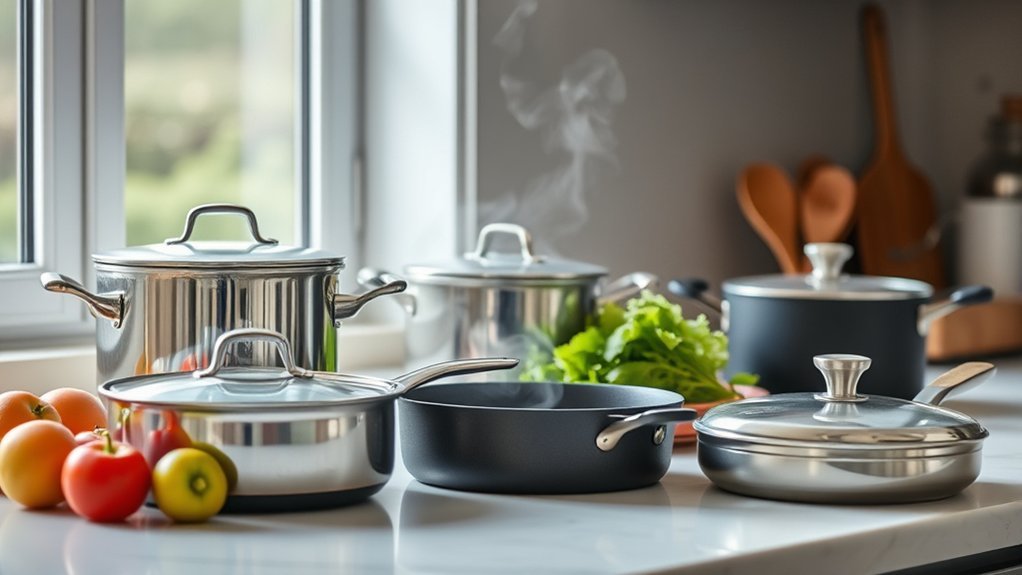
The safest cookware is cookware that is well made, appropriate for the food and heat level, and kept in good condition. For most kitchens, stainless steel, cast iron, carbon steel, enameled cast iron, and glass are dependable choices. Ceramic-coated and PTFE nonstick pans can also be used safely when they are reputable products and used within the manufacturer’s directions. Material matters, but so do coatings, manufacturing quality, heat, food acidity, allergies, and wear.
Quick Answer
For most people, high-quality stainless steel is one of the safest and most versatile everyday cookware choices. Cast iron, carbon steel, enameled cast iron, and glass are also solid options. Ceramic-coated and PTFE nonstick cookware can be appropriate when used as directed. Avoid damaged cookware and products that may contain unsafe lead or cadmium.
Key Takeaways
- Stainless steel is durable, corrosion-resistant, coating-free, and suitable for most everyday cooking.
- Cast iron and carbon steel avoid synthetic nonstick coatings but need seasoning and extra care with long acidic cooking.
- Ceramic, enamel, and glass can be safe when made for food use and free from unsafe lead or cadmium migration.
- Current evidence does not show that properly used PTFE nonstick cookware creates the same exposure risk as environmental or occupational PFAS exposure; overheating an empty coated pan is the clearer cookware-related concern.
- Material alone does not guarantee safety. Manufacturing quality, damage, heat, allergies, food acidity, and correct use all matter.
What Is the Safest Cookware Material?
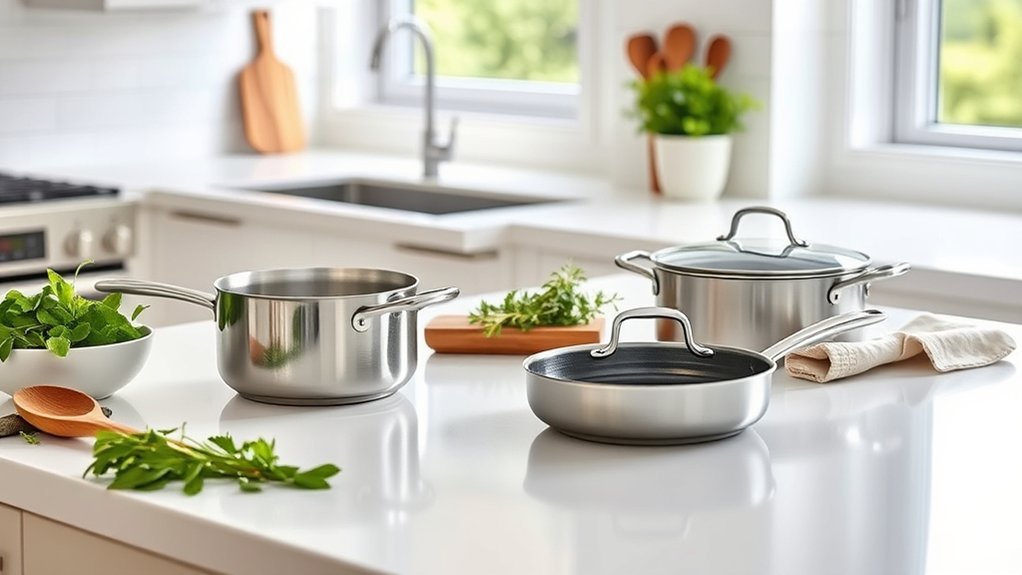
There is no single cookware material that is safest for every person and every recipe. In everyday use, however, stainless steel is one of the strongest all-around choices because it is durable, highly corrosion-resistant, has no applied nonstick coating, and works with a wide range of foods.
Stainless steel is often described as non-reactive, but that does not mean absolutely nothing can migrate from the metal. Studies have measured small releases of nickel and chromium, particularly with new cookware, acidic foods, and long cooking times. People with significant nickel sensitivity may prefer nickel-free stainless steel, glass, enamel, or another suitable material.
Cast iron is another durable option. It contains no synthetic nonstick coating and develops a seasoned surface with use. It can transfer iron into food, especially acidic foods, but cookware should not be used as a treatment for iron deficiency. Bare cast iron is also less suitable for long simmering or storage of acidic foods because acid can strip seasoning and increase metal transfer.
Carbon steel behaves similarly to cast iron but is generally thinner and more responsive to temperature changes. It also requires seasoning and careful drying to prevent rust.
Glass and enameled cast iron provide non-reactive food-contact surfaces when intact. Ceramic cookware can also be appropriate, but shoppers should distinguish between solid or glazed ceramic and ceramic-coated metal cookware, because they are constructed differently and have different durability limits.
Note: “Safest” does not mean that a material releases absolutely nothing under every condition. Food acidity, cooking time, temperature, surface condition, alloy composition, glaze quality, and individual sensitivities can all affect exposure.
Why PFAS Cookware Is Risky
PFAS are a large group of synthetic fluorinated chemicals used in many industrial and consumer applications. Certain PFAS exposures have been associated with health effects, but it is important not to treat every PFAS compound or every source of exposure as identical.
PTFE, the fluoropolymer commonly used on traditional nonstick cookware, falls within broad PFAS definitions. However, current U.S. Food and Drug Administration guidance states that authorized nonstick coatings are highly polymerized and that studies show a negligible amount of PFAS capable of migrating to food from these coatings when manufactured and used for their intended purpose.
FDA guidance on PFAS in food-contact applications therefore does not support treating normal use of modern PTFE cookware as equivalent to exposure from contaminated water, food, dust, industrial sites, or other significant PFAS sources.
The better-established cookware concern is severe overheating. Health Canada advises against preheating empty nonstick cookware and recommends avoiding high heat above about 260°C (500°F). Germany’s Federal Institute for Risk Assessment also warns that PTFE can begin breaking down at substantially higher temperatures, around 360°C (680°F), potentially releasing hazardous gases.
Warning: Never leave an empty nonstick pan heating unattended. Follow the cookware manufacturer’s temperature limits, ventilate the kitchen, and replace cookware that is badly warped or otherwise damaged.
PFAS exposure is nevertheless widespread. The U.S. Agency for Toxic Substances and Disease Registry says nearly all people in the United States have measurable PFAS in their blood, with exposure coming from multiple possible sources. Research has linked increased exposure to specific PFAS with outcomes such as higher cholesterol, changes in liver enzymes, reduced antibody response to some vaccines, pregnancy-induced hypertension, small decreases in birth weight, and kidney or testicular cancer for PFOA.
Those population-level findings should not be presented as proof that normal use of a PTFE pan produces the same risks.
- PFAS are a broad chemical class, not one single substance.
- PTFE is the fluoropolymer commonly used in conventional nonstick coatings.
- FDA currently reports negligible migration from authorized polymerized nonstick coatings.
- Overheating an empty PTFE-coated pan is a more clearly established cookware-related hazard.
- “PFOA-free” does not mean the same thing as “PTFE-free” or “PFAS-free.”
Which Cookware Materials Are Safest?
Stainless steel, cast iron, carbon steel, enameled cast iron, and glass are among the most dependable cookware choices when they are properly manufactured and used. Ceramic-coated, aluminum, anodized aluminum, lined copper, and PTFE-coated cookware can also have a place in a safe kitchen.
| Material | Main Strength | Main Caution |
|---|---|---|
| Stainless steel | Durable, corrosion-resistant, versatile, no applied nonstick coating | Can release some nickel/chromium; nickel-sensitive users may need alternatives |
| Cast iron | Long-lasting, excellent heat retention, no synthetic coating | Needs seasoning; avoid prolonged acidic cooking or storage |
| Carbon steel | Responsive heat control and naturally seasoned surface | Needs seasoning and rust prevention |
| Enameled cast iron | Non-reactive surface suitable for acidic dishes | Avoid badly chipped cooking surfaces |
| Glass | Non-reactive and useful for baking and storage | Can break under impact or severe thermal shock |
| Ceramic-coated | Easy-release surface without conventional PTFE coating when specified by the manufacturer | Coating generally wears faster than stainless steel or iron |
| Anodized aluminum | Good heat conduction with a harder, more resistant surface | Replace badly worn or damaged pieces and follow manufacturer directions |
| Lined copper | Excellent temperature response | Do not cook in exposed or damaged unlined copper surfaces |
| PTFE nonstick | Low-stick cooking and easy cleaning | Do not severely overheat, especially while empty |
The safest practical choice therefore depends on the job. Stainless steel works well as an everyday foundation, while cast iron and carbon steel are useful for high-heat cooking. Glass and enamel are especially useful for acidic foods, and a nonstick pan can be convenient for delicate foods when used within its temperature limits.
Is Stainless Steel the Best Everyday Choice?
Among the safer cookware options, stainless steel is one of the most practical everyday choices. Quality stainless cookware is durable, corrosion-resistant, oven-capable when its handles allow it, and suitable for searing, sautéing, simmering, boiling, and many acidic foods.
Common 18/10 stainless steel contains about 18% chromium and 10% nickel. Chromium helps form the corrosion-resistant surface layer, while nickel improves corrosion resistance and other performance characteristics.
Stainless steel is not literally incapable of releasing metals. Peer-reviewed research has measured nickel and chromium migration during cooking, with higher release under some combinations of low pH, long cooking time, new cookware, and particular alloys. A 2017 study using 18/10 stainless-steel pots found that measured release varied with conditions but remained below known allergy-triggering thresholds in those experiments.
Stainless steel is best described as highly corrosion-resistant and generally low-migration—not as a material from which nothing can ever enter food.
- Durable enough for everyday use
- No applied nonstick coating is required
- Suitable for a wide range of cooking methods
- Compatible with acidic foods for ordinary cooking
- Long service life when cared for properly
People with significant nickel allergy may want to discuss dietary nickel exposure with a clinician and consider nickel-free stainless steel or alternative cookware if needed. For most other users, stainless steel remains a practical and long-lasting choice.
Pro Tip: Add salt after water reaches a boil instead of leaving concentrated salt sitting on a stainless-steel surface. Health Canada recommends this to reduce surface pitting.
When Cast Iron and Carbon Steel Work Best
Cast iron and carbon steel are strong choices for cooks who prioritize durability, high-heat performance, and a seasoned cooking surface without a factory-applied synthetic nonstick coating. Cast iron retains heat exceptionally well, while thinner carbon steel usually responds to burner changes faster.
| Material | Best Use | Key Benefit |
|---|---|---|
| Cast iron | Searing, baking | Stable high temperatures |
| Carbon steel | Stir-frying, sautéing | Quick response |
| Cast iron | Ovens, campfires | Excellent heat retention |
| Carbon steel | Woks, skillets | Lighter handling |
| Both | Seasoned use | Low-stick seasoned surface |
Seasoning helps protect both materials from rust and improves release, but it is not an indestructible coating. Long simmering or storage of acidic foods such as tomato sauce can strip seasoning and increase iron transfer from bare cast iron.
For that reason, enameled cast iron or stainless steel is usually more convenient for long acidic braises and sauces.
Cast iron can increase the iron content of food, but the amount varies with the food, cooking time, cookware condition, and acidity. People should not rely on cookware as a treatment for iron deficiency, and anyone who has been medically advised to limit iron intake should follow that medical guidance.
Is Ceramic-Coated Cookware Really Safe?
Ceramic-coated cookware can be a practical nonstick option when it comes from a reputable manufacturer and is used as directed. Most cookware sold as “ceramic nonstick” is not a solid ceramic pan. It is usually metal cookware covered with a silica-based sol-gel coating.
Products marketed as ceramic-coated are often advertised as PTFE-free, but buyers should check the manufacturer’s actual materials statement rather than assuming every product marketed with the word “ceramic” has the same chemistry.
Ceramic coatings generally lose their easy-release performance faster than stainless steel, cast iron, or carbon steel wears out. Very high heat, abrasive cleaners, and rough utensils can accelerate that decline.
Temperature limits also vary by product, so a blanket claim such as “safe to 450°F” should not be applied to every ceramic pan.
- Buy cookware intended for food use from a reputable manufacturer.
- Check whether the company specifically states PTFE-free or PFAS-free if that distinction matters to you.
- Follow the stated oven and stovetop temperature limits.
- Avoid abrasive cleaning that damages the cooking surface.
- Replace cookware when the coating is extensively deteriorated or the underlying pan is damaged.
Solid or glazed ceramic cookware is a different category. With glazed ceramic, manufacturing quality matters because improperly formulated glazes or decorations can release lead or cadmium.
Are Enameled Cast Iron and Glass Safe?
Enameled cast iron and glass are useful cookware choices because their intact food-contact surfaces are relatively non-reactive.
Enameled cast iron is especially convenient for acidic foods such as tomato sauce, wine-based braises, and vinegar-containing dishes. The enamel separates food from the underlying iron and does not require seasoning.
Its main limitation is physical damage. Small cosmetic marks on the exterior are different from serious damage to the cooking surface, but cookware with badly chipped interior enamel should be evaluated according to the manufacturer’s instructions and replaced when the food-contact surface is no longer sound.
Glass cookware is also non-reactive and useful for baking, reheating, and food storage when the product is designed for those uses. However, “tempered” does not mean immune to breakage.
Warning: Avoid severe thermal shock with glass cookware. Do not assume every glass dish can move directly between a freezer, hot oven, stovetop, cold counter, or wet surface. Follow the manufacturer’s heating and cooling instructions.
Ceramic, enamel, and decorated glass also deserve attention to glaze quality. Health Canada notes that pigments or glazes can create lead or cadmium concerns when products do not meet applicable foodware limits. FDA similarly warns against using decorative or questionable lead-glazed pottery for cooking, serving, or storing food.
How to Tell If a Label Is Misleading
Cookware labels can be confusing because several similar-looking chemical claims mean different things.
- PFOA-free: The product is not claiming to contain PFOA. This is now a weak differentiator for U.S. cookware because major participating manufacturers worked toward eliminating PFOA from emissions and product content by 2015.
- PTFE-free: The cookware does not use PTFE as its nonstick coating. This does not automatically describe every other fluorinated chemical that may or may not be present.
- PFAS-free: This is a broader claim, but consumers still have to rely on the manufacturer’s definition, documentation, and accuracy.
- Non-toxic: This is broad marketing language unless the manufacturer explains what substances were tested or excluded.
- Lead-free or cadmium-free: These claims are most useful when supported by applicable food-contact standards or credible testing.
PFOA was historically used as a processing aid in fluoropolymer manufacturing. Under the U.S. Environmental Protection Agency’s 2010/2015 PFOA Stewardship Program, participating companies worked toward eliminating PFOA and related chemicals from emissions and product content by 2015. Therefore, “PFOA-free” does not tell you whether a modern pan contains PTFE.
Certification claims also need context. A sustainability certification is not necessarily a food-safety certification, and a general food-equipment standard may not prove every marketing statement about a consumer pan.
- Read the actual material and coating description.
- Check the manufacturer’s use and temperature instructions.
- Look for specific test standards rather than undefined wellness terms.
- Check government recalls, import alerts, and safety warnings when a product or material raises concern.
- Be cautious with cookware of uncertain composition or origin.
How to Choose Safe Cookware
Safe cookware choices begin with a reliable manufacturer, food-contact materials appropriate for the intended use, and cookware that remains in good condition.
For a simple everyday set, stainless steel works well for most boiling, sautéing, simmering, and sauce making. Cast iron or carbon steel can add high-heat searing capability. Enameled cast iron or stainless steel is convenient for long acidic braises, while glass works well for appropriate baking and storage applications.
A nonstick pan can also be useful for eggs, delicate fish, pancakes, and other foods that benefit from easy release. If using PTFE-coated cookware, avoid preheating it empty or taking it beyond the manufacturer’s recommended temperature.
Consumers should also pay attention to lead contamination. In 2025, FDA warned that certain imported cookware made from aluminum, brass, and alloys known as Hindalium/Hindolium or Indalium/Indolium could leach significant levels of lead into food. FDA import-alert records continued to identify cookware for lead concerns in September 2026.
That does not mean all aluminum or all imported cookware is unsafe. It means the exact product, alloy, manufacturer, and regulatory compliance matter.
Health Canada similarly notes that ordinary aluminum cookware transfers more metal under some conditions, particularly when it is worn or pitted and when highly acidic or salty foods are cooked for long periods. Anodized aluminum has a harder surface that reduces aluminum transfer compared with ordinary aluminum.
Copper also requires context. Copper conducts heat extremely well, but bare copper can react with acidic foods. Modern copper cookware intended for general cooking is therefore normally lined with stainless steel or another appropriate food-contact material. Stop using it for food if the protective lining becomes seriously damaged and exposes substantial bare copper.
Note: A material name by itself cannot prove that a pan is safe. A well-made aluminum or coated pan can be a better choice than poorly manufactured cookware whose alloy, glaze, or coating contains contaminants.
Regular inspection is therefore part of safe cookware use. Look for severe corrosion, exposed copper where a lining has failed, extensive coating deterioration, badly chipped cooking-surface enamel, cracked glass, loose handles, and other structural damage.
Following the manufacturer’s instructions for heat, cleaning, utensils, oven use, and dishwasher use is more reliable than applying one universal rule to every pan.
Frequently Asked Questions
What Is the Least Toxic Type of Cookware?
There is no scientifically established single “least toxic” pan for everyone. High-quality stainless steel, cast iron, carbon steel, enameled cast iron, and glass are dependable choices because they can be used without a synthetic nonstick coating. Ceramic-coated and PTFE nonstick cookware can also be appropriate when made by reputable manufacturers and used as directed. Condition, manufacturing quality, heat, allergies, and food acidity matter as much as the material name.
Is Ceramic Safer Than Stainless Steel?
Ceramic is not automatically safer than stainless steel. Stainless steel is extremely durable and has no applied nonstick coating, although small amounts of nickel and chromium can migrate under some conditions. Ceramic-coated cookware offers easy release but its coating usually wears faster. Glazed solid ceramic should come from a reliable foodware manufacturer because poorly controlled glazes can present lead or cadmium concerns.
What Pans Should You Stay Away From?
Avoid cookware that is not intended for food use, cookware subject to a government lead or contamination warning, badly damaged enamel or glass, exposed unlined copper used with acidic food, and products of unknown composition that may contain unsafe metals. Do not severely overheat PTFE nonstick cookware, especially while empty. Ordinary aluminum, stainless steel, cast iron, or modern nonstick cookware should not be condemned solely because of the material name; product quality and correct use matter.
What Should You Not Cook in Stainless Steel?
Most common foods, including tomato sauce and other acidic recipes, can be cooked in stainless steel. Research shows that very acidic food, long cooking times, new pans, and alloy composition can increase nickel and chromium release, so people with significant nickel sensitivity may prefer another material for prolonged acidic cooking. Avoid leaving concentrated salt against the pan surface because it can promote pitting.
Is Nonstick Cookware Unsafe Because It Contains PTFE?
Current FDA guidance does not indicate that properly manufactured PTFE cookware releases PFAS into food at levels expected to create a safety concern during intended use. The more important precaution is to avoid severe overheating, particularly heating an empty pan. Follow the manufacturer’s temperature limit and provide normal kitchen ventilation.
When Should Cookware Be Replaced?
Replace cookware when damage affects safe use: cracked glass, badly chipped food-contact enamel, a failed copper lining that exposes bare copper, severe corrosion or pitting, loose structural parts, or extensive deterioration of a coated cooking surface. Cosmetic wear alone does not always make a pan unsafe, so follow the manufacturer’s replacement guidance when available.
Conclusion
The safest cookware is not defined by one perfect material. High-quality stainless steel is one of the most versatile everyday choices, while cast iron, carbon steel, enameled cast iron, and glass each have useful strengths. Ceramic-coated, anodized aluminum, lined copper, and PTFE nonstick cookware can also be used appropriately when they are well manufactured and used according to their instructions.
The most practical safety habits are to avoid cookware of uncertain composition, pay attention to lead and cadmium warnings, protect glass from thermal shock, avoid prolonged acidic cooking in bare cast iron, avoid severely overheating empty nonstick pans, and replace cookware when damage compromises the food-contact surface. That evidence-based approach is more useful than assuming that an entire material category is always completely safe or always dangerous.
Sources
- U.S. Food and Drug Administration — Questions and Answers on PFAS in Food — current FDA assessment of PFAS food-contact uses and nonstick cookware.
- Health Canada — The Safe Use of Cookware and Bakeware — guidance for stainless steel, cast iron, aluminum, copper, ceramic, glass, and nonstick cookware.
- Agency for Toxic Substances and Disease Registry — PFAS Health Effects — current summary of health associations involving exposure to specific PFAS.
- German Federal Institute for Risk Assessment — PTFE Nonstick Cookware — normal-use and overheating guidance for PTFE-coated cookware.
- U.S. Food and Drug Administration — Imported Cookware Lead Warning — warning about certain imported cookware capable of leaching significant lead.
- Guarneri et al., Contact Dermatitis — Nickel and Chromium Release from Stainless Steel Cookware — peer-reviewed evidence on metal migration under common cooking conditions.

4 thoughts on “What Is the Safest Cookware? Safety, Materials & What to Know”