
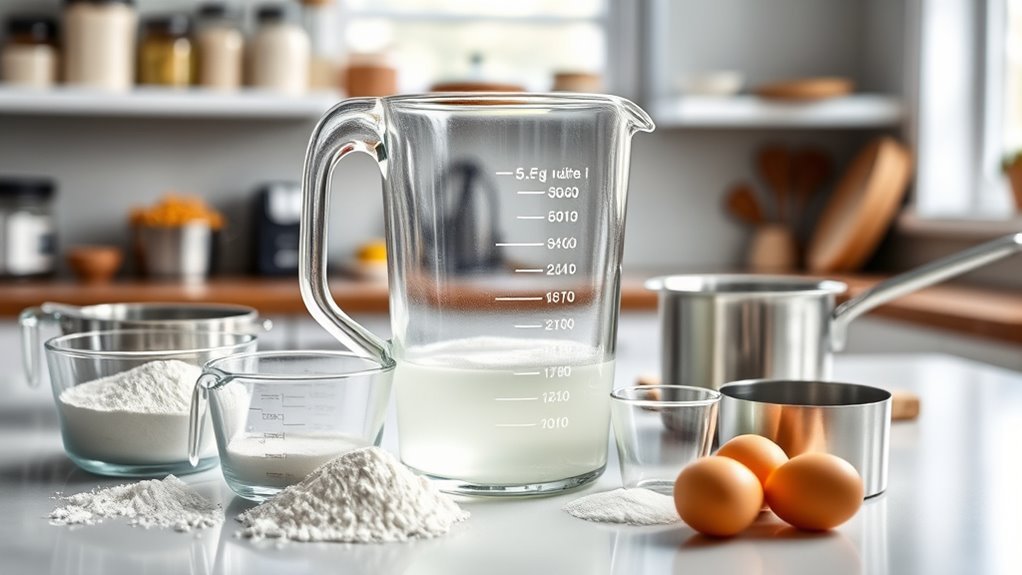
When you’re in the kitchen, knowing how to convert 5.5 quarts into cups can streamline your cooking process. By simply multiplying by 4, you’ll find that 5.5 quarts equals 22 cups. This conversion isn’t just a trivial detail; it’s essential for maintaining the integrity of your recipes. However, many overlook common pitfalls that can lead to inaccuracies. Understanding these nuances can make a significant difference in your culinary outcomes. What are the key mistakes you should avoid?
Quick Calculation: Quart to Cup Conversion for 5.5 Quarts
When you’re converting 5.5 quarts to cups, it’s straightforward: just remember that each quart equals 4 cups. To find how many cups are in 5.5 quarts, you simply multiply 5.5 by 4. This gives you 22 cups.
Mastering this quart to cup conversion isn’t just about numbers; it’s vital for precise ingredient measurements in cooking. When you know how to convert quickly, you can enhance your efficiency, especially when preparing recipes that require specific volumes.
Moreover, accurate conversions are important if you’re adjusting serving sizes for larger groups. Whether you’re scaling up a dish for a gathering or tweaking a personal recipe, understanding the quart to cup conversion can liberate you from measurement errors.
Embrace this knowledge to elevate your cooking and guarantee consistent results every time.
Understanding the Quart to Cup Conversion
Understanding the quart to cup conversion is vital for anyone who enjoys cooking or baking. Knowing how to accurately measure your ingredients can make all the difference in your culinary creations.
Here are some key points to keep in mind:
- One quart equals four cups.
- To convert quarts to cups, multiply the number of quarts by 4.
- Accurate conversions guarantee proper serving sizes.
- Familiarity with these measurements enhances recipe scaling.
With this foundation, you can easily convert 5.5 quarts to 22 cups (5.5 qt x 4 = 22 c).
Mastering the relationship between quarts and cups allows you to navigate recipes with confidence, making sure you maintain the right proportions. This accuracy is significant, especially when you’re scaling up or down.
Why Do Quart to Cup Conversions Matter in Cooking?
Understanding quart to cup conversions is essential for precise ingredient measurements, which directly impacts recipe consistency.
When you scale recipes, knowing that 1 quart equals 4 cups helps you maintain the intended flavor and texture.
Additionally, mastering these conversions boosts your cooking efficiency, saving you time in the kitchen.
Accurate Ingredient Measurement
Accurate ingredient measurement plays a pivotal role in cooking, as it guarantees balanced flavors and textures essential for successful dishes. Understanding quart to cup conversions is crucial for every cook. Here’s why:
- It helps you adjust ingredient quantities based on serving sizes.
- Accurate ingredient measurement prevents waste and promotes consistency, especially in baking.
- Mastering conversions boosts your kitchen efficiency, allowing quicker meal prep.
- Familiarity with these measurements enhances your cooking skills and confidence.
Knowing that 1 quart equals 4 cups can transform your cooking experience. Whether you’re a novice or a seasoned chef, precise measurements empower you to create dishes that delight and impress.
Embrace this knowledge to elevate your culinary journey!
Recipe Consistency
When you’re cooking, recipe consistency hinges on precise measurements, making quart to cup conversions vital. Understanding that 5.5 quarts equals 22 cups guarantees you’re maintaining accurate ingredient proportions.
This precision is essential because even minor discrepancies can drastically alter taste and texture, leading to disappointing results. Many recipes depend on specific volume measurements, and being familiar with conversions allows you to adapt them based on your available cookware or desired serving sizes.
Accurate conversions streamline your cooking process, enabling you to scale recipes up or down effortlessly. By mastering these conversions, you empower yourself to create dishes that consistently delight, freeing you to explore culinary creativity without the fear of inconsistency.
Cooking Efficiency
Mastering quart to cup conversions greatly boosts your cooking efficiency. When you understand these conversions, you streamline your cooking process and enhance your culinary skills.
Here’s why knowing quart to cup conversions matters:
- Accurate ingredient measurements simplify recipe adherence.
- Efficient cooking depends on understanding volume, like converting 5.5 quarts to 22 cups for proper serving sizes.
- Correct measurements prevent food waste, fostering better resource management.
- Familiarity with these conversions allows for flexible recipe scaling.
Avoid These Mistakes When Converting Quarts to Cups
Converting quarts to cups can be straightforward, but many people make simple errors that lead to confusion. The most common mistake is forgetting to multiply the quart measurement by 4. This oversight can result in incorrect volume calculations. Always verify your conversions using the formula: quarts × 4 = cups.
To help you avoid these pitfalls, keep a conversion chart handy. Here’s a quick reference:
| Quarts | Cups |
|---|---|
| 1 | 4 |
| 2 | 8 |
| 3 | 12 |
| 4 | 16 |
| 5 | 20 |
Additionally, confirm you’re using the correct measurement system, as quarts and cups are standard in the US. Double-checking your calculations can save you from frustrating mistakes and enhance your cooking efficiency. Embrace these practices for a smoother kitchen experience!
Tips for Accurately Measuring Cups in the Kitchen
To guarantee accurate measurements in the kitchen, using the right tools is essential.
Always level off your ingredients and understand volume conversions to maintain precision.
Use Proper Measuring Tools
Accurate measuring is essential in the kitchen, especially when it comes to achieving the right balance of flavors and textures in your recipes.
Using the proper measuring tools can make all the difference. Here are some tips to guarantee precision:
- Use clear measuring cups with markings for both dry and liquid ingredients.
- For dry ingredients, fill the measuring cup with a spoon and level it off using a straight edge.
- Choose liquid measuring cups with spouts for easy pouring and place them on a flat surface for accurate readings.
- Always verify the measurement size, as designs can vary, leading to potential inaccuracies.
Level Off Ingredients
Mastering the technique of leveling off ingredients is essential for achieving accurate measurements in your cooking.
When measuring dry ingredients like flour or sugar, fill your measuring cup with a spoon, then level it off using a straight edge. Avoid packing the ingredients down.
For liquids, verify your measuring cup is on a flat surface and fill it to the desired line at eye level.
When dealing with sticky ingredients like honey or molasses, lightly coat the cup with oil to facilitate easy pouring.
Always choose the right measuring cups: use dry measuring cups for solids and liquid measuring cups with spouts for liquids.
For bulk ingredients, scoop directly from the container and level off for precision.
Understand Volume Conversions
Understanding volume conversions is essential in the kitchen, especially when you’re working with different units of measurement. Accurate conversions can make or break your recipe.
Here are some tips to help you master volume conversion:
- To convert quarts to cups, multiply by 4; 1 quart equals 4 cups.
- For instance, 5.5 quarts equals 22 cups (5.5 x 4).
- Use a liquid measuring cup for precise volume measurements.
- Always verify the cup is filled to the brim without overflowing.
Familiarizing yourself with volume conversion tables can also save time and guarantee you get ingredient proportions right.
With this knowledge, you’ll navigate your recipes with confidence and freedom, elevating your culinary creations.
How to Adjust Recipes Based on Cup and Quart Measurements
How can you effectively adjust recipes when measurements shift between cups and quarts? Understanding that 1 quart equals 4 cups is key.
Effective recipe adjustments hinge on knowing that 1 quart equals 4 cups, ensuring precise ingredient proportions.
For instance, if a recipe calls for 5.5 quarts, that translates to 22 cups—making sure you maintain the right ingredient proportions.
When scaling a recipe, remember that each cup corresponds to 0.25 quarts. For smaller adjustments, convert fractions of quarts into cups easily; for example, 0.5 quarts equals 2 cups.
Always check the total volume needed in cups to confirm your cooking equipment can accommodate your adjusted recipe.
This precision allows for seamless shifts between measurements, empowering you to explore various culinary creations without fear of miscalculations.
Other Volume Conversions You Should Know
While you may be familiar with converting quarts to cups, there are several other volume conversions that can enhance your cooking precision. Mastering these conversions allows you to adjust recipes effortlessly and guarantee ingredient proportions are just right.
Here are some key volume conversions to keep in mind:
- 1 quart = 4 cups
- 2 quarts = 8 cups
- 3 quarts = 12 cups
- 1.5 quarts = 6 cups
Understanding these volume conversions not only simplifies your cooking but also empowers you to tackle larger batch preparations.
For instance, knowing that 10 quarts equal 40 cups can be a game-changer for family gatherings or meal prep. By honing your skills in these conversions, you’ll liberate yourself from the stress of inaccurate measurements, paving the way for culinary success.
Resources for Further Learning on Cooking Measurements
Accurate cooking measurements are foundational to successful recipes, and having reliable resources at your fingertips can make all the difference. To enhance your knowledge, consider using the following resources:
| Resource Type | Description | Where to Find |
|---|---|---|
| Measurement Charts | Visual tools showing common conversions | Cookbooks, online blogs |
| Conversion Tables | Quick reference for volume conversions | Culinary websites |
| Online Calculators | Instant conversions with user-friendly interfaces | Smartphone apps, websites |
| Video Tutorials | Step-by-step guides on cooking measurements | YouTube, cooking channels |
| Kitchen Scales | Accurate measurement for precise cooking | Local kitchen supply stores |
Familiarizing yourself with these cooking measurements will not only boost your confidence but also enhance the accuracy and consistency of your recipes. Embrace these tools and liberate your culinary creativity!
Frequently Asked Questions
How Many Cups Make 5 Quarts?
Five quarts equal 20 cups. To understand this measurement conversion, remember that each quart contains four cups.
When you’re cooking or baking, accurate measurements are essential for success, so it’s helpful to know these conversions. If a recipe calls for quarts and you need cups, just multiply the quarts by four.
This knowledge empowers you to adjust your recipes confidently, ensuring your dishes turn out just right every time.
Is 1 Quart the Same as 4 Cups?
Yes, 1 quart is indeed the same as 4 cups.
This measurement conversion simplifies your cooking endeavors, freeing you from the chaos of miscalculations.
By grasping this relationship, you empower yourself to navigate recipes with precision, ensuring every dish turns out just right.
Whether you’re whipping up a quick meal or crafting a culinary masterpiece, knowing quarts convert to cups helps you measure ingredients accurately and confidently, elevating your cooking experience.
How Many Cups Are in a 5 Quart Container?
A 5 quart container holds 20 cups. To grasp this measurement conversion, remember that each quart equals 4 cups.
So, when you multiply 5 quarts by 4, you get 20 cups. This knowledge isn’t just about numbers; it empowers you to confidently measure ingredients for larger recipes.
Understanding these conversions allows you to adjust servings effortlessly, ensuring your dishes turn out just right. Embrace this skill for culinary freedom!
Does 20 Cups Equal 5 Quarts?
Yes, 20 cups equal 5 quarts. In measurement conversion, knowing the relationship between cups and quarts is essential for precise cooking.
Since 1 quart equals 4 cups, you can quickly determine this by dividing 20 cups by 4, which gives you 5 quarts.
This understanding not only enhances your cooking skills but also empowers you to adjust recipes confidently, ensuring you maintain the right balance of ingredients for your culinary creations.
Conclusion
To summarize, converting 5.5 quarts to cups is straightforward—just multiply by 4 for 22 cups. This simple math is like a digital scale in a world of analog measuring; it streamlines cooking and guarantees you nail down flavors and textures. By mastering these conversions and avoiding common pitfalls, you’ll enhance your culinary skills. Remember, a little precision goes a long way in the kitchen, turning every dish into a masterpiece. Keep learning, and happy cooking!
