
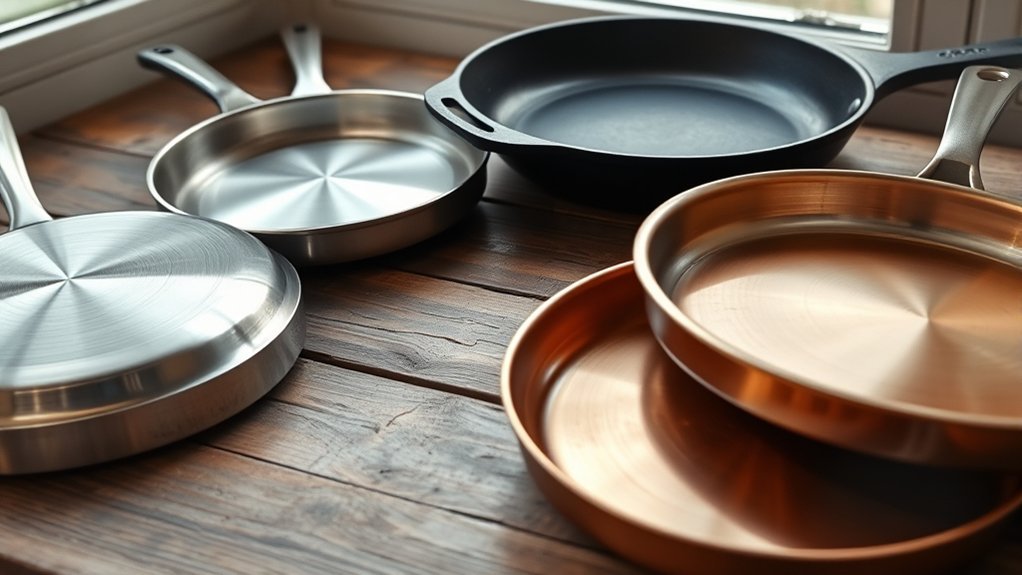
Frying pans are commonly made from cast iron, carbon steel, stainless steel, aluminum, and copper, while many aluminum or stainless-steel pans use PTFE-based or ceramic nonstick coatings. Material and construction affect heat response, heat retention, browning, food release, weight, durability, stove compatibility, and care. Cast iron stores heat well, aluminum and copper respond quickly, stainless steel is durable, and coated pans make delicate foods easier to release. The best choice depends on what you cook and how much maintenance you want.
Quick Answer
There is no single best frying pan material. Choose stainless steel for versatile browning and pan sauces, cast iron for heat retention, carbon steel for a lighter seasoned surface, aluminum for fast heating, copper for precise temperature response, and PTFE or ceramic-coated pans for easier food release.
Key Takeaways
- Heat conductivity and heat retention are different. Copper and aluminum respond quickly to burner changes, while heavy cast iron changes temperature more slowly but stores more heat.
- Construction matters as much as the surface. Stainless steel is often bonded to aluminum or copper because stainless itself conducts heat relatively slowly.
- Coated pans need gentler treatment. Avoid unnecessary overheating, abrasive cleaning, and utensils that conflict with the manufacturer’s instructions.
- Induction requires a magnetic base. Cast iron and many stainless-steel pans work directly; aluminum and copper need a bonded magnetic layer.
- Care requirements vary. Cast iron and carbon steel need protection from rust, while stainless steel requires much less seasoning-related maintenance.
Frying Pan Materials Compared
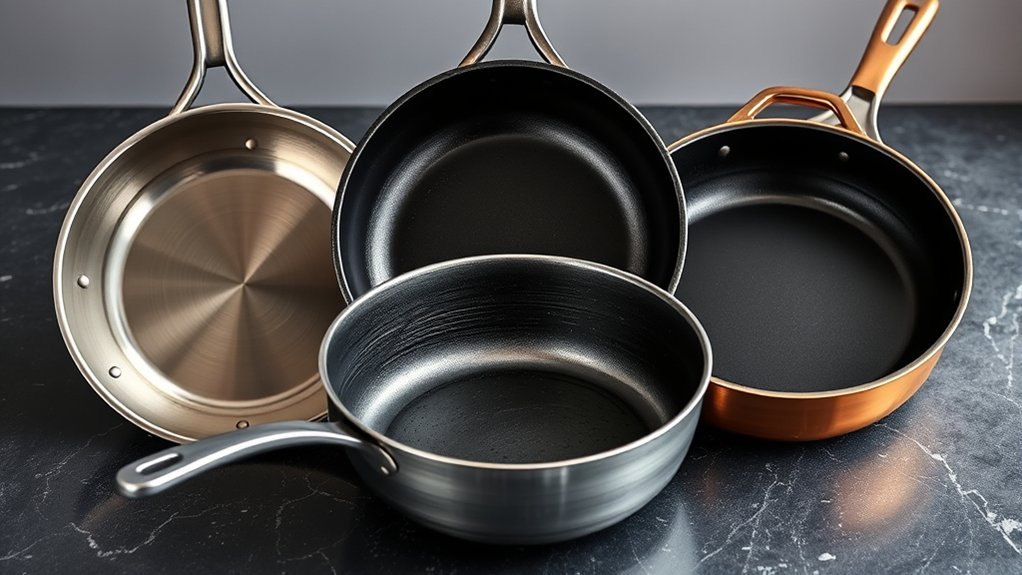
Frying pan materials differ in thermal conductivity, thermal mass, surface behavior, weight, and maintenance. A material that responds to burner changes quickly is not automatically the material that holds heat the longest, and a naturally durable metal is not automatically easy to cook on without sticking.
| Material or Surface | Main Strength | Main Tradeoff | Good For |
|---|---|---|---|
| Cast iron | High heat capacity and durability | Heavy; can rust if neglected | Searing, frying, oven cooking |
| Carbon steel | Seasoned surface with less weight than cast iron | Needs drying and seasoning | Searing, eggs after seasoning, sautéing |
| Clad stainless steel | Durability, browning, pan sauces | Food can stick without good technique | General-purpose frying and deglazing |
| Aluminum | Fast heat transfer and low weight | Thin pans can deform; bare aluminum can react with some foods | Fast everyday cooking |
| Copper | Very responsive temperature control | Expensive and normally requires a food-safe lining | Temperature-sensitive cooking |
| PTFE nonstick | Excellent food release | Coating requires temperature and utensil care | Eggs, pancakes, delicate fish |
| Ceramic-coated | Easy release when the coating is in good condition | Release performance can decline with wear | Lower- to moderate-heat everyday cooking |
Cast Iron
Cast iron is valued for its thermal mass and heat retention. Once a heavy skillet is thoroughly preheated, it can maintain substantial heat when food is added, which is useful for searing meat, frying, and oven cooking.
Heat retention should not be confused with fast or perfectly even heat conduction. Cast iron responds more slowly than copper or aluminum, and a skillet can develop hotter and cooler areas if the burner is much smaller than the pan. Gradual preheating helps the cooking surface become more uniform.
A seasoned cast-iron surface can release food well, but it is not identical to a manufactured nonstick coating. Seasoning is a polymerized oil layer that needs reasonable care and occasional repair if the pan becomes rusty or heavily stripped.
Carbon Steel
Carbon steel has many of the practical qualities of cast iron but is usually thinner and lighter. It heats and cools faster than a comparably sized heavy cast-iron skillet and can develop a smooth seasoned cooking surface over time.
It works well for high-heat searing, sautéing, crêpes, and many egg dishes once the seasoning is established. Like bare cast iron, carbon steel can rust if left wet. Long cooking of acidic sauces may also weaken seasoning and add a metallic taste, so stainless steel is usually more convenient for tomato, wine, or citrus-heavy pan sauces.
Stainless Steel
Stainless steel is durable, corrosion-resistant, and well suited to browning and deglazing. It does not have an inherently nonstick surface, so preheating, cooking fat, food temperature, and patience all affect release.
Because stainless steel itself is a relatively poor heat conductor, quality frying pans often bond it to a conductive aluminum or copper layer. Fully clad pans extend those layers through the pan walls, while disc-bottom designs concentrate the conductive layer under the cooking surface.
Stainless steel is practical for acidic foods, although “nonreactive” should not be interpreted as meaning that absolutely nothing can migrate from the metal. A 2017 study of 18/10 stainless-steel cookware found that nickel and chromium release varied with food acidity, cooking time, cookware age, and manufacturer. Under the study conditions, measured amounts were below known allergy-triggering thresholds, although very sensitive individuals can have different tolerances.
Aluminum and Hard-Anodized Aluminum
Aluminum is lightweight and transfers heat efficiently, which makes it common both as a pan body and as the hidden conductive core inside stainless-steel cookware. Thin aluminum pans can be more susceptible to denting or warping than heavier constructions, so thickness and manufacturing quality matter.
Hard anodizing modifies the aluminum surface to make it harder and more corrosion-resistant. Hard-anodized cookware may be sold with or without an additional nonstick coating, so care instructions should be based on the actual cooking surface rather than the words “hard anodized” alone.
Copper
Copper is among the most thermally conductive metals commonly used in cookware, so it responds rapidly when burner output changes. That makes it useful when fine temperature control matters.
Food-contact copper cookware is normally lined with stainless steel or tin. The FDA Food Code limits direct contact between copper or copper alloys and foods below pH 6 in retail food-service settings because acidic foods can leach copper. For home cookware, the practical takeaway is to keep a copper pan’s food-contact lining intact and follow the manufacturer’s care instructions.
PTFE and Ceramic Nonstick Coatings
“Nonstick” describes a cooking surface rather than one base metal. Many nonstick pans use an aluminum body because aluminum distributes heat efficiently.
PTFE-based coatings provide very low-friction food release. The FDA states that authorized polymerized PFAS nonstick coatings have negligible migration to food. Proper temperature control still matters. Germany’s Federal Institute for Risk Assessment states that PTFE cookware used as intended is not expected to cause adverse health effects, but strongly heating an empty PTFE-coated pan can overheat the coating.
Ceramic nonstick coatings are different from PTFE coatings and are typically silica-based sol-gel surfaces applied over a metal pan. They can provide excellent initial release, but food-release performance may decline as the coating wears. Use low to moderate heat unless the manufacturer specifically allows more, and avoid abrasive cleaning that can damage the surface.
Warning: Do not leave an empty PTFE-coated pan over strong heat. The German Federal Institute for Risk Assessment advises against overheating PTFE cookware and notes that decomposition can occur at temperatures around 360°C (680°F) and above. Follow the pan manufacturer’s temperature limits, especially on powerful gas and induction burners.
How Each Material Performs
Cooking performance depends on more than whether a pan feels “hot.” Three properties are especially useful to separate:
- Conductivity: how readily heat moves through the material.
- Responsiveness: how quickly the pan changes temperature after the burner is adjusted.
- Heat retention: how strongly the pan resists temperature drops when cool food is added.
Copper and aluminum conduct heat efficiently and respond quickly. Heavy cast iron responds more slowly but stores substantial thermal energy. Stainless steel is durable but conducts heat less efficiently, which is why most high-performing stainless frying pans use an aluminum or copper core.
For searing, a heavy cast-iron, carbon-steel, or clad stainless-steel pan can work well when fully preheated. For sauces that require quick temperature adjustment, copper or conductive multi-ply cookware offers more immediate control. For delicate eggs or fish, an intact nonstick surface usually requires less technique to prevent sticking.
A pan that holds heat well is not necessarily a pan that spreads heat quickly. Cast iron emphasizes thermal mass; copper and aluminum emphasize conductivity and responsiveness.
How Pan Construction Changes Cooking
Beyond the base material, a frying pan’s construction changes how evenly it heats, how resistant it is to warping, how heavy it feels, and which cooktops it can use.
Thickness
A thicker pan generally changes temperature more slowly than a very thin pan of the same material. More material also helps the cooking surface resist sudden temperature drops when food is added. Excessively thin cookware may develop stronger hot spots or deform more easily, depending on the alloy and manufacturing method.
Fully Clad vs. Disc-Bottom Construction
In fully clad stainless cookware, conductive aluminum or copper is bonded between stainless-steel layers across the base and usually up the sidewalls. Disc-bottom pans instead bond a conductive plate primarily to the base. Either design can work well, but construction quality, layer thickness, pan shape, and burner size matter more than simply counting the number of advertised layers.
Pan Shape
A wide flat cooking area makes it easier to brown food without crowding. Flared sides make tossing and spatula access easier, while steeper sides increase usable volume and reduce splatter. Handle design also affects balance and oven use.
Induction Compatibility
Induction cooktops require a magnetic cooking base. Cast iron and many stainless-steel pans work directly. Bare aluminum and copper do not work unless the pan includes a magnetic bonded layer. GE recommends the simple magnet test: if a magnet holds firmly to the bottom, the pan is generally suitable for induction.
Note: A magnet test tells you whether the base contains magnetic material; it does not prove that the entire pan is stainless steel. An aluminum or copper pan can have a bonded magnetic induction plate.
Which Frying Pan Material Is Best for You?
Choosing the best frying pan material depends on the food you cook, the burner you use, your tolerance for maintenance, and whether you value low weight, easy release, high-heat browning, or long service life.
| If You Mainly Want… | Consider | Why |
|---|---|---|
| Strong searing and heat retention | Cast iron | Heavy construction stores heat well. |
| Seasoned performance with less weight | Carbon steel | Develops seasoning and responds faster than heavy cast iron. |
| Versatile browning, sauces, and acidic foods | Clad stainless steel | Durable surface with a conductive core. |
| Light weight and quick heating | Aluminum or hard-anodized aluminum | Good conductivity without cast iron’s weight. |
| Precise temperature response | Lined copper | Responds quickly to burner adjustments. |
| Easy eggs, pancakes, and delicate fish | PTFE or ceramic nonstick | Low-friction cooking surface simplifies release. |
A home cook does not need every material. A practical combination is often one durable stainless-steel or cast-iron/carbon-steel pan for browning and one smaller coated pan for delicate foods. The exact combination depends on weight preference, stove type, storage, and cleaning habits.
Pro Tip: When comparing two pans made from the same named material, check the total weight, base thickness, whether the pan is fully clad or disc-bottomed, induction compatibility, handle construction, and manufacturer temperature limit. Those details can affect cooking performance as much as the material label.
Food Reactivity and Cookware Safety
Cookware safety is better judged by the actual food-contact surface, its condition, the food being cooked, and the temperature used than by marketing terms such as “non-toxic.”
For copper, an intact lining matters because acidic foods can dissolve copper from an unlined surface. The FDA Food Code specifically restricts unlined copper contact with acidic foods below pH 6 in retail food-service settings.
Stainless steel is highly corrosion-resistant, but research shows measurable nickel and chromium migration can occur, especially with new cookware, longer cooking times, and acidic food. For most users this is not a reason to avoid stainless steel, but it explains why calling any material completely inert or universally “healthiest” is too absolute.
Seasoned cast iron and carbon steel are durable uncoated choices, but acidic ingredients can strip seasoning during longer cooks. Cast iron can also contribute iron to food. That may be useful context for some people, but cookware should not be treated as a controlled nutritional supplement.
For PTFE cookware, the FDA reports negligible migration from authorized polymerized nonstick coatings. The greater practical concern is misuse through severe overheating, particularly when the pan is empty. Ceramic-coated cookware has a different surface chemistry and should be used according to its own manufacturer’s heat and utensil guidance.
How to Care for Frying Pan Materials
Proper care depends on the cooking surface rather than using one rule for every pan.
Cast Iron
Wash cast iron by hand, dry it promptly, and apply a very thin film of oil when the surface needs protection. Contrary to an old kitchen rule, a small amount of modern mild dish soap is acceptable. Lodge specifically states that soap can be used on cast iron. Avoid soaking the pan or putting seasoned cast iron in the dishwasher because prolonged moisture can encourage rust and detergents can damage seasoning.
Carbon Steel
Hand-wash carbon steel, avoid soaking it, dry it immediately, and maintain its seasoning. If rust develops or seasoning is stripped, clean the affected area and reseason the pan rather than assuming it is ruined.
Stainless Steel
Let a hot stainless-steel pan cool somewhat before exposing it to large amounts of cold water, which reduces thermal shock. For ordinary residue, soak briefly and use a nonabrasive sponge. Tough deposits can often be loosened with water and a suitable stainless-steel cleaner. Highly abrasive tools may scratch polished finishes even when they do not make the pan unusable.
Aluminum and Hard-Anodized Aluminum
Follow the manufacturer’s surface-specific instructions. Bare and hard-anodized aluminum do not always have the same utensil restrictions as a nonstick-coated aluminum pan. If the pan has PTFE or ceramic coating, the coating’s care instructions take priority.
PTFE and Ceramic-Coated Pans
Use utensils and cleaning tools approved by the manufacturer, avoid unnecessary high heat, and do not scour the coating aggressively. Hand washing is generally gentler on coated surfaces even when a manufacturer labels the pan dishwasher-safe.
Replace a coated pan when the manufacturer recommends replacement or when the cooking surface has severe peeling, flaking, blistering, or other structural damage that prevents normal use. A small cosmetic mark is not automatically the same as coating failure, so follow the maker’s guidance for the specific product.
Copper
Keep the food-contact lining intact. If a tin-lined copper pan wears through enough to expose significant copper on the cooking surface, have it professionally relined before using it with food. Stainless-lined copper generally requires less lining maintenance but should still be cleaned according to the manufacturer’s instructions.
Frequently Asked Questions
What Is the Healthiest Material for a Frying Pan?
There is no single frying pan material that is healthiest for everyone. Well-made stainless steel, cast iron, carbon steel, lined copper, aluminum cookware, and properly used coated pans can all have appropriate uses. Safety depends on the cooking surface, its condition, temperature, food acidity, and manufacturer instructions. People with a known metal allergy or another specific medical restriction may need more individualized guidance.
Which Non-Toxic Frying Pan Is Best?
“Non-toxic” is too broad to identify one universally best pan. If you want an uncoated cooking surface, stainless steel, cast iron, and carbon steel are common options with different maintenance needs. If you prefer nonstick performance, use a reputable PTFE or ceramic-coated pan within its stated temperature and care limits. Lined copper is another durable option when its food-contact lining remains intact.
How Do I Know if My Pan Is Aluminum or Not?
Start with the manufacturer’s stamp, packaging, or model information. Aluminum is generally lightweight and the aluminum itself is not magnetic, but a magnet test is not definitive because an aluminum pan can have a bonded magnetic induction base. Do not intentionally scratch a cooking surface just to identify the metal; that can damage a coating. Existing exposed metal on an uncoated underside may provide a clue, but product documentation is more reliable.
Is a Nonstick Pan Unhealthy?
A PTFE nonstick pan used as intended is not expected to present a health risk according to current FDA and BfR guidance. FDA reports negligible migration from authorized polymerized PFAS nonstick coatings. The important precaution is to avoid severe overheating, especially while the pan is empty. Ceramic-coated pans use a different coating system and should be kept within their manufacturer’s temperature and care limits.
Which Frying Pan Materials Work on Induction?
Cast iron, carbon steel, and many magnetic stainless-steel pans work on induction. Aluminum and copper need a magnetic base or bonded induction layer. A simple check is to place a magnet against the bottom of the pan; a strong attraction usually indicates an induction-compatible base.
Can You Cook Acidic Foods in Cast Iron or Carbon Steel?
Brief contact with acidic ingredients is usually manageable in a well-seasoned pan, but long simmers with tomato, wine, vinegar, or citrus can weaken seasoning and sometimes affect flavor. Stainless steel or enameled cookware is generally more convenient for long acidic preparations.
Conclusion
The best frying pan depends on the interaction between material, construction, cooking surface, and intended use. Cast iron provides strong heat retention, carbon steel offers seasoned performance with less mass, clad stainless steel combines durability with a conductive core, aluminum heats quickly, and lined copper gives precise temperature response. PTFE and ceramic coatings simplify food release but require more attention to heat, utensils, and surface condition.
For many kitchens, one durable pan for high-heat browning plus one coated pan for delicate foods covers most everyday cooking. Before buying, compare weight, base construction, induction compatibility, oven limits, handle design, coating type, and the maintenance you are willing to do.
Sources
- U.S. Food and Drug Administration — Questions and Answers on PFAS in Food — supports current information on authorized nonstick coatings and migration to food.
- German Federal Institute for Risk Assessment — PTFE Non-Stick Cookware — supports intended-use safety and overheating precautions.
- U.S. Food and Drug Administration — Food Code 2022 — supports the limitation on direct copper contact with acidic foods.
- Guarneri et al., Contact Dermatitis — Nickel and Chromium Release From Stainless Steel Cookware — supports the discussion of metal migration during acidic cooking.
- Lodge Cast Iron — How to Clean Cast Iron — supports current cast-iron cleaning, soap, drying, and rust-prevention guidance.
- GE Appliances — Induction Cooktop Guidance — supports magnetic-base requirements and the magnet test for induction cookware.

3 thoughts on “What Are Frying Pans Made of? Materials & Construction Explained”